If your 5th graders freeze when they see “round 3.247 to the nearest hundredth,” you’re not alone. Decimal rounding is where place value understanding either clicks or completely falls apart. The good news? With the right strategies, you can help every student master this critical skill and build confidence for middle school math.
Key Takeaway
Successful decimal rounding instruction connects visual place value models to the decision-making process students use when determining which direction to round.
Why Decimal Rounding Matters in 5th Grade
Rounding decimals represents a major milestone in CCSS.Math.Content.5.NBT.A.4, which requires students to “use place value understanding to round decimals to any place.” This standard builds directly on 4th-grade whole number rounding and prepares students for 6th-grade operations with decimals.
Research from the National Council of Teachers of Mathematics shows that students who master decimal place value in 5th grade perform 40% better on middle school fraction and decimal assessments. The skill typically appears in curriculum around October-November, after students have solid decimal reading and comparison foundations.
Decimal rounding connects to multiple mathematical practices: reasoning abstractly (MP2), constructing viable arguments (MP3), and looking for patterns (MP8). Students must understand that rounding is about finding the “closest” value, not just memorizing rules.
Looking for a ready-to-go resource? I put together a differentiated decimal rounding pack that covers everything below — but first, the teaching strategies that make it work.
Common Decimal Rounding Misconceptions in 5th Grade
Common Misconception: Students round 2.65 to the nearest tenth as 2.6 instead of 2.7.
Why it happens: They focus only on the digit in the rounding place, ignoring the “look right” step.
Quick fix: Use number lines to show 2.65 is closer to 2.7 than 2.6.
Common Misconception: Students think “round to the nearest hundredth” means “make it have two decimal places.”
Why it happens: They confuse rounding with truncating or place value identification.
Quick fix: Always start with “which two hundredths is this number between?”
Common Misconception: Students automatically round 5 up without considering context.
Why it happens: They memorize “5 or more, round up” without understanding why.
Quick fix: Use real-world contexts where rounding 5 makes sense in both directions.
Common Misconception: Students lose track of place value when rounding longer decimals.
Why it happens: They haven’t internalized the relationship between place value positions.
Quick fix: Use place value charts consistently and have students identify the target place first.
5 Research-Backed Strategies for Teaching Decimal Rounding
Strategy 1: Number Line Visualization
Help students see rounding as finding the closest landmark number by using targeted number lines that zoom in on the rounding decision.
What you need:
- Large number lines (wall-sized or individual)
- Decimal cards
- Colored markers or sticky notes
Steps:
- Draw a number line showing only the two possible rounded values (e.g., 3.4 and 3.5 for rounding to tenths)
- Mark the exact middle point and discuss why it matters
- Place the target decimal on the line using a different color
- Measure or estimate which landmark is closer
- Connect the visual to the numerical decision
Strategy 2: Place Value Anchor Charts with Decision Trees
Create visual decision-making tools that students can reference independently when determining how to round any decimal.
What you need:
- Large chart paper
- Place value headers
- Sample problems at different difficulty levels
Steps:
- Build a place value chart showing decimal positions through thousandths
- Add a decision tree: “Look at the digit to the right of your target place”
- Create two branches: “0-4 stays the same” and “5-9 round up”
- Include examples showing the complete process for each scenario
- Post prominently and reference during guided practice
Strategy 3: Real-World Rounding Investigations
Connect decimal rounding to authentic contexts where students see why precision matters and when rounding makes sense.
What you need:
- Sports statistics printouts
- Store receipts or price lists
- Weather data
- Measurement tools
Steps:
- Present real data that needs rounding (batting averages, gas prices, rainfall)
- Discuss why someone would want rounded vs. exact values
- Have students round the same number to different places and compare results
- Analyze how different rounding choices affect the story the data tells
- Create class presentations showing their findings
Strategy 4: Decimal Rounding Games and Centers
Build fluency through engaging practice that reinforces the decision-making process without feeling like drill work.
What you need:
- Decimal cards at various difficulty levels
- Rounding target cards (“to the nearest tenth,” etc.)
- Answer recording sheets
- Timer for added engagement
Steps:
- Set up partner stations with different rounding challenges
- Students draw a decimal card and rounding target card
- Partners work together to solve, then check each other’s reasoning
- Rotate through stations focusing on different decimal lengths
- End with whole-class sharing of interesting problems or strategies
Strategy 5: Error Analysis and Mathematical Discourse
Deepen understanding by having students identify, explain, and correct common rounding mistakes using precise mathematical language.
What you need:
- Prepared examples with intentional errors
- Student work samples (anonymous)
- Sentence stems for mathematical discussions
Steps:
- Present a solved rounding problem with an error
- Ask students to identify what went wrong and why
- Have them explain the correct process using place value vocabulary
- Practice with multiple error types (wrong place, wrong direction, place value confusion)
- Students create their own “mistake problems” for classmates to solve
How to Differentiate Decimal Rounding for All Learners
For Students Who Need Extra Support
Start with concrete place value models using base-ten blocks or decimal squares. Focus on rounding to the nearest whole number first, then tenths. Provide number lines with smaller increments and use consistent language like “Which is closer?” rather than abstract rules. Review prerequisite skills like reading decimals aloud and comparing decimal values. Offer extended time and allow use of place value charts during independent work.
For On-Level Students
Students work with CCSS.Math.Content.5.NBT.A.4 expectations: rounding decimals through thousandths to any specified place. They should explain their reasoning using place value vocabulary and connect rounding to estimation strategies. Provide mixed practice with different rounding targets and decimal lengths. Students should demonstrate fluency with the standard algorithm while understanding why it works.
For Students Ready for a Challenge
Extend to real-world applications requiring multiple rounding decisions, such as calculating tips or analyzing scientific data. Explore what happens when you round the same number to different places, or investigate how rounding affects calculations. Challenge students to create word problems requiring decimal rounding and teach mini-lessons to younger students. Connect to 6th-grade standards by exploring how rounding affects operations with decimals.
A Ready-to-Use Decimal Rounding Resource for Your Classroom
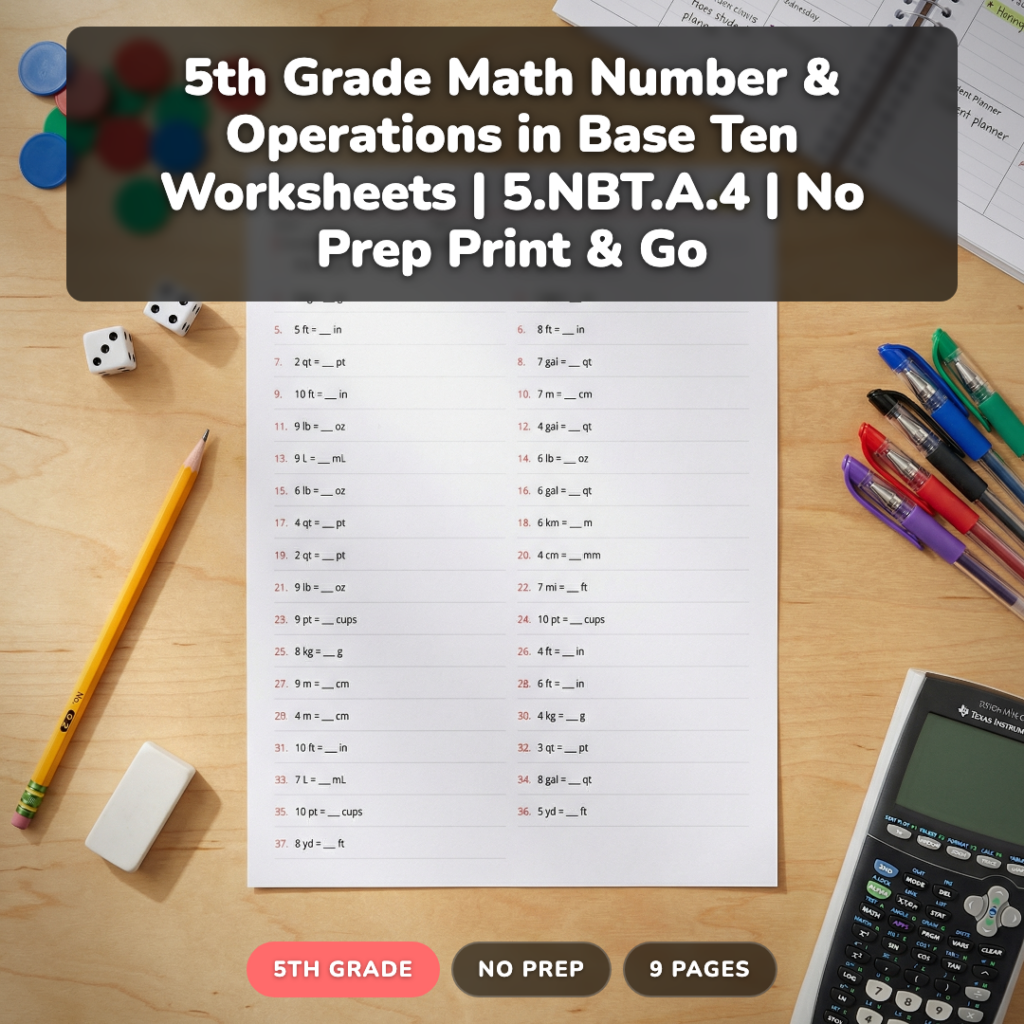
Teaching decimal rounding effectively requires tons of differentiated practice — which means hours of prep time creating problems at just the right difficulty level. That’s exactly why I created this comprehensive Number & Operations in Base Ten worksheet pack.
This resource includes 132 carefully crafted problems across three difficulty levels: 37 practice problems for building foundational skills, 50 on-level problems that meet grade-level expectations, and 45 challenge problems for students ready to extend their thinking. Each level targets CCSS.Math.Content.5.NBT.A.4 with scaffolded support that builds confidence while maintaining rigor.
What makes this different from generic worksheets? The problems are strategically sequenced to address common misconceptions, include real-world contexts students actually care about, and provide immediate feedback opportunities. Plus, you get complete answer keys and can print exactly what you need for each student.
Stop spending your weekends creating decimal rounding practice. This no-prep resource gives you everything you need to differentiate instruction and help every student master this critical 5th-grade skill.
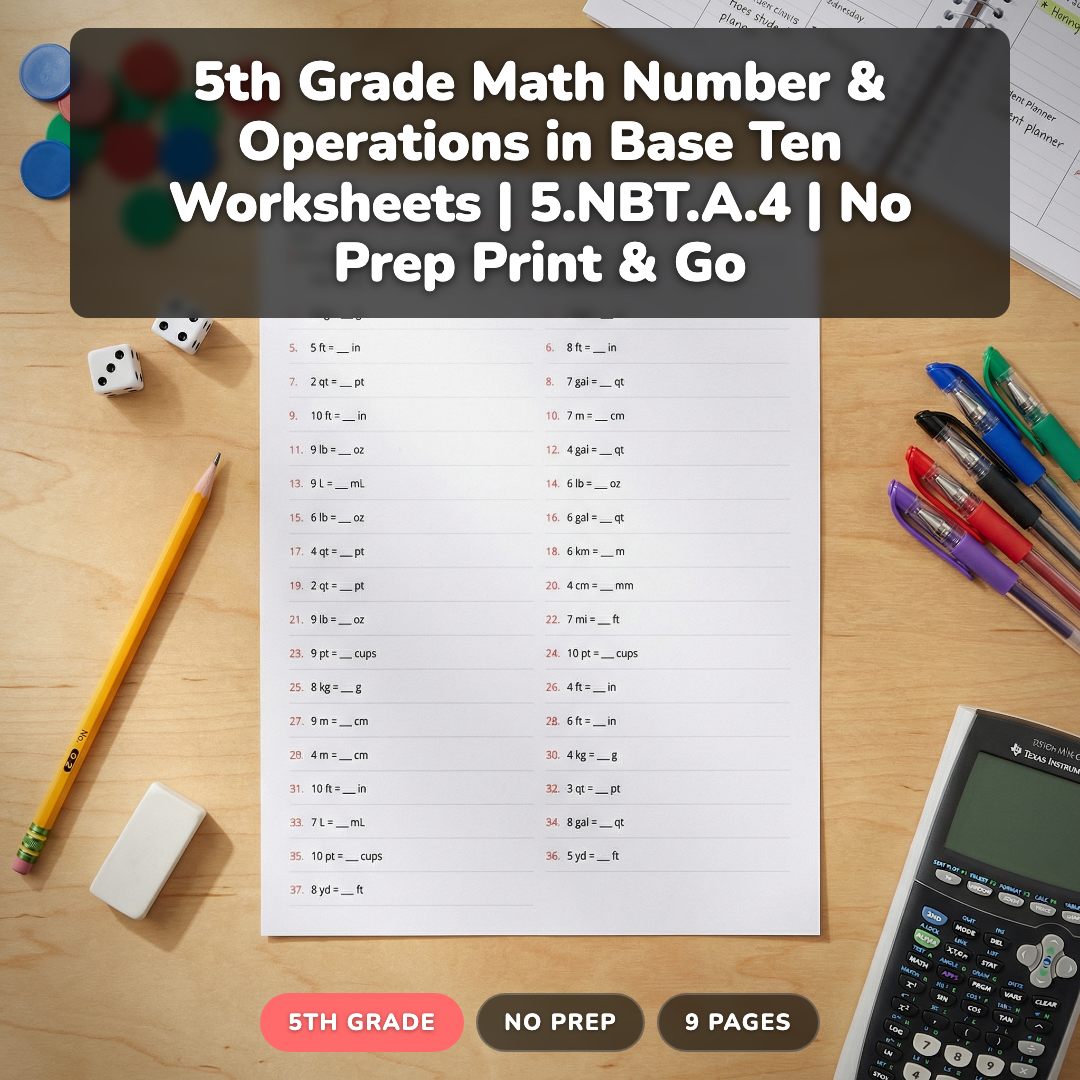
Grab a Free Decimal Rounding Practice Sheet to Try
Want to see how these differentiated problems work in your classroom? I’ll send you a free sample with problems from each difficulty level, plus my go-to anchor chart for teaching the rounding decision process.
Frequently Asked Questions About Teaching Decimal Rounding
When should I introduce decimal rounding in 5th grade?
Introduce decimal rounding after students can confidently read, write, and compare decimals through thousandths. This typically happens in October or November, following CCSS.Math.Content.5.NBT.A.3 foundations. Students need solid place value understanding before tackling rounding decisions.
What’s the biggest mistake students make when rounding decimals?
Students often focus only on the digit in the target place rather than looking at the digit to the right. For example, rounding 3.47 to the nearest tenth, they see the 4 and think “round down” instead of looking at the 7. Always teach “look right to decide” as the first step.
Should I teach the “round 5 up” rule or something different?
The standard convention is rounding 5 up, which aligns with CCSS.Math.Content.5.NBT.A.4 expectations. However, emphasize that 5 is exactly halfway, so we need a consistent rule. Some contexts use “round to even,” but 5th graders should master the standard approach first.
How do I help students who confuse rounding with truncating?
Use number lines consistently to show that rounding finds the closest value, while truncating just “cuts off” digits. Have students estimate first: “Is 2.67 closer to 2.6 or 2.7?” before applying any rules. This builds the conceptual understanding that rules are shortcuts for logical thinking.
What real-world connections work best for decimal rounding?
Money contexts are familiar but limited since we only round to hundredths. Sports statistics, weather data, and measurement scenarios provide authentic reasons to round to different places. Gas prices, batting averages, and recipe conversions show why precision matters in different situations.
Mastering decimal rounding sets your students up for success with all future decimal operations and builds the place value reasoning they’ll need in middle school. Remember, it’s not about memorizing rules — it’s about understanding why those rules make mathematical sense.
What’s your go-to strategy for helping students visualize the rounding decision? I’d love to hear what works in your classroom, and don’t forget to grab that free practice sheet above!