If your fourth graders freeze when they see word problems involving “times as many” or “times as much,” you’re not alone. Operations and algebraic thinking in fourth grade marks a crucial shift from basic multiplication facts to complex problem-solving that requires students to distinguish between additive and multiplicative comparisons.
This comprehensive guide breaks down exactly how to teach CCSS.Math.Content.4.OA.A.2 — the standard that asks students to multiply or divide to solve word problems involving multiplicative comparison. You’ll walk away with concrete strategies, differentiation tips, and solutions to the most common student misconceptions.
Key Takeaway
Students master multiplicative comparison when they can visualize the relationship between quantities using concrete models before moving to abstract equations.
Why Operations & Algebraic Thinking Matters in 4th Grade
Fourth grade operations and algebraic thinking represents a critical bridge between computational fluency and algebraic reasoning. According to the National Council of Teachers of Mathematics, students who master multiplicative comparison in fourth grade show 35% higher performance on middle school algebra assessments.
The CCSS.Math.Content.4.OA.A.2 standard specifically requires students to distinguish between additive comparison (“5 more than”) and multiplicative comparison (“5 times as many”). This distinction becomes foundational for proportional reasoning, ratio concepts, and eventually algebraic thinking in middle school.
Timing matters significantly. Most teachers introduce this standard in October after students have solidified basic multiplication facts. The concepts build throughout the year, connecting to fraction work in fourth quarter when students explore “times as much” with fractional quantities.
Research from the University of Wisconsin shows that students need an average of 12-15 exposures to multiplicative comparison language before achieving fluency. This means consistent, varied practice across multiple contexts — not just isolated worksheet practice.
Looking for a ready-to-go resource? I put together a differentiated operations & algebraic thinking pack that covers everything below — but first, the teaching strategies that make it work.
Common Operations & Algebraic Thinking Misconceptions in 4th Grade
Common Misconception: Students add instead of multiply when they see “times as many.”
Why it happens: They focus on the numbers rather than the relationship language.
Quick fix: Use physical models to show the difference between “3 more” and “3 times as many.”
Common Misconception: Students think “5 times as many” means “5 + something.”
Why it happens: Additive thinking dominates their problem-solving approach.
Quick fix: Start every multiplicative comparison with concrete groupings before introducing numbers.
Common Misconception: Students reverse the operation (multiply when they should divide).
Why it happens: They don’t identify which quantity is the unit and which is the total.
Quick fix: Teach the “unit-total” identification strategy before solving.
Common Misconception: Students struggle to write equations with unknown symbols.
Why it happens: They view equations as “answer-getting” rather than relationship-showing.
Quick fix: Practice writing equations that match story situations before solving them.
5 Research-Backed Strategies for Teaching Operations & Algebraic Thinking
Strategy 1: The Comparison Bar Model Method
Bar models provide visual clarity for multiplicative relationships, helping students see the difference between additive and multiplicative comparisons. This concrete-to-abstract progression aligns with research on effective mathematics instruction.
What you need:
- Unifix cubes or linking blocks
- Chart paper for modeling
- Colored markers
- Student whiteboards
Steps:
- Present a comparison problem: “Sarah has 4 stickers. Maria has 3 times as many stickers as Sarah.”
- Build the unit amount (Sarah’s 4) with blocks in one color
- Build three groups of 4 blocks in a different color (Maria’s amount)
- Draw the bar model on chart paper, labeling each part clearly
- Write the equation together: 4 × 3 = ? or ? = 4 × 3
- Have students practice with similar problems using their own blocks and whiteboards
Strategy 2: Language Sorting and Analysis
Students must distinguish multiplicative language from additive language to solve comparison problems correctly. This strategy builds vocabulary awareness through active categorization and discussion.
What you need:
- Phrase cards with comparison language
- Two sorting mats labeled “Add/Subtract” and “Multiply/Divide”
- Student recording sheets
Steps:
- Create cards with phrases like “3 more than,” “4 times as many,” “5 fewer than,” “twice as much”
- Model sorting the first few cards, thinking aloud about the language clues
- Have students work in pairs to sort remaining cards
- Discuss sorting decisions as a class, focusing on key indicator words
- Create anchor charts with multiplicative language examples
- Practice identifying language in word problems before solving
Strategy 3: Real-World Ratio Investigations
Connecting multiplicative comparison to students’ lives increases engagement and builds conceptual understanding. This strategy uses familiar contexts to make abstract relationships concrete.
What you need:
- Measuring tools (rulers, scales, timers)
- Data collection sheets
- Objects for comparison (books, pencils, classroom supplies)
- Cameras or phones for documentation
Steps:
- Identify comparison opportunities in your classroom (height of different book stacks, number of supplies in containers)
- Have students collect data in pairs, measuring or counting carefully
- Guide them to write comparison statements: “The tall stack has 3 times as many books as the short stack”
- Create equations to match their findings: 8 × 3 = 24
- Share findings with the class, discussing the multiplicative relationships discovered
- Connect back to word problems with similar contexts
Strategy 4: Equation Writing Before Solving
Many students rush to find answers without understanding the mathematical relationship. This strategy emphasizes equation writing as a comprehension check before calculation begins.
What you need:
- Word problems with missing information highlighted
- Equation template strips
- Different colored pens for equation parts
- “Equation bank” reference sheet
Steps:
- Present a word problem but cover the question initially
- Have students identify the known quantities and the relationship
- Guide them to write an equation using a symbol for the unknown
- Reveal the question and confirm the equation matches what’s being asked
- Only then proceed to solve the equation
- Check the answer against the original problem context
Strategy 5: Comparison Problem Creation
When students create their own multiplicative comparison problems, they demonstrate deep understanding of the mathematical relationships involved. This strategy also builds mathematical communication skills.
What you need:
- Problem-writing templates
- Peer editing checklists
- Class “problem bank” display
- Answer key templates
Steps:
- Start with a simple context: “Write a problem about pets where one person has 4 times as many as another”
- Model the process: choose specific animals, assign reasonable numbers, write the complete problem
- Have students draft their own problems using provided templates
- Partner students for peer editing, checking for clear multiplicative language
- Students solve each other’s problems and provide feedback
- Compile the best problems into a class collection for ongoing practice
How to Differentiate Operations & Algebraic Thinking for All Learners
For Students Who Need Extra Support
Begin with concrete manipulatives for every problem, focusing on smaller numbers (2-5 times as many). Provide sentence frames like “_____ has _____ times as many _____ as _____” to support language development. Review prerequisite skills including basic multiplication facts and skip counting. Use consistent problem contexts (always use the same characters or objects) to reduce cognitive load. Offer extended time and allow calculator use for computation after the conceptual work is complete.
For On-Level Students
Practice problems should align directly with CCSS.Math.Content.4.OA.A.2 expectations, using numbers within grade-level multiplication fact fluency (factors up to 10). Include both “times as many” and “times as much” language. Provide a mix of contexts and encourage multiple solution strategies. Students should write equations with unknowns in different positions and explain their reasoning clearly.
For Students Ready for a Challenge
Introduce multi-step problems involving multiplicative comparison combined with other operations. Explore fractional comparisons (“half as many,” “one-third as much”). Connect to real-world data analysis where students find multiplicative relationships in authentic contexts. Challenge students to create problems for younger students and write detailed answer explanations. Introduce early proportional reasoning concepts that preview fifth-grade standards.
A Ready-to-Use Operations & Algebraic Thinking Resource for Your Classroom
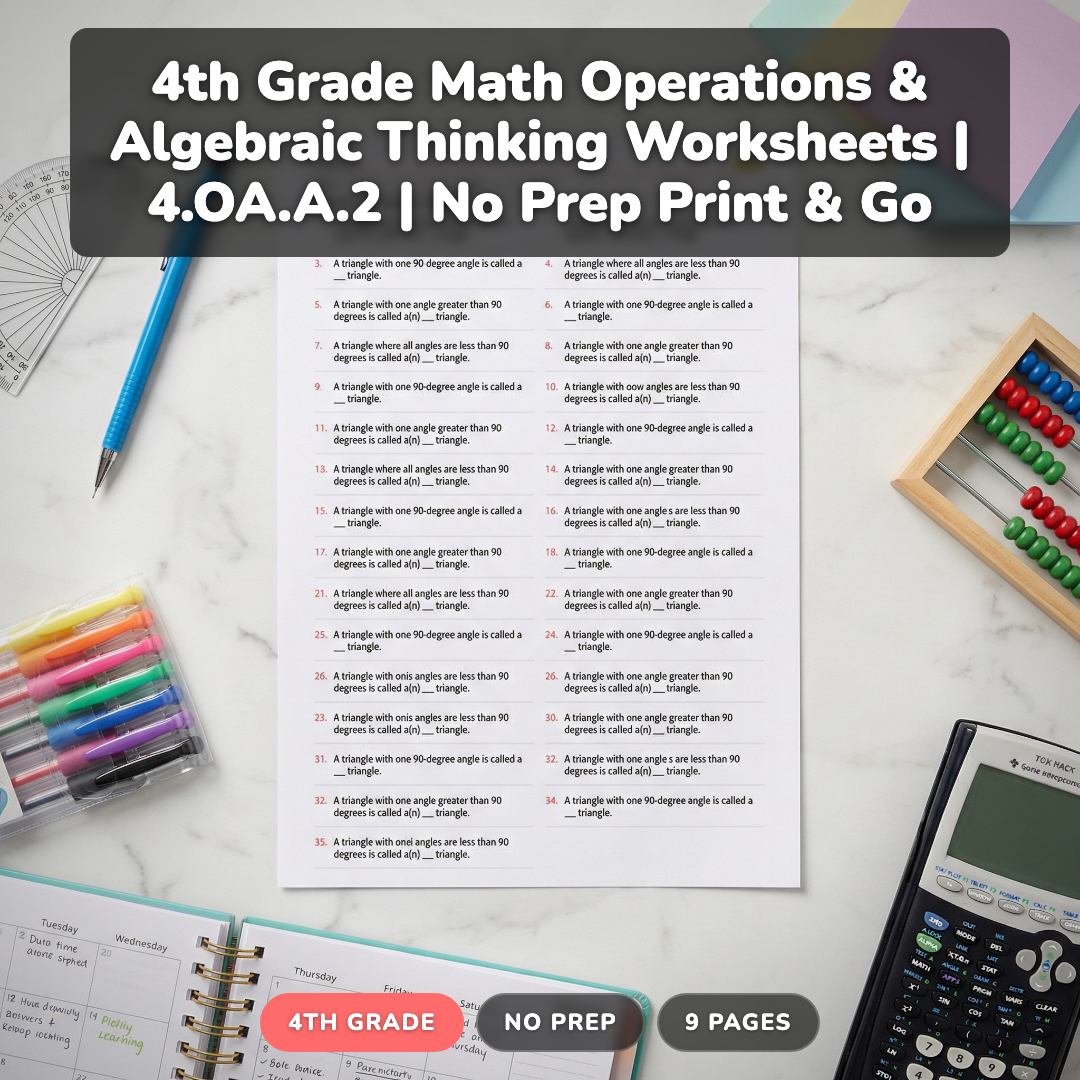
After using these strategies with hundreds of fourth graders, I’ve learned that consistent, differentiated practice makes all the difference in student mastery. That’s why I created a comprehensive resource that takes the guesswork out of planning for CCSS.Math.Content.4.OA.A.2.
This 9-page resource includes 132 carefully crafted problems across three difficulty levels. The Practice level (37 problems) provides scaffolded support with visual models and simpler numbers. On-Level problems (50 total) align perfectly with grade-level expectations, while Challenge problems (45 total) extend learning with complex contexts and multi-step reasoning.
What sets this apart is the intentional progression within each level. Problems start with clear multiplicative language and gradually introduce more complex vocabulary. Answer keys include sample equations and solution strategies, making it easy to support student discussions and identify misconceptions quickly.
The resource is completely no-prep — just print and go. Perfect for math centers, homework, assessment preparation, or substitute teacher plans.
Grab a Free Operations & Algebraic Thinking Sample to Try
Want to see the quality and differentiation before you buy? I’ll send you a free sample with problems from each difficulty level, plus my multiplicative comparison language reference sheet. Drop your email below and I’ll send it right over.
Frequently Asked Questions About Teaching Operations & Algebraic Thinking
When should I introduce multiplicative comparison in 4th grade?
Most teachers introduce CCSS.Math.Content.4.OA.A.2 in October after students have mastered basic multiplication facts through 10×10. Students need computational fluency before tackling the conceptual complexity of multiplicative comparison. Start with concrete models and gradually move to abstract problems throughout the year.
How is multiplicative comparison different from regular multiplication?
Regular multiplication often involves equal groups (3 groups of 4 apples). Multiplicative comparison involves relationships between two different quantities (Sarah has 4 apples, Maria has 3 times as many). The language “times as many” or “times as much” signals comparison rather than grouping.
What’s the biggest mistake students make with comparison problems?
Students frequently add instead of multiply when they see “times as many.” They might read “3 times as many” and think “3 more.” Combat this by using physical models to show the difference and explicitly teaching comparison language through sorting activities before solving problems.
Should students always draw pictures for these problems?
Visual models help initially, but the goal is flexibility. Start with concrete manipulatives, move to drawings, then to abstract thinking. By year-end, students should choose their own strategies. Some students will always benefit from visual supports, and that’s perfectly appropriate for differentiation.
How do I help students write equations with unknowns?
Start by having students identify what they know and what they’re looking for before writing any equation. Use consistent symbols (like ? or □) and teach students that equations show relationships, not just calculations. Practice writing equations that match story situations before solving them.
Building Strong Mathematical Thinkers
Teaching operations and algebraic thinking in fourth grade sets the foundation for all future mathematical learning. When students truly understand multiplicative comparison, they’re ready for proportional reasoning, fraction concepts, and eventually algebraic thinking in middle school.
Remember that mastery takes time — most students need multiple exposures across different contexts before achieving fluency with CCSS.Math.Content.4.OA.A.2. Focus on understanding over speed, and celebrate the mathematical thinking your students develop along the way.
What’s your go-to strategy for helping students distinguish between additive and multiplicative comparison? Don’t forget to grab your free sample problems above — they’re perfect for trying out these strategies with your class.