If your fourth graders freeze when they see 3 × ¼ or struggle to understand why 4 × ⅓ equals 4/3, you’re not alone. Multiplying fractions by whole numbers is where many students hit their first real fraction roadblock. The good news? With the right visual models and concrete experiences, this concept clicks beautifully for most students.
Key Takeaway
Students master fraction multiplication when they see it as repeated addition with visual models before moving to the shortcut algorithm.
Why Fourth Graders Learn to Multiply Fractions by Whole Numbers
Standard CCSS.Math.Content.4.NF.B.4 asks students to apply and extend previous understandings of multiplication to multiply a fraction by a whole number. This standard bridges students’ whole number multiplication knowledge with fraction concepts they’ve been building since third grade.
Students typically encounter this skill in late fall or winter, after they’ve worked with equivalent fractions and comparing fractions. Research from the National Mathematics Advisory Panel shows that students who develop strong conceptual understanding of fraction multiplication before learning procedures score 23% higher on fraction assessments throughout middle school.
The standard specifically requires students to understand multiplication as repeated addition (4 × ⅓ = ⅓ + ⅓ + ⅓ + ⅓) and as scaling (4 × ⅓ means “4 groups of one-third”). Students must represent these problems with visual fraction models, equations, and word problems.
Looking for a ready-to-go resource? I put together a differentiated fraction multiplication pack with 132 problems across three levels — but first, the teaching strategies that make it work.
Common Fraction Multiplication Misconceptions in Fourth Grade
Common Misconception: Students multiply both the numerator and denominator by the whole number (3 × ¼ = 3/12).
Why it happens: They overgeneralize rules from equivalent fractions where you multiply top and bottom by the same number.
Quick fix: Always start with visual models showing repeated addition before introducing the algorithm.
Common Misconception: Students think the answer should be smaller than the whole number because “multiplication makes things bigger.”
Why it happens: Their experience with whole number multiplication where products are always larger than factors.
Quick fix: Use number lines to show that 3 × ¼ means “3 jumps of ¼” which lands at ¾.
Common Misconception: Students add instead of multiply when they see friendly numbers (2 × ½ = 2½).
Why it happens: They misread the operation or confuse mixed numbers with multiplication expressions.
Quick fix: Read problems aloud as “2 groups of one-half” to emphasize the multiplicative structure.
5 Research-Backed Strategies for Teaching Fraction Multiplication
Strategy 1: Fraction Bars with Repeated Addition
Students use physical fraction bars to build understanding that multiplication means repeated addition. This concrete approach helps students see that 4 × ⅓ literally means “⅓ + ⅓ + ⅓ + ⅓.”
What you need:
- Fraction bars or strips (paper or manipulatives)
- Whole unit bars for comparison
- Recording sheets
Steps:
- Show students one whole bar and one ⅓ piece
- Ask: “If I want 4 groups of ⅓, how many ⅓ pieces do I need?”
- Have students line up four ⅓ pieces under the whole bar
- Count together: “⅓, ⅔, 3/3, 4/3”
- Record the equation: 4 × ⅓ = 4/3 = 1⅓
- Repeat with different fractions and whole numbers
Strategy 2: Number Line Jumps
Students use number lines to visualize multiplication as repeated jumps of the same size. This strategy connects to students’ understanding of skip counting and helps them see fraction multiplication as a measurement process.
What you need:
- Large number line (0 to 3, marked in halves, thirds, or fourths)
- Colored markers or crayons
- Individual number line worksheets
Steps:
- Start at zero on the number line
- For 3 × ¼, make the first jump of ¼ and mark it
- Make the second jump of ¼ from your new position
- Make the third jump of ¼
- Count the total distance: “We jumped ¼ three times and landed at ¾”
- Record: 3 × ¼ = ¾
Strategy 3: Array Models with Rectangles
Students draw rectangular arrays to represent fraction multiplication, connecting to their area model experience from whole number multiplication. This visual approach helps students see the multiplicative structure clearly.
What you need:
- Grid paper or rectangle templates
- Colored pencils
- Rulers
Steps:
- Draw a rectangle and divide it into equal parts based on the denominator
- For 5 × ⅓, divide the rectangle into 3 equal columns
- Shade one column to represent ⅓
- Copy this shaded pattern 5 times (5 rectangles total)
- Count the total shaded parts: 5 out of 15 total parts = 5/3
- Convert to mixed number if appropriate: 5/3 = 1⅔
Strategy 4: Real-World Recipe Problems
Students solve authentic problems involving recipes, measurement, and sharing to understand when and why we multiply fractions by whole numbers. This contextual approach helps students see the practical applications of the skill.
What you need:
- Simple recipe cards with fractional measurements
- Measuring cups (if available)
- Problem-solving recording sheets
Steps:
- Present a problem: “A cookie recipe calls for ¼ cup of vanilla. If you’re making 3 batches, how much vanilla do you need?”
- Have students visualize: “3 groups of ¼ cup”
- Draw or model the solution using fraction bars or number lines
- Calculate: 3 × ¼ = ¾ cup
- Check reasonableness: “Does ¾ cup make sense for 3 batches?”
- Create similar problems with different contexts (fabric, paint, time)
Strategy 5: Pattern Recognition with Tables
Students explore patterns in multiplication tables to develop number sense and predict outcomes. This algebraic thinking approach helps students see relationships and build fluency with common fraction products.
What you need:
- Multiplication tables with fractions
- Calculators (for checking)
- Pattern recording sheets
Steps:
- Create a table with 1 × ⅓, 2 × ⅓, 3 × ⅓, 4 × ⅓, 5 × ⅓
- Calculate each product using visual models first
- Record results: ⅓, ⅔, 3/3, 4/3, 5/3
- Look for patterns: “The numerator equals the whole number”
- Test the pattern with different unit fractions
- Develop the rule: “When multiplying a whole number by a unit fraction, the numerator becomes the whole number”
How to Differentiate Fraction Multiplication for All Learners
For Students Who Need Extra Support
Begin with concrete manipulatives and unit fractions only (½, ⅓, ¼). Use fraction bars, circles, or number lines consistently. Focus on the repeated addition interpretation before introducing the multiplication symbol. Provide sentence frames like “___ groups of ___ equals ___.” Review equivalent fractions and mixed number conversions daily. Limit whole number multipliers to 2-5 initially.
For On-Level Students
Students work with unit fractions and simple non-unit fractions (⅖, ¾) multiplied by whole numbers 1-10. They should fluently move between visual models and symbolic notation. Expect students to solve word problems, explain their reasoning, and check answers for reasonableness. Students should master CCSS.Math.Content.4.NF.B.4 expectations by representing problems multiple ways and connecting to real-world contexts.
For Students Ready for a Challenge
Extend to fractions with larger denominators (⅕, ⅛, 1/10) and explore patterns across fraction families. Challenge students to multiply mixed numbers by whole numbers or investigate what happens when multiplying by zero or one. Connect to early decimal concepts (4 × ¼ = 1.0) and introduce the commutative property (3 × ¼ = ¼ × 3). Students can create their own word problems and teach strategies to classmates.
A Ready-to-Use Fraction Multiplication Resource for Your Classroom
After years of teaching this concept, I’ve learned that students need lots of varied practice at different levels. That’s why I created a comprehensive fraction multiplication resource that takes the guesswork out of differentiation.
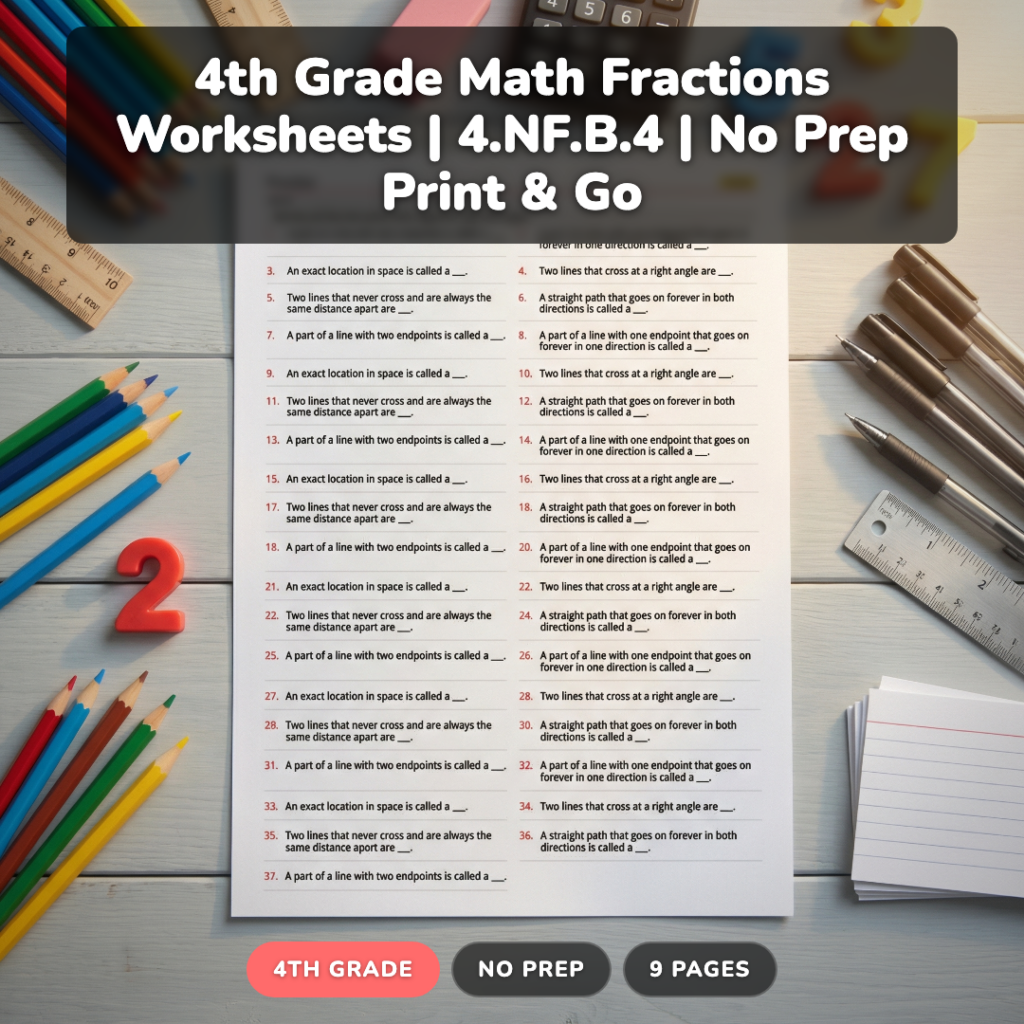
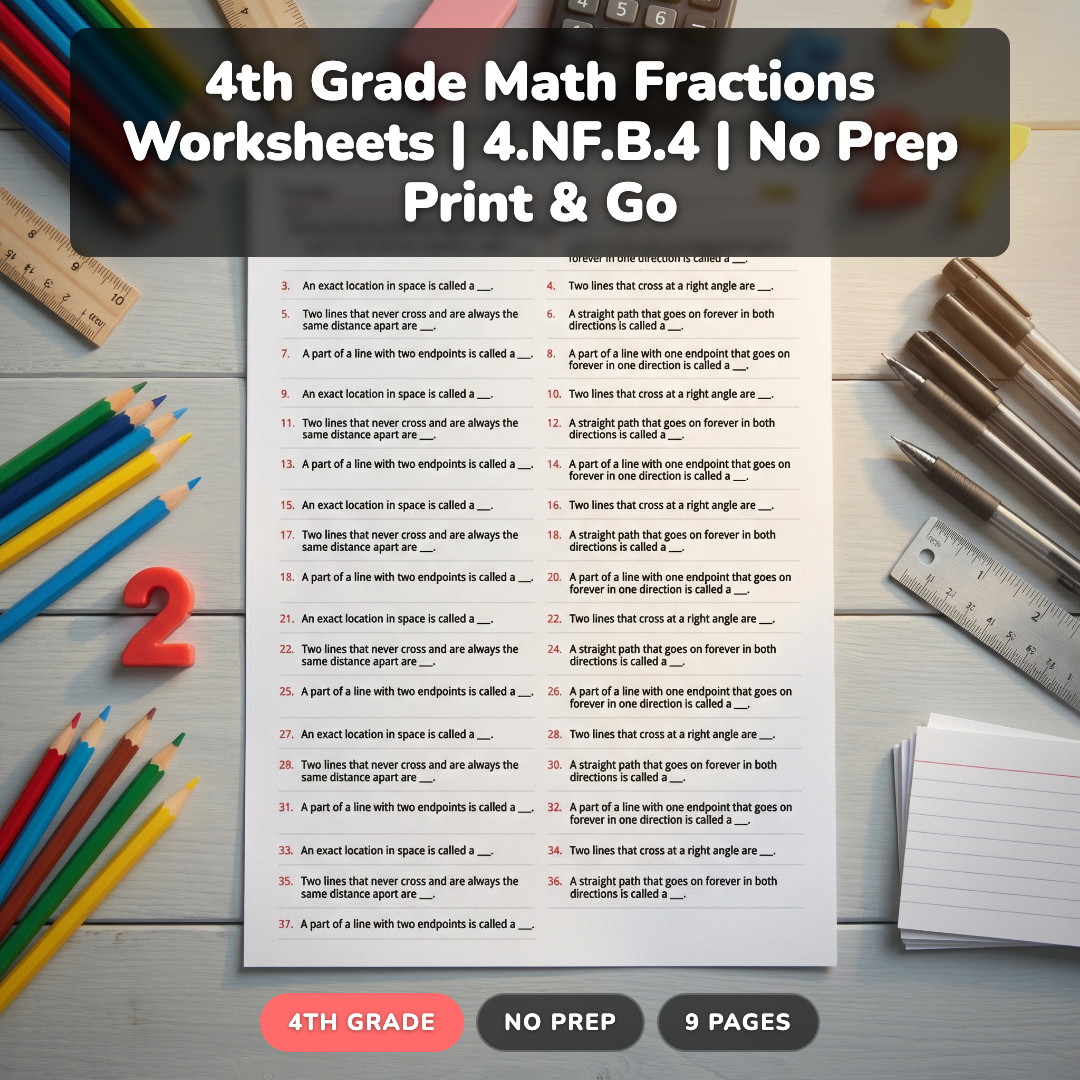
This 9-page resource includes 132 carefully crafted problems across three difficulty levels: Practice (37 problems), On-Level (50 problems), and Challenge (45 problems). Each level targets CCSS.Math.Content.4.NF.B.4 while providing appropriate scaffolding or extension. The Practice level focuses on unit fractions with visual supports, On-Level includes mixed practice with word problems, and Challenge incorporates complex fractions and multi-step reasoning.
What makes this resource different is the intentional progression and built-in differentiation. You get answer keys for quick grading, and problems are designed to build conceptual understanding alongside procedural fluency.
Grab a Free Fraction Multiplication Sample to Try
Want to see how these strategies work in practice? I’ll send you a free sample worksheet with problems from each difficulty level, plus a visual model reference sheet your students can use during instruction.
Frequently Asked Questions About Teaching Fraction Multiplication
When should I introduce the algorithm for multiplying fractions by whole numbers?
Introduce the algorithm (multiply numerator by whole number, keep denominator) only after students demonstrate conceptual understanding through visual models and repeated addition. This typically takes 3-5 lessons of concrete experience before moving to the shortcut.
How do I help students who confuse fraction multiplication with addition?
Use consistent language like “groups of” instead of “times.” Say “3 groups of one-fourth” rather than “3 times one-fourth.” Visual models like number line jumps help students see the multiplicative structure clearly and distinguish it from addition.
Should fourth graders convert improper fractions to mixed numbers?
Yes, CCSS.Math.Content.4.NF.B.4 expects students to express answers greater than 1 as mixed numbers. However, accept improper fractions initially and teach conversion as a separate step. Students should understand that 5/3 and 1⅔ represent the same quantity.
What’s the biggest mistake teachers make when teaching this concept?
Rushing to the algorithm without building conceptual understanding first. Students who learn “just multiply the top” without understanding why often struggle with fraction division later. Spend time with visual models and repeated addition before introducing shortcuts.
How can I assess whether students truly understand fraction multiplication?
Ask students to solve problems using two different methods (visual model and algorithm), explain their thinking aloud, and create word problems for given equations. Students who truly understand can move flexibly between representations and justify their reasoning.
Teaching fraction multiplication doesn’t have to be overwhelming when you start with concrete experiences and build understanding gradually. Remember to keep visual models at the center of your instruction, even as students develop procedural fluency.
What’s your go-to strategy for helping students visualize fraction multiplication? I’d love to hear what works in your classroom!
Don’t forget to grab your free fraction multiplication sample above — it includes problems from all three levels plus visual reference sheets.