If your fourth graders freeze when they see 3,427 × 6 or start randomly multiplying digits without understanding why, you’re not alone. Multi-digit multiplication is where many students hit their first major math wall. The good news? With the right strategies that build on place value understanding, you can turn this challenging concept into a series of manageable steps your students will actually understand.
Key Takeaway
Successful multi-digit multiplication instruction connects place value understanding to the distributive property through concrete models before moving to abstract algorithms.
Why Multi-Digit Multiplication Matters in Fourth Grade
Multi-digit multiplication represents a crucial bridge between elementary arithmetic and more complex mathematical reasoning. According to the National Council of Teachers of Mathematics, students who master place value-based multiplication strategies show 40% better performance on middle school algebra readiness assessments.
The timing of this skill in fourth grade is strategic. By this point, students have solid single-digit multiplication facts and understand place value through thousands. CCSS.Math.Content.4.NBT.B.5 specifically requires students to multiply up to four-digit numbers by one-digit numbers and two two-digit numbers using place value strategies, not just memorized algorithms.
Research from the Institute of Education Sciences shows that students who learn multiplication through multiple representations—arrays, area models, and place value decomposition—demonstrate significantly deeper number sense than those taught only traditional algorithms. This foundation becomes essential for fraction multiplication, algebraic thinking, and problem-solving in later grades.
Looking for a ready-to-go resource? I put together a differentiated multi-digit multiplication pack that covers everything below — but first, the teaching strategies that make it work.
Common Multi-Digit Multiplication Misconceptions in 4th Grade
Common Misconception: Students multiply each digit separately without considering place value (247 × 3 = 6, 12, 21).
Why it happens: They apply single-digit multiplication rules without understanding that each digit represents different place values.
Quick fix: Always start with expanded form: 247 = 200 + 40 + 7, then multiply each part.
Common Misconception: When multiplying two two-digit numbers, students forget to add partial products (23 × 14 = 92 + 230 = 230).
Why it happens: They see each step as separate problems rather than parts of one calculation.
Quick fix: Use area models to show all four partial products visually before combining.
Common Misconception: Students think ‘carrying’ or regrouping is just moving numbers around without understanding the place value exchange.
Why it happens: Traditional algorithms emphasize procedure over conceptual understanding.
Quick fix: Use base-ten blocks to physically show regrouping 10 ones for 1 ten.
Common Misconception: Students believe larger numbers always produce larger products (thinking 15 × 12 > 25 × 8).
Why it happens: They focus on individual digits rather than the complete numbers being multiplied.
Quick fix: Estimation practice: round both numbers and compare estimated products before calculating.
5 Research-Backed Strategies for Teaching Multi-Digit Multiplication
Strategy 1: Place Value Decomposition with Base-Ten Blocks
This concrete approach helps students visualize why the standard algorithm works by breaking numbers into their place value components before multiplying.
What you need:
- Base-ten blocks (hundreds, tens, ones)
- Place value mats
- Recording sheets with expanded form templates
Steps:
- Model the larger number using base-ten blocks (for 243, use 2 hundreds, 4 tens, 3 ones)
- Write the expanded form: 243 = 200 + 40 + 3
- Multiply each place value by the one-digit multiplier separately
- Use blocks to show each partial product (200 × 4, 40 × 4, 3 × 4)
- Combine all partial products to find the total
- Connect the concrete model to the written algorithm
Strategy 2: Area Model Visualization
Area models provide a visual representation that makes the distributive property concrete and helps students understand why we multiply each place value separately.
What you need:
- Grid paper or area model templates
- Colored pencils or markers
- Rulers
- Calculators for checking partial products
Steps:
- Draw a rectangle and label dimensions with the factors (23 × 14)
- Divide the rectangle based on place values (20 + 3 by 10 + 4)
- Create four smaller rectangles showing all partial products
- Calculate the area of each section: 20×10=200, 20×4=80, 3×10=30, 3×4=12
- Add all partial products: 200 + 80 + 30 + 12 = 322
- Verify using the standard algorithm
Strategy 3: Array Building with Manipulatives
Physical arrays help students connect multiplication to repeated addition while building understanding of the commutative and distributive properties.
What you need:
- Centimeter cubes or square tiles
- Large sheets of paper
- Masking tape for grouping
- Array recording sheets
Steps:
- Build an array for single-digit multiplication review (6 × 4 = 24 squares)
- Extend to two-digit problems by building larger arrays (12 × 6)
- Use tape to separate the array into place value sections
- Count squares in each section to find partial products
- Record the process: 12 × 6 = (10 × 6) + (2 × 6) = 60 + 12 = 72
- Challenge students to find multiple ways to partition the same array
Strategy 4: Estimation and Reasonableness Checks
Teaching estimation alongside exact calculation develops number sense and helps students catch errors in their work.
What you need:
- Number lines
- Rounding reference charts
- Estimation recording sheets
- Calculators for verification
Steps:
- Round both factors to the nearest ten or hundred
- Calculate the estimated product mentally
- Solve the exact problem using chosen strategy
- Compare exact answer to estimate for reasonableness
- Discuss whether the exact answer should be higher or lower than the estimate
- Identify and correct any unreasonable results
Strategy 5: Stepped Algorithm Introduction
Once students understand the conceptual foundation, introduce the standard algorithm as an efficient way to organize the place value decomposition they’ve been practicing.
What you need:
- Algorithm recording sheets with place value columns
- Different colored pens for each step
- Place value charts
- Connection worksheets linking models to algorithms
Steps:
- Start with the area model or decomposition for the same problem
- Show how the algorithm organizes the same partial products vertically
- Use colors to connect each algorithm step to its conceptual meaning
- Practice the algorithm while verbalizing the place value reasoning
- Gradually reduce scaffolds as students gain fluency
- Always return to estimation for reasonableness checks
How to Differentiate Multi-Digit Multiplication for All Learners
For Students Who Need Extra Support
Begin with concrete manipulatives and limit problems to two-digit by one-digit multiplication. Provide place value charts and expanded form templates. Use problems with zeros in the ones place (like 240 × 3) to reduce computational complexity. Break multi-step problems into smaller chunks with frequent check-ins. Offer calculator support for basic facts while focusing on place value understanding.
For On-Level Students
Students work with CCSS.Math.Content.4.NBT.B.5 expectations: four-digit by one-digit and two two-digit number multiplication. They should demonstrate fluency with multiple strategies—area models, decomposition, and standard algorithm. Provide mixed practice combining estimation, exact calculation, and reasonableness checks. Include real-world word problems that require choosing appropriate strategies.
For Students Ready for a Challenge
Extend to three-digit by two-digit problems and introduce patterns in products of multiples of 10, 100, and 1000. Challenge students to create their own word problems and explain why different strategies work. Explore connections to distributive property and early algebraic thinking. Investigate efficiency of different methods for different types of problems.
A Ready-to-Use Multi-Digit Multiplication Resource for Your Classroom
After teaching this concept for years, I know how much prep time it takes to create differentiated practice that truly meets every student’s needs. That’s why I developed this comprehensive 4th grade multiplication worksheet pack that takes the guesswork out of differentiation.
This 9-page resource includes 132 carefully crafted problems across three difficulty levels. The Practice level (37 problems) focuses on two-digit by one-digit multiplication with visual supports. On-Level worksheets (50 problems) cover the full CCSS.Math.Content.4.NBT.B.5 standard with four-digit by one-digit and two two-digit problems. Challenge pages (45 problems) extend learning with multi-step problems and pattern exploration.
What makes this different from generic worksheets? Each level includes problems specifically designed to address common misconceptions, space for showing work using multiple strategies, and built-in estimation practice. Plus, detailed answer keys save you grading time while helping you identify exactly where students need additional support.
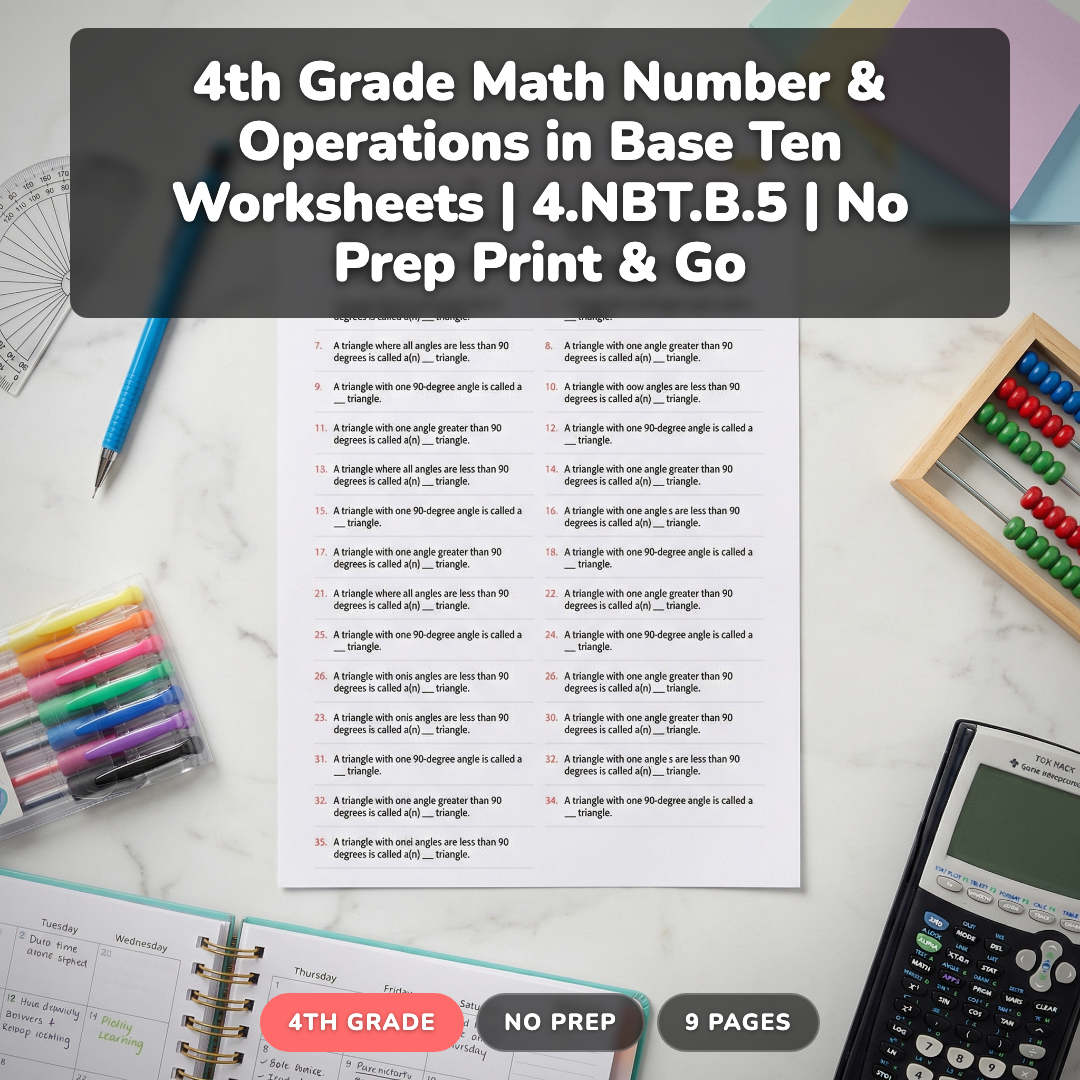
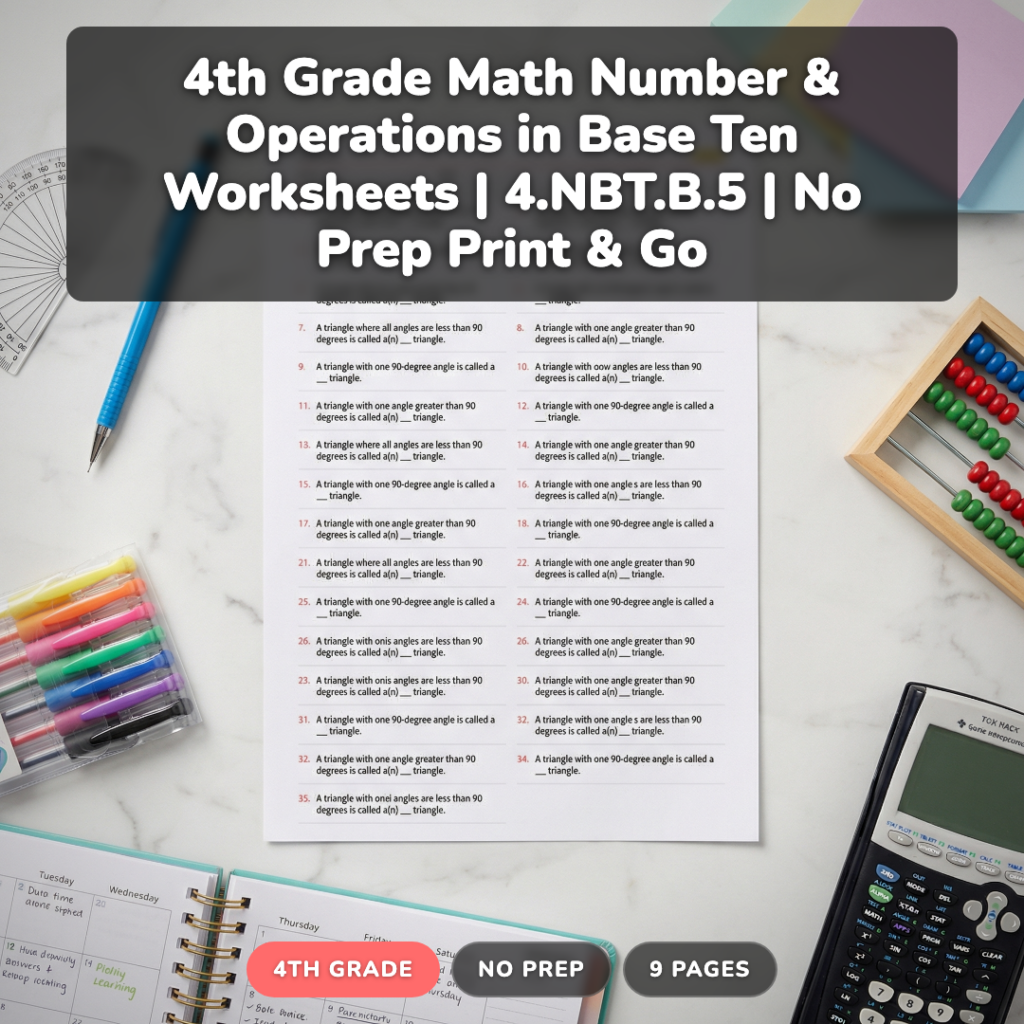
The worksheets are completely no-prep—just print and go. Perfect for math centers, homework, or assessment preparation.
Grab a Free Multi-Digit Multiplication Sample to Try
Want to see the quality and differentiation in action? I’ll send you a free sample worksheet with problems from each difficulty level, plus my place value decomposition template that students love.
Frequently Asked Questions About Teaching Multi-Digit Multiplication
When should I introduce the standard algorithm for multiplication?
Introduce the standard algorithm only after students demonstrate solid understanding of place value decomposition and can explain why partial products work. This typically happens mid-year in fourth grade, but prioritize conceptual understanding over timing.
How do I help students who still struggle with basic multiplication facts?
Provide fact charts or calculators for basic facts while focusing instruction on place value strategies. Students can learn multi-digit concepts even while building fact fluency. Separate these two learning goals to avoid cognitive overload.
What’s the difference between CCSS.Math.Content.4.NBT.B.5 and 5th grade multiplication standards?
Fourth grade focuses on whole number multiplication with emphasis on place value strategies and multiple representations. Fifth grade (5.NBT.B.5) extends to decimal multiplication and emphasizes fluency with the standard algorithm for whole numbers.
How much time should I spend on each multiplication strategy?
Spend 2-3 weeks on concrete models and decomposition, 1-2 weeks on area models and arrays, then 2-3 weeks connecting these to the standard algorithm. Adjust timing based on student understanding, not calendar deadlines.
Should students memorize the multiplication algorithm or understand it?
Both. Students need conceptual understanding of why the algorithm works (through place value) AND procedural fluency for efficiency. Understanding must come first, but fluency is the ultimate goal for grade-level success.
Multi-digit multiplication doesn’t have to be a stumbling block for your fourth graders. When you build understanding through place value decomposition and multiple representations before introducing algorithms, students develop both conceptual understanding and computational fluency. What’s your go-to strategy for helping students visualize multi-digit multiplication? Don’t forget to grab your free sample worksheets above to try these strategies with your class!