If your 4th graders freeze when they see 2¾ + 1⅝, you’re not alone. Mixed number operations feel overwhelming to students because they’re juggling whole numbers AND fractions in the same problem. The good news? With the right teaching strategies, your students will confidently add and subtract mixed numbers by winter break.
Key Takeaway
Students master mixed number operations when they understand the relationship between whole numbers, fractions, and improper fractions through concrete experiences before moving to abstract algorithms.
Why Mixed Number Operations Matter in 4th Grade
Mixed number addition and subtraction represents a critical bridge between basic fraction concepts and more complex rational number operations. According to the National Council of Teachers of Mathematics, students who struggle with mixed numbers in 4th grade often carry these difficulties into middle school algebra.
Standard CCSS.Math.Content.4.NF.B.3c specifically requires students to add and subtract mixed numbers with like denominators by replacing each mixed number with an equivalent fraction and using properties of operations. This standard typically appears in late fall or early winter, after students have mastered equivalent fractions and basic fraction addition.
Research from the University of Delaware shows that 68% of 4th grade students initially approach mixed number problems by adding whole numbers and fractions separately (2¾ + 1⅝ = 3 + 11/8), leading to incorrect answers and conceptual confusion.
Looking for a ready-to-go resource? I put together a differentiated mixed number practice pack with 132 problems across three levels — but first, the teaching strategies that make it work.
Common Mixed Number Misconceptions in 4th Grade
Common Misconception: Students add whole numbers and fractions separately: 2¾ + 1⅝ = 3 + 11/8.
Why it happens: They see mixed numbers as two separate problems rather than one unified quantity.
Quick fix: Use visual models showing mixed numbers as single quantities on number lines.
Common Misconception: When subtracting, students subtract the smaller whole number from the larger one regardless of position: 3⅛ – 1⅝ = 2 – 4/8.
Why it happens: They apply whole number subtraction rules without considering the unified mixed number.
Quick fix: Emphasize converting to improper fractions first to maintain the relationship.
Common Misconception: Students think they can’t subtract when the fraction part of the minuend is smaller: 4¼ – 2¾ is “impossible.”
Why it happens: They don’t understand regrouping with fractions or converting to improper fractions.
Quick fix: Model regrouping one whole as equivalent fractions using manipulatives.
Common Misconception: Students believe mixed numbers and improper fractions are completely different types of numbers.
Why it happens: Insufficient experience seeing the same quantity represented both ways.
Quick fix: Daily warm-ups converting between forms using visual fraction bars.
5 Research-Backed Strategies for Teaching Mixed Number Operations
Strategy 1: Fraction Bar Modeling for Visual Understanding
Students use fraction bars to physically represent mixed numbers before attempting abstract calculations. This concrete approach helps them see mixed numbers as unified quantities rather than separate whole and fraction parts.
What you need:
- Fraction bars (halves, thirds, fourths, eighths)
- Whole unit bars
- Recording sheets
- Document camera for modeling
Steps:
- Model 2¾ using two whole bars plus three-fourths of another bar
- Model 1⅝ using one whole bar plus five-eighths (converted to eighths)
- Combine all bars and count the total
- Record as both mixed number and improper fraction
- Repeat with subtraction using “take away” language
Strategy 2: Number Line Jumps for Operation Sense
Students visualize mixed number operations as movements along a number line, building intuition for why certain strategies work and helping them estimate reasonable answers.
What you need:
- Large number line (0-6) marked in eighths
- Colored markers or sticky notes
- Individual student number lines
- Problem cards
Steps:
- Start at zero and jump to the first mixed number (2¾)
- From that position, jump forward or backward by the second amount
- Mark the landing spot and identify the result
- Compare to the abstract calculation
- Discuss why the answer makes sense
Strategy 3: The “Convert-Compute-Convert” Method
Students learn a systematic three-step process: convert mixed numbers to improper fractions, perform the operation, then convert back to mixed number form. This method aligns directly with CCSS.Math.Content.4.NF.B.3c expectations.
What you need:
- Anchor chart with three-step process
- Individual reference cards
- Practice problems with like denominators
- Timer for fluency building
Steps:
- Convert: Change 2¾ to 11/4 and 1⅝ to 13/8
- Find common denominators if needed (11/4 = 22/8)
- Compute: Add or subtract the improper fractions (22/8 + 13/8 = 35/8)
- Convert back: 35/8 = 4⅜
- Check reasonableness using estimation
Strategy 4: Regrouping with Fraction Circles
For subtraction problems where regrouping is needed, students use fraction circles to physically “borrow” one whole and convert it to fractional parts, making the abstract regrouping process concrete.
What you need:
- Fraction circle sets (fourths, eighths)
- Whole circle pieces
- Problem mats with spaces for “before” and “after”
- Recording sheets
Steps:
- Model the minuend (4¼) with circles
- Attempt to subtract the fraction part (¾)
- Realize you need more fourths
- “Borrow” one whole circle and exchange for four-fourths
- Now subtract ¾ from 5/4, then subtract whole numbers
Strategy 5: Real-World Recipe Mathematics
Students solve mixed number problems in the context of doubling, halving, or combining recipes, providing authentic motivation and helping them see practical applications of these skills.
What you need:
- Simple recipe cards with mixed number measurements
- Measuring cups and spoons (optional)
- Recipe adjustment worksheets
- Calculator for checking
Steps:
- Present a recipe calling for 2¾ cups flour and 1⅝ cups sugar
- Ask: “How much total dry ingredients?” or “How much more flour than sugar?”
- Students solve using their preferred method
- Discuss whether the answer makes sense in context
- Connect to measurement tools when possible
How to Differentiate Mixed Number Operations for All Learners
For Students Who Need Extra Support
Begin with halves and fourths exclusively, as these denominators connect to students’ prior knowledge of half-dollars and quarters. Provide conversion charts showing mixed numbers and their improper fraction equivalents. Use manipulatives for every problem initially, gradually fading to drawings, then to abstract work. Review prerequisite skills like equivalent fractions and basic fraction addition before introducing mixed numbers. Allow extra time and provide step-by-step checklists.
For On-Level Students
Work primarily with denominators of 2, 4, and 8, introducing thirds and sixths once students show mastery. Expect students to use multiple strategies and choose efficient methods. Provide practice with both addition and subtraction, including problems requiring regrouping. Students should demonstrate fluency with the convert-compute-convert method and explain their thinking using mathematical vocabulary. Regular formative assessment ensures steady progress toward CCSS.Math.Content.4.NF.B.3c mastery.
For Students Ready for a Challenge
Introduce mixed denominators requiring common denominator work before operations. Present multi-step problems involving three or more mixed numbers. Challenge students to create their own word problems and teach strategies to classmates. Explore connections to decimal equivalents and early algebraic thinking. Provide opportunities to investigate why the convert-compute-convert method works mathematically and explore alternative algorithms.
A Ready-to-Use Mixed Number Resource for Your Classroom
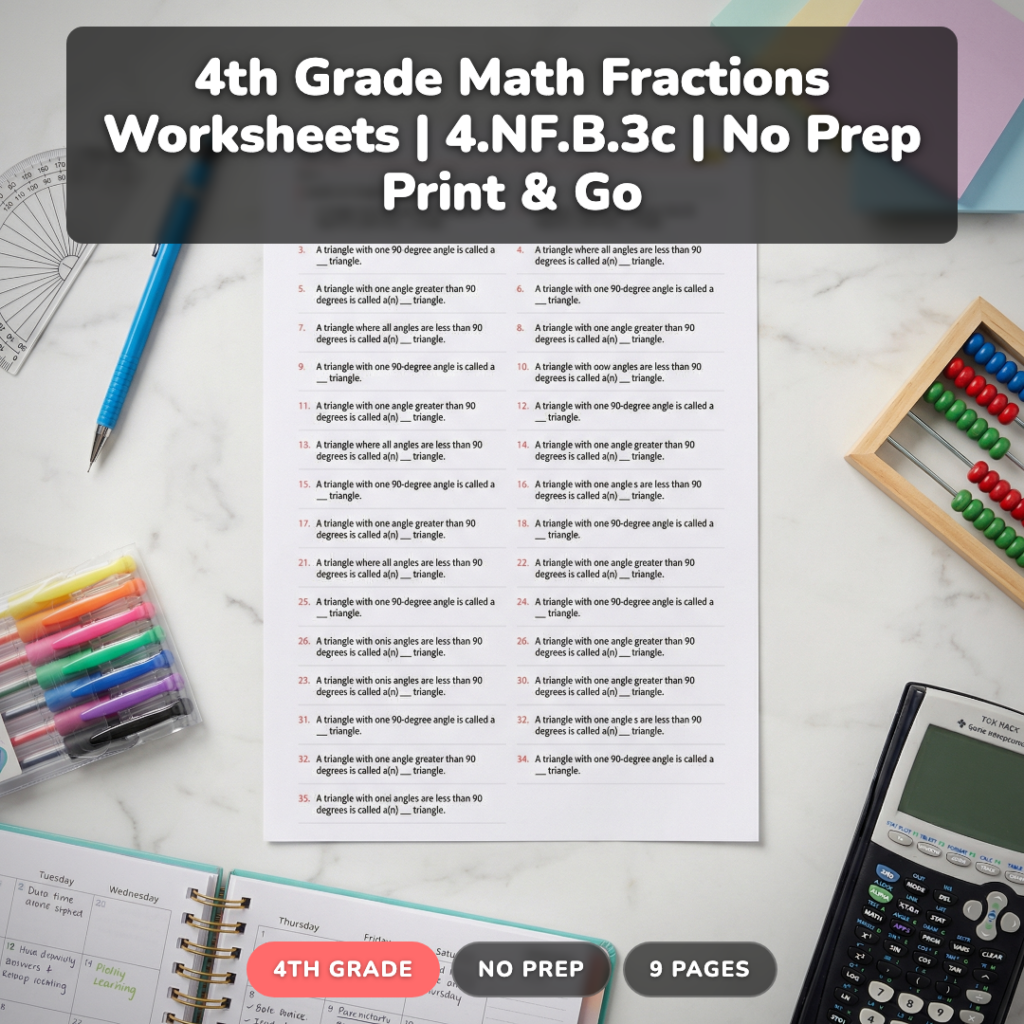
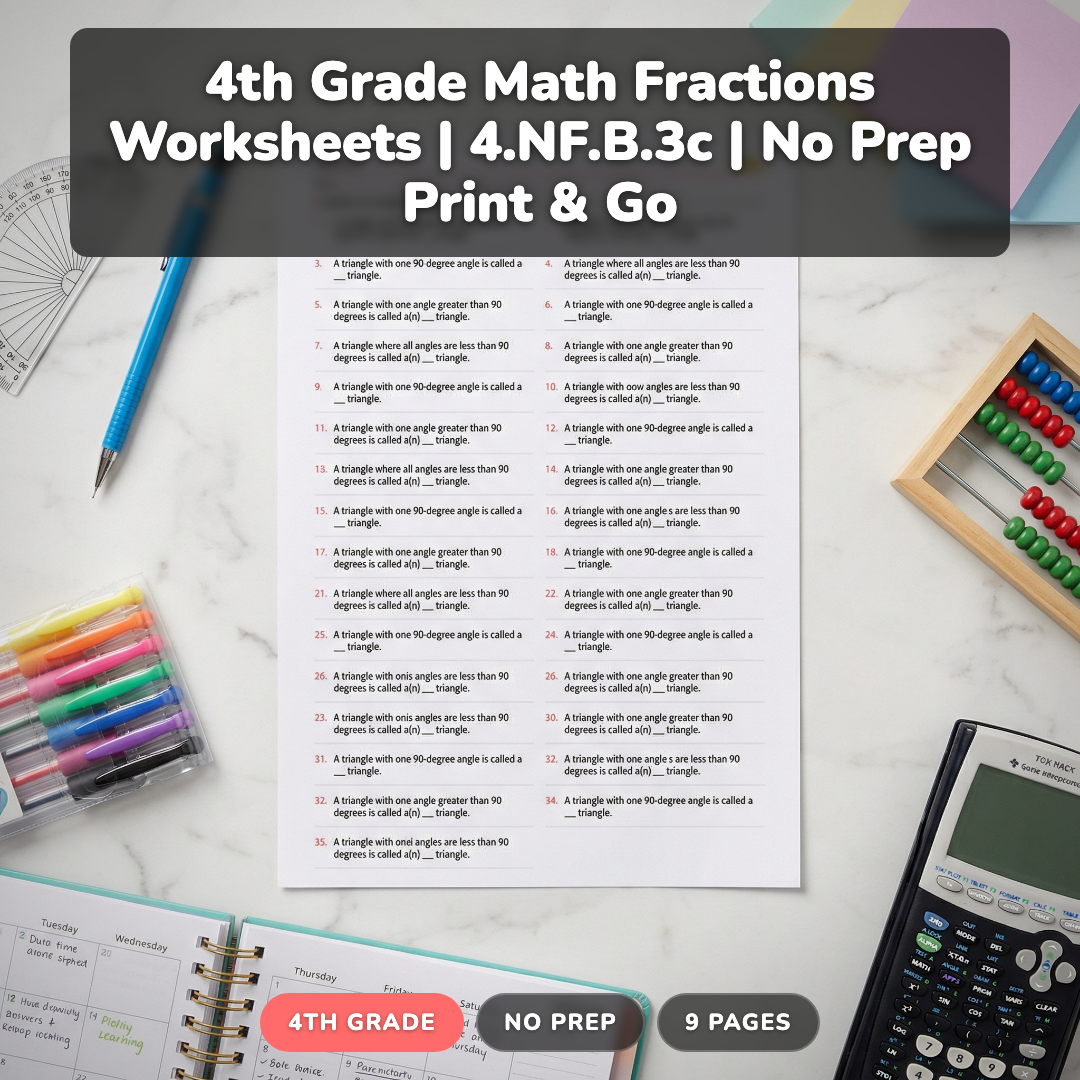
After years of creating mixed number materials from scratch, I developed a comprehensive practice pack that addresses every learning level in your classroom. This 9-page resource includes 132 carefully crafted problems across three differentiation levels: Practice (37 problems), On-Level (50 problems), and Challenge (45 problems).
What makes this resource different is the intentional progression within each level. Practice problems focus on halves and fourths with clear visual supports. On-Level problems introduce eighths and include both addition and subtraction with regrouping. Challenge problems incorporate mixed denominators and multi-step scenarios that prepare students for 5th grade fraction work.
Each page includes answer keys and teaching notes, so you can quickly identify which students need additional support or are ready for advancement. The problems align perfectly with CCSS.Math.Content.4.NF.B.3c expectations while providing the spiral review that helps students retain these crucial skills.
Whether you need emergency sub plans, homework assignments, or assessment prep, this resource saves hours of planning time while ensuring every student gets appropriately challenging practice.
Grab a Free Mixed Number Practice Sheet to Try
Want to test these strategies with your students first? I’ll send you a free mixed number practice sheet with problems at all three levels, plus answer keys and teaching tips. Perfect for seeing what works best in your classroom before diving deeper.
Frequently Asked Questions About Teaching Mixed Number Operations
Should I teach addition or subtraction of mixed numbers first?
Start with addition since it builds naturally from whole number and fraction addition concepts. Students can combine quantities without the complexity of regrouping. Once addition is solid, introduce subtraction with problems that don’t require regrouping, then progress to regrouping situations.
When should students stop using manipulatives for mixed number operations?
Students should continue using manipulatives until they can accurately solve problems and explain their reasoning without them. This typically takes 2-3 weeks of consistent practice. Some students may need manipulative support longer, especially for regrouping in subtraction problems.
How do I help students who keep adding whole numbers and fractions separately?
Use number line models extensively to show mixed numbers as single points rather than separate parts. Have students convert to improper fractions for every problem initially, then gradually introduce other methods. Emphasize estimation to help students recognize unreasonable answers.
What’s the most efficient method for students to learn first?
The convert-compute-convert method (changing to improper fractions) is most reliable for 4th graders because it works for all problems without requiring decisions about when to regroup. Once mastered, students can explore more efficient mental math strategies for simple problems.
How does CCSS.Math.Content.4.NF.B.3c connect to 5th grade standards?
This standard provides the foundation for 5th grade work with unlike denominators (4.NF.B.3c leads to 5.NF.A.1). Students who master like-denominator operations develop the conceptual understanding needed for finding common denominators and working with more complex fraction operations in 5th grade.
Teaching mixed number operations doesn’t have to feel overwhelming for you or your students. With concrete experiences, visual models, and systematic practice, your 4th graders will develop both procedural fluency and conceptual understanding. What’s your biggest challenge when teaching mixed numbers? Try the free practice sheet above and see which strategies resonate most with your students.