If your 5th graders freeze when they see a four-digit number divided by a two-digit number, you’re not alone. Long division with larger numbers feels overwhelming to many students — but with the right strategies, you can help them build confidence and fluency with multi-digit division.
Key Takeaway
Teaching 5th grade division through multiple strategies — place value understanding, visual models, and estimation — helps students choose the method that makes sense to them while building number sense.
Why Multi-Digit Division Matters in 5th Grade
Division with up to four-digit dividends and two-digit divisors represents a major milestone in elementary math. Students must coordinate multiple skills: place value understanding, multiplication facts, estimation, and logical reasoning. According to research from the National Council of Teachers of Mathematics, students who master flexible division strategies in 5th grade show stronger algebraic thinking in middle school.
This skill directly addresses CCSS.Math.Content.5.NBT.B.6, which requires students to find whole-number quotients using strategies based on place value, properties of operations, and the relationship between multiplication and division. The standard emphasizes that students should illustrate and explain their calculations using equations, rectangular arrays, and area models — not just memorize an algorithm.
Timing matters too. Most curricula introduce this standard in the second quarter, after students have solidified their understanding of multi-digit multiplication. Students need approximately 4-6 weeks of focused instruction and practice to develop fluency with these complex division problems.
Looking for a ready-to-go resource? I put together a differentiated division practice pack that covers everything below — but first, the teaching strategies that make it work.
Common Division Misconceptions in 5th Grade
Understanding where students typically struggle helps you address problems before they become ingrained habits.
Common Misconception: Students think they can ignore place value and just “bring down” digits randomly.
Why it happens: They memorized steps without understanding the underlying mathematics.
Quick fix: Always connect division to multiplication and use place value language.
Common Misconception: Students believe the remainder must be smaller than the dividend.
Why it happens: They confuse the remainder rule with the original numbers in the problem.
Quick fix: Emphasize that remainders must be smaller than the divisor, not the dividend.
Common Misconception: Students think estimation isn’t necessary if they know the algorithm.
Why it happens: They view estimation and exact calculation as separate skills.
Quick fix: Require estimation before every division problem to check reasonableness.
Common Misconception: Students assume larger dividends always produce larger quotients.
Why it happens: They overgeneralize patterns from addition and subtraction.
Quick fix: Use real-world contexts where this clearly doesn’t make sense.
5 Research-Backed Strategies for Teaching Multi-Digit Division
Strategy 1: Area Model Division for Visual Understanding
Area models help students see division as the inverse of multiplication while maintaining place value understanding. This approach aligns perfectly with CCSS.Math.Content.5.NBT.B.6 requirements for using area models to illustrate calculations.
What you need:
- Grid paper or area model templates
- Colored pencils for different place values
- Sample problems like 2,484 ÷ 23
Steps:
- Draw a rectangle and label one side with the divisor (23)
- Estimate: “What times 23 gets close to 2,484?”
- Break the quotient into friendly numbers (100 + 8 = 108)
- Create sections: 23 × 100 = 2,300 and 23 × 8 = 184
- Verify: 2,300 + 184 = 2,484 ✓
Strategy 2: Partial Quotients Method
This strategy builds on students’ multiplication knowledge and allows them to work with numbers that make sense to them rather than forcing a rigid algorithm.
What you need:
- Multiplication reference charts
- Problems written vertically
- Space for multiple subtraction steps
Steps:
- Set up the problem: 3,654 ÷ 42
- Find an easy multiple: 42 × 10 = 420, 42 × 50 = 2,100
- Subtract the largest comfortable multiple: 3,654 – 2,100 = 1,554 (record 50)
- Continue: 1,554 – 420 = 1,134 (record 10), then 1,134 – 840 = 294 (record 20)
- Finish: 294 – 252 = 42 (record 6), then 42 – 42 = 0 (record 1)
- Add partial quotients: 50 + 10 + 20 + 6 + 1 = 87
Strategy 3: Estimation and Adjustment Game
This interactive approach builds number sense while making division feel less intimidating. Students learn to make smart estimates and adjust based on their results.
What you need:
- Division problems on cards
- Estimation recording sheets
- Calculators for checking
- Timer for added engagement
Steps:
- Present a problem like 4,186 ÷ 67
- Round both numbers: 4,200 ÷ 70 = 60
- Check if 60 is reasonable: 67 × 60 = 4,020 (close!)
- Adjust up: try 62. Calculate 67 × 62 = 4,154
- Check remainder: 4,186 – 4,154 = 32 (less than 67 ✓)
- Final answer: 62 remainder 32
Strategy 4: Real-World Context Problems
Connecting division to authentic situations helps students understand when and why they need this skill, making the mathematics more meaningful and memorable.
What you need:
- Real-world scenario cards
- Manipulatives for modeling
- Chart paper for showing work
Steps:
- Present a scenario: “A school ordered 2,856 pencils. They come in boxes of 24. How many boxes did they receive?”
- Students identify the operation needed (division)
- Set up the problem: 2,856 ÷ 24
- Solve using their preferred method
- Check reasonableness: “Does 119 boxes make sense for 2,856 pencils?”
- Interpret any remainder in context
Strategy 5: Digital Array Exploration
Using technology tools helps students visualize large-number division through interactive arrays and immediate feedback on their thinking.
What you need:
- Tablets or computers
- Array-building apps or virtual manipulatives
- Recording sheets for offline work
Steps:
- Students input a division problem like 1,932 ÷ 28
- Build rectangular arrays to represent the problem
- Experiment with different arrangements
- Record their findings: 28 × 69 = 1,932
- Verify using a different strategy
- Explain their reasoning to a partner
How to Differentiate Multi-Digit Division for All Learners
For Students Who Need Extra Support
Begin with concrete manipulatives and two-digit dividends. Use base-ten blocks to model division physically before moving to abstract representations. Provide multiplication charts and encourage students to use the partial quotients method, which builds on their existing multiplication knowledge. Focus on one-step problems initially, and always connect division to familiar multiplication facts. Consider providing problems where the quotient has no remainder to build confidence before introducing remainders.
For On-Level Students
Students working at grade level should practice with three and four-digit dividends using multiple strategies. Encourage them to choose the method that makes most sense for each problem — sometimes area models work better, other times partial quotients feel more efficient. Provide mixed practice with problems that have remainders and those that divide evenly. Emphasize estimation and checking their work for reasonableness.
For Students Ready for a Challenge
Advanced students can explore efficiency by comparing different strategies for the same problem. Challenge them with larger numbers, including five-digit dividends with three-digit divisors. Introduce decimal quotients when appropriate, and connect division to real-world applications like calculating unit rates or determining equal sharing in complex scenarios. Have them create their own word problems for classmates to solve.
A Ready-to-Use Division Resource for Your Classroom
After years of teaching 5th grade division, I created a comprehensive resource that addresses every strategy mentioned above while providing the differentiated practice students need to build true fluency.
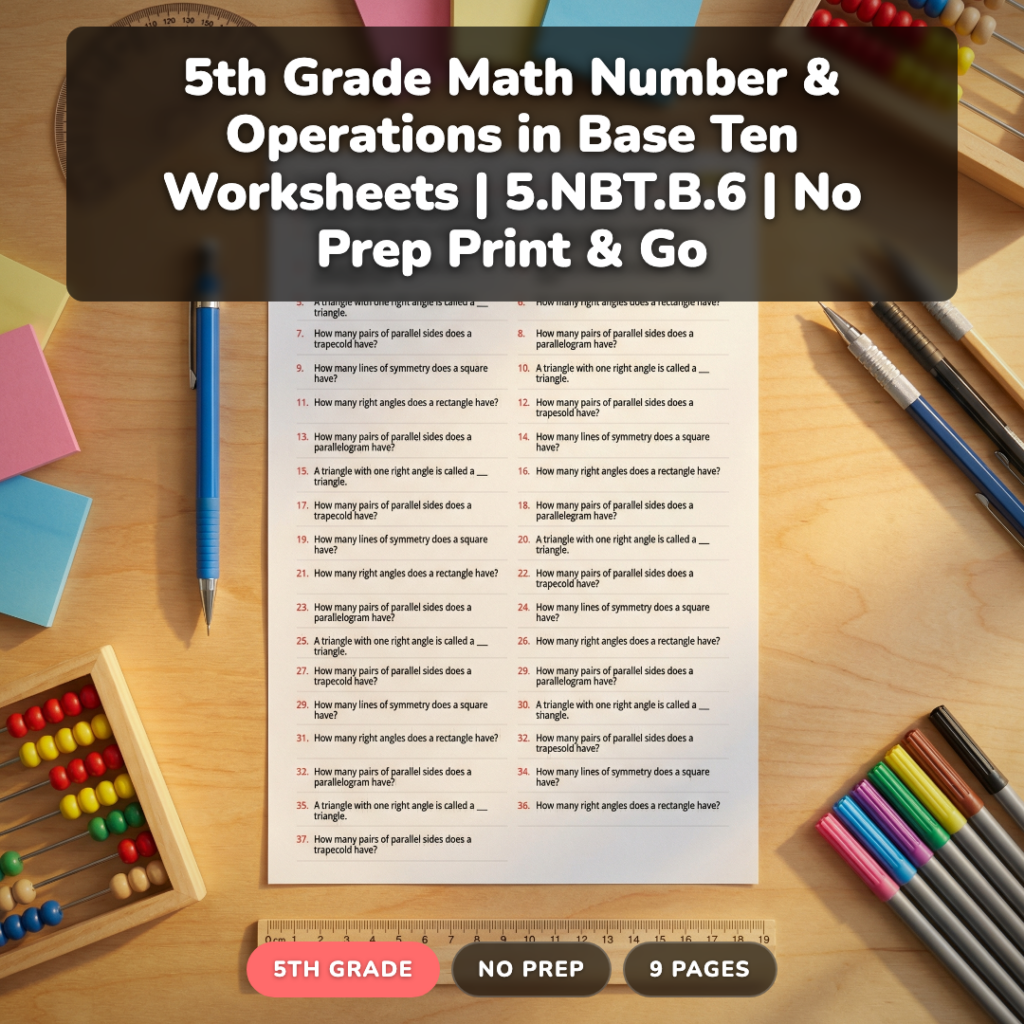
This Number & Operations in Base Ten worksheet pack includes 132 carefully crafted problems across three difficulty levels. The Practice level offers 37 problems focusing on foundational skills with smaller numbers and clear visual supports. The On-Level section provides 50 problems that directly align with grade-level expectations, including four-digit dividends and two-digit divisors. The Challenge level features 45 advanced problems that push students to apply their division skills in complex, multi-step scenarios.
What makes this resource different is the intentional progression within each level. Problems start with friendly numbers that support mental math strategies, then gradually increase in complexity. Each page includes space for students to show their work using area models, partial quotients, or traditional algorithms — whatever method makes sense to them.
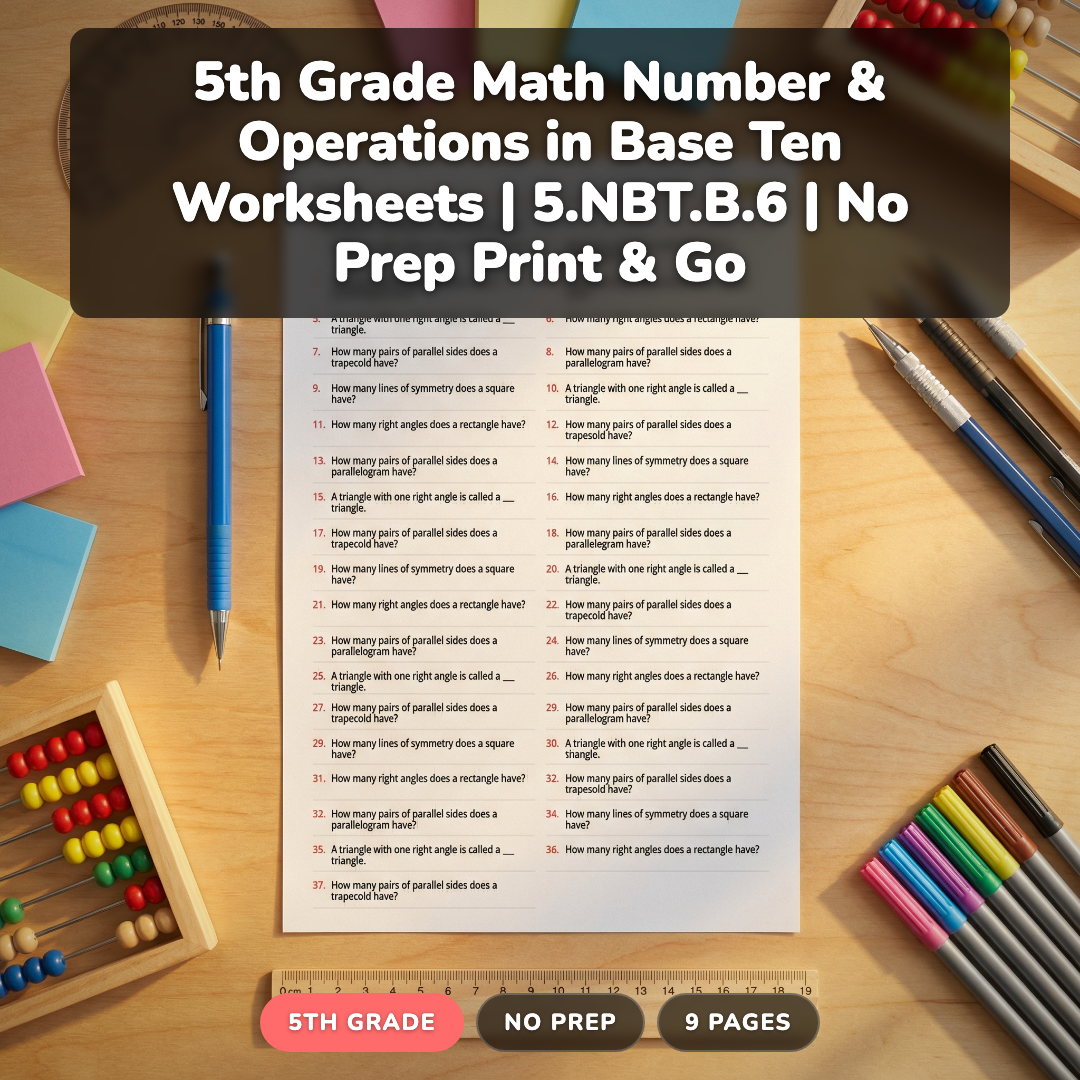
The pack covers everything needed to meet CCSS.Math.Content.5.NBT.B.6 requirements while giving you flexibility to match instruction to your students’ needs. Complete answer keys are included for easy grading and progress monitoring.
Grab a Free Division Strategy Guide to Try
Want to see how these strategies work in action? I’ve put together a free guide with step-by-step examples of the area model and partial quotients methods, plus a sample worksheet you can use tomorrow. Drop your email below and I’ll send it right over.
Frequently Asked Questions About Teaching Multi-Digit Division
When should students master four-digit by two-digit division?
Most students develop fluency with four-digit by two-digit division by mid-to-late 5th grade, typically after 4-6 weeks of focused instruction. However, conceptual understanding should come before speed, and some students may need additional time to internalize the strategies.
Should I teach the traditional long division algorithm?
Yes, but not as the only method. CCSS.Math.Content.5.NBT.B.6 emphasizes multiple strategies including place value methods and area models. Students should understand why the algorithm works, not just memorize steps. Introduce it after students have solid conceptual understanding.
How do I help students who struggle with multiplication facts during division?
Provide multiplication charts and encourage estimation strategies. Focus on partial quotients method, which allows students to use comfortable multiples like 10s and 100s rather than requiring instant recall of all facts. Build fact fluency alongside division instruction.
What’s the best way to handle remainders in word problems?
Always return to the context of the problem. Sometimes you round up (buying enough buses for all students), sometimes you round down (complete groups only), and sometimes the remainder is the answer (leftover items). Practice with various scenarios helps students think flexibly.
How can I make division practice more engaging?
Use real-world contexts, incorporate games like “estimation challenges,” and allow students to choose their preferred strategy. Digital tools and collaborative problem-solving also increase engagement while building mathematical understanding and communication skills.
Teaching multi-digit division successfully comes down to helping students see the connections between multiplication and division while building their confidence with multiple strategies. Remember to grab that free division strategy guide above — it’ll give you concrete examples to try with your students tomorrow.
What’s your go-to strategy for helping students tackle challenging division problems? I’d love to hear what works in your classroom!