If your 5th graders freeze when they see a decimal like 347.392 or struggle to connect “three hundred forty-seven and three hundred ninety-two thousandths” to its expanded form, you’re not alone. Teaching decimals to thousandths is one of those skills that seems straightforward until you’re standing in front of 25 confused faces.
You need concrete strategies that help students truly understand place value relationships, not just memorize procedures. This post breaks down exactly how to teach CCSS.Math.Content.5.NBT.A.3a with research-backed methods that stick.
Key Takeaway
Students master decimal place value when they can physically manipulate base-ten models, verbally express relationships, and connect multiple representations of the same number.
Why Decimal Place Value Matters in 5th Grade
Standard CCSS.Math.Content.5.NBT.A.3a requires students to read and write decimals to thousandths using three critical representations: base-ten numerals (347.392), number names (three hundred forty-seven and three hundred ninety-two thousandths), and expanded form (3 × 100 + 4 × 10 + 7 × 1 + 3 × 1/10 + 9 × 1/100 + 2 × 1/1000).
This standard builds directly on 4th grade decimal work with tenths and hundredths, preparing students for 6th grade operations with decimals. Research from the National Council of Teachers of Mathematics shows that students who master multiple representations of decimals in 5th grade demonstrate 40% better performance on middle school fraction and decimal operations.
The timing matters too. Most curricula introduce this standard in the first quarter, giving students the full year to apply these place value understandings to addition, subtraction, and comparison problems later.
Looking for a ready-to-go resource? I put together a differentiated decimal place value pack that covers everything below — but first, the teaching strategies that make it work.
Common Decimal Misconceptions in 5th Grade
Common Misconception: Students read 0.392 as “three hundred ninety-two” instead of “three hundred ninety-two thousandths.”
Why it happens: They apply whole number reading patterns without considering place value positions after the decimal point.
Quick fix: Always include the place value name when reading decimals aloud during instruction.
Common Misconception: Students think 0.5 is smaller than 0.05 because “5 is smaller than 50.”
Why it happens: They compare the digits without understanding that 0.5 means 5 tenths while 0.05 means 5 hundredths.
Quick fix: Use base-ten blocks to show that 5 tenths covers much more area than 5 hundredths.
Common Misconception: Students write the expanded form as 347.392 = 300 + 40 + 7 + 300 + 90 + 2.
Why it happens: They don’t recognize that decimal places represent fractional parts, not additional whole numbers.
Quick fix: Explicitly teach that each place after the decimal represents division by 10, 100, or 1000.
Common Misconception: Students add unnecessary zeros, writing “three hundred ninety-two thousandths” as 0.3920 instead of 0.392.
Why it happens: They confuse place value positions with the total number of digits.
Quick fix: Use place value charts consistently, showing that 0.392 fills exactly three decimal places.
5 Research-Backed Strategies for Teaching Decimal Place Value
Strategy 1: Base-Ten Block Decimal Modeling
Students use physical manipulatives to build decimal numbers, creating concrete understanding before moving to abstract representations. This strategy addresses the CRA (Concrete-Representational-Abstract) progression research shows is essential for place value mastery.
What you need:
- Base-ten blocks (flats = ones, longs = tenths, units = hundredths)
- Thousandths grids (printed on paper)
- Place value mats with decimal sections
Steps:
- Establish that a flat represents one whole unit
- Show students that a long is 1/10 of a flat (one tenth)
- Demonstrate that a unit cube is 1/100 of a flat (one hundredth)
- Introduce thousandths grids where one small square represents 1/1000
- Have students build numbers like 2.347 using blocks and grids
- Ask students to write both the decimal and expanded form of their model
Strategy 2: Place Value Chart Progression
Students use structured charts to organize their thinking about decimal place values, making the pattern of “divide by 10” explicit as they move right from the decimal point.
What you need:
- Large place value charts (hundreds to thousandths)
- Individual student charts (laminated for dry erase)
- Digit cards or magnetic numbers
Steps:
- Start with a number like 347 in the whole number places
- Add the decimal point and explain it separates wholes from parts
- Place 3 in the tenths column, emphasizing “3 tenths” not just “3”
- Add 9 in the hundredths place, saying “9 hundredths”
- Place 2 in the thousandths column, saying “2 thousandths”
- Read the complete number: “347 and 392 thousandths”
- Write the expanded form using the chart as a guide
Strategy 3: Number Name Translation Practice
Students practice converting between written number names and decimal notation, strengthening the connection between verbal and symbolic representations that research shows improves number sense.
What you need:
- Number name cards (“forty-three and twenty-seven hundredths”)
- Decimal notation cards (43.27)
- Recording sheets for student work
Steps:
- Start with simple examples like “five and three tenths” = 5.3
- Emphasize that “and” always marks the decimal point location
- Practice with hundredths: “twelve and forty-five hundredths” = 12.45
- Move to thousandths: “six and two hundred eight thousandths” = 6.208
- Have students work in pairs, one reads the name, other writes the decimal
- Switch roles and check answers using place value charts
Strategy 4: Expanded Form Building Blocks
Students decompose decimal numbers into their place value components, explicitly showing how each digit contributes to the total value through multiplication and addition.
What you need:
- Expanded form templates
- Calculator for verification
- Fraction cards (1/10, 1/100, 1/1000)
Steps:
- Write a decimal like 285.746 on the board
- Identify each digit’s place value position
- Show that 2 is in hundreds place: 2 × 100 = 200
- Continue with 8 × 10 = 80, then 5 × 1 = 5
- For decimals: 7 × (1/10) = 7/10, 4 × (1/100) = 4/100, 6 × (1/1000) = 6/1000
- Write complete expanded form: 200 + 80 + 5 + 7/10 + 4/100 + 6/1000
- Verify by adding components on calculator
Strategy 5: Decimal Number Line Positioning
Students locate decimals on number lines to develop spatial understanding of decimal magnitude and relationships between different decimal values.
What you need:
- Large number lines (0-10 with tenth markings)
- Smaller number lines for detailed work
- Sticky notes or moveable markers
Steps:
- Start with a number line from 0 to 1, marked in tenths
- Place simple decimals like 0.3, 0.7, 0.9
- Zoom in between 0.3 and 0.4, marking hundredths
- Place numbers like 0.35, 0.38, 0.32
- Zoom in further between 0.35 and 0.36 for thousandths
- Have students estimate positions before measuring precisely
- Connect positions back to written forms and expanded notation
How to Differentiate Decimal Place Value for All Learners
For Students Who Need Extra Support
Begin with concrete manipulatives and limit work to tenths and hundredths initially. Use place value charts with clear visual separators and provide number name templates with blanks to fill in. Focus on one representation at a time before connecting multiple forms. Review fraction concepts like 1/10 and 1/100 before introducing decimal notation. Provide calculators to verify expanded form additions and reduce cognitive load on computation while building conceptual understanding.
For On-Level Students
Work with decimals to thousandths as specified in CCSS.Math.Content.5.NBT.A.3a. Practice all three representations (base-ten numerals, number names, expanded form) with numbers ranging from simple cases like 4.025 to more complex examples like 847.392. Use a mix of concrete models and abstract work. Emphasize precision in mathematical language, requiring students to say “thousandths” rather than just the digits. Include real-world contexts like money, measurement, and sports statistics.
For Students Ready for a Challenge
Extend to ten-thousandths and hundred-thousandths place values. Explore very large decimals (thousands with decimal parts) and very small decimals (less than 0.001). Investigate patterns in place value (each place is 10 times larger than the place to its right). Connect to scientific notation as a preview of middle school concepts. Create their own decimal numbers and challenge classmates to write them in different forms. Explore decimals in different contexts like precision measurements and financial calculations.
A Ready-to-Use Decimal Place Value Resource for Your Classroom
Teaching decimal place value effectively requires tons of practice problems at just the right level for each student. You need scaffolded worksheets that build understanding step-by-step, not just random drill sheets.
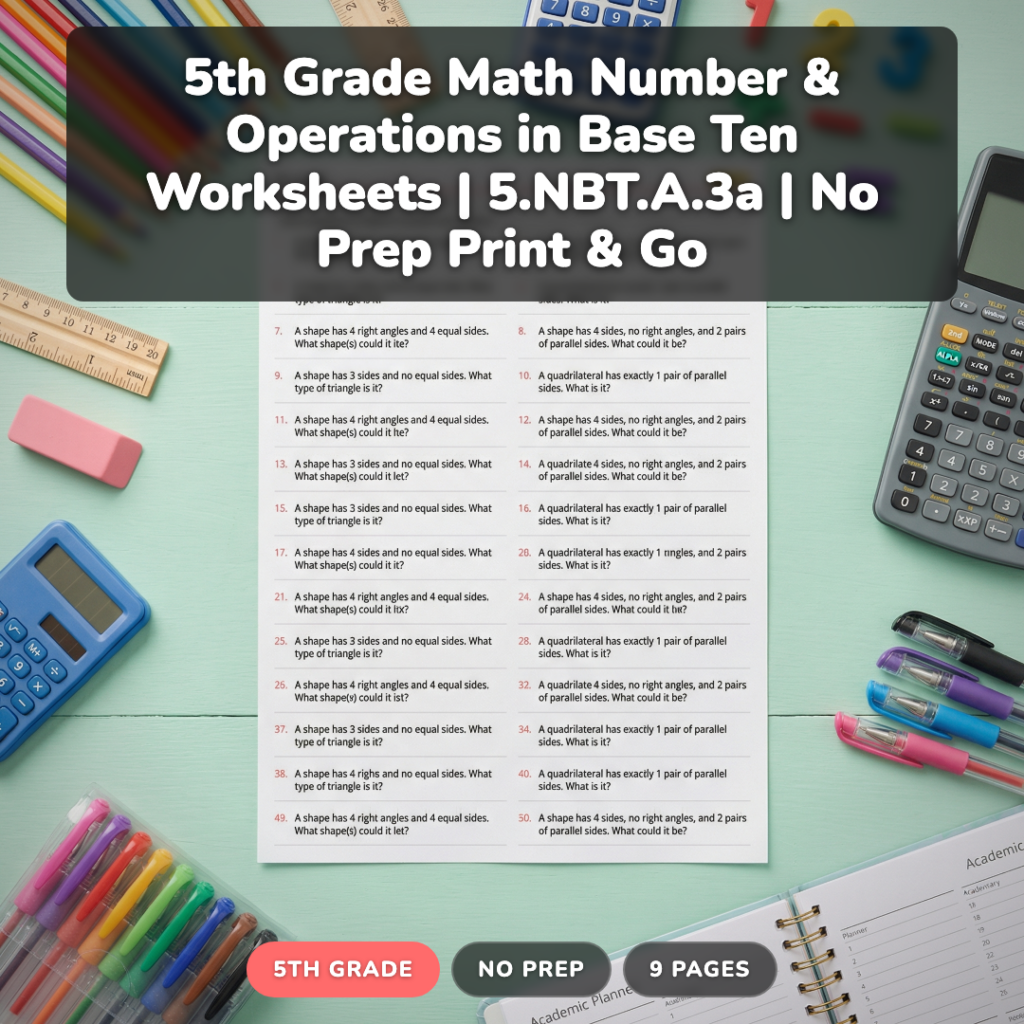
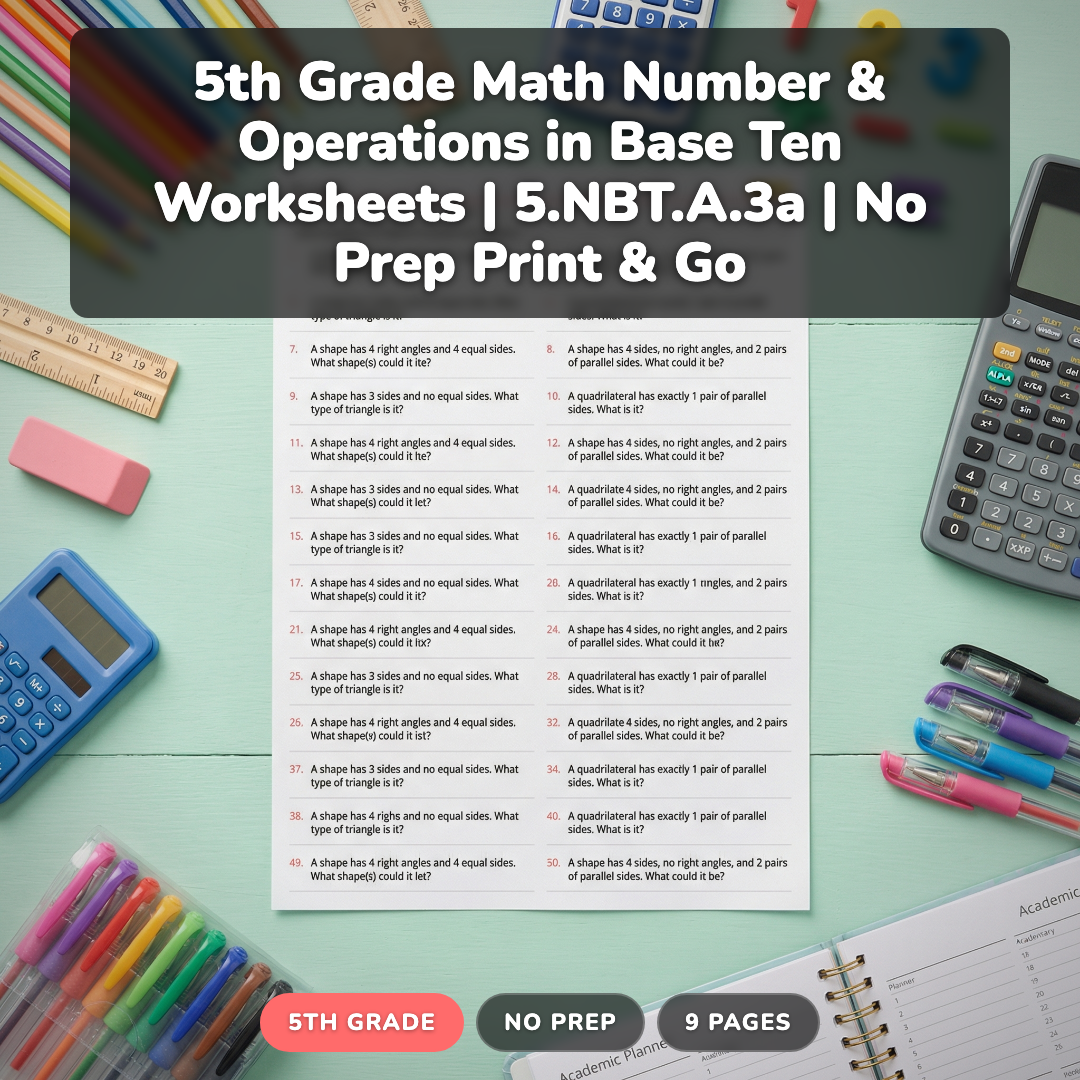
This differentiated decimal place value pack gives you exactly that — 132 carefully crafted problems across three difficulty levels. The Practice level (37 problems) focuses on building foundational understanding with simpler decimals and guided support. On Level worksheets (50 problems) target grade-level expectations with CCSS.Math.Content.5.NBT.A.3a standard problems. Challenge pages (45 problems) extend learning with complex decimals and real-world applications.
Each level includes problems for reading, writing, and expanding decimals to thousandths, plus answer keys for quick grading. The 9 pages are completely no-prep — just print and go. What makes this different from generic worksheets is the careful scaffolding within each level and the clear progression between difficulty levels.
Perfect for math centers, homework, assessment prep, or substitute plans. Students can work at their level while you focus on small group instruction.
Grab a Free Decimal Place Value Sample to Try
Want to see the quality and format before you buy? I’ll send you a free sample page from each difficulty level, plus my decimal place value teaching checklist. Perfect for trying the format with your students first.
Frequently Asked Questions About Teaching Decimal Place Value
What’s the most common mistake students make with decimal place value?
Students often read decimal numbers like whole numbers, saying “three hundred ninety-two” instead of “three hundred ninety-two thousandths” for 0.392. This happens because they don’t understand that place value names change after the decimal point. Consistent use of place value charts and verbal practice prevents this misconception.
Should I teach expanded form with fractions or decimals first?
Start with fractions (3 × 1/10 + 9 × 1/100 + 2 × 1/1000) because it shows the true meaning of each place value position. Once students understand that decimal places represent parts of one, you can introduce the decimal equivalent (0.3 + 0.09 + 0.002). The fraction form connects better to place value understanding.
How long should I spend on decimal place value before moving to operations?
Plan 2-3 weeks of focused instruction on CCSS.Math.Content.5.NBT.A.3a before introducing decimal operations. Students need solid place value understanding to succeed with decimal addition, subtraction, and comparison. Rush this foundation and they’ll struggle with operations all year. Use formative assessments to ensure 80% mastery before moving on.
What manipulatives work best for teaching thousandths?
Base-ten blocks work well for tenths and hundredths, but thousandths require printed grids since physical blocks become too small. Use 10×10 grids where each small square represents one thousandth. Alternatively, use place value disks or virtual manipulatives that can show thousandths clearly. The key is maintaining the 10:1 relationship between adjacent places.
How do I help students who confuse decimal and fraction notation?
Explicitly teach that 0.3 and 3/10 represent the same amount but use different notation systems. Use visual models like number lines and area models to show equivalence. Practice converting between forms regularly: “Write 0.247 as a fraction” and “Write 156/1000 as a decimal.” This builds flexibility in thinking about decimal values.
Mastering decimal place value sets your 5th graders up for success with all future decimal work. When students can confidently move between number names, standard form, and expanded form, they have the foundation they need for middle school mathematics.
What’s your go-to strategy for helping students understand decimal place value? I’d love to hear what works in your classroom. And don’t forget to grab that free sample above — it’s a great way to try these strategies risk-free.