If your 4th graders freeze when they see “find all factor pairs for 24” or confuse factors with multiples, you’re not alone. Teaching CCSS.Math.Content.4.OA.B.4 requires students to understand some of the most abstract concepts they’ve encountered in elementary math — and it’s the foundation for everything from fractions to algebra.
You’ll walk away with five research-backed strategies that make factors, multiples, and prime versus composite numbers click for your students, plus differentiation tips for every learner in your classroom.
Key Takeaway
Students master factors and multiples when they see the visual patterns first, then connect to abstract number relationships through hands-on exploration.
Why Factors and Multiples Matter in 4th Grade
Fourth grade marks the critical transition from concrete arithmetic to algebraic thinking. Standard CCSS.Math.Content.4.OA.B.4 asks students to find factor pairs, recognize multiples, and classify numbers as prime or composite — skills that directly support fraction operations, least common multiples, and greatest common factors in 5th grade.
Research from the National Council of Teachers of Mathematics shows that students who master multiplicative reasoning in 4th grade are 60% more likely to succeed in middle school algebra. The factor-multiple relationship is the bridge between “repeated addition” thinking and true multiplicative understanding.
This standard typically appears in October-November, after students have solidified multiplication facts but before diving into multi-digit multiplication algorithms. Students need automatic recall of multiplication facts through 12×12 and a solid understanding that multiplication and division are inverse operations.
Looking for a ready-to-go resource? I put together a differentiated factors and multiples pack with 132 problems across three levels — but first, the teaching strategies that make it work.
Common Factor and Multiple Misconceptions in 4th Grade
Common Misconception: Students think 1 and the number itself don’t count as factors.
Why it happens: They focus on “breaking down” numbers and miss that every number divides by 1 and itself.
Quick fix: Start every factor hunt with “What’s 12 ÷ 1? What’s 12 ÷ 12?”
Common Misconception: Students confuse factors and multiples completely.
Why it happens: Both involve multiplication, but the relationship is inverse.
Quick fix: Use the phrase “Factors are small and go into the number. Multiples are big and the number goes into them.”
Common Misconception: Students think prime numbers are “bad” or “broken.”
Why it happens: They see only having two factors as incomplete.
Quick fix: Call them “VIP numbers” — so special they only let 1 and themselves be factors.
Common Misconception: Students forget that 1 is neither prime nor composite.
Why it happens: It only has one factor, which doesn’t fit either definition clearly.
Quick fix: Teach 1 as the “unique number” — it’s in its own special category.
5 Research-Backed Strategies for Teaching Factors and Multiples
Strategy 1: Rectangle Arrays for Factor Visualization
Students build every possible rectangle for a given number using square tiles or graph paper. This concrete approach helps them see that factors come in pairs and understand why some numbers have more factor pairs than others.
What you need:
- Square tiles or centimeter graph paper
- Factor recording sheets
- Numbers 1-30 written on cards
Steps:
- Give students 24 tiles and ask them to make rectangles
- Record each rectangle as length × width (factor pairs)
- Notice patterns: 1×24, 2×12, 3×8, 4×6
- Connect to division: “If I can make a 3×8 rectangle, then 24÷3=8”
- Introduce vocabulary: “3 and 8 are factors of 24”
Strategy 2: The Factor Rainbow Method
Students create colorful “factor rainbows” that visually organize factor pairs and help them avoid missing any pairs. This method particularly helps students see the systematic nature of finding factors.
What you need:
- Colored pencils or markers
- Factor rainbow templates
- Hundreds chart for reference
Steps:
- Write the target number in the center
- Start with 1 and the number itself on opposite ends
- Test 2: Does it divide evenly? If yes, add 2 and its pair
- Continue with 3, 4, 5… until factors start repeating
- Connect each factor pair with a colored arc (rainbow)
- Count total factors and identify if prime or composite
Strategy 3: Multiple Patterns on Hundreds Charts
Students color multiples of different numbers on hundreds charts to discover visual patterns. This kinesthetic approach helps them understand that multiples continue infinitely and follow predictable patterns.
What you need:
- Hundreds charts (one per student)
- Different colored highlighters
- Transparent overlay sheets
Steps:
- Start with multiples of 2: color 2, 4, 6, 8, 10…
- Notice the pattern (every other number)
- Try multiples of 5 in a different color
- Observe where colors overlap (common multiples)
- Extend beyond 100: “What’s the next multiple of 7 after 98?”
- Connect to factors: “Since 15 is colored for multiples of 3, that means 3 is a factor of 15”
Strategy 4: Prime and Composite Detective Game
Students become “number detectives” who investigate whether numbers are prime or composite by systematically checking for factors. This game format makes the sometimes tedious process of factor-checking engaging and systematic.
What you need:
- Detective badges or magnifying glasses
- “Case files” with numbers to investigate
- Factor investigation recording sheets
Steps:
- Present a “suspect number” (like 17)
- Students test if 2, 3, 4, 5… are factors
- Use division to check: “Does 17÷2 give a whole number?”
- If only 1 and 17 work, declare it “prime”
- If other factors exist, it’s “composite”
- Create a “most wanted” poster for prime numbers
Strategy 5: Real-World Factor Applications
Students solve authentic problems that require finding factors, such as arranging desks in rectangular formations or dividing items into equal groups. This strategy connects abstract number theory to practical situations.
What you need:
- Real-world problem scenarios
- Manipulatives for modeling
- Chart paper for recording solutions
Steps:
- Present scenario: “We have 36 students. What rectangular seating arrangements are possible?”
- Students find all factor pairs of 36
- Model each arrangement: 1×36, 2×18, 3×12, 4×9, 6×6
- Discuss pros and cons of each arrangement
- Extend: “If 4 students are absent, how does this change our options?”
How to Differentiate Factors and Multiples for All Learners
For Students Who Need Extra Support
Begin with numbers under 20 and provide multiplication charts for reference. Use physical manipulatives for every problem — tiles, counters, or graph paper squares. Focus on the concept that “if you can make equal groups, those group sizes are factors.” Provide sentence frames like “___ is a factor of ___ because ___ × ___ = ___.” Review multiplication facts daily and allow calculator use when the focus is conceptual understanding rather than computation fluency.
For On-Level Students
Work with numbers 1-50 for factor practice and extend multiples beyond 100. Students should find all factor pairs systematically and explain their thinking using mathematical vocabulary. They can begin exploring patterns like “even numbers always have 2 as a factor” and “numbers ending in 5 have 5 as a factor.” Expect fluent use of terms like prime, composite, factor, multiple, and factor pair in both written and verbal explanations.
For Students Ready for a Challenge
Extend to three-digit numbers and introduce concepts like greatest common factor and least common multiple. Challenge students to find numbers with exactly 4 factors, exactly 6 factors, or other specific quantities. Explore mathematical questions like “Why do perfect squares have an odd number of factors?” Connect to real-world applications involving area, perimeter, and optimization problems. Introduce the Sieve of Eratosthenes for finding prime numbers systematically.
A Ready-to-Use Factors and Multiples Resource for Your Classroom
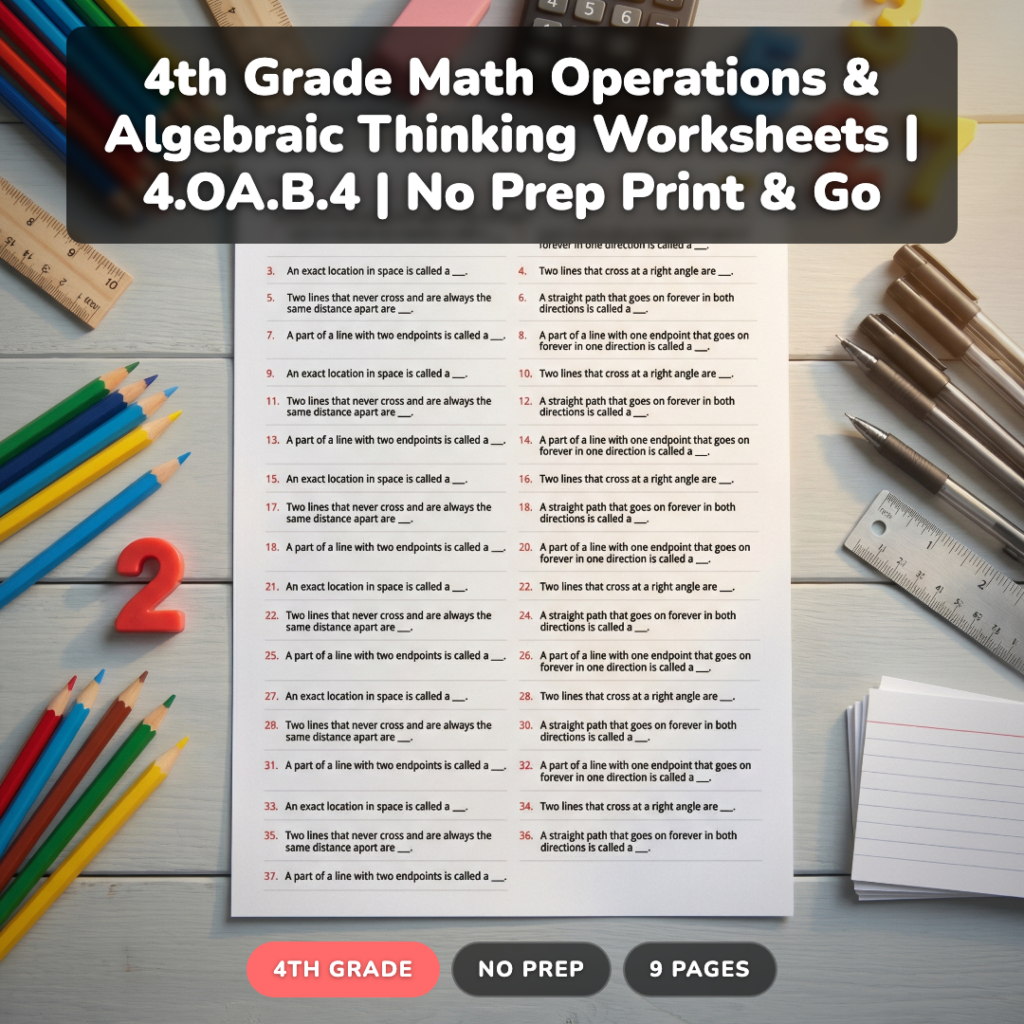
After years of creating factor and multiple activities from scratch, I developed a comprehensive worksheet pack that saves hours of prep time while ensuring every student gets the right level of challenge. This 9-page resource includes 132 carefully scaffolded problems across three difficulty levels.
The Practice level (37 problems) focuses on numbers 1-30 with visual supports and guided examples. The On-Level section (50 problems) covers the full standard with numbers 1-100, including prime/composite classification. The Challenge level (45 problems) extends beyond the standard with three-digit numbers and pattern exploration.
What makes this different from other factor worksheets is the systematic progression — students build from concrete rectangle models to abstract number theory, with clear answer keys that show multiple solution methods.
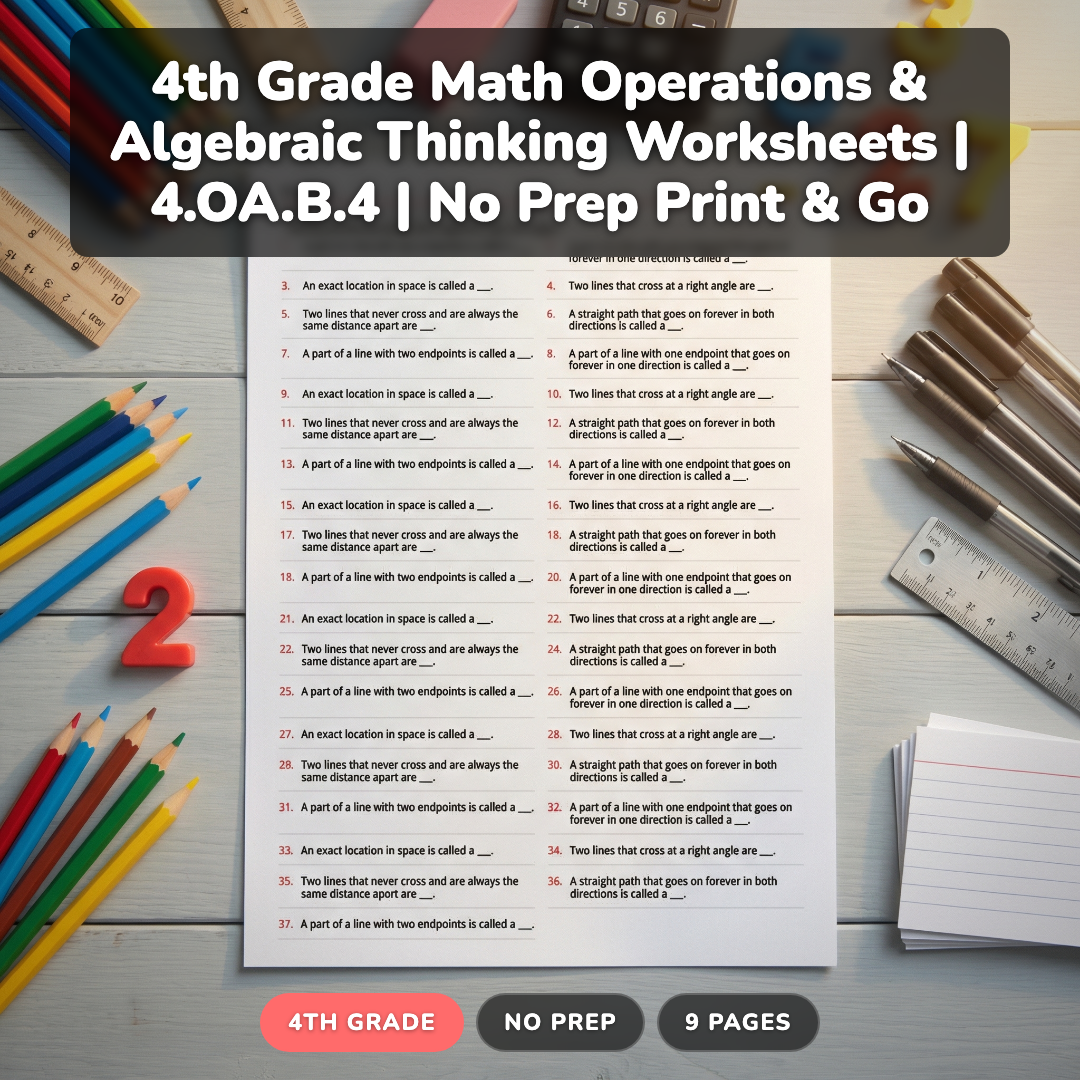
Each level includes step-by-step examples, multiple problem types, and real-world applications. The answer keys show visual models alongside numerical solutions, making it easy to support students who need extra help.
Grab a Free Factor Rainbow Template to Try
Want to test the factor rainbow strategy with your students? I’ll send you a free template that includes guided practice problems and a hundreds chart for multiples exploration.
Frequently Asked Questions About Teaching Factors and Multiples
When should I introduce prime and composite numbers?
Introduce prime and composite after students can reliably find all factors of numbers 1-30. Start with obvious examples: 2 (prime), 4 (composite), then progress to less obvious numbers like 17 and 21. Use the factor rainbow method to make the distinction visual.
How do I help students remember the difference between factors and multiples?
Use size relationships: “Factors are small friends that fit inside the number. Multiples are big numbers that the original number fits inside.” Practice with concrete examples: 3 is a factor of 12, but 12 is a multiple of 3.
What’s the best way to teach that 1 is neither prime nor composite?
Explain that prime numbers have exactly two factors, and composite numbers have more than two factors. Since 1 only has one factor (itself), it doesn’t fit either category. Call it “the unique number” to help students remember its special status.
Should students memorize prime numbers or learn to identify them?
Focus on the process of identification rather than memorization. Students should understand how to test if a number is prime by checking for factors systematically. Memorizing primes under 20 can be helpful, but understanding the concept is more important.
How does CCSS.Math.Content.4.OA.B.4 connect to other 4th grade standards?
This standard directly supports fraction work in 4.NF by building understanding of common factors and multiples. It also connects to 4.OA.C.5 (number patterns) and prepares students for 5th grade work with equivalent fractions and common denominators.
Making Factors and Multiples Stick
The key to helping students master CCSS.Math.Content.4.OA.B.4 is moving from concrete to abstract gradually. Start with hands-on rectangle building, progress to visual factor rainbows, and finally connect to real-world applications. When students can see the patterns and relationships, the abstract concepts become manageable.
What’s your go-to strategy for helping students understand the factor-multiple relationship? And don’t forget to grab that free factor rainbow template above — your students will love the visual approach to organizing their thinking.