If your fourth graders freeze when they see fraction word problems, you’re not alone. These problems combine reading comprehension, fraction concepts, and problem-solving strategies — a triple challenge that trips up even strong math students. The good news? With the right teaching approach, you can help your students tackle these problems with confidence.
Key Takeaway
Fourth graders succeed with fraction word problems when they learn to visualize the problem, identify key information, and choose appropriate models before calculating.
Why Fraction Word Problems Matter in 4th Grade
Fraction word problems mark a crucial shift in fourth grade mathematics. Students move beyond basic fraction identification to applying fractional reasoning in real-world contexts. According to the National Assessment of Educational Progress, only 24% of fourth graders perform proficiently on fraction problems involving problem-solving.
The CCSS.Math.Content.4.NF.B.3d standard requires students to solve word problems involving addition and subtraction of fractions with like denominators using visual models and equations. This standard bridges concrete fraction understanding with abstract problem-solving skills that prepare students for fifth grade’s more complex fraction operations.
Research from the National Council of Teachers of Mathematics shows that students who master visual fraction models in fourth grade demonstrate 40% better performance on algebraic reasoning tasks in middle school. The key timing for this instruction falls in late fall through early spring, after students have solid understanding of equivalent fractions and basic addition/subtraction with like denominators.
Looking for a ready-to-go resource? I put together a differentiated fraction word problem pack with 132 problems across three levels — but first, the teaching strategies that make it work.
Common Fraction Word Problem Misconceptions in 4th Grade
Common Misconception: Students add or subtract the numerators and denominators separately (3/4 + 1/4 = 4/8).
Why it happens: They apply whole number addition rules to fractions without understanding fractional parts.
Quick fix: Use pie models to show that 3 pieces plus 1 piece equals 4 pieces of the same size.
Common Misconception: Students ignore the context and perform the wrong operation (subtracting when they should add).
Why it happens: They focus on numbers rather than the story’s meaning.
Quick fix: Teach them to act out problems with manipulatives before calculating.
Common Misconception: Students convert unlike denominators unnecessarily in like-denominator problems.
Why it happens: They overgeneralize fraction rules from previous lessons.
Quick fix: Highlight the phrase “same whole” and check denominators before starting.
Common Misconception: Students provide answers that don’t make sense in context (eating 7/4 of a pizza).
Why it happens: They disconnect the math from the real-world situation.
Quick fix: Always ask “Does this answer make sense?” and relate back to the story.
5 Research-Backed Strategies for Teaching Fraction Word Problems
Strategy 1: The CUBES Method for Fraction Problems
CUBES (Circle numbers, Underline question, Box key words, Eliminate extra info, Solve and check) gives students a systematic approach to break down complex fraction word problems into manageable steps.
What you need:
- CUBES anchor chart
- Colored pencils or highlighters
- Sample word problems on chart paper
- Student copies of problems
Steps:
- Model CUBES with a sample problem: “Maya ate 2/8 of a pizza for lunch and 3/8 for dinner. How much pizza did she eat in total?”
- Circle the numbers (2/8, 3/8) and underline the question
- Box key words that indicate operations (“in total” suggests addition)
- Eliminate any extra information not needed for solving
- Solve using visual models first, then write the equation
- Check: Does 5/8 of a pizza make sense for two meals?
Strategy 2: Fraction Strip Acting Out
Physical manipulation helps students visualize fraction problems before abstracting to numbers. This concrete-representational-abstract approach builds deep understanding of fraction operations in context.
What you need:
- Fraction strips or bars (paper or magnetic)
- Word problem cards
- Document camera or chart paper
- Student recording sheets
Steps:
- Read the problem aloud: “Tom walked 3/10 of a mile to school and 4/10 of a mile to the library. How far did he walk altogether?”
- Students select fraction strips showing tenths
- Act out the first part: place 3 strips representing 3/10
- Act out the second part: add 4 more strips for 4/10
- Count total strips: 7 strips out of 10 equal parts = 7/10
- Write the equation: 3/10 + 4/10 = 7/10
- Connect to real life: “Tom walked 7/10 of a mile total.”
Strategy 3: The Draw-Label-Solve Protocol
This three-step visual approach helps students organize their thinking and catch errors before they happen. Students create pictures that match the problem’s context, making abstract fractions concrete.
What you need:
- Large paper or whiteboards
- Colored pencils
- Timer for each step
- Sample problems with visual solutions
Steps:
- Draw: Students sketch the situation (pizza slices, measuring cups, etc.)
- Label: Add fractions to each part of the drawing
- Solve: Write the equation and calculate, checking against the picture
- Share drawings with partners to compare approaches
- Discuss which visual models work best for different problem types
Strategy 4: Fraction Problem Sort and Solve
Students categorize problems by operation type before solving, building pattern recognition skills that transfer to new problems. This strategy develops mathematical reasoning alongside computational fluency.
What you need:
- Problem cards sorted by operation type
- Sorting mats labeled “Addition” and “Subtraction”
- Key word reference charts
- Answer recording sheets
Steps:
- Present mixed addition and subtraction problems without telling students which is which
- Students read each problem and identify key words (“altogether,” “how much more,” “left over”)
- Sort problems onto appropriate mats based on the operation needed
- Solve problems in each category, comparing solution strategies
- Reflect: What patterns help you identify addition vs. subtraction problems?
Strategy 5: Real-World Fraction Problem Creation
Students become problem writers, deepening their understanding of fraction contexts while practicing the standard. When students create problems, they must understand the mathematical structure and real-world applications.
What you need:
- Problem template sheets
- Real-world context cards (cooking, sports, time, etc.)
- Fraction manipulatives for testing problems
- Peer evaluation rubrics
Steps:
- Students choose a context card (cooking, gardening, sports)
- Create a realistic scenario using fractions with like denominators
- Write the problem including a clear question
- Solve their own problem using visual models
- Trade with partners to solve each other’s problems
- Revise problems based on peer feedback
How to Differentiate Fraction Word Problems for All Learners
For Students Who Need Extra Support
Start with problems using familiar contexts (pizza, candy bars) and smaller denominators (halves, fourths, eighths). Provide visual models for every problem and allow students to use manipulatives throughout. Focus on one-step problems where the operation is clearly indicated by context. Review prerequisite skills like identifying fractions and basic addition/subtraction with like denominators. Use sentence frames: “I need to _____ because the problem says _____.”
For On-Level Students
Present problems aligned with CCSS.Math.Content.4.NF.B.3d using denominators through 12. Include a mix of addition and subtraction problems with clear contexts. Encourage students to use visual models initially, then transition to abstract equations. Incorporate problems where students must identify unnecessary information. Expect students to explain their reasoning and check answers for reasonableness.
For Students Ready for a Challenge
Introduce problems with mixed numbers, improper fractions, or multiple steps. Include comparison problems (“How much more?”) that require careful analysis. Present problems where the operation isn’t immediately obvious from key words. Connect to measurement contexts using real data. Challenge students to create their own problems for classmates to solve, ensuring mathematical accuracy and realistic contexts.
A Ready-to-Use Fraction Word Problem Resource for Your Classroom
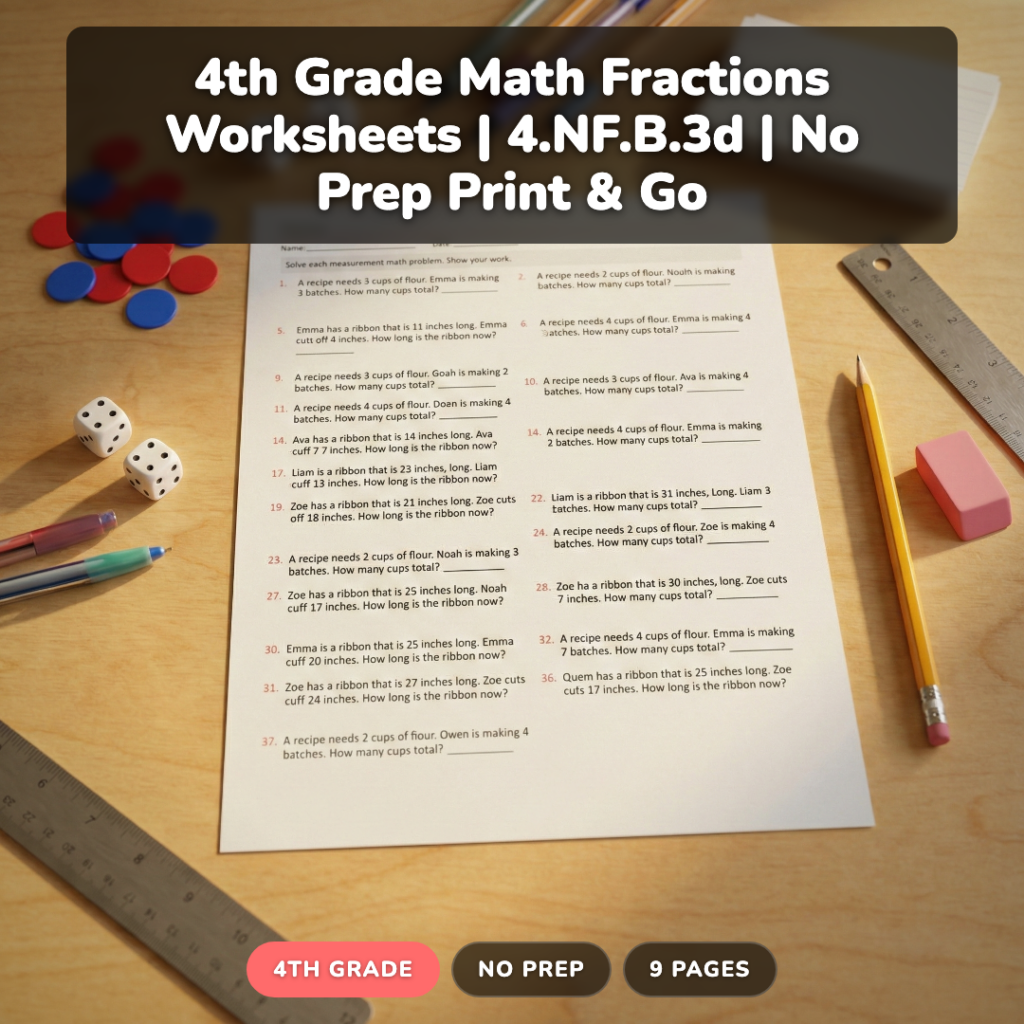
After years of creating fraction problems from scratch, I developed a comprehensive resource that saves hours of prep time while providing the differentiation your students need. This fraction word problem pack includes 132 carefully crafted problems across three distinct levels.
The Practice level features 37 problems with clear contexts and visual supports, perfect for students building confidence with fraction operations. The On-Level section provides 50 problems that directly align with grade-level expectations, incorporating varied contexts and problem types. The Challenge level offers 45 problems that push thinking with multi-step scenarios and complex reasoning requirements.
What makes this resource different is the intentional progression within each level and the consistent problem structure that builds student independence. Every problem includes space for visual models, equations, and reasoning explanations. Answer keys provide multiple solution approaches, helping you support diverse student thinking.
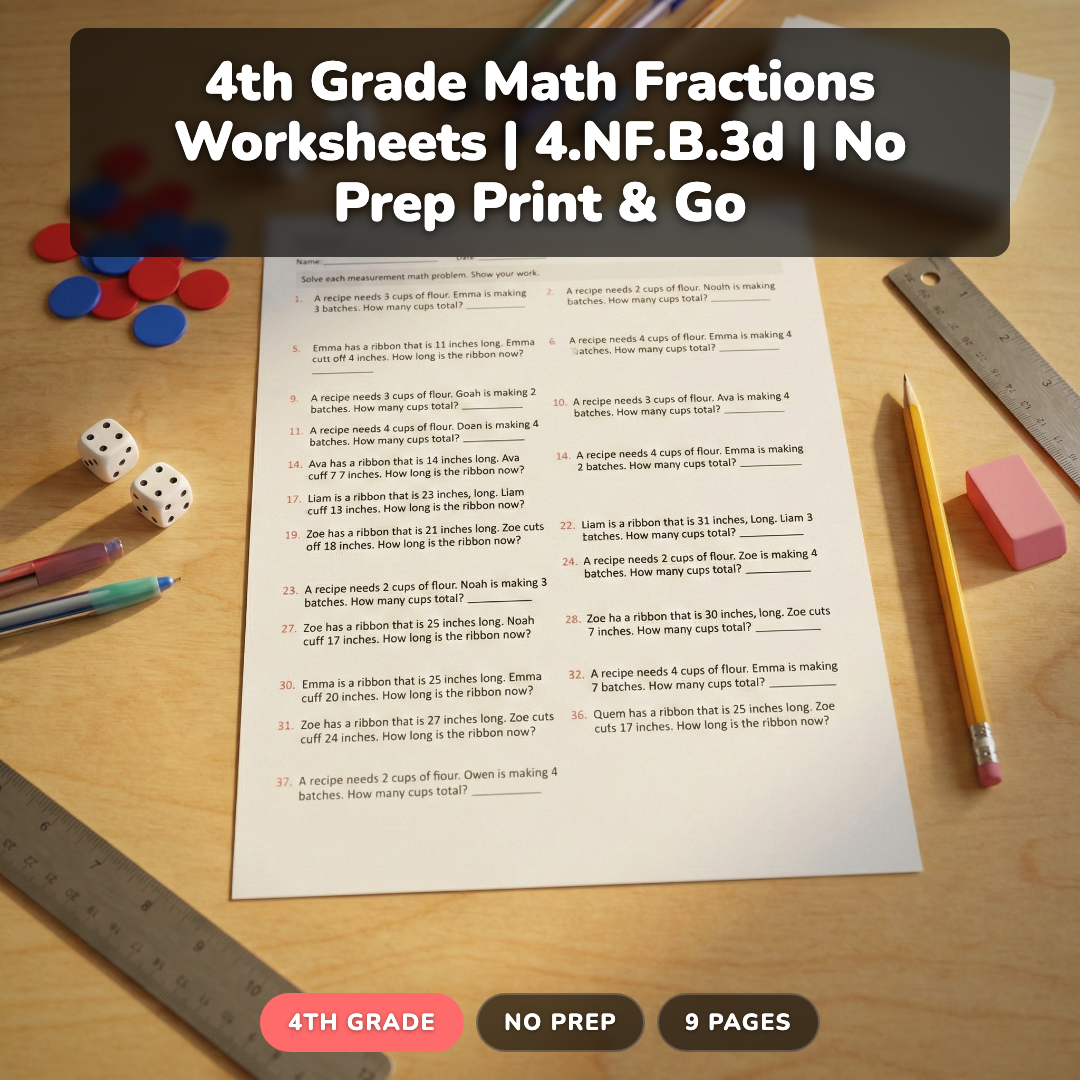
The entire resource prints as 9 ready-to-go pages that you can use immediately for centers, homework, or assessment preparation. No prep required — just print and teach.
Grab a Free Fraction Word Problem Sample to Try
Want to see how these strategies work in practice? I’ll send you a free sample pack with 6 fraction word problems across all three levels, plus a strategy guide for implementation. Perfect for trying these techniques with your students before diving into the full resource.
Frequently Asked Questions About Teaching Fraction Word Problems
When should I introduce fraction word problems in 4th grade?
Introduce fraction word problems after students master basic fraction concepts and addition/subtraction with like denominators, typically in late fall. Students need solid understanding of equivalent fractions and visual fraction models before tackling word problems successfully.
What’s the biggest mistake teachers make with fraction word problems?
Rushing to abstract equations without building conceptual understanding through visual models. Students need extensive practice with concrete representations before moving to symbolic notation. Always start with pictures and manipulatives.
How do I help students who struggle with reading comprehension in math word problems?
Break problems into smaller chunks, highlight key information, and act out scenarios with manipulatives. Use the CUBES strategy consistently and provide sentence frames for organizing thinking. Focus on mathematical vocabulary explicitly.
Should 4th graders work with unlike denominators in word problems?
No, CCSS.Math.Content.4.NF.B.3d specifically focuses on like denominators. Unlike denominators appear in 5th grade standards. Keep 4th grade problems within the same whole with matching denominators to build solid foundational understanding.
How can I assess student understanding of fraction word problems?
Use a combination of student drawings, written explanations, and mathematical equations. Look for accurate visual models, appropriate operation choice, correct calculations, and reasonable answers. Exit tickets with one problem work well for daily assessment.
Teaching fraction word problems successfully comes down to building strong conceptual understanding before moving to abstract calculations. When students can visualize problems, identify key information, and choose appropriate strategies, they develop confidence that transfers to new mathematical challenges.
What’s your biggest challenge when teaching fraction word problems? Try these strategies with your students and grab the free sample to see how they work in your classroom.