If your fourth graders freeze when asked to round 3,847 to the nearest hundred, or confidently declare that 2,999 rounds to 2,000, you’re not alone. Rounding multi-digit numbers requires students to juggle place value understanding, number line visualization, and decision-making rules — all at once.
You’ll discover five research-backed strategies that help students master rounding with confidence, plus differentiation tips for every learner in your classroom.
Key Takeaway
Successful rounding instruction combines place value understanding with visual models and systematic decision-making strategies.
Why Rounding Matters in 4th Grade Math
Rounding multi-digit whole numbers sits at the heart of fourth grade number sense development. CCSS.Math.Content.4.NBT.A.3 requires students to use place value understanding to round numbers to any place — a skill that directly supports estimation, mental math, and real-world problem solving throughout their mathematical journey.
Research from the National Council of Teachers of Mathematics shows that students who master place value-based rounding strategies demonstrate 40% better performance on multi-step word problems involving estimation. This skill typically appears in curriculum around October-November, after students have solidified their understanding of place value through 100,000.
The standard connects directly to earlier work with place value (CCSS.Math.Content.4.NBT.A.1) and sets the foundation for decimal rounding in fifth grade. Students must understand that rounding involves finding the nearest landmark number based on the halfway point between multiples.
Looking for a ready-to-go resource? I put together a differentiated rounding practice pack with 132 problems across three levels — but first, the teaching strategies that make it work.
Common Rounding Misconceptions in 4th Grade
Common Misconception: Students round 2,999 to the nearest thousand as 2,000.
Why it happens: They focus on the digit in the rounding place (2) without considering the value of digits to the right.
Quick fix: Use number lines to show that 2,999 is much closer to 3,000 than 2,000.
Common Misconception: Students think you always round up when the digit is 5.
Why it happens: Oversimplified rules without understanding the ‘halfway’ concept.
Quick fix: Show 5 as the exact halfway point between 0 and 10 on a number line.
Common Misconception: Students change multiple digits when rounding (e.g., 4,678 rounded to nearest thousand becomes 4,000).
Why it happens: They don’t understand that only the target place value and everything to the right changes.
Quick fix: Use place value charts to show which digits stay the same and which change.
Common Misconception: Students can’t identify which place value to round to.
Why it happens: Weak place value foundation or confusion about place value names vs. positions.
Quick fix: Practice identifying place values with concrete models before introducing rounding.
5 Research-Backed Strategies for Teaching Rounding
Strategy 1: Number Line Rounding with Landmark Numbers
This visual strategy helps students see rounding as finding the nearest landmark number rather than applying abstract rules. Students plot numbers on number lines marked with multiples of 10, 100, or 1,000.
What you need:
- Large number lines (0-100, 0-1,000, 0-10,000)
- Sticky notes or number cards
- Colored markers or highlighters
Steps:
- Draw a number line showing the two landmark numbers your target falls between (e.g., for rounding 347 to nearest hundred, show 300 and 400)
- Mark the halfway point clearly (350)
- Have students place the target number on the line
- Ask: ‘Which landmark is closer?’ and measure the distances visually
- Establish the rule: if exactly halfway, round up
Strategy 2: Place Value Chart Rounding Method
This systematic approach uses place value charts to help students identify the rounding place, examine the digit to the right, and make decisions methodically. It’s particularly effective for students who need structured, step-by-step processes.
What you need:
- Place value charts (through hundred thousands)
- Different colored pencils or markers
- Rounding decision flowchart
Steps:
- Write the number in the place value chart
- Circle the digit in the place you’re rounding to
- Look at the digit immediately to the right (underline it)
- If that digit is 5 or greater, round up; if less than 5, round down
- Replace all digits to the right of the rounding place with zeros
Strategy 3: Rounding Mountain Visualization
This kinesthetic and visual strategy represents numbers as climbing a mountain, where the peak (5) determines whether you slide down (round down) or climb up (round up). Students physically move to understand the concept.
What you need:
- Large floor number line or tape
- Mountain drawing or physical hill model
- Number cards for practice
Steps:
- Create a ‘mountain’ on your number line with 0 and 9 at the base, 5 at the peak
- Students stand at their number’s position on the mountain
- If they’re on the ‘up’ side (5-9), they climb to the next ten
- If they’re on the ‘down’ side (0-4), they slide back to the previous ten
- Practice with increasingly complex numbers
Strategy 4: Real-World Rounding Scenarios
This application-based strategy connects rounding to authentic situations where estimation makes sense, helping students understand why rounding matters beyond the math classroom.
What you need:
- Real-world scenario cards
- Calculators for checking
- Local maps, store flyers, or population data
Steps:
- Present authentic scenarios: ‘Our school has 1,847 students. About how many is that?’
- Discuss which place value makes sense for the context
- Have students round and explain their reasoning
- Compare rounded estimates to exact answers for reasonableness
- Create student-generated scenarios from their own experiences
Strategy 5: Rounding War Card Game
This engaging partner activity reinforces rounding skills through gameplay while providing repeated practice with immediate feedback. Students compare rounded values rather than exact numbers.
What you need:
- Deck of number cards (4-digit numbers)
- Rounding place cards (tens, hundreds, thousands)
- Recording sheets
Steps:
- Partners each draw a number card and a rounding place card
- Both players round their number to the specified place
- The player with the larger rounded number wins both cards
- Continue for 10 rounds, then count total cards won
- Discuss any disagreements by working through problems together
How to Differentiate Rounding for All Learners
For Students Who Need Extra Support
Begin with concrete manipulatives like base-ten blocks to build place value understanding. Use number lines with every number marked for rounding to nearest 10. Provide rounding charts with decision trees and allow calculator use to check answers. Focus on 3-digit numbers initially, and always connect to visual models before moving to abstract algorithms.
For On-Level Students
Practice CCSS.Math.Content.4.NBT.A.3 expectations with 4-digit numbers rounded to any place. Use a mix of visual models and algorithmic approaches. Include word problems that require determining the appropriate place value for rounding. Expect students to explain their reasoning and check answers for reasonableness.
For Students Ready for a Challenge
Extend to 5- and 6-digit numbers, including rounding to places like ten-thousands. Introduce rounding with decimals as a preview of 5th grade skills. Have students create their own rounding problems and teach strategies to classmates. Explore when rounding might not be appropriate in real-world contexts.
A Ready-to-Use Rounding Resource for Your Classroom
Teaching rounding effectively requires tons of differentiated practice — and creating 132 unique problems across three difficulty levels takes hours you don’t have. That’s where a well-designed resource becomes invaluable for busy teachers.
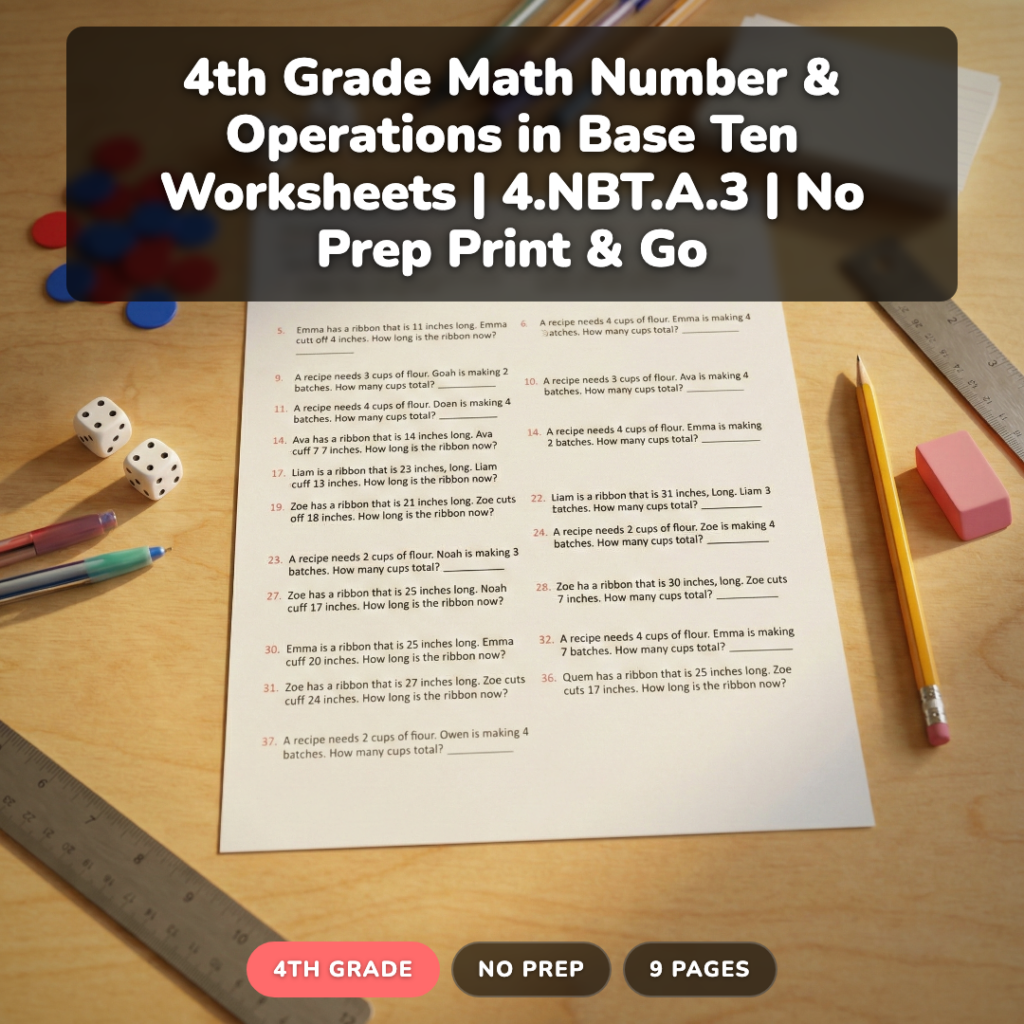
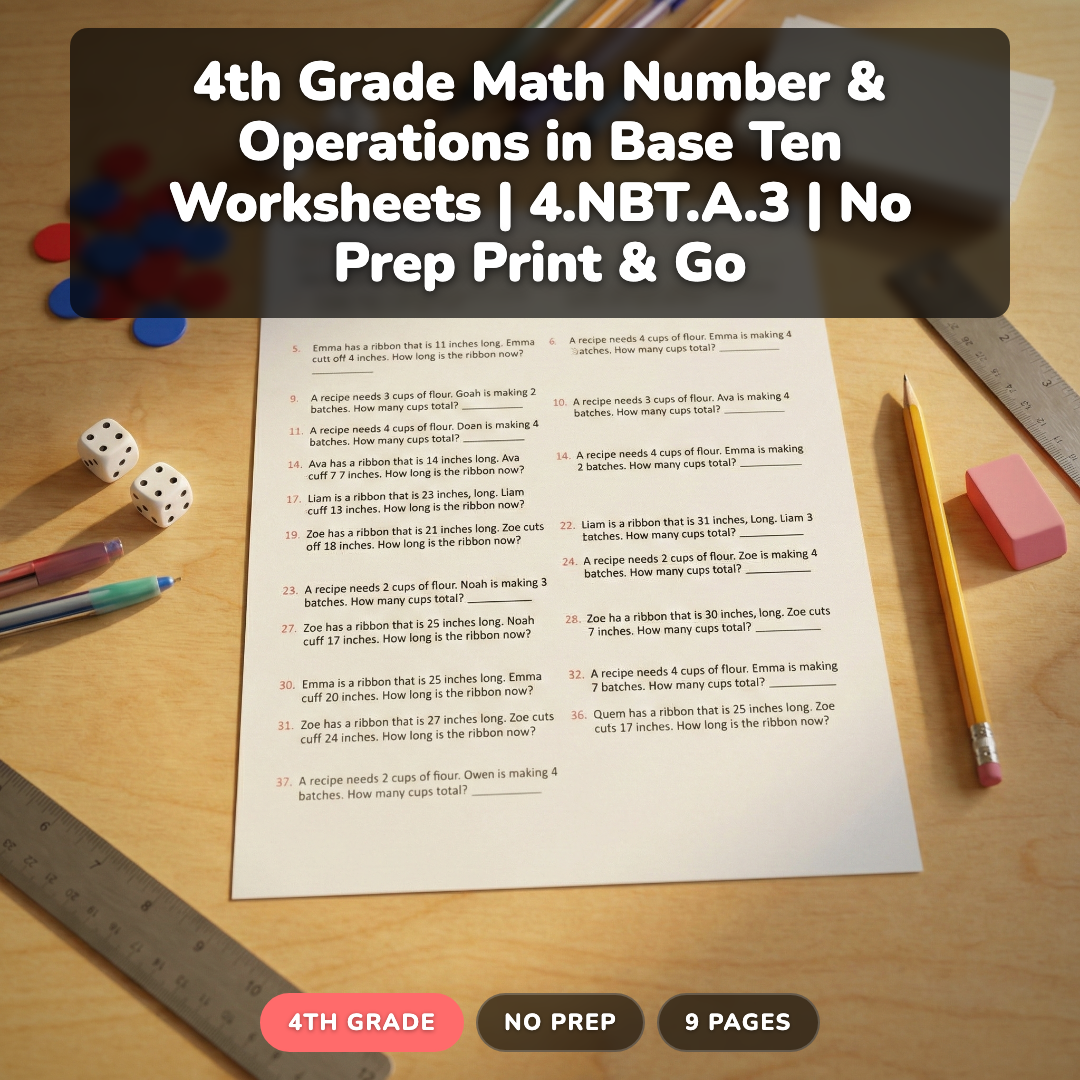
This 4th Grade Number & Operations in Base Ten worksheet collection includes 37 practice problems for students building foundational skills, 50 on-level problems aligned to grade expectations, and 45 challenge problems for advanced learners. Each level targets the same CCSS.Math.Content.4.NBT.A.3 standard while meeting students where they are.
What makes this different from generic worksheets? The problems progress systematically from 3-digit to 5-digit numbers, include real-world contexts, and provide immediate feedback opportunities. Plus, it’s completely no-prep — just print and go.
You can save hours of planning and get differentiated rounding practice that actually works in your classroom.
Grab a Free Rounding Practice Sheet to Try
Want to see how differentiated rounding practice works? I’ll send you a free sample with problems at all three levels, plus an answer key. Perfect for trying these strategies with your students.
Frequently Asked Questions About Teaching Rounding
What’s the best order for teaching rounding to different place values?
Start with rounding to the nearest 10 using 2-digit numbers, then progress to nearest 100 with 3-digit numbers. Once students master the concept, introduce rounding 4-digit numbers to tens, hundreds, then thousands. Always build from concrete to abstract understanding.
How do I help students who confuse place value names?
Use place value charts consistently and have students point to each place while saying its name. Practice identifying place values before introducing rounding. Create anchor charts showing place value patterns (ones, tens, hundreds, thousands) with visual examples.
Should I teach the ’round 5 up’ rule or something different?
Teach 5 as the halfway point first using number lines, then introduce the conventional ’round 5 up’ rule. This builds conceptual understanding before procedural fluency. Some curricula use ’round 5 to even,’ but fourth grade typically uses ’round 5 up.’
When should students stop using visual models for rounding?
Students should use visual models as long as they’re helpful, typically transitioning to mental strategies by mid-year. However, encourage returning to models when working with larger numbers or when errors occur. Visual understanding supports procedural fluency.
How does 4th grade rounding connect to later math skills?
Fourth grade rounding builds foundation for decimal rounding in 5th grade, estimation strategies in middle school, and scientific notation in high school. Strong place value understanding through rounding supports all future number sense development.
Rounding success comes from building strong place value foundations first, then connecting visual models to systematic procedures. Remember to celebrate when students can explain their reasoning — that’s when you know the learning has stuck.
What’s your go-to strategy for helping students visualize rounding? I’d love to hear what works in your classroom, and don’t forget to grab that free practice sheet above!