If your kindergarteners freeze when you ask “What makes 10 with 7?” you’re not alone. Making 10 is one of those foundational math skills that seems simple to adults but requires significant mental gymnastics for five and six-year-olds. You need concrete strategies that help students visualize, manipulate, and internalize these crucial number relationships that will support all their future addition and subtraction work.
Key Takeaway
Teaching making 10 requires moving from concrete objects to visual representations to abstract thinking, with plenty of practice at each stage.
Why Making 10 Matters in Kindergarten Math
The skill of finding numbers that make 10 forms the foundation of our entire number system. When students master CCSS.Math.Content.K.OA.A.4, they’re building the mental math strategies they’ll use for years to come. Research from the National Council of Teachers of Mathematics shows that students who develop strong number sense around 10 perform significantly better on standardized assessments through elementary school.
This standard appears in the second half of kindergarten, typically after students have mastered counting to 20 and basic addition concepts within 5. You’ll want to introduce making 10 around January or February, giving students plenty of time to practice before first grade. The timing connects perfectly with learning teen numbers (11-19), since understanding 10 + 3 = 13 makes reading “thirteen” much more meaningful.
Making 10 directly supports future work with place value, mental math strategies like “make a ten” for addition, and even early algebraic thinking. When students can quickly recall that 7 + 3 = 10, they’re ready to tackle problems like 17 + 3 or 27 + 3 using the same pattern.
Looking for a ready-to-go resource? I put together a differentiated making 10 pack that covers everything below — but first, the teaching strategies that make it work.
Common Making 10 Misconceptions in Kindergarten
Common Misconception: Students think “making 10” means adding 10 to any number.
Why it happens: They confuse the goal (reaching 10) with the process (finding the missing addend).
Quick fix: Use consistent language like “What do we add to 6 to make 10?” instead of “What makes 10?”
Common Misconception: Students count up from the given number instead of recognizing the pattern.
Why it happens: They rely on counting strategies rather than building number relationships.
Quick fix: Practice with ten frames daily so students see the visual pattern of “empty spaces to fill.”
Common Misconception: Students memorize individual facts without understanding the inverse relationship.
Why it happens: They treat each combination as separate rather than seeing 4+6 and 6+4 as related.
Quick fix: Always show both combinations together using the same manipulatives.
Common Misconception: Students think there’s only one right answer for each starting number.
Why it happens: Limited exposure to the concept or rigid worksheet practice.
Quick fix: Emphasize that 3+7=10 and 7+3=10 are both correct ways to make 10 with 3 and 7.
5 Research-Backed Strategies for Teaching Making 10
Strategy 1: Ten Frame Exploration with Two-Color Counters
Ten frames provide the perfect visual scaffold for making 10 because students can literally see the empty spaces they need to fill. This concrete approach helps students move beyond counting and start recognizing patterns.
What you need:
- Ten frames (printed or drawn)
- Two-color counters (red/yellow work well)
- Small whiteboard and marker for recording
Steps:
- Place a specific number of red counters in the ten frame (start with 4)
- Ask: “How many empty spaces do we have?”
- Have students fill the empty spaces with yellow counters
- Count together: “4 red plus 6 yellow equals 10 total”
- Record the equation: 4 + 6 = 10
- Remove all counters and try the reverse: 6 red, then yellow to make 10
Strategy 2: Finger Pattern Games for Quick Recall
Using fingers creates a kinesthetic memory that students can access anywhere, anytime. This strategy builds automatic recall while keeping the learning playful and interactive.
What you need:
- Just hands!
- Optional: finger number cards for visual support
Steps:
- Show students a number on your fingers (example: 3 fingers up)
- Students hold up the number that makes 10 (7 fingers)
- Count together: “3 and 7 makes 10!”
- Switch roles – students show a number, you respond
- Speed up gradually as students gain confidence
- Add the challenge: “Show me two ways to make 10 with your fingers!”
Strategy 3: Making 10 with Everyday Objects
Real-world connections help students see that making 10 isn’t just a math worksheet skill – it’s everywhere around them. This approach builds number sense through meaningful contexts.
What you need:
- Sets of 10 identical objects (crayons, blocks, stickers)
- Small containers or cups
- Recording sheet
Steps:
- Give students 10 crayons and ask them to put some in each hand
- Count crayons in left hand, then right hand
- Record: “5 crayons plus 5 crayons equals 10 crayons”
- Try different splits: 3 and 7, 2 and 8, etc.
- Connect to real situations: “If we need 10 stickers and I give you 4, how many more do you need?”
- Let students create their own “making 10” problems with classroom objects
Strategy 4: Number Bond Houses for Visual Learning
Number bond diagrams help students see the relationship between parts and wholes. This visual model supports students who need to see mathematical relationships rather than just memorize facts.
What you need:
- Large number bond templates (house-shaped or circle-based)
- Dry erase markers
- Number cards 0-10
Steps:
- Draw or show a number bond with 10 in the “whole” position
- Place a number card in one “part” circle (example: 6)
- Ask: “What number goes in the empty part to make 10?”
- Students write or place the missing number (4)
- Read together: “6 and 4 are parts that make the whole 10”
- Practice with different starting numbers, always keeping 10 as the whole
Strategy 5: Making 10 Memory Games and Centers
Game-based practice helps students develop fluency without the pressure of timed drills. Memory and matching games create multiple exposures to the same number combinations in an engaging format.
What you need:
- Cards with numbers 1-9
- Cards with ten frame dot patterns
- Timer (optional)
Steps:
- Create pairs of cards that make 10 (1&9, 2&8, 3&7, 4&6, 5&5)
- Spread cards face down in a grid
- Students take turns flipping two cards
- If cards make 10, student keeps the pair and states the equation
- If not, cards flip back over
- Game continues until all pairs are matched
How to Differentiate Making 10 for All Learners
For Students Who Need Extra Support
These students benefit from extended concrete practice and smaller number sets. Start with making 5 using fingers and small objects before moving to 10. Use consistent ten frame practice daily, always starting with 5 in the frame since it creates the clearest visual pattern. Provide number lines and counting bears for students who need to count up to find answers. Focus on just 2-3 number combinations per week (like 5+5 and 4+6) rather than trying to cover all possibilities. Consider peer partnerships where stronger students can model thinking aloud.
For On-Level Students
These students should work with all combinations that make 10, using varied representations including ten frames, fingers, objects, and number bonds. They can handle mixed practice with different starting numbers and should begin recognizing patterns (like how 3+7 and 7+3 both equal 10). Introduce simple word problems that require making 10, such as “There are 6 kids on the playground. How many more kids need to come to make 10?” Encourage students to explain their thinking and show their work using pictures or manipulatives.
For Students Ready for a Challenge
Advanced students can explore making other numbers (like making 15 or 20) and work with multiple addends (“Find three numbers that make 10”). They can create their own word problems and solve missing addend problems in different contexts. Introduce early algebraic thinking with equations like 6 + __ = 10 or __ + 3 = 10. These students can also work as peer tutors, explaining making 10 strategies to classmates who need support. Consider extension activities like finding all the ways to make 10 using three numbers.
A Ready-to-Use Making 10 Resource for Your Classroom
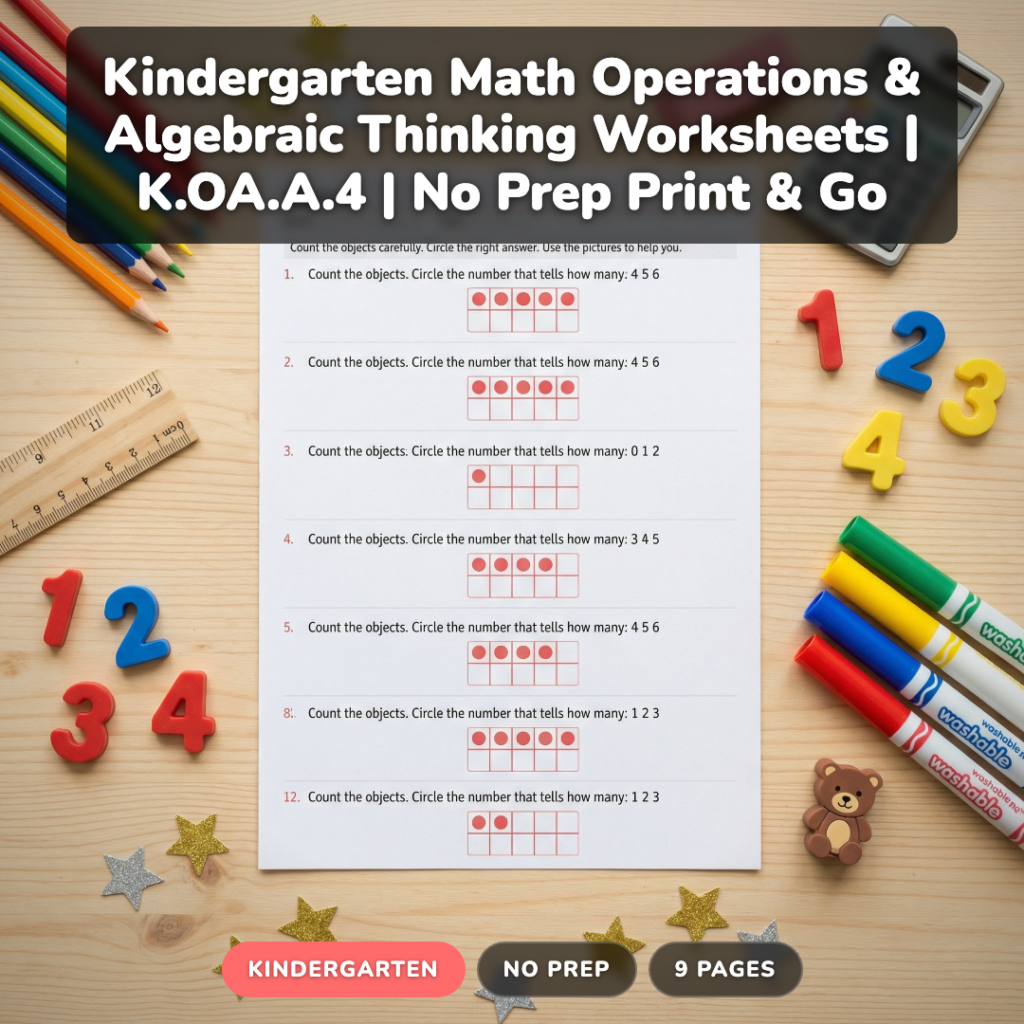
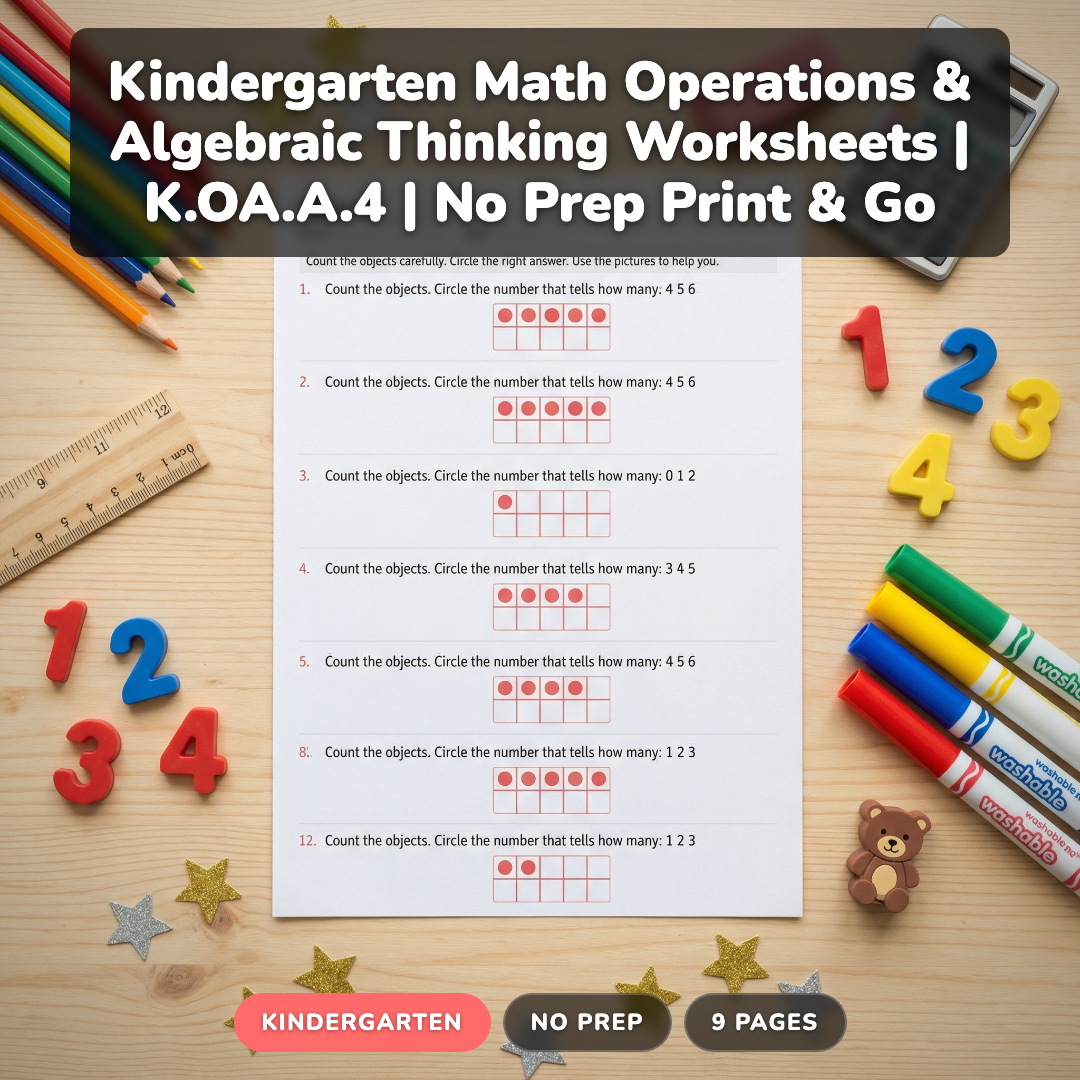
Teaching making 10 effectively requires differentiated practice at multiple levels, and creating those materials from scratch takes hours you don’t have. This comprehensive worksheet pack provides 79 carefully designed problems across three difficulty levels, so every student in your class gets exactly the right amount of challenge.
The Practice level (22 problems) focuses on concrete representations with ten frames and visual supports. On-Level worksheets (30 problems) include a mix of equation writing and problem-solving that aligns perfectly with CCSS.Math.Content.K.OA.A.4. Challenge pages (27 problems) extend learning with multi-step problems and early algebraic thinking.
Each worksheet includes clear directions, engaging graphics that keep kindergarteners focused, and answer keys that save you grading time. The no-prep format means you can print and use immediately, whether for whole group instruction, math centers, or homework practice.
Grab a Free Making 10 Practice Sheet to Try
Want to see the quality and format before you buy? I’ll send you a sample worksheet from each difficulty level, plus a ten frame template you can use for hands-on practice. Perfect for trying out these strategies with your students right away.
Frequently Asked Questions About Teaching Making 10
When should I introduce making 10 in kindergarten?
Introduce making 10 after students can count to 20 and understand basic addition within 5, typically in January or February. Students need solid number recognition and basic addition concepts before tackling CCSS.Math.Content.K.OA.A.4 successfully.
How long does it take kindergarteners to master making 10?
Most kindergarteners need 6-8 weeks of consistent practice to develop fluency with making 10. Daily practice sessions of 10-15 minutes work better than longer, less frequent lessons for building automaticity.
Should students memorize making 10 facts or understand the concept?
Both understanding and memorization are important. Start with concrete understanding using manipulatives and visual models, then build toward automatic recall through games and repeated practice. Conceptual understanding supports long-term retention.
What if students still count on their fingers to make 10?
Finger counting is a normal developmental stage. Gradually encourage mental strategies by covering fingers or asking students to “picture the ten frame in your mind.” Most students naturally move away from finger counting with sufficient practice.
How does making 10 connect to first grade math standards?
Making 10 directly supports first grade addition and subtraction strategies, particularly “make a ten” for problems like 8+5. Students use 8+2=10, then add the remaining 3 to get 13. This foundation is crucial for mental math development.
Building Strong Number Sense Through Making 10
Teaching making 10 successfully requires patience, concrete materials, and plenty of practice at each student’s level. When you use these research-backed strategies consistently, you’ll see students develop the number sense and mental math skills that will serve them throughout their mathematical journey. What’s your favorite hands-on activity for practicing making 10? Try the free sample worksheets and see which strategies work best for your students.