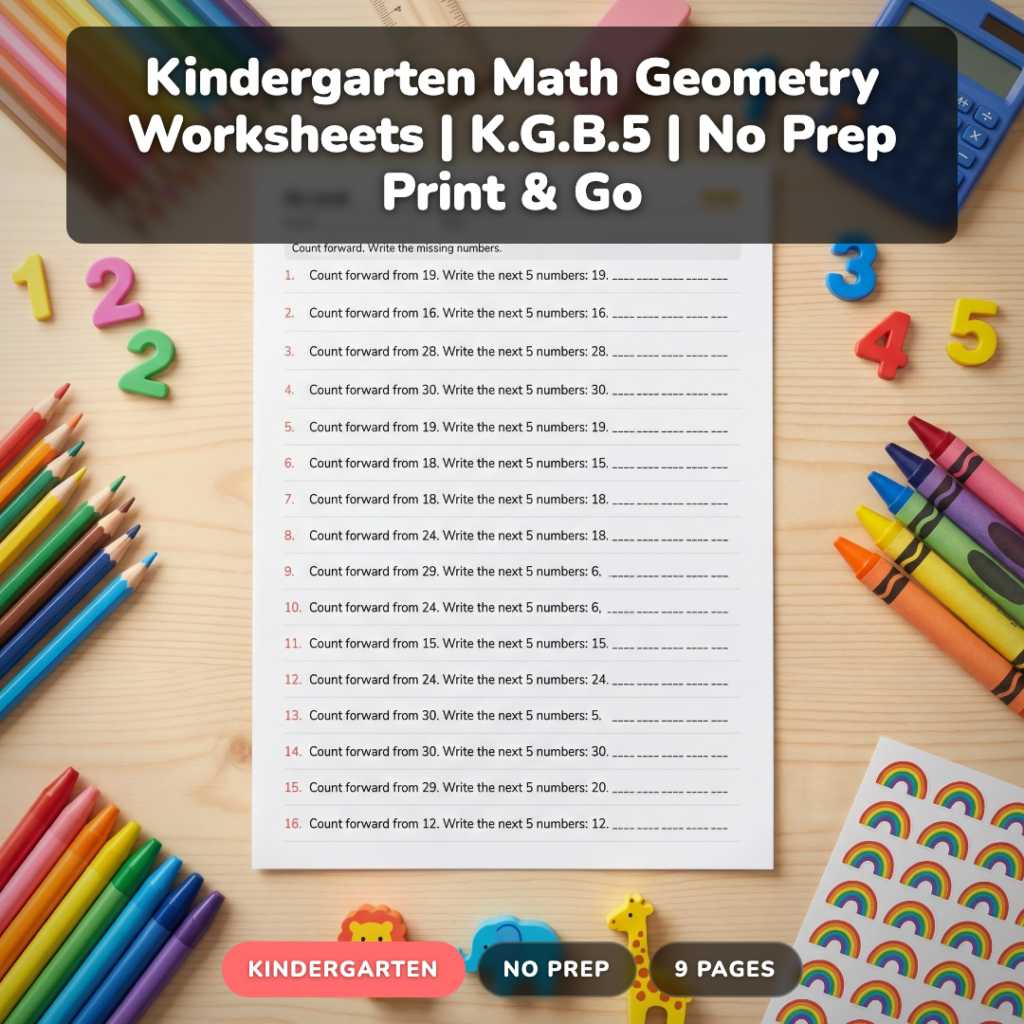
If your kindergarteners look confused when you ask them to build a triangle from blocks, you’re not alone. Teaching geometry to five-year-olds requires more than pointing to shapes on a poster — they need to touch, build, and create to truly understand how shapes work in their world.
Key Takeaway
Kindergarteners learn geometry best through hands-on building and real-world connections, not abstract worksheets.
Why Geometry Matters in Kindergarten
Geometry forms the foundation for spatial reasoning skills that students will use throughout their mathematical journey. Research from the National Council of Teachers of Mathematics shows that early geometry experiences directly impact students’ ability to understand fractions, measurement, and even algebra concepts later.
The CCSS.Math.Content.K.G.B.5 standard expects kindergarteners to model shapes by building them from components and drawing them. This isn’t just about recognizing a triangle — it’s about understanding that three sticks connected at their ends will always create a triangle, whether it’s pointing up, down, or sideways.
Timing matters too. Introduce shape building in October after students have had time to explore basic shape recognition. Plan 2-3 weeks of focused geometry instruction, revisiting these concepts monthly throughout the year.
Looking for a ready-to-go resource? I put together a differentiated kindergarten geometry pack that covers everything below — but first, the teaching strategies that make it work.
Common Geometry Misconceptions in Kindergarten
Common Misconception: Students think a rotated square is a diamond or different shape.
Why it happens: They rely on visual orientation rather than counting sides and corners.
Quick fix: Rotate shapes together while counting sides each time.
Common Misconception: Students believe triangles must point upward to be ‘real’ triangles.
Why it happens: Most classroom posters show triangles in standard position.
Quick fix: Show triangles in multiple orientations from day one.
Common Misconception: Students think rectangles and squares are completely different shapes.
Why it happens: They focus on names rather than properties.
Quick fix: Emphasize that squares are special rectangles with equal sides.
Common Misconception: Students can’t connect 2D shapes to 3D objects in their environment.
Why it happens: Abstract thinking is still developing at this age.
Quick fix: Use real objects first, then transition to drawings.
5 Research-Backed Strategies for Teaching Kindergarten Geometry
Strategy 1: Shape Building with Everyday Materials
Start with tangible materials that students can manipulate. This concrete approach aligns perfectly with CCSS.Math.Content.K.G.B.5 by having students physically construct shapes from components.
What you need:
- Craft sticks or straws
- Play dough or clay
- Pipe cleaners
- Toothpicks and marshmallows
Steps:
- Give each student 3 craft sticks and small balls of play dough
- Demonstrate connecting sticks at the ends using play dough as ‘joints’
- Ask students to build a triangle, emphasizing the connection points
- Repeat with 4 sticks for squares and rectangles
- Have students rotate their shapes and count sides together
Strategy 2: Shape Hunt and Real-World Connections
Connect classroom learning to students’ everyday experiences by finding shapes in their environment. This builds the spatial reasoning foundation needed for future geometry concepts.
What you need:
- Clipboards and pencils
- Shape recording sheet
- Digital camera or tablet
- Classroom objects
Steps:
- Take students on a ‘shape walk’ around the classroom
- Point out rectangular windows, circular clocks, triangular roof shapes
- Have students draw or photograph shapes they find
- Return to discuss: ‘Why do you think windows are rectangles?’
- Create a class book of environmental shapes
Strategy 3: Interactive Shape Drawing Practice
Move from concrete building to representational drawing gradually. This bridges the gap between manipulation and abstract understanding.
What you need:
- Large paper or whiteboards
- Thick markers or crayons
- Shape templates (optional)
- Dot paper
Steps:
- Start by tracing around 3D blocks to create 2D shapes
- Show students how to draw shapes step-by-step: ‘First line, second line…’
- Use dot paper to help with straight lines and corners
- Practice drawing the same shape in different orientations
- Have students explain their drawing process to a partner
Strategy 4: Shape Attribute Games and Sorting
Help students focus on mathematical properties rather than superficial features through systematic comparison and classification activities.
What you need:
- Attribute blocks or shape cutouts
- Sorting mats
- Shape property cards
- Hula hoops for Venn diagrams
Steps:
- Give students mixed shape collections
- Start with one attribute: ‘Sort by number of sides’
- Progress to two attributes: ‘Find shapes with 4 sides AND 4 corners’
- Play ‘Guess My Rule’ where you sort and students identify the pattern
- Use Venn diagrams to show shapes that belong to multiple categories
Strategy 5: Collaborative Shape Creation Projects
Combine building, drawing, and real-world application through group projects that reinforce the CCSS.Math.Content.K.G.B.5 modeling component.
What you need:
- Large construction paper
- Various building materials
- Glue sticks
- Shape cutouts
Steps:
- Assign small groups to create a ‘shape neighborhood’
- Each group builds houses using specific shapes (triangle roofs, square windows)
- Students explain their design choices: ‘Why did you use rectangles for doors?’
- Groups present their neighborhoods to the class
- Create a gallery walk where students identify shapes in others’ work
How to Differentiate Geometry for All Learners
For Students Who Need Extra Support
Focus on concrete manipulation before moving to abstract concepts. Provide hand-over-hand guidance for shape building and use larger materials that are easier to manipulate. Start with clear shape differences (circle vs. triangle) before introducing similar shapes. Use consistent language and repeat shape names frequently. Consider pairing struggling students with shape-confident peers for building activities.
For On-Level Students
These students can handle the standard progression from concrete to abstract. They should master building basic shapes with materials, then progress to drawing shapes independently. Expect them to identify shapes in different orientations and begin describing simple shape properties like ‘corners’ and ‘sides.’ They can participate fully in sorting activities and simple shape games.
For Students Ready for a Challenge
Extend learning by introducing shape combinations and patterns. Have them create complex pictures using multiple shapes, or challenge them to build 3D structures and identify the 2D faces. Introduce early geometry vocabulary like ‘vertices’ and ‘edges.’ Ask them to teach shape concepts to younger students or create their own shape sorting rules for classmates to follow.
A Ready-to-Use Geometry Resource for Your Classroom
After years of creating geometry materials from scratch, I developed a comprehensive kindergarten geometry pack that saves prep time while providing exactly the differentiation your students need. This resource includes 79 problems across three difficulty levels — 22 practice problems for students who need extra support, 30 on-level problems for grade-appropriate work, and 27 challenge problems for advanced learners.
What makes this different from generic worksheets is the careful scaffolding. Practice pages focus on shape recognition and simple building tasks. On-level pages include shape drawing and basic property identification. Challenge pages involve complex shape combinations and early problem-solving. Each level includes clear answer keys and can be used for independent work, centers, or homework.
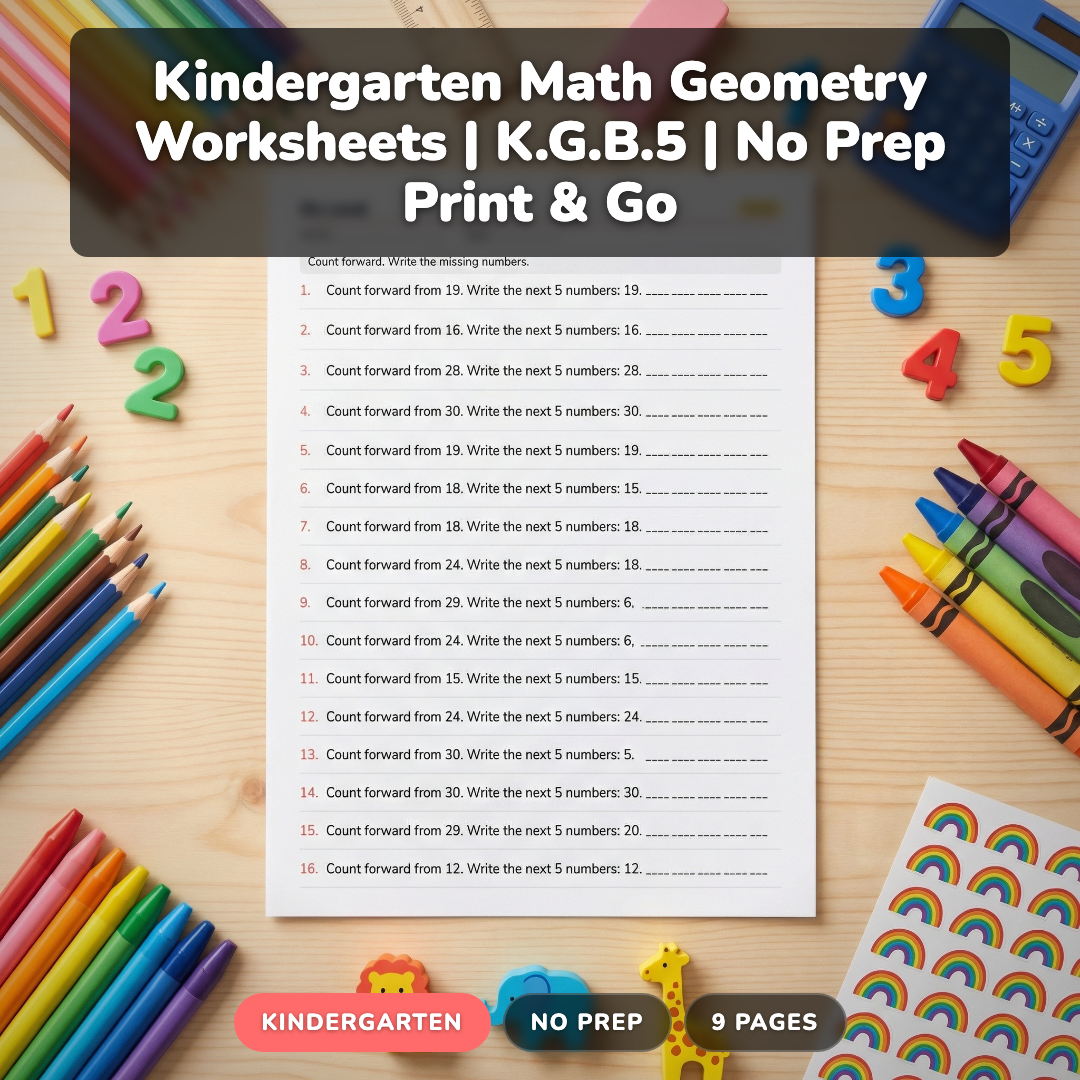
The pack covers everything from basic shape identification to complex building challenges, all aligned to CCSS.Math.Content.K.G.B.5. You get immediate access to print-and-go pages that require zero prep time.
Grab a Free Shape Building Activity to Try
Want to test these strategies with your students first? I’ll send you a free sample page from the geometry pack plus my shape building checklist that helps you track student progress through hands-on activities.
Frequently Asked Questions About Teaching Kindergarten Geometry
When should I introduce shape building in kindergarten?
Start shape building activities in October after students have mastered basic shape recognition. This timing allows for 2-3 focused weeks of instruction while leaving time for review throughout the year. Students need the fine motor development that comes with the first month of school.
What’s the difference between shape recognition and shape building?
Recognition involves identifying existing shapes, while building requires understanding how shapes are constructed from components. CCSS.Math.Content.K.G.B.5 specifically targets building because it develops deeper spatial reasoning than recognition alone. Building helps students understand shape properties, not just visual appearance.
How do I help students who confuse squares and rectangles?
Emphasize that squares are special rectangles with four equal sides. Use the language ‘rectangle family’ and show that squares belong to this family. Have students build both shapes with craft sticks, noting that squares need equal-length sticks while rectangles can use different lengths.
Should kindergarteners learn 3D shape names like cube and sphere?
Focus primarily on 2D shapes as required by kindergarten standards, but connect them to 3D objects students know. Say ‘This ball is round like a circle’ rather than introducing ‘sphere.’ The goal is building 2D shape understanding that supports future learning.
How can I assess geometry understanding in kindergarten?
Use performance-based assessment: ask students to build specific shapes, draw shapes independently, or find shapes in the environment. Observe their process, not just final products. Can they count sides correctly? Do they recognize rotated shapes? Document progress with photos and brief notes.
Building Strong Geometry Foundations
Teaching kindergarten geometry successfully comes down to making abstract concepts concrete through hands-on building and real-world connections. When students can physically construct shapes and see them in their environment, they develop the spatial reasoning skills that will serve them throughout their mathematical journey.
What’s your favorite hands-on geometry activity? I’d love to hear what works best with your kindergarteners. Don’t forget to grab that free shape building activity above — it’s a great way to get started with these strategies in your classroom.