If your kindergarten students confuse circles with ovals or can’t tell you what’s “beside” the block tower, you’re not alone. Teaching geometry concepts to 5-year-olds requires concrete, hands-on experiences that make abstract spatial relationships tangible and fun.
You’ll discover five research-backed strategies that transform how kindergarteners understand shapes and spatial language, plus differentiation tips to meet every learner where they are.
Key Takeaway
Kindergarten geometry success comes from combining shape identification with positional vocabulary through movement, manipulation, and real-world connections.
Why Geometry Matters in Kindergarten
Geometry forms the foundation for spatial reasoning, a skill that predicts later success in STEM fields. Research from the National Science Foundation shows that students with strong spatial skills in elementary school are 2.3 times more likely to pursue engineering careers.
The CCSS.Math.Content.K.G.A.1 standard focuses on two critical components: identifying shapes by name and using positional vocabulary to describe location. This standard typically appears in the second half of the kindergarten year, after students have developed basic counting and number recognition skills.
Kindergarteners naturally think in concrete terms, making geometry an ideal entry point for mathematical thinking. They can see, touch, and move shapes before understanding abstract number concepts. Studies by Clements and Sarama (2011) demonstrate that students who master basic geometry concepts in kindergarten show stronger problem-solving skills throughout elementary school.
Looking for a ready-to-go resource? I put together a differentiated kindergarten geometry pack that covers everything below — but first, the teaching strategies that make it work.
Common Geometry Misconceptions in Kindergarten
Common Misconception: Students think a rotated square is a diamond.
Why it happens: They rely on visual orientation rather than shape properties like equal sides and corners.
Quick fix: Rotate shapes while counting sides and corners together to show properties don’t change.
Common Misconception: Students confuse “beside” and “next to” with “near.”
Why it happens: Positional vocabulary requires precise spatial understanding that develops gradually.
Quick fix: Use consistent hand gestures and physical positioning to demonstrate each term.
Common Misconception: Students identify rectangles as “not squares” when all squares are rectangles.
Why it happens: They focus on differences rather than shared properties.
Quick fix: Teach squares as “special rectangles” with four equal sides.
Common Misconception: Students think shapes must be filled in or outlined to “count.”
Why it happens: Limited exposure to shape variations in different contexts.
Quick fix: Show shapes as outlines, filled solids, and real objects consistently.
5 Research-Backed Strategies for Teaching Kindergarten Geometry
Strategy 1: Shape Detective Walks
Transform your classroom and school into a geometry laboratory where students hunt for shapes in their environment. This strategy builds the connection between abstract shapes and real-world objects required by CCSS.Math.Content.K.G.A.1.
What you need:
- Clipboard with recording sheet
- Pencils
- Camera or tablet (optional)
- Shape reference chart
Steps:
- Give each student a clipboard with a simple recording sheet showing the target shapes
- Walk around the classroom, playground, or hallway together
- When someone spots a shape, have the whole group stop and verify: “Is this really a rectangle? Let’s count the sides and corners.”
- Record findings with tallies, drawings, or photos
- Back in class, sort discoveries by shape type and discuss patterns
Strategy 2: Body Position Game
Use students’ own bodies to teach positional vocabulary through movement and play. Kinesthetic learning helps cement spatial concepts that kindergarteners often find abstract.
What you need:
- Large foam shapes or carpet squares
- Masking tape for floor lines
- Positional vocabulary cards
- Music (optional)
Steps:
- Place large shapes around the room using tape or carpet squares
- Call out instructions: “Stand beside the triangle,” “Sit in front of the circle”
- Have students take turns being the “caller” to reinforce vocabulary
- Add complexity: “Put your hand above your head while standing next to the square”
- End with partner challenges where one student gives directions to another
Strategy 3: Shape Attribute Sorting
Develop critical thinking skills by having students sort shapes based on multiple attributes rather than just naming them. This builds the analytical foundation needed for geometry reasoning.
What you need:
- Various shape manipulatives in different sizes and colors
- Sorting hoops or containers
- Attribute labels (sides, corners, curved/straight)
- Chart paper for recording
Steps:
- Start with one attribute: “Put all shapes with 4 sides in this hoop”
- Discuss what students notice: “What do these shapes have in common?”
- Introduce a second sorting rule: “Now sort the 4-sided shapes by size”
- Challenge students to create their own sorting rules
- Record discoveries on a class chart: “Squares have 4 equal sides and 4 corners”
Strategy 4: Shape Story Theater
Combine literacy and geometry by creating stories where shapes are characters and positional words drive the action. This cross-curricular approach reinforces both vocabulary and narrative skills.
What you need:
- Large cardboard or felt shapes
- Simple story templates
- Flannel board or magnetic board
- Student recording sheets
Steps:
- Begin with a simple story: “Circle rolled behind the house to hide from Square”
- Have students act out the story using large shapes as props
- Encourage students to add details: “Where did Triangle go next?”
- Let students create their own shape stories in pairs
- Share stories with the class, emphasizing positional vocabulary
Strategy 5: Geometry Cooking Projects
Use simple cooking activities to explore shapes while practicing following directions and measuring. Food provides memorable, multi-sensory geometry experiences that students remember long-term.
What you need:
- Cookie cutters in various shapes
- Play dough or simple cookie dough
- Shape-themed snacks (crackers, cheese slices)
- Cutting mats and plastic knives
Steps:
- Give each student play dough and shape cutters
- Create shapes while discussing attributes: “How many sides does your triangle have?”
- Arrange shapes on plates using positional vocabulary: “Put the circle above the square”
- For real cooking, use simple recipes like shape sandwiches or decorated crackers
- Document creations with photos and descriptive writing
How to Differentiate Kindergarten Geometry for All Learners
For Students Who Need Extra Support
Focus on three basic shapes (circle, square, triangle) and two positional terms (above, below) initially. Use large, tactile materials and provide hand-over-hand guidance during sorting activities. Create personal shape books with photos of familiar objects for each shape. Review shapes daily through songs and finger plays. Consider whether students need prerequisite skills like basic spatial awareness or following simple directions.
For On-Level Students
Work with all basic shapes plus rectangles and introduce the full range of positional vocabulary from the standard. Students should identify shapes in various orientations and sizes, use positional terms accurately in complete sentences, and begin noticing shape attributes like number of sides and corners. Provide independent practice through center activities and shape journals.
For Students Ready for a Challenge
Introduce complex shapes like hexagons, pentagons, and ovals. Challenge students to identify shapes within shapes (triangles in a hexagon) and use multiple positional descriptors (“The triangle is above and to the right of the circle”). Connect to first-grade standards by exploring 3D shapes and their 2D faces. Encourage students to teach shape concepts to younger children or create their own geometry games.
A Ready-to-Use Kindergarten Geometry Resource for Your Classroom
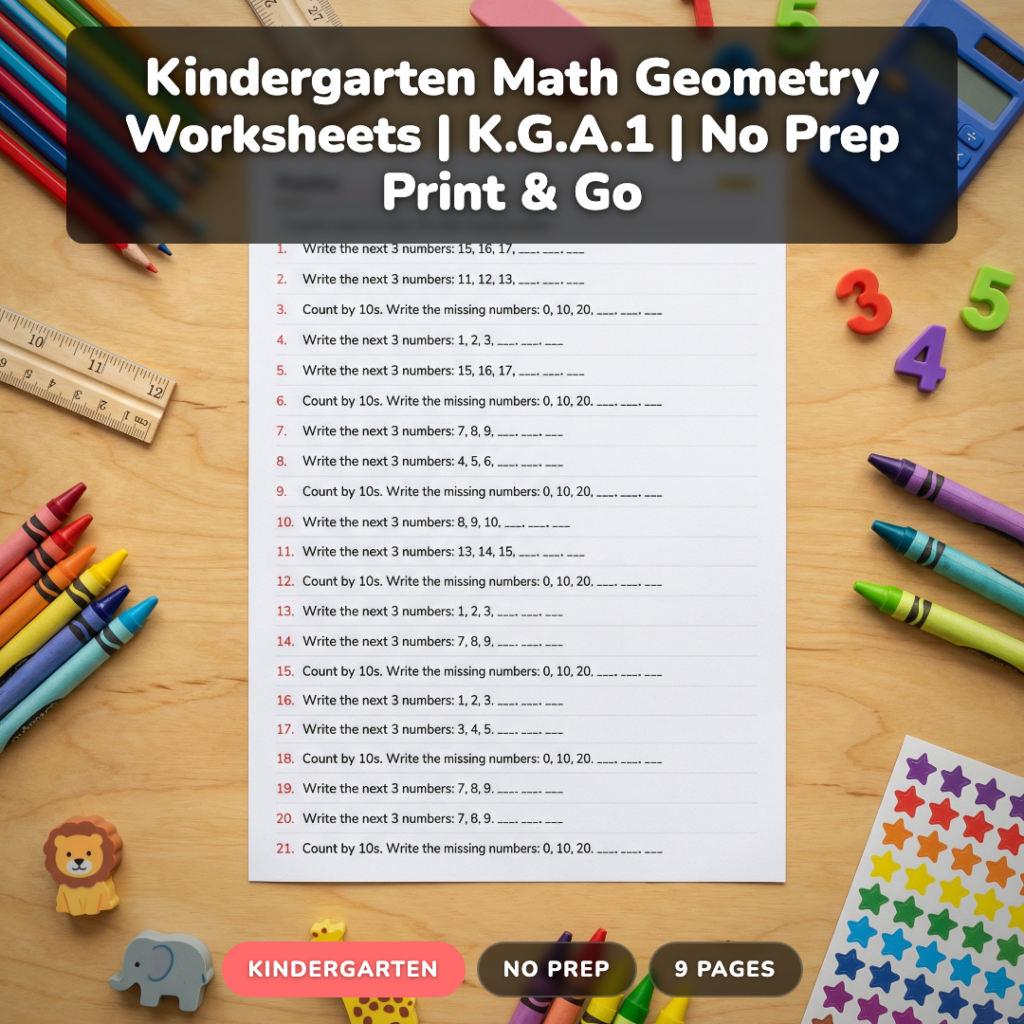
Planning differentiated geometry lessons takes hours, but you need materials that work for all your learners right away. This comprehensive kindergarten geometry pack includes 79 carefully crafted problems across three difficulty levels, saving you prep time while ensuring every student gets appropriate practice.
The resource includes 22 practice problems for students who need extra support, 30 on-level problems for grade-level expectations, and 27 challenge problems for advanced learners. Each worksheet focuses on shape identification and positional vocabulary aligned to CCSS.Math.Content.K.G.A.1, with clear answer keys and implementation suggestions.
What makes this different: problems progress systematically from basic shape recognition to complex spatial relationships, with visual supports and real-world contexts throughout.
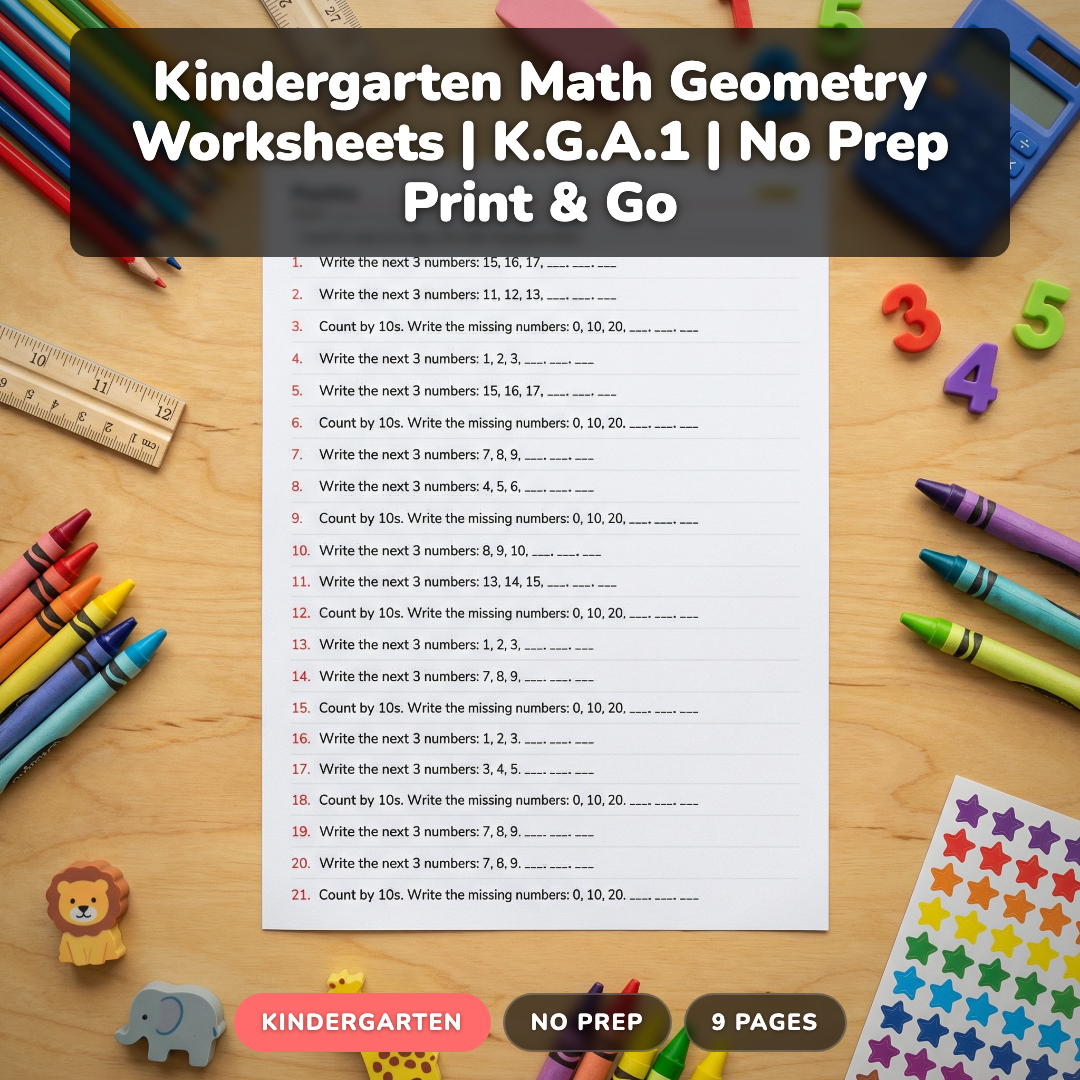
The pack covers everything from simple shape matching to multi-step positional challenges, all designed specifically for kindergarten attention spans and fine motor abilities. You’ll get 9 pages of no-prep worksheets that you can use immediately for centers, homework, or assessment.
Grab a Free Geometry Sample to Try
Want to see how these differentiated worksheets work in your classroom? I’ll send you a free sample with problems from each level, plus a bonus shape identification game you can play tomorrow.
Frequently Asked Questions About Teaching Kindergarten Geometry
When should I introduce 3D shapes in kindergarten?
Focus on 2D shapes first as required by CCSS.Math.Content.K.G.A.1. Introduce 3D shapes informally through play and exploration, but formal instruction typically begins in first grade when students have mastered basic 2D shape identification and positional vocabulary.
How do I help students who confuse squares and rectangles?
Teach squares as “special rectangles” with four equal sides. Use consistent language: “All squares are rectangles, but not all rectangles are squares.” Provide lots of hands-on sorting practice and emphasize that both shapes have four sides and four corners.
What’s the best way to assess kindergarten geometry skills?
Use performance-based assessments where students manipulate real objects. Ask them to “Show me a triangle” or “Put the circle beside the square.” Observe during center time and document with photos. Avoid paper-and-pencil tests for this age group.
How much time should I spend on geometry each week?
Plan 15-20 minutes of focused geometry instruction 2-3 times per week, plus integration throughout the day. Point out shapes during read-alouds, use positional vocabulary during transitions, and incorporate geometry into art and dramatic play activities.
Should kindergarteners learn shape names or properties first?
Start with names using familiar objects, then gradually introduce properties. Say “This is a triangle like a slice of pizza” before teaching “Triangles have three sides.” Young children need concrete connections before abstract attributes make sense.
Teaching geometry to kindergarteners works best when you combine hands-on exploration with consistent vocabulary practice. Remember to connect every lesson to real objects in your students’ world — that’s where mathematical understanding begins.
What’s your favorite way to make shapes come alive for your kindergarteners? Try one of these strategies this week and grab the free sample to see differentiated geometry practice in action.