If your fifth graders freeze when they see 2/3 × 1/4, you’re not alone. Multiplying fractions feels backwards to students who’ve spent years learning that “multiplication makes numbers bigger.” When the answer is smaller than both factors, confusion sets in fast.
You need concrete strategies that help students visualize what’s really happening when fractions multiply. This post breaks down five research-backed approaches that make fraction multiplication click for every learner in your classroom.
Key Takeaway
Students master fraction multiplication when they understand it as “finding a part of a part” rather than memorizing abstract rules.
Why Fraction Multiplication Matters in Fifth Grade
Fraction multiplication sits at a critical junction in elementary math. Students who master CCSS.Math.Content.5.NF.B.4 — applying multiplication to multiply fractions and whole numbers — build the foundation for middle school algebra, geometry, and beyond.
Research from the National Mathematics Advisory Panel shows that students who struggle with fraction operations in elementary school face significant challenges in algebra. The standard requires students to multiply fractions by fractions, whole numbers by fractions, and interpret products in real-world contexts.
This skill typically appears in the second half of fifth grade, after students have developed fluency with fraction equivalence and addition/subtraction. Students need strong number sense around what fractions represent before tackling multiplication.
Looking for a ready-to-go resource? I put together a differentiated fraction multiplication pack that covers everything below — but first, the teaching strategies that make it work.
Common Fraction Multiplication Misconceptions in 5th Grade
Common Misconception: Students multiply numerators and denominators separately (2/3 × 1/4 = 2×1/3×4 = 2/12) but think this means “2 groups of 1/4 shared among 3 groups of 12.”
Why it happens: They apply whole number multiplication thinking without understanding what the operation means with fractions.
Quick fix: Always start with visual models before introducing the algorithm.
Common Misconception: Students expect products to be larger than factors, getting confused when 1/2 × 1/3 = 1/6.
Why it happens: Years of whole number experience where multiplication increases values.
Quick fix: Emphasize “finding a fraction OF another fraction” language consistently.
Common Misconception: Students add instead of multiply when they see word problems with fractions (“Maria ate 1/4 of 2/3 of a pizza”).
Why it happens: Fraction word problems often involve sharing or combining, which students associate with addition.
Quick fix: Use “groups of” and “part of” language to distinguish operations clearly.
Common Misconception: Students think 3 × 1/4 means “3 plus 1/4” or struggle to see why it equals 3/4.
Why it happens: They haven’t connected whole number × fraction to repeated addition of fractions.
Quick fix: Show 3 × 1/4 as 1/4 + 1/4 + 1/4 with visual models first.
5 Research-Backed Strategies for Teaching Fraction Multiplication
Strategy 1: Area Model Visualization
The area model helps students see fraction multiplication as finding the area of a rectangle where each dimension represents one factor. This visual approach builds conceptual understanding before introducing algorithms.
What you need:
- Grid paper or rectangular manipulatives
- Colored pencils or crayons
- Fraction strips or bars
Steps:
- Draw a rectangle and divide it vertically to show the first fraction (for 2/3, make 3 columns, shade 2)
- Divide the same rectangle horizontally for the second fraction (for 1/4, make 4 rows, shade 1)
- Count the total small squares created and identify how many are double-shaded
- Express the double-shaded area as a fraction of the whole rectangle
- Connect this visual to the numerical answer (2/3 × 1/4 = 2/12 = 1/6)
Strategy 2: “Part of a Part” Language Framework
Consistent mathematical language helps students understand that multiplying fractions means finding a fractional part of another fraction, not combining separate quantities.
What you need:
- Sentence frames and anchor charts
- Real-world context cards
- Fraction manipulatives
Steps:
- Introduce the phrase “[first fraction] OF [second fraction]” for every multiplication problem
- Model with concrete examples: “1/2 of 1/4 of a pizza” or “3/4 of 2/5 of the students”
- Have students restate problems using “of” language before solving
- Connect to visual models: “Show me 1/3 OF this 1/2 section”
- Practice translating between “×” and “of” representations
Strategy 3: Real-World Context Building
Students understand fraction multiplication better when embedded in meaningful situations that naturally require finding “part of a part.”
What you need:
- Recipe cards with fractional ingredients
- Measurement tools (measuring cups, rulers)
- Story problem templates
Steps:
- Start with recipe contexts: “The recipe calls for 2/3 cup flour, but you only want to make 1/2 of the recipe”
- Use measurement scenarios: “The board is 3/4 of a foot long, and you need to cut off 1/3 of that length”
- Create sharing situations: “2/5 of the class brought lunch, and 1/4 of those students brought sandwiches”
- Have students create their own word problems using provided contexts
- Connect each story back to the mathematical operation and visual model
Strategy 4: Number Line Multiplication
Number lines provide a linear model that helps students see fraction multiplication as scaling or shrinking distances, complementing area models.
What you need:
- Large number line displays (0 to 1)
- Colored tape or markers
- Individual student number lines
Steps:
- Mark the first fraction on a 0-1 number line (locate 2/3)
- Divide that segment into parts based on the second fraction (split the 0 to 2/3 section into 4 equal parts for ×1/4)
- Identify where the product lands (1 part out of 4 parts of the 2/3 segment)
- Calculate the distance from 0 to that point (1/4 of 2/3 = 2/12 = 1/6)
- Compare products to original factors to reinforce that multiplication by proper fractions creates smaller results
Strategy 5: Pattern Recognition with Fraction Arrays
Arrays help students discover patterns in fraction multiplication and connect to their existing knowledge of whole number multiplication arrays.
What you need:
- Dot arrays or square tiles
- Fraction circle pieces
- Recording sheets for pattern observation
Steps:
- Build arrays showing whole number × fraction (3 × 1/4 as 3 rows of 1/4)
- Transition to fraction × whole number (1/4 × 3 as 1/4 of 3 columns)
- Move to fraction × fraction using partial arrays (2/3 × 1/4 as 2/3 of 1/4 of an array)
- Record patterns students notice about numerators, denominators, and product size
- Connect array patterns to the multiplication algorithm (multiply across)
How to Differentiate Fraction Multiplication for All Learners
For Students Who Need Extra Support
Students struggling with CCSS.Math.Content.5.NF.B.4 benefit from extended concrete manipulation and simplified contexts. Start with unit fractions only (1/2, 1/3, 1/4) and whole number × fraction problems. Use physical manipulatives like fraction tiles or circles for every problem. Provide sentence frames: “I need to find ___ of ___, which means _____.” Review prerequisite skills like fraction equivalence and ensure students can identify fractions on number lines and area models before introducing multiplication.
For On-Level Students
Grade-level students work with proper fractions in both positions (a/b × c/d) and connect multiple representations. They solve word problems involving measurement, cooking, and sharing contexts. Students explain their reasoning using mathematical language and check answers for reasonableness. They begin to see patterns in the multiplication algorithm and can choose appropriate models (area, number line, or array) based on the problem context.
For Students Ready for a Challenge
Advanced students extend fraction multiplication to mixed numbers, explore connections to decimal multiplication, and solve multi-step problems involving multiple operations. They investigate why multiplication by proper fractions produces smaller products and explore this concept with improper fractions. Challenge students create their own word problems, find multiple solution paths, and make connections to algebraic thinking by representing problems with variables.
A Ready-to-Use Fraction Multiplication Resource for Your Classroom
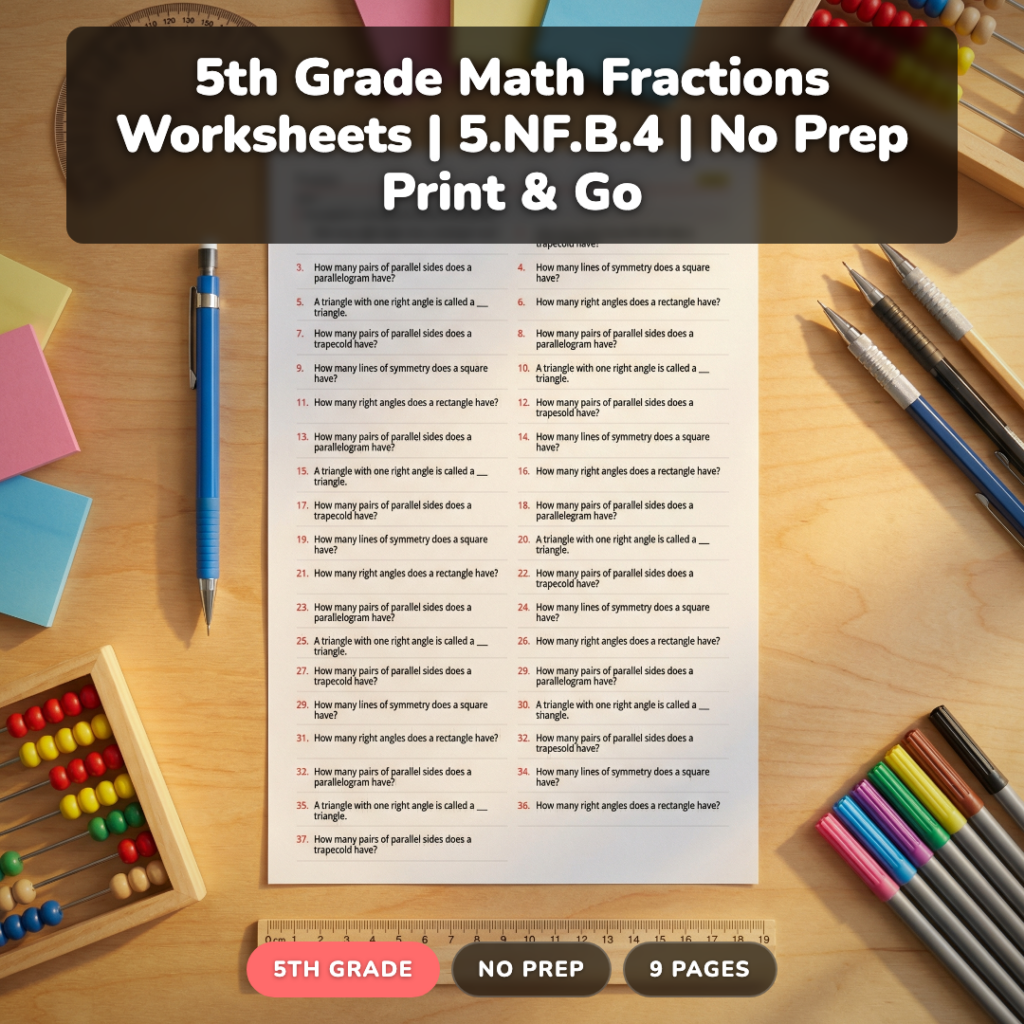
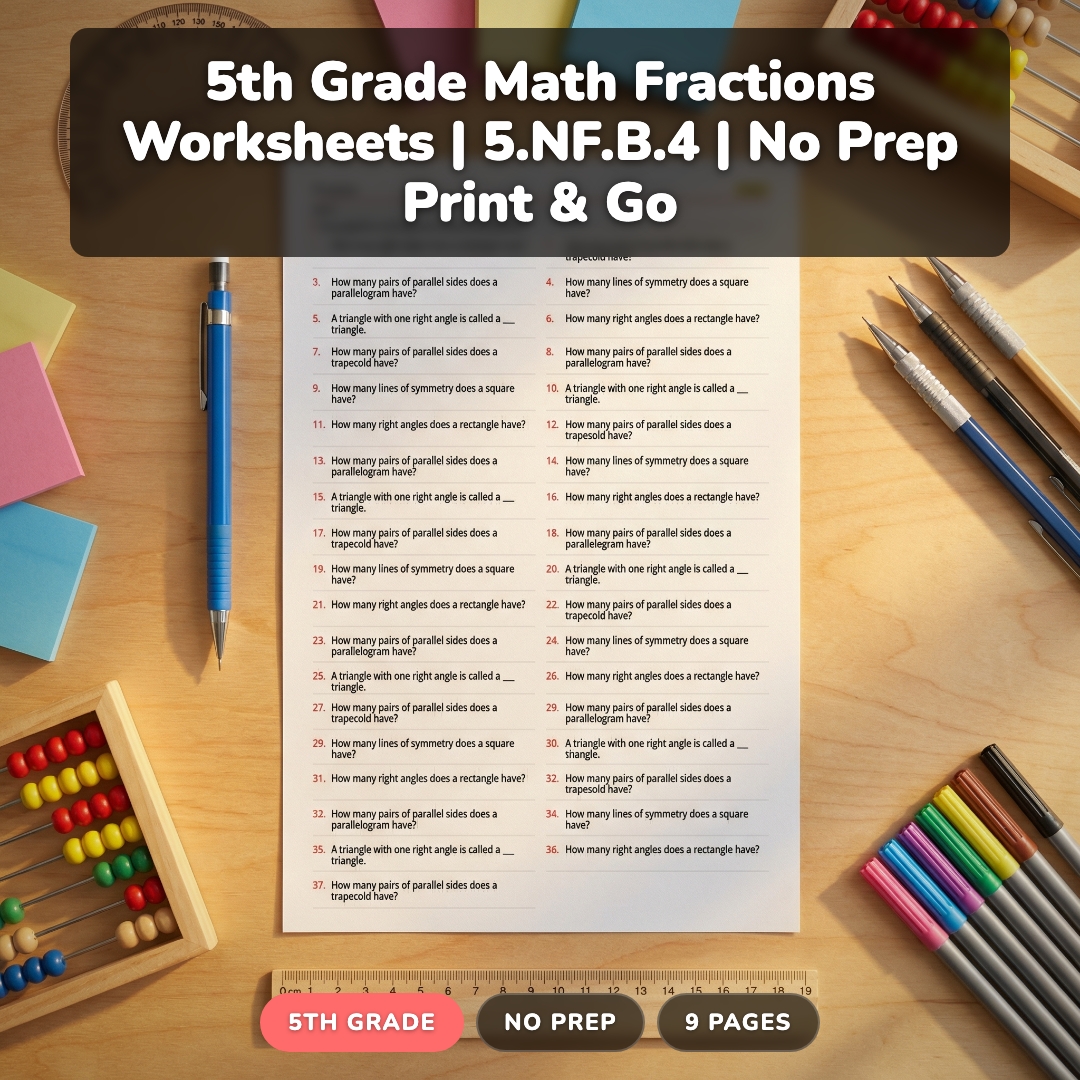
Teaching fraction multiplication effectively requires extensive practice at multiple difficulty levels, and creating differentiated materials takes hours of prep time. That’s why I developed a comprehensive fraction multiplication pack that addresses CCSS.Math.Content.5.NF.B.4 with 132 carefully scaffolded problems across three levels.
The resource includes 37 practice problems for students building foundational understanding, 50 on-level problems for grade-appropriate mastery, and 45 challenge problems for advanced learners. Each level includes word problems, visual models, and computational practice. Answer keys and teaching notes help you implement the strategies above efficiently.
What makes this resource different is the intentional progression from concrete models to abstract algorithms, plus built-in differentiation that lets every student access the content at their level.
Grab a Free Fraction Multiplication Sample to Try
Want to see how these strategies work in practice? I’ll send you a free sample page from each difficulty level, plus a quick reference guide for implementing the area model strategy. Perfect for trying out the approach with your students.
Frequently Asked Questions About Teaching Fraction Multiplication
When should I introduce the multiplication algorithm for fractions?
Introduce the algorithm only after students understand what fraction multiplication means through visual models and real-world contexts. Most students need 2-3 weeks of conceptual work before the “multiply across” rule makes sense and sticks.
Why do students struggle more with fraction × fraction than whole number × fraction?
Whole number × fraction connects to repeated addition (3 × 1/4 = 1/4 + 1/4 + 1/4), which students understand. Fraction × fraction requires the more abstract “part of a part” concept, which needs extensive visual modeling to develop.
How do I help students remember that products are smaller than factors?
Use consistent language like “finding a piece of” or “taking part of” rather than just “multiplying.” Connect to real experiences: taking half of a half pizza gives you less than the original half pizza.
What’s the most effective visual model for fraction multiplication?
Area models work best for most students because they clearly show the “part of a part” concept. Number lines help students who think linearly, while arrays connect to prior multiplication knowledge. Use multiple models for complete understanding.
How does CCSS.Math.Content.5.NF.B.4 connect to other fifth grade standards?
This standard builds on 5.NF.A (fraction equivalence and comparison) and connects forward to 5.NF.B.5 (interpreting multiplication as scaling). It also supports 5.NF.B.6 (real-world fraction problems) and prepares students for ratio reasoning in sixth grade.
Fraction multiplication becomes manageable when students understand the underlying concept before memorizing procedures. These five strategies give you multiple entry points for every learner in your classroom.
What’s your biggest challenge when teaching fraction multiplication? The visual models and consistent language in these strategies have transformed how my students approach these problems. Don’t forget to grab your free sample resource above — it’s a great way to test these approaches with your class.