If your 5th graders freeze when they see “Find the area of a rectangle with side lengths 2½ and 3¾,” you’re not alone. Teaching fractional area feels like combining two complex concepts—and that’s exactly what makes it challenging for students.
The good news? With the right strategies, your students can master CCSS.Math.Content.5.NF.B.4b and see the beautiful connection between multiplication and area, even with fractions. You’ll walk away with five research-backed approaches that transform confusion into confidence.
Key Takeaway
Students master fractional area when they can visualize the connection between tiling with unit squares and multiplying side lengths—making the abstract concrete.
Why Fractional Area Matters in 5th Grade
Fractional area represents a critical bridge in mathematical thinking. Students move from whole number area calculations they mastered in 3rd and 4th grade to the more complex world of rational numbers. This skill directly supports CCSS.Math.Content.5.NF.B.4b, which requires students to find areas by both tiling with unit squares and multiplying fractional side lengths.
Research from the National Council of Teachers of Mathematics shows that students who can visualize fractional area through multiple representations develop stronger number sense and are better prepared for algebra. The standard specifically asks students to “show that the area is the same” whether they tile or multiply—this dual approach builds mathematical reasoning.
Timing matters too. Introduce fractional area after students are solid with fraction multiplication (around February-March). They need to understand that ½ × ⅓ = ⅙ before they can see why a rectangle with sides ½ and ⅓ has area ⅙ square units.
Looking for a ready-to-go resource? I put together a differentiated fractional area pack that covers everything below—but first, the teaching strategies that make it work.
Common Fractional Area Misconceptions in 5th Grade
Common Misconception: Students add the side lengths instead of multiplying them.
Why it happens: They confuse area with perimeter or haven’t internalized that area means “covering space.”
Quick fix: Always start with concrete tiling before moving to the multiplication shortcut.
Common Misconception: Students think the area should be larger than both side lengths.
Why it happens: With whole numbers, area is usually bigger than the sides (3 × 4 = 12). With fractions, ½ × ⅓ = ⅙, which is smaller.
Quick fix: Use the phrase “when you multiply by a fraction, you get part of the original amount.”
Common Misconception: Students multiply denominators and numerators separately without understanding why.
Why it happens: They memorized the fraction multiplication algorithm without connecting it to area.
Quick fix: Show the visual model first, then connect it to the numerical calculation.
Common Misconception: Students can’t connect unit squares to the final area calculation.
Why it happens: They see tiling and multiplication as separate, unrelated processes.
Quick fix: Count unit squares together, then show how multiplication gives the same answer faster.
5 Research-Backed Strategies for Teaching Fractional Area
Strategy 1: Start with Concrete Tiling Using Fraction Squares
Before students ever see a multiplication problem, they need to physically tile rectangles with unit fraction squares. This builds the conceptual foundation that makes the standard algorithm meaningful.
What you need:
- Fraction square manipulatives (physical or printed)
- Large sheets of paper or whiteboards
- Rulers marked in fractions
Steps:
- Give students a rectangle drawn with sides 1½ by 2 units
- Provide ½-unit squares and ask them to cover the rectangle completely
- Count the unit squares together: “How many half-unit squares fit?”
- Connect to multiplication: “We used 6 half-unit squares, so the area is 6 × ½ = 3 square units”
- Repeat with different fractional side lengths, always counting first
Strategy 2: The Grid Paper Visualization Method
Grid paper transforms abstract fractional area into something students can see and count. This strategy bridges concrete manipulation and abstract thinking.
What you need:
- Grid paper (quarter-inch works well)
- Colored pencils or markers
- Fraction rulers
Steps:
- Students draw a rectangle with fractional dimensions on grid paper
- They shade the rectangle using a consistent color
- Count grid squares inside: full squares, half squares, quarter squares
- Convert the count to area: “15 quarter-squares = 15 × ¼ = 3¾ square units”
- Show how this matches multiplying the side lengths
Strategy 3: The Double Number Line Connection
Double number lines help students see the relationship between linear measurements and area calculations, making the multiplication visible.
What you need:
- Large chart paper
- Markers in two colors
- Sticky notes
Steps:
- Draw two parallel number lines, one for each dimension
- Mark fractional increments on both lines
- Students place sticky notes at the side lengths
- Draw the rectangle using the number lines as guides
- Calculate area by multiplying the coordinates where the sticky notes intersect
Strategy 4: Real-World Garden Plot Planning
Students design garden plots with fractional dimensions, making area calculations meaningful and memorable through authentic problem-solving.
What you need:
- Graph paper
- Garden planning sheets
- Calculators for checking
- Seed packet information (optional)
Steps:
- Students choose vegetables to “plant” in rectangular plots
- Give them fractional dimensions based on realistic garden sizes
- They calculate area to determine how many plants fit
- Compare different plot shapes with the same area
- Present findings to “garden committee” (classmates)
Strategy 5: The Area Model Bridge to Fraction Multiplication
This strategy explicitly connects area models students know from whole number multiplication to fractional calculations, building on prior knowledge.
What you need:
- Large rectangular templates
- Fraction strips
- Colored pencils
Steps:
- Start with a whole number area model students recognize
- Gradually introduce fractional parts: “What if one side is 2½?”
- Partition the rectangle to show the fractional parts
- Calculate each section’s area separately, then combine
- Show how this equals multiplying the mixed numbers directly
How to Differentiate Fractional Area for All Learners
For Students Who Need Extra Support
Start with unit fractions and whole number combinations (like 2 × ½). Use physical manipulatives for every problem until students can visualize independently. Provide fraction multiplication charts and encourage drawing pictures for each calculation. Review prerequisite skills: basic fraction concepts, area of rectangles with whole numbers, and simple fraction multiplication. Break complex problems into smaller steps and celebrate progress with simpler fractional side lengths.
For On-Level Students
Students work with mixed numbers and improper fractions in area calculations. They should fluently move between tiling models and multiplication algorithms. Expect them to explain their reasoning using mathematical vocabulary and connect area calculations to real-world contexts. Provide practice with CCSS.Math.Content.5.NF.B.4b at grade-level expectations, including problems that require converting between mixed numbers and improper fractions.
For Students Ready for a Challenge
Introduce complex fractions like 2⅝ × 1¾ and multi-step problems involving area comparisons. Students can explore how changing one dimension affects total area and investigate optimization problems (“What rectangle with perimeter 10½ has the greatest area?”). Connect to coordinate geometry by placing rectangles on coordinate planes with fractional coordinates. Challenge them to create their own word problems involving fractional area for classmates to solve.
A Ready-to-Use Fractional Area Resource for Your Classroom
Teaching fractional area requires extensive practice with problems at just the right level for each student. That’s where differentiated worksheets become essential—you need enough problems to build fluency without overwhelming students.
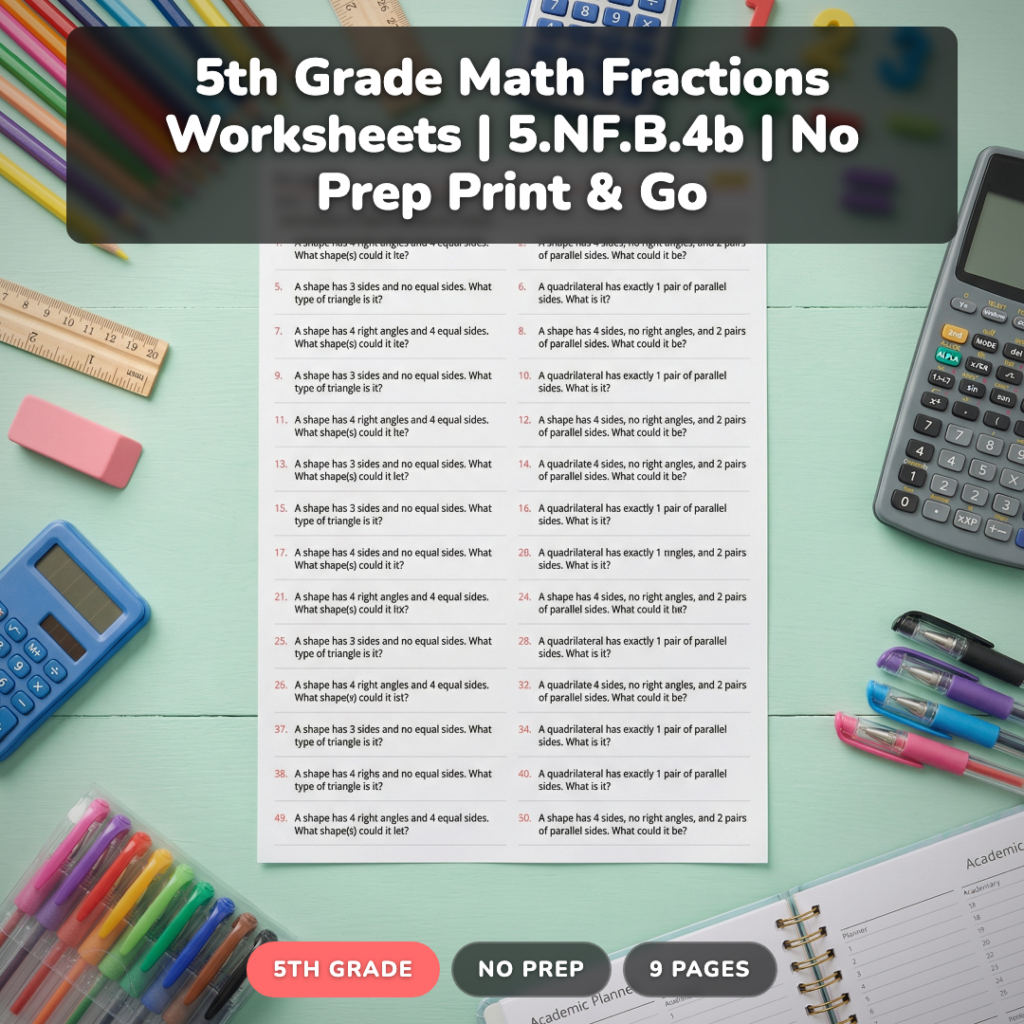
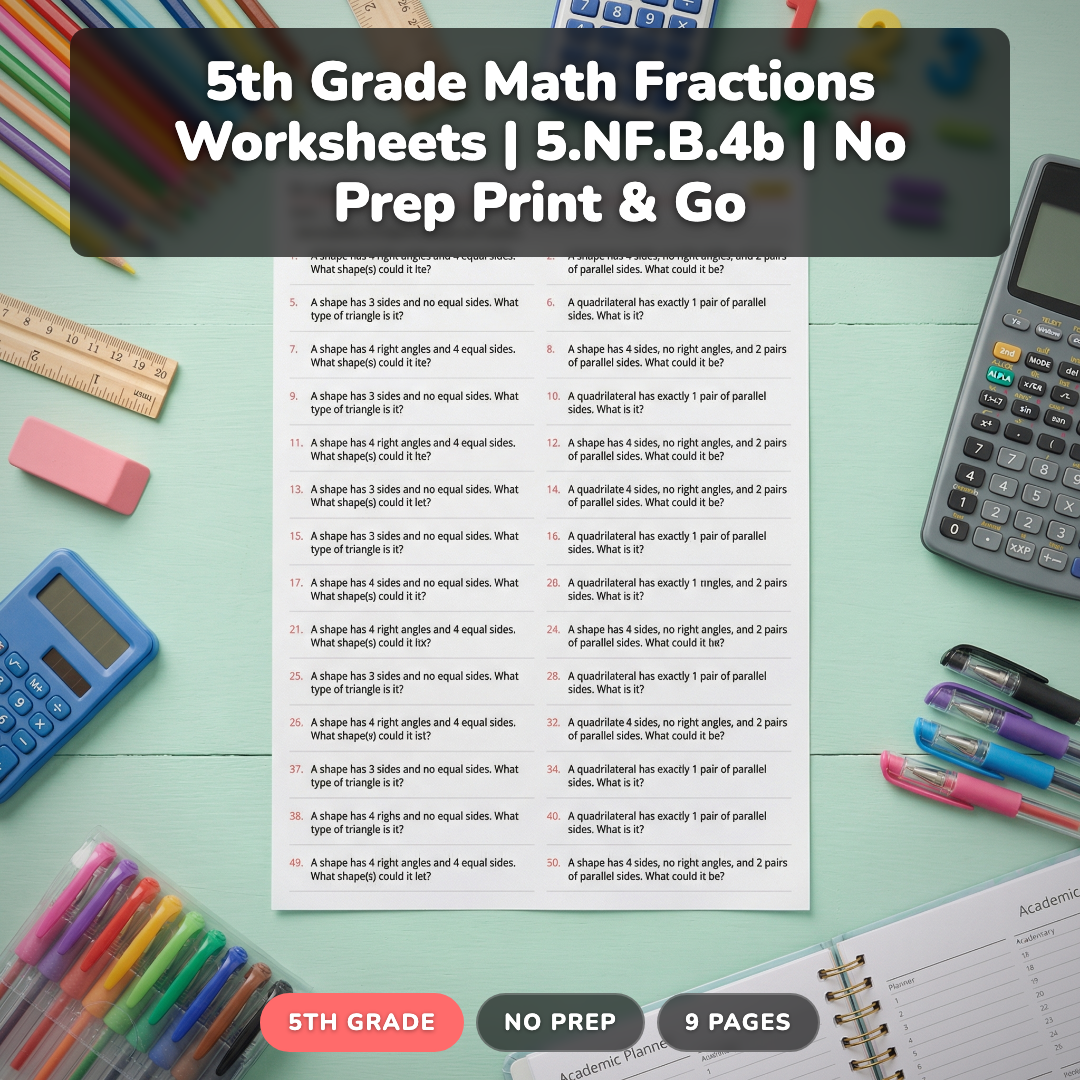
This fractional area worksheet pack includes 132 carefully crafted problems across three difficulty levels. The Practice level focuses on unit fractions and simple mixed numbers with clear visual supports. On-Level problems match grade 5 expectations with mixed numbers and improper fractions. Challenge problems push students with complex fractions and multi-step applications.
Each level includes detailed answer keys and follows the progression from concrete tiling to abstract multiplication that makes CCSS.Math.Content.5.NF.B.4b meaningful. The problems spiral in difficulty, so students build confidence before tackling more complex calculations.
Nine pages of differentiated practice means you can meet every student where they are while building toward the same learning goal.
Grab a Free Fractional Area Sample to Try
Want to see how these differentiated problems work in your classroom? I’ll send you a free sample with problems from each level, plus a quick reference guide for common student misconceptions.
Frequently Asked Questions About Teaching Fractional Area
When should I introduce fractional area in 5th grade?
Introduce fractional area after students master basic fraction multiplication, typically in February or March. Students need to understand that ½ × ⅓ = ⅙ before they can see why a rectangle with fractional sides has fractional area. Build on their whole number area foundation first.
What’s the biggest mistake students make with CCSS.Math.Content.5.NF.B.4b?
Students often add side lengths instead of multiplying them, confusing area with perimeter. They also struggle to connect tiling with unit squares to the multiplication algorithm. Always start with concrete tiling before moving to abstract calculations to avoid this misconception.
How do I help students who can’t visualize fractional unit squares?
Use physical manipulatives first—actual fraction squares they can touch and move. Progress to grid paper where they can count partial squares. Many students need this concrete stage for several weeks before they can visualize mentally. Don’t rush to abstract thinking.
Should students always convert mixed numbers to improper fractions for area?
Not necessarily. Students can use the distributive property with mixed numbers (2½ × 3 = 2×3 + ½×3). This often makes more sense conceptually and connects to their area model thinking. Teach both methods and let students choose their preferred approach.
How does fractional area connect to 6th grade math standards?
Fractional area builds foundation for coordinate geometry, where students plot points with fractional coordinates. It also supports ratio and proportion work, as students compare areas with different fractional dimensions. Strong fractional area skills make 6th grade much smoother.
Making Fractional Area Click for Every Student
The key to successful fractional area instruction is helping students see that tiling and multiplication are two ways to solve the same problem—not separate, unrelated skills. When students can visualize how unit squares fill a rectangle and connect that to multiplying side lengths, they truly understand CCSS.Math.Content.5.NF.B.4b.
What’s your go-to strategy for helping students visualize fractional area? The concrete-to-abstract progression works for most students, but every class has its own personality.
Don’t forget to grab your free fractional area sample above—it’s a great way to test these strategies with your students before diving into more extensive practice.