If your 5th graders freeze when they see decimal operations, you’re not alone. Adding, subtracting, multiplying, and dividing decimals to hundredths feels overwhelming to many students — but with the right teaching strategies, you can build their confidence and computational fluency step by step.
Key Takeaway
Teaching decimal operations effectively requires connecting concrete models to place value understanding before introducing abstract algorithms.
Why Decimal Operations Matter in 5th Grade
Decimal operations form the foundation for middle school mathematics, from solving multi-step problems to understanding percentages and ratios. Standard CCSS.Math.Content.5.NBT.B.7 requires students to add, subtract, multiply, and divide decimals to hundredths using concrete models, place value strategies, and written methods while explaining their reasoning.
Research from the National Council of Teachers of Mathematics shows that students who master decimal operations with conceptual understanding perform 40% better on algebraic reasoning tasks in middle school. The key is teaching these operations through multiple representations — concrete models, visual drawings, and strategic thinking — before moving to standard algorithms.
Most schools introduce decimal operations in late fall or winter, after students have solid whole number place value understanding. Students need approximately 3-4 weeks of focused instruction to develop fluency with all four operations to hundredths.
Looking for a ready-to-go resource? I put together a differentiated decimal operations pack that covers everything below — but first, the teaching strategies that make it work.
Common Decimal Operations Misconceptions in 5th Grade
Common Misconception: When adding decimals, students line up the right-most digits instead of decimal points.
Why it happens: They apply whole number addition rules without considering place value.
Quick fix: Use grid paper and emphasize “decimal point under decimal point” as a mantra.
Common Misconception: Students think 0.5 × 0.3 should equal a larger number than either factor.
Why it happens: Whole number multiplication always makes numbers bigger, so they expect the same pattern.
Quick fix: Connect to fraction multiplication (1/2 × 3/10) and use area models to show why products get smaller.
Common Misconception: When dividing decimals, students move decimal points randomly without understanding why.
Why it happens: They memorize rules without connecting to place value meaning.
Quick fix: Always start with money contexts and equivalent fractions before teaching decimal point movement.
Common Misconception: Students believe 0.7 – 0.25 equals 0.18 by subtracting digits in each place separately.
Why it happens: They don’t understand regrouping across decimal places.
Quick fix: Use base-ten blocks where flats = ones, rods = tenths, units = hundredths to show regrouping visually.
5 Research-Backed Strategies for Teaching Decimal Operations
Strategy 1: Money Model Foundation
Start every decimal operation unit with money because students already understand dollars and cents intuitively. This concrete connection helps them grasp decimal place value before moving to abstract numbers.
What you need:
- Play money (bills and coins)
- Decimal grids or hundredths charts
- Real-world shopping scenarios
Steps:
- Present problems like “You buy a pencil for $0.75 and an eraser for $0.48. How much do you spend?”
- Have students solve using actual coins first, then record on decimal grids
- Connect the money solution to decimal notation: $0.75 + $0.48 = $1.23
- Practice all four operations with money contexts before moving to abstract decimals
Strategy 2: Base-Ten Block Visualization
Use base-ten blocks with a different place value assignment to make decimal operations concrete. This helps students see regrouping and understand why algorithms work.
What you need:
- Base-ten blocks (flats, rods, units)
- Place value mats labeled for decimals
- Recording sheets to connect models to numbers
Steps:
- Establish that flats = ones, rods = tenths, small cubes = hundredths
- Model addition problems like 1.35 + 0.47 by building both numbers with blocks
- Combine like pieces, trading 10 hundredths for 1 tenth when needed
- Record each step numerically to connect the concrete model to abstract notation
- Extend to subtraction by demonstrating regrouping with blocks
Strategy 3: Grid Paper Precision Method
Grid paper eliminates alignment errors and helps students visualize place value relationships. This strategy works especially well for addition and subtraction of decimals.
What you need:
- Quarter-inch grid paper
- Colored pencils or markers
- Decimal operation problems
Steps:
- Show students how to write one digit per square, with decimal points taking their own column
- Use different colors for ones, tenths, and hundredths places
- Practice the mantra “decimal point under decimal point” while setting up problems
- Add zeros as placeholders when needed (2.5 + 0.37 becomes 2.50 + 0.37)
- Solve using standard algorithms with perfect alignment guaranteed
Strategy 4: Fraction Connection for Multiplication
Connect decimal multiplication to fraction multiplication to build conceptual understanding before teaching the decimal point counting rule.
What you need:
- Fraction-decimal equivalence charts
- Area model grids (10×10)
- Colored pencils for shading
Steps:
- Start with problems like 0.3 × 0.4, converting to fractions: 3/10 × 4/10
- Use area models on 10×10 grids to show 3 rows and 4 columns shaded
- Count the overlapping squares: 12 out of 100 = 12/100 = 0.12
- Connect this visual to the decimal algorithm: 3 × 4 = 12, with 2 decimal places total
- Practice with various decimal combinations, always connecting to the area model first
Strategy 5: Estimation and Reasonableness Checks
Teach students to estimate before calculating and check their answers for reasonableness. This prevents common decimal point placement errors.
What you need:
- Number lines marked in tenths and hundredths
- Estimation anchor charts
- Calculator for verification
Steps:
- Before solving any decimal problem, have students estimate using rounding or benchmarks
- For 4.73 + 2.89, estimate: “About 5 + 3 = 8”
- Solve using chosen method, then compare to estimate
- If the answer is far from the estimate, investigate the error
- Use calculators to verify final answers and build number sense
How to Differentiate Decimal Operations for All Learners
For Students Who Need Extra Support
Focus on money contexts exclusively for the first week, ensuring students can add and subtract dollars and cents fluently. Provide place value charts with decimal points pre-marked and use only tenths and hundredths initially. Scaffold with base-ten blocks for every problem before moving to paper-and-pencil methods. Review fraction equivalents (1/2 = 0.5, 1/4 = 0.25) frequently to strengthen decimal number sense.
For On-Level Students
Students working at grade level should master all four operations with decimals to hundredths as outlined in CCSS.Math.Content.5.NBT.B.7. They should explain their reasoning using multiple strategies and connect concrete models to abstract algorithms. Provide mixed practice with all operations and real-world problem-solving contexts. Students should estimate answers and check for reasonableness consistently.
For Students Ready for a Challenge
Extend to thousandths place operations and multi-step problems combining different operations. Introduce scientific notation basics and connect decimal operations to measurement conversions (meters to centimeters to millimeters). Challenge students to create their own word problems and teach decimal strategies to younger students. Explore patterns in decimal multiplication and division, such as multiplying by 0.1, 0.01, etc.
A Ready-to-Use Decimal Operations Resource for Your Classroom
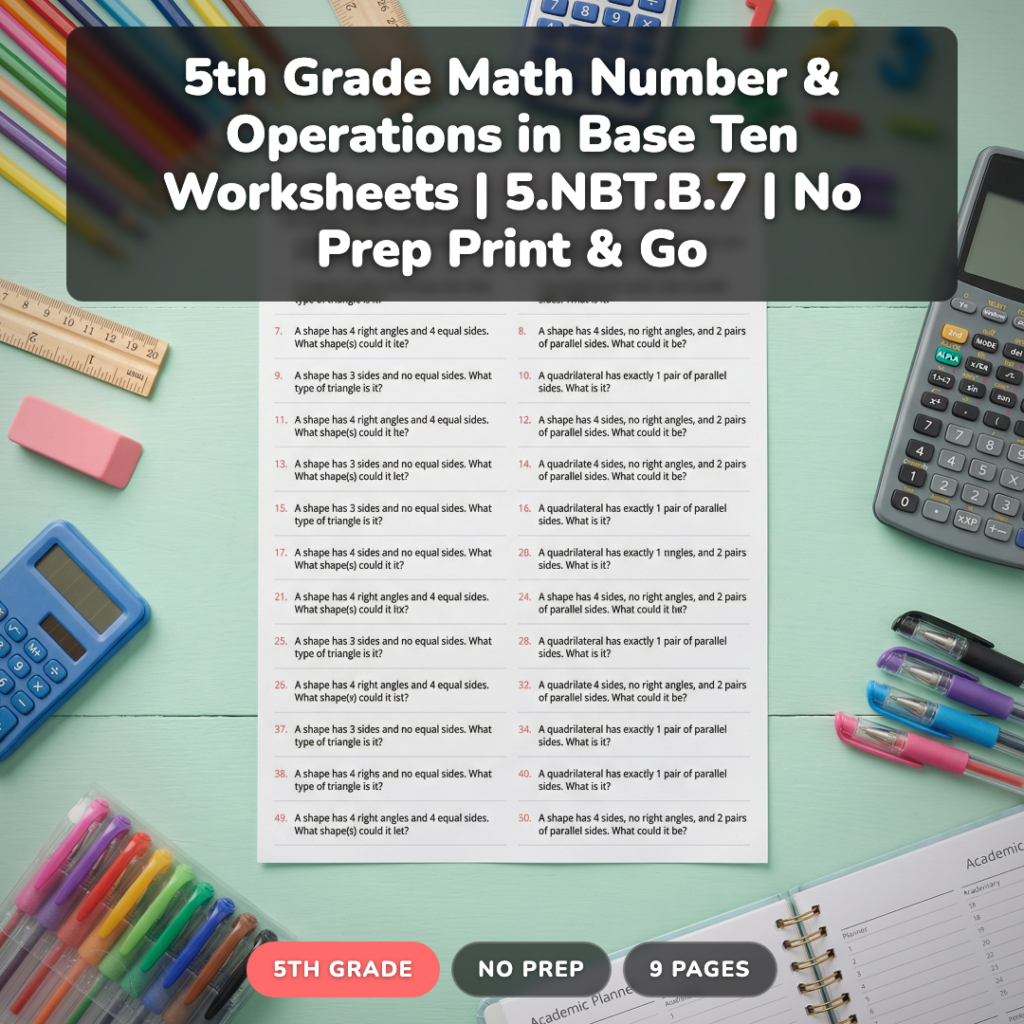
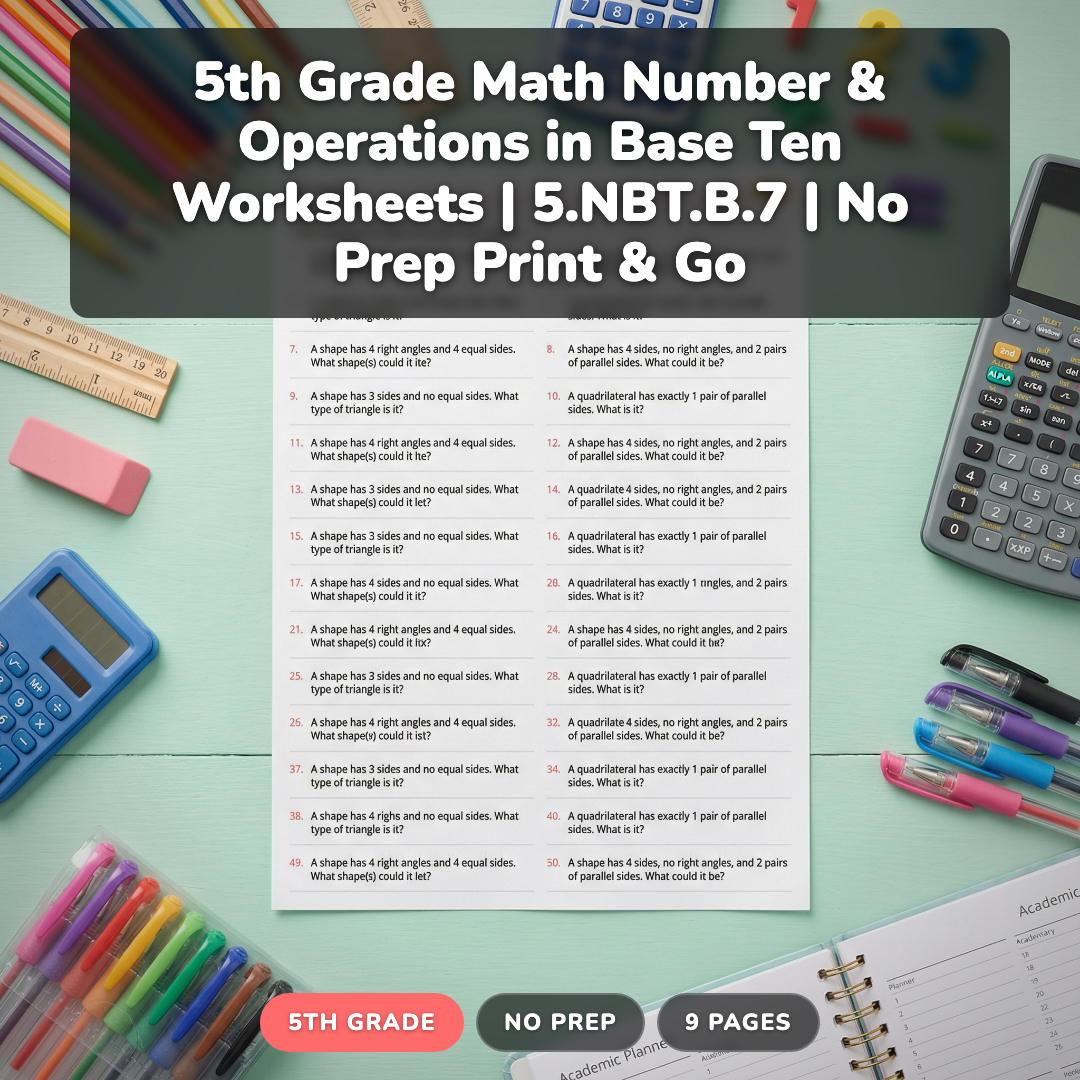
Teaching decimal operations requires extensive practice at multiple difficulty levels, and creating differentiated worksheets from scratch takes hours of prep time. The Number & Operations in Base Ten worksheet pack I created specifically addresses CCSS.Math.Content.5.NBT.B.7 with 132 carefully scaffolded problems across three difficulty levels.
The Practice level (37 problems) focuses on basic operations with visual supports and money contexts. The On-Level section (50 problems) provides grade-appropriate challenges with mixed operations and word problems. The Challenge level (45 problems) extends learning with multi-step problems and real-world applications. Each level includes complete answer keys with step-by-step solutions.
What sets this resource apart is the intentional progression from concrete to abstract thinking, with problems designed to address the most common misconceptions. You can use these worksheets for whole-group instruction, math centers, homework, or assessment preparation.
The 9-page pack saves you hours of prep time while ensuring every student gets appropriately challenging practice.
Grab a Free Decimal Operations Sample to Try
Want to see the quality and format before purchasing? I’ll send you a free sample worksheet with problems from each difficulty level, plus my decimal operations teaching tips checklist.
Frequently Asked Questions About Teaching Decimal Operations
When should I introduce decimal multiplication and division in 5th grade?
Introduce decimal multiplication after students master decimal addition and subtraction, typically in late winter. Start with multiplication by whole numbers, then progress to decimal × decimal. Division should come last, beginning with whole number divisors before decimal divisors.
How do I help students remember decimal point placement rules?
Always connect rules to conceptual understanding first. For multiplication, use area models to show why decimal places add together. For division, start with money problems and equivalent fractions. Memorized rules without understanding lead to errors and confusion.
What’s the biggest mistake teachers make when teaching decimal operations?
Moving to abstract algorithms too quickly without building conceptual foundation. Students need extensive experience with concrete models and visual representations before standard procedures make sense. Rushing to algorithms creates procedural knowledge without understanding.
How much practice do students need to become fluent with decimal operations?
Research suggests students need 15-20 practice sessions with immediate feedback to develop fluency. Mix problem types and contexts, and include both computational practice and word problems. Distributed practice over several weeks works better than massed practice.
Should I allow calculators when teaching decimal operations?
Use calculators strategically for verification and exploration, not as a replacement for understanding. Students should develop computational fluency first, then use calculators to check reasonableness and solve complex multi-step problems where computation isn’t the focus.
Building Decimal Confidence Step by Step
Teaching decimal operations successfully requires patience, multiple representations, and lots of practice at the right level. When students understand the why behind the procedures, they develop both computational fluency and mathematical confidence.
What’s your biggest challenge when teaching decimal operations? I’d love to hear about strategies that work in your classroom — and don’t forget to grab that free sample worksheet to try these approaches with your students.