How to Teach Coordinate Planes in 5th Grade: 5 Strategies That Work
If your 5th graders look confused when you mention ordered pairs, or they consistently mix up x and y coordinates, you’re not alone. Teaching coordinate planes can feel like introducing a foreign language — but with the right strategies, students can master this foundational geometry skill. You’ll discover five research-backed approaches that make coordinate systems click for every learner in your classroom.
Key Takeaway
Students master coordinate planes when they connect movement and direction to mathematical notation through hands-on practice and visual anchors.
Why Coordinate Planes Matter in 5th Grade
Coordinate planes introduce students to the foundation of algebraic thinking and spatial reasoning. This skill directly supports CCSS.Math.Content.5.G.A.1, which requires students to understand how perpendicular number lines create a coordinate system where ordered pairs locate specific points.
Research from the National Council of Teachers of Mathematics shows that students who master coordinate systems in elementary grades perform 23% better on algebraic concepts in middle school. The coordinate plane bridges concrete mathematical thinking with abstract representation — a critical shift that happens in 5th grade.
Timing matters significantly. Most teachers introduce coordinate planes in late fall or early winter, after students have solidified their understanding of positive and negative integers. This skill connects directly to graphing functions in 6th grade and solving linear equations in algebra.
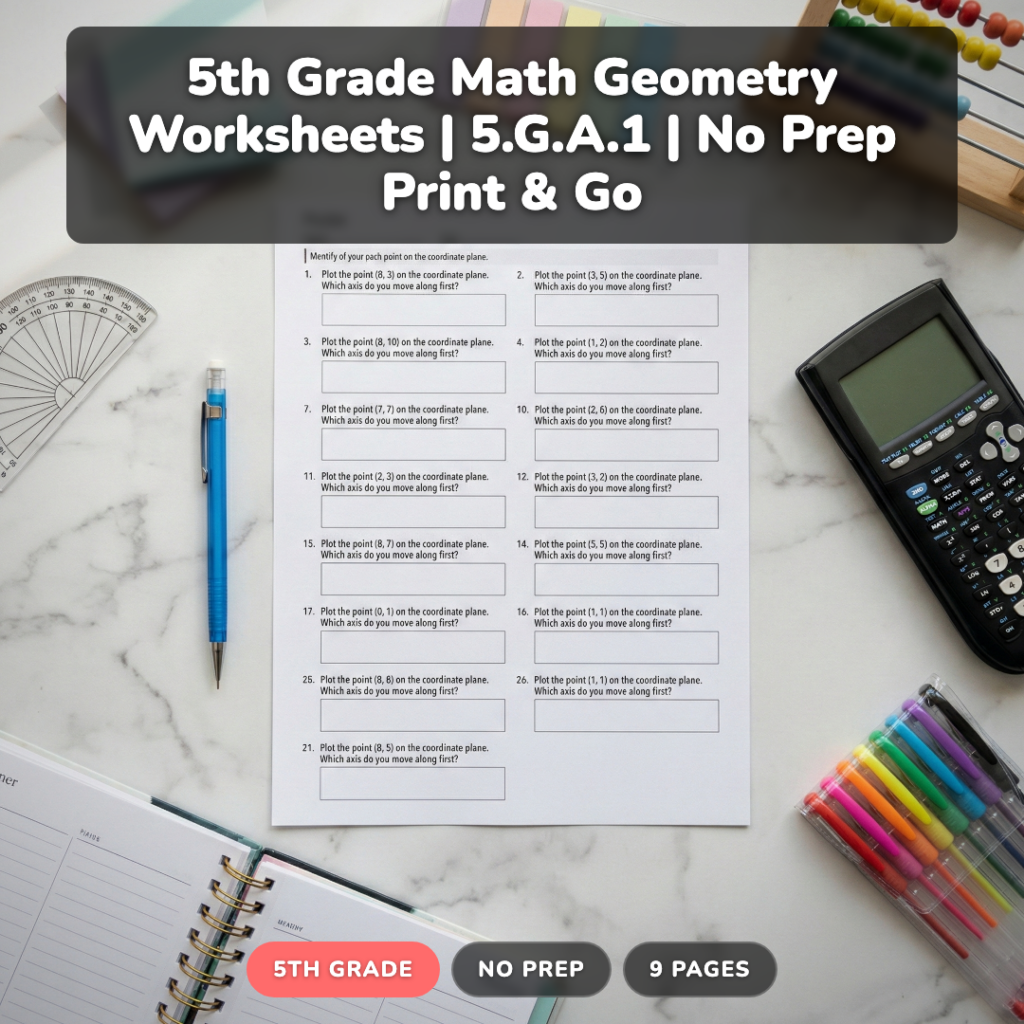
Looking for a ready-to-go resource? I put together a differentiated coordinate plane pack that covers everything below — but first, the teaching strategies that make it work.
Common Coordinate Plane Misconceptions in 5th Grade
Common Misconception: Students read coordinates as (y, x) instead of (x, y).
Why it happens: They naturally read from top to bottom, like reading text.
Quick fix: Teach the phrase “across the hall, up the stairs” — x first, then y.
Common Misconception: Students think the origin is just another point.
Why it happens: They don’t understand its special role as the starting reference.
Quick fix: Call it “home base” and always start every coordinate journey there.
Common Misconception: Students confuse which direction is positive or negative.
Why it happens: The abstract nature of direction on a flat plane.
Quick fix: Use consistent directional language: “right is positive x, up is positive y.”
Common Misconception: Students plot points in random locations without counting.
Why it happens: They rush to place points without understanding the systematic approach.
Quick fix: Require finger tracing from origin to destination for every point.
5 Research-Backed Strategies for Teaching Coordinate Planes
Strategy 1: Human Coordinate Plane with Floor Tape
Transform your classroom floor into a giant coordinate plane where students become the points. This kinesthetic approach helps students internalize the movement patterns that define coordinate systems.
What you need:
- Painter’s tape or masking tape
- Index cards with coordinates written on them
- Small prizes or stickers for motivation
Steps:
- Create a large coordinate plane on your floor using tape, with the origin in the center
- Mark numbers 1-10 on both axes using tape and markers
- Call out coordinates and have students walk to that location
- Start with positive coordinates only, then add negative numbers
- Have students call out their own coordinates from where they’re standing
Strategy 2: Coordinate Plane Battleship
Adapt the classic game to reinforce coordinate notation while maintaining high engagement. Students practice reading and writing ordered pairs in a familiar game context.
What you need:
- Printed coordinate grids (10×10 works well)
- Small manipulatives for “ships”
- Recording sheets for guesses
Steps:
- Partners each place 5 “ships” on their hidden coordinate grid
- Players take turns calling out coordinates to find opponent’s ships
- Require proper coordinate notation: “I attack (4, 7)”
- Mark hits and misses on a separate tracking grid
- First player to find all ships wins the round
Strategy 3: Coordinate Plane Art with Mystery Pictures
Students plot sequential coordinates to reveal hidden pictures, combining mathematical precision with creative satisfaction. This strategy reinforces accurate plotting while providing immediate visual feedback.
What you need:
- Coordinate grid paper
- Lists of ordered pairs that create simple pictures
- Colored pencils or markers
Steps:
- Provide students with a list of 15-20 coordinates in sequence
- Students plot each point carefully and connect them in order
- The connected points reveal a recognizable shape or picture
- Start with simple shapes like houses or stars
- Progress to more complex images as students improve accuracy
Strategy 4: Real-World Coordinate Mapping
Connect coordinate planes to students’ lives by mapping familiar locations like their school, neighborhood, or classroom. This strategy builds relevance and helps students see practical applications.
What you need:
- Simple maps or floor plans
- Transparent coordinate grid overlays
- Location cards with school places
Steps:
- Place a coordinate grid overlay on a school map
- Identify the origin as a central location like the main office
- Students find coordinates for locations like the library (3, 5) or gym (-2, 4)
- Practice giving directions using coordinate language
- Create treasure hunts with coordinate clues
Strategy 5: Interactive Coordinate Plane Anchor Charts
Build visual reference tools with students that reinforce key vocabulary and movement patterns. These student-created anchors become permanent classroom supports.
What you need:
- Large poster paper
- Markers in different colors
- Sticky notes for student additions
Steps:
- Create a large coordinate plane together, with students directing each element
- Add directional arrows and label positive/negative regions
- Include memory devices like “x comes before y in the alphabet”
- Plot example points with different colors for x and y coordinates
- Add student-generated examples throughout the unit
How to Differentiate Coordinate Planes for All Learners
For Students Who Need Extra Support
Begin with positive coordinates only on smaller grids (5×5 or 8×8). Use physical manipulatives to trace the path from origin to destination. Provide coordinate cards with the movement written out: “(3,4) means go right 3, up 4.” Practice with concrete objects before moving to abstract plotting. Review number line skills if students struggle with counting or direction.
For On-Level Students
Work with standard 10×10 coordinate planes including all four quadrants. Students should master CCSS.Math.Content.5.G.A.1 expectations: plotting points, reading coordinates, and understanding the relationship between axes and coordinate notation. Include varied practice with both positive and negative coordinates. Focus on accuracy and proper mathematical language.
For Students Ready for a Challenge
Introduce coordinate patterns and transformations. Students can explore what happens when you add the same number to all x-coordinates or y-coordinates. Create coordinate plane puzzles where students must determine missing coordinates in a pattern. Connect to early algebraic thinking by having students describe coordinate relationships using mathematical language.
A Ready-to-Use Coordinate Plane Resource for Your Classroom
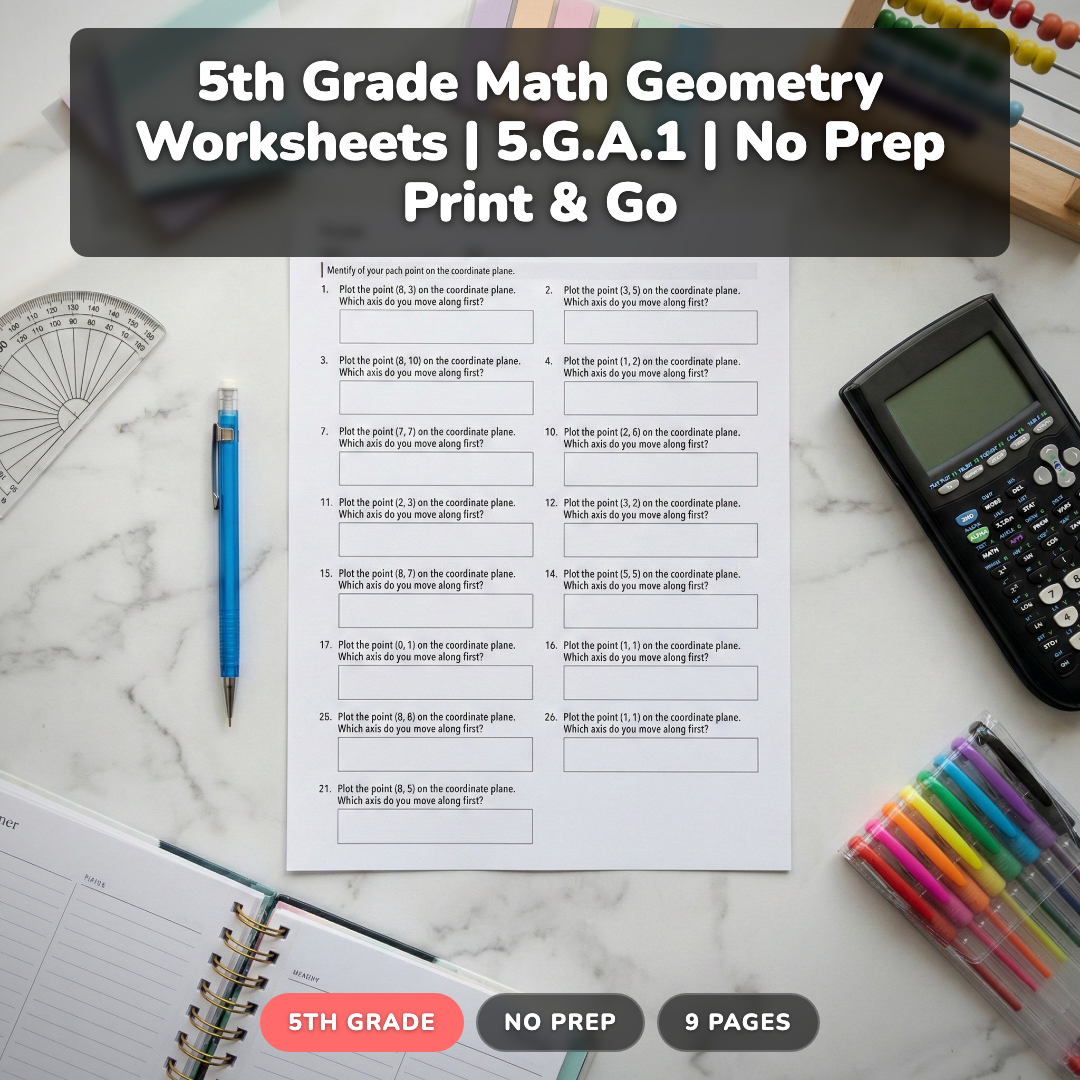
After years of creating coordinate plane activities from scratch, I developed a comprehensive resource that saves hours of prep time while providing exactly the differentiation your students need. This coordinate plane pack includes 132 carefully crafted problems across three difficulty levels.
The Practice level focuses on positive coordinates with clear visual supports. On-Level problems cover all four quadrants with varied coordinate ranges. Challenge problems include coordinate patterns and real-world applications. Each level includes detailed answer keys and teaching notes that explain common student errors.
What makes this resource different is the systematic progression — students build confidence with simpler coordinates before tackling negative numbers. The problems include engaging contexts like treasure maps, city planning, and geometric art that keep students motivated while practicing essential skills.
With 9 pages of differentiated practice covering every aspect of coordinate planes, this resource provides weeks of meaningful practice without any prep work on your part.
Grab a Free Coordinate Plane Activity to Try
Want to test these strategies in your classroom? I’ve created a free coordinate plane mystery picture that your students will love. It includes step-by-step plotting instructions and works perfectly with any of the teaching strategies above. Drop your email below and I’ll send it right over.
Frequently Asked Questions About Teaching Coordinate Planes
When should I introduce coordinate planes in 5th grade?
Introduce coordinate planes after students master integer concepts, typically in late fall or early winter. Students need solid number line understanding and directional awareness before tackling coordinate systems. Allow 2-3 weeks for complete mastery of CCSS.Math.Content.5.G.A.1 standards.
How do I help students remember x comes before y?
Teach memorable phrases like “across the hall, up the stairs” or “x comes before y in the alphabet.” Use consistent hand gestures — point right for x-axis, point up for y-axis. Practice with physical movement before abstract plotting to build muscle memory.
Should 5th graders work with negative coordinates?
Yes, 5th graders should practice all four quadrants according to Common Core standards. Start with positive coordinates for confidence, then gradually introduce negative numbers. Use real-world contexts like temperature or elevation to make negative coordinates meaningful and relatable.
What’s the biggest mistake students make with coordinate planes?
Students most commonly reverse the order of coordinates, reading (y, x) instead of (x, y). This happens because they naturally read from top to bottom. Combat this with consistent verbal reinforcement and kinesthetic practice that emphasizes horizontal movement first.
How much practice do students need with coordinate planes?
Students typically need 10-15 practice sessions with coordinate planes to achieve fluency. Include 5-10 minutes of daily practice over 2-3 weeks rather than marathon sessions. Varied activities maintain engagement while building automaticity with coordinate notation and plotting.
Teaching coordinate planes successfully comes down to making abstract concepts concrete through movement, visual supports, and systematic practice. When students can confidently navigate coordinate systems, they’re prepared for the algebraic thinking that defines middle school mathematics.
What’s your favorite strategy for helping students master coordinate planes? Try the free mystery picture activity and see which approach works best for your classroom — then grab the complete resource pack for differentiated practice that meets every learner’s needs.