If your 5th graders freeze when they see fraction word problems, you’re not alone. Adding and subtracting fractions with unlike denominators is where many students hit their first major math wall. The good news? With the right teaching strategies, you can help every student master CCSS.Math.Content.5.NF.A.2 and build lasting fraction sense.
Key Takeaway
Success with fraction word problems comes from building visual understanding before moving to algorithms, teaching benchmark fraction estimation, and connecting real-world contexts to mathematical reasoning.
Why 5th Grade Fraction Word Problems Matter
The jump from basic fraction operations to word problems represents a critical shift in mathematical thinking. CCSS.Math.Content.5.NF.A.2 specifically requires students to solve word problems involving addition and subtraction of fractions with unlike denominators, use visual models, and estimate using benchmark fractions.
Research from the National Assessment of Educational Progress shows that only 24% of 5th graders demonstrate proficiency with fraction operations in problem-solving contexts. This skill directly impacts success in middle school algebra, where fraction operations become foundational for solving equations and working with rational expressions.
The standard appears in most curricula between February and April, building on earlier work with equivalent fractions (5.NF.A.1) and setting the stage for fraction multiplication later in the year. Students need approximately 4-6 weeks of intensive instruction and practice to develop automaticity with these concepts.
Looking for a ready-to-go resource? I put together a differentiated fraction word problems pack that covers everything below — but first, the teaching strategies that make it work.
Common Fraction Word Problem Misconceptions in 5th Grade
Common Misconception: Students add or subtract numerators and denominators separately (1/3 + 1/4 = 2/7).
Why it happens: They apply whole number addition rules to fractions without understanding what denominators represent.
Quick fix: Use visual models consistently to show why denominators must be the same before adding.
Common Misconception: Students always find the LCD by multiplying denominators (3 × 4 = 12 for 1/3 + 1/4).
Why it happens: They memorize a rule without understanding equivalent fractions or factor relationships.
Quick fix: Teach multiple methods for finding common denominators and emphasize choosing the most efficient one.
Common Misconception: Students ignore reasonableness and accept impossible answers (3/4 + 2/3 = 17/12 without recognizing this exceeds 1).
Why it happens: They focus solely on computation without developing number sense for fraction quantities.
Quick fix: Always require estimation before computation using benchmark fractions like 1/2, 1/4, and 3/4.
Common Misconception: Students struggle to identify the operation needed in word problems.
Why it happens: They lack experience connecting real-world fraction contexts to mathematical operations.
Quick fix: Use consistent problem types and teach students to identify key phrases and visualize the action in the problem.
5 Research-Backed Strategies for Teaching Fraction Word Problems
Strategy 1: Visual Fraction Models First
Start every fraction word problem with a visual representation before moving to abstract computation. This builds conceptual understanding and helps students see why common denominators are necessary.
What you need:
- Fraction bars or circles
- Grid paper
- Interactive whiteboard or document camera
- Colored pencils or markers
Steps:
- Read the problem aloud and identify the fractions involved
- Draw or use manipulatives to show each fraction separately
- Discuss what the problem is asking (combining parts or finding the difference)
- Model the operation visually before writing the equation
- Connect the visual solution to the numerical answer
Strategy 2: Benchmark Fraction Estimation
Teach students to estimate answers using benchmark fractions (0, 1/4, 1/2, 3/4, 1) before solving. This develops number sense and helps catch unreasonable answers.
What you need:
- Number line from 0 to 2
- Benchmark fraction reference chart
- Sticky notes for marking estimates
Steps:
- Identify where each fraction falls relative to benchmark fractions
- Estimate the sum or difference using benchmarks
- Mark the estimate on a number line
- Solve the problem using standard algorithms
- Compare the exact answer to the estimate and discuss reasonableness
Strategy 3: Problem-Solving Protocol with Think-Alouds
Use a consistent four-step protocol for approaching fraction word problems, modeling your thinking process explicitly through teacher think-alouds.
What you need:
- Problem-solving anchor chart
- Highlighters for marking key information
- Scratch paper for work
Steps:
- Understand: Read twice, highlight key information, identify what we know and what we need to find
- Plan: Choose a strategy (visual model, equation, number line) and estimate the answer
- Solve: Work through the chosen strategy step-by-step, showing all work
- Check: Compare answer to estimate, verify using a different method if possible
Strategy 4: Real-World Context Connections
Use authentic, relatable contexts that help students understand when and why they would add or subtract fractions in real life.
What you need:
- Recipe cards with fractional measurements
- Measuring cups and spoons
- Time schedules with fractional hours
- Sports statistics with fractions
Steps:
- Introduce problems in contexts students understand (cooking, sports, time)
- Connect the mathematical operation to the real-world action
- Have students create their own word problems using similar contexts
- Solve problems using multiple representations (visual, numerical, verbal)
- Discuss how the mathematical solution relates back to the real situation
Strategy 5: Error Analysis and Mathematical Discourse
Present common student errors and facilitate discussions about why mistakes happen and how to fix them, building metacognitive awareness.
What you need:
- Examples of incorrect student work
- Chart paper for recording student thinking
- Colored pens for marking corrections
Steps:
- Show an incorrect solution to a fraction word problem
- Ask students to identify where the error occurred
- Discuss why the student might have made that mistake
- Work together to correct the error using visual models
- Have students explain the correct reasoning in their own words
How to Differentiate Fraction Word Problems for All Learners
For Students Who Need Extra Support
Focus on building foundational understanding with concrete manipulatives and simplified problem contexts. Provide fraction strips or circles for every problem, and start with like denominators before moving to unlike denominators. Use problems with smaller, friendlier numbers (halves, fourths, thirds) and real-world contexts they can visualize easily. Offer sentence frames like ‘I need to find…’ and ‘This means I should…’ to support mathematical communication.
For On-Level Students
Present problems that align directly with CCSS.Math.Content.5.NF.A.2 expectations, including a mix of denominators and problem types. Encourage students to solve problems using at least two different methods (visual and numerical) and explain their reasoning. Provide opportunities for peer collaboration and mathematical discourse. Focus on developing efficiency with common denominator strategies while maintaining conceptual understanding.
For Students Ready for a Challenge
Extend learning with multi-step word problems involving three or more fractions, mixed numbers, and more complex real-world contexts. Challenge students to create their own word problems and solve them multiple ways. Introduce connections to decimals and percentages, and explore problems where estimation and reasonableness become crucial for checking work. Have them analyze and correct errors in other students’ work.
A Ready-to-Use Fraction Word Problems Resource for Your Classroom
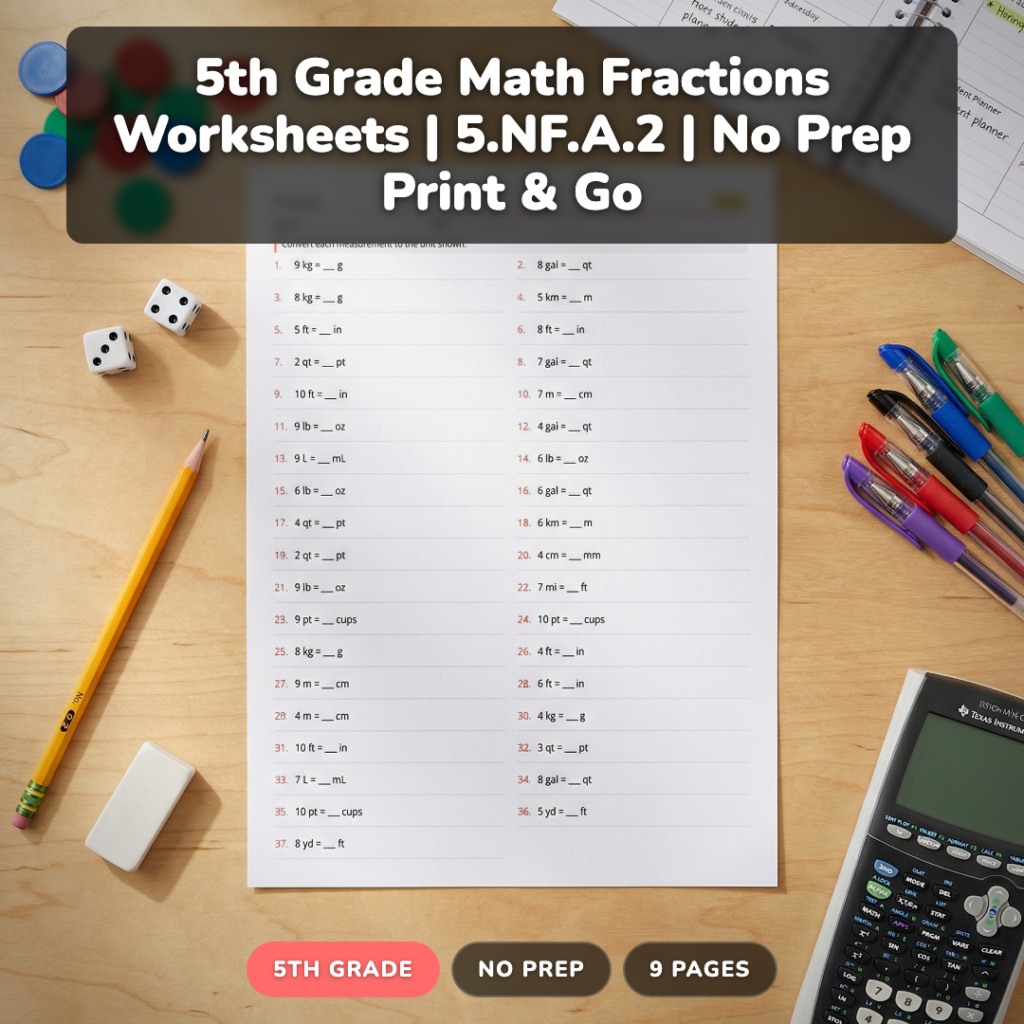
After years of teaching 5th grade fractions, I created a comprehensive resource that addresses every aspect of CCSS.Math.Content.5.NF.A.2. This 9-page differentiated pack includes 132 carefully crafted word problems across three levels: 37 practice problems for building foundations, 50 on-level problems for grade-level mastery, and 45 challenge problems for extending learning.
What makes this resource different is the intentional progression within each level. Problems start with visual support and familiar contexts, then gradually increase in complexity. Each level includes a mix of addition and subtraction problems, various denominator combinations, and real-world contexts that matter to 5th graders. Complete answer keys show multiple solution strategies, making it easy to support different learner needs.
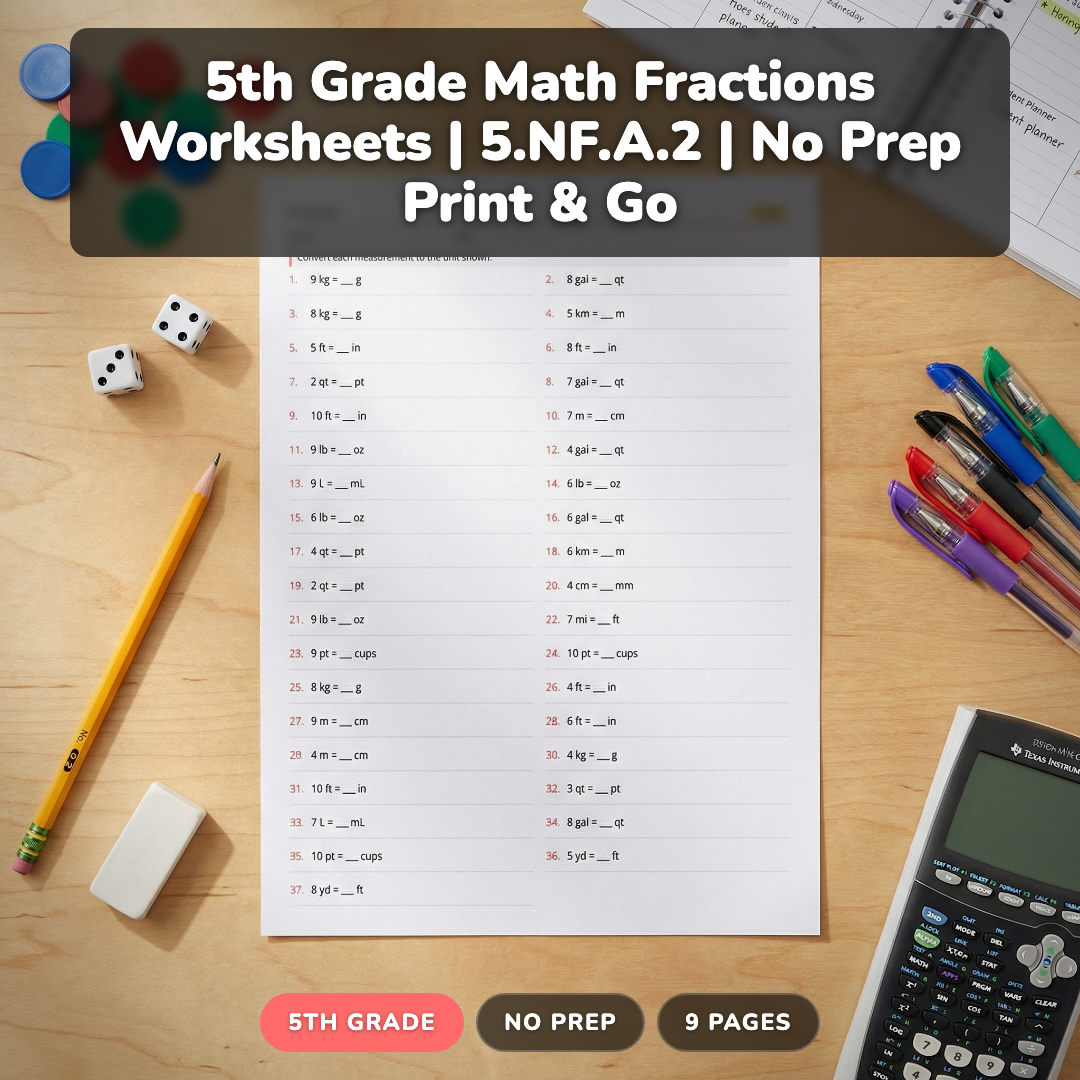
The resource saves hours of prep time while ensuring every student gets appropriately challenging practice. Whether you need quick warm-up problems, center activities, or assessment preparation, this pack has you covered.
Grab a Free Fraction Word Problems Sample to Try
Want to see the quality and differentiation before you buy? I’ll send you a free 3-problem sample from each level so you can try it with your students first. Just drop your email below and I’ll send it right over, along with my best fraction teaching tips.
Frequently Asked Questions About Teaching 5th Grade Fraction Word Problems
When should I introduce fraction word problems in 5th grade?
Introduce fraction word problems after students master equivalent fractions and basic addition/subtraction with like denominators, typically in February or March. Students need solid foundational skills before tackling the complexity of word problems with unlike denominators as required by CCSS.Math.Content.5.NF.A.2.
How do I help students who struggle with finding common denominators?
Start with visual fraction models to show why common denominators are necessary. Teach multiple strategies: listing multiples, using factor trees, or recognizing patterns. Focus on efficiency by identifying when one denominator is a multiple of another before defaulting to multiplication methods.
What’s the best way to teach students to estimate fraction answers?
Use benchmark fractions (0, 1/4, 1/2, 3/4, 1) consistently. Have students place fractions on number lines and compare to benchmarks before solving. Practice estimating sums and differences using only benchmarks, then compare to exact answers to build number sense.
How can I make fraction word problems more engaging for students?
Use contexts that matter to 5th graders: cooking, sports statistics, video game progress, or school activities. Let students create their own problems using favorite topics. Incorporate movement by having students act out problems or use manipulatives to build solutions physically.
What should I do when students get correct answers but can’t explain their thinking?
Require visual representations alongside numerical work. Use think-pair-share activities where students must explain their reasoning to partners. Provide sentence frames for mathematical explanations and model academic vocabulary. Focus on the ‘why’ behind procedures, not just the ‘how.’
Teaching fraction word problems successfully requires patience, multiple representations, and lots of practice with real-world contexts. When students can visualize the math, estimate reasonable answers, and explain their thinking, they develop the deep understanding needed for future success.
What’s your biggest challenge when teaching fraction word problems? I’d love to hear about strategies that work in your classroom!
Don’t forget to grab that free sample pack above — it’s a great way to see how differentiated practice can support every learner in your classroom.