If your 4th graders freeze when they see a multistep word problem, you’re not alone. One minute they’re confidently solving single-step problems, and the next they’re staring at a problem about buying school supplies with multiple operations, completely overwhelmed. You know they can do the math — but something about those extra words and steps makes everything fall apart.
Key Takeaway
Fourth graders master multistep word problems when they learn to identify key information, choose appropriate operations, and represent problems with equations before calculating.
Why Multistep Word Problems Matter in 4th Grade
Multistep word problems represent a crucial bridge between computational fluency and mathematical reasoning. At this grade level, students transition from solving isolated math facts to applying multiple operations in realistic contexts. This skill directly supports CCSS.Math.Content.4.OA.A.3, which requires students to solve multistep word problems using all four operations, interpret remainders appropriately, and represent problems with equations using variables.
Research from the National Council of Teachers of Mathematics shows that students who master multistep problem-solving in 4th grade demonstrate significantly stronger algebraic thinking in middle school. These problems typically appear in your curriculum between October and February, building on place value understanding and single-step problem solving from earlier in the year.
The standard specifically emphasizes three critical components: solving problems with multiple operations, interpreting remainders in context, and using equations with variables to represent mathematical relationships. Students must also assess answer reasonableness using estimation and mental math strategies.
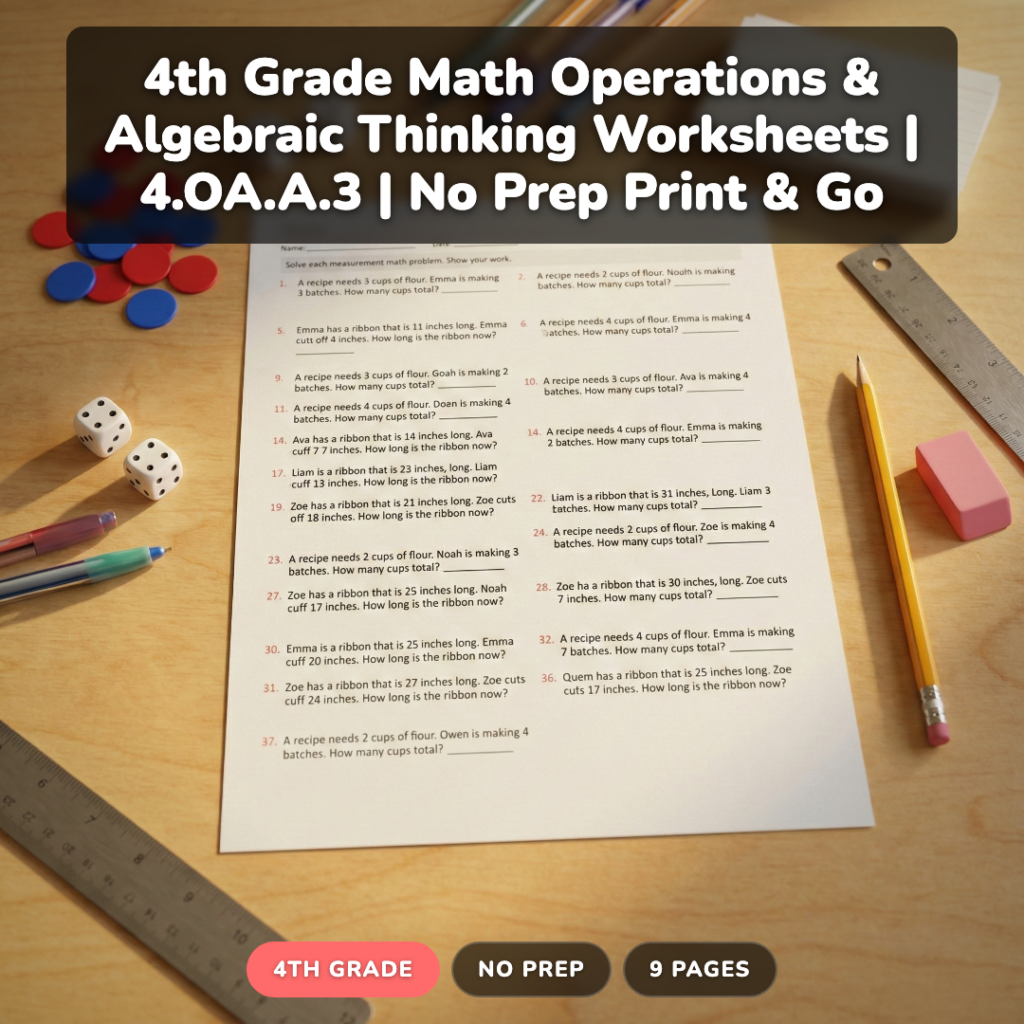
Looking for a ready-to-go resource? I put together a differentiated 4th grade operations pack with 132 problems across three difficulty levels — but first, the teaching strategies that make it work.
Common Multistep Word Problem Misconceptions in 4th Grade
Common Misconception: Students perform operations in the order they appear in the problem text.
Why it happens: They process information linearly rather than analyzing the mathematical relationships.
Quick fix: Teach students to identify what the question asks for first, then work backward to determine necessary steps.
Common Misconception: Students think remainders always get dropped or always round up.
Why it happens: They apply division algorithms without considering real-world context.
Quick fix: Practice interpreting remainders in different contexts — sometimes you need the whole number, sometimes the remainder matters, sometimes you round up.
Common Misconception: Students write equations that match their thinking process rather than the mathematical relationship.
Why it happens: They confuse the steps they take to solve with the equation that represents the problem.
Quick fix: Model how to write equations that show mathematical relationships, not solution steps.
Common Misconception: Students accept unreasonable answers without checking.
Why it happens: They focus entirely on computation and lose sight of the problem context.
Quick fix: Build estimation into every problem-solving routine before students calculate.
5 Research-Backed Strategies for Teaching Multistep Word Problems
Strategy 1: The CUBES Method for Problem Analysis
CUBES gives students a systematic approach to break down complex word problems into manageable parts. This acronym stands for Circle key numbers, Underline the question, Box signal words, Evaluate and eliminate extra information, and Solve step by step.
What you need:
- Word problems printed on paper
- Different colored pencils or highlighters
- CUBES anchor chart
- Student reference cards
Steps:
- Model the process with a sample problem, thinking aloud as you circle numbers in red
- Underline the question in blue, emphasizing what the problem is actually asking
- Box signal words (altogether, left, each, per) in green that indicate operations
- Cross out unnecessary information that doesn’t help solve the problem
- Write the equation and solve, checking reasonableness at the end
Strategy 2: Equation Building with Unknown Quantities
Students learn to represent word problems with algebraic equations before solving, developing crucial algebraic thinking skills required by the standard.
What you need:
- Sentence strips or whiteboards
- Variable cards (letters like n, x, or descriptive variables like boxes)
- Operation symbol cards
- Number cards
Steps:
- Read the problem and identify what quantity is unknown
- Choose a letter or word to represent the unknown (let b = number of boxes)
- Build the equation using manipulative cards before writing it down
- Write the complete equation that represents the mathematical relationship
- Solve the equation and substitute back to check reasonableness
Strategy 3: Remainder Interpretation Stations
Students practice interpreting remainders in different real-world contexts through hands-on exploration at learning stations.
What you need:
- Station materials: toy cars and parking spaces, pizza slices and plates, students and teams
- Problem cards for each station
- Recording sheets
- Timer for rotations
Steps:
- Set up four stations: Drop the Remainder (cars in parking lots), Use the Remainder (leftover pizza), Round Up (forming equal teams), and Express as Mixed Number (sharing equally)
- Students solve problems at each station using manipulatives to model the situation
- At each station, students must explain why they interpreted the remainder as they did
- Rotate every 10-12 minutes, discussing different interpretations as a whole group
- Create a class chart showing when to use each remainder interpretation strategy
Strategy 4: Estimation Before Calculation Protocol
Students develop number sense and reasonableness checking by estimating answers before solving multistep problems.
What you need:
- Estimation recording sheets
- Number line or hundred chart references
- Calculators for checking (optional)
- Sticky notes for quick estimates
Steps:
- Read the problem and identify the approximate size of numbers involved
- Round numbers to friendly values (nearest 10, 100, or easy-to-work-with numbers)
- Perform the operations mentally using rounded numbers
- Record the estimate and explain the reasoning
- Solve the actual problem and compare to the estimate
- Discuss whether the answer makes sense in the problem context
Strategy 5: Problem-Solving Think Alouds with Student Modeling
Students observe and practice mathematical reasoning through structured think-aloud sessions where peers model problem-solving processes.
What you need:
- Document camera or chart paper
- Sample multistep problems at various difficulty levels
- Thinking stems poster (I notice…, This reminds me of…, I need to find…)
- Student volunteer rotation schedule
Steps:
- Select a student volunteer to model their thinking with a new problem
- Student reads the problem aloud and shares their initial thinking
- Class asks clarifying questions using sentence stems
- Student works through their solution process, explaining each decision
- Class discusses alternative approaches and checks reasonableness together
- Rotate different students as presenters to showcase various thinking strategies
How to Differentiate Multistep Word Problems for All Learners
For Students Who Need Extra Support
Begin with two-step problems using smaller numbers and familiar contexts. Provide graphic organizers that break problems into clear steps: What do I know? What do I need to find? What operations will I use? Use manipulatives or drawings to represent each step before moving to abstract equations. Focus on one remainder interpretation type at a time, and provide estimation ranges rather than requiring independent estimates.
For On-Level Students
Present three-step problems with numbers in the hundreds and thousands. Students should independently apply the CUBES method and write equations with variables. They practice all remainder interpretation types within appropriate contexts and use mental math strategies for estimation. Expect students to explain their reasoning and check answer reasonableness without prompting.
For Students Ready for a Challenge
Introduce problems with four or more steps, including those requiring multiple remainder interpretations or decimal answers. Students create their own word problems for classmates to solve and explore problems with multiple solution paths. Challenge them to solve problems using different strategies and compare efficiency. Connect to 5th grade standards by introducing problems with decimal operations or fraction components.
A Ready-to-Use Operations & Algebraic Thinking Resource for Your Classroom
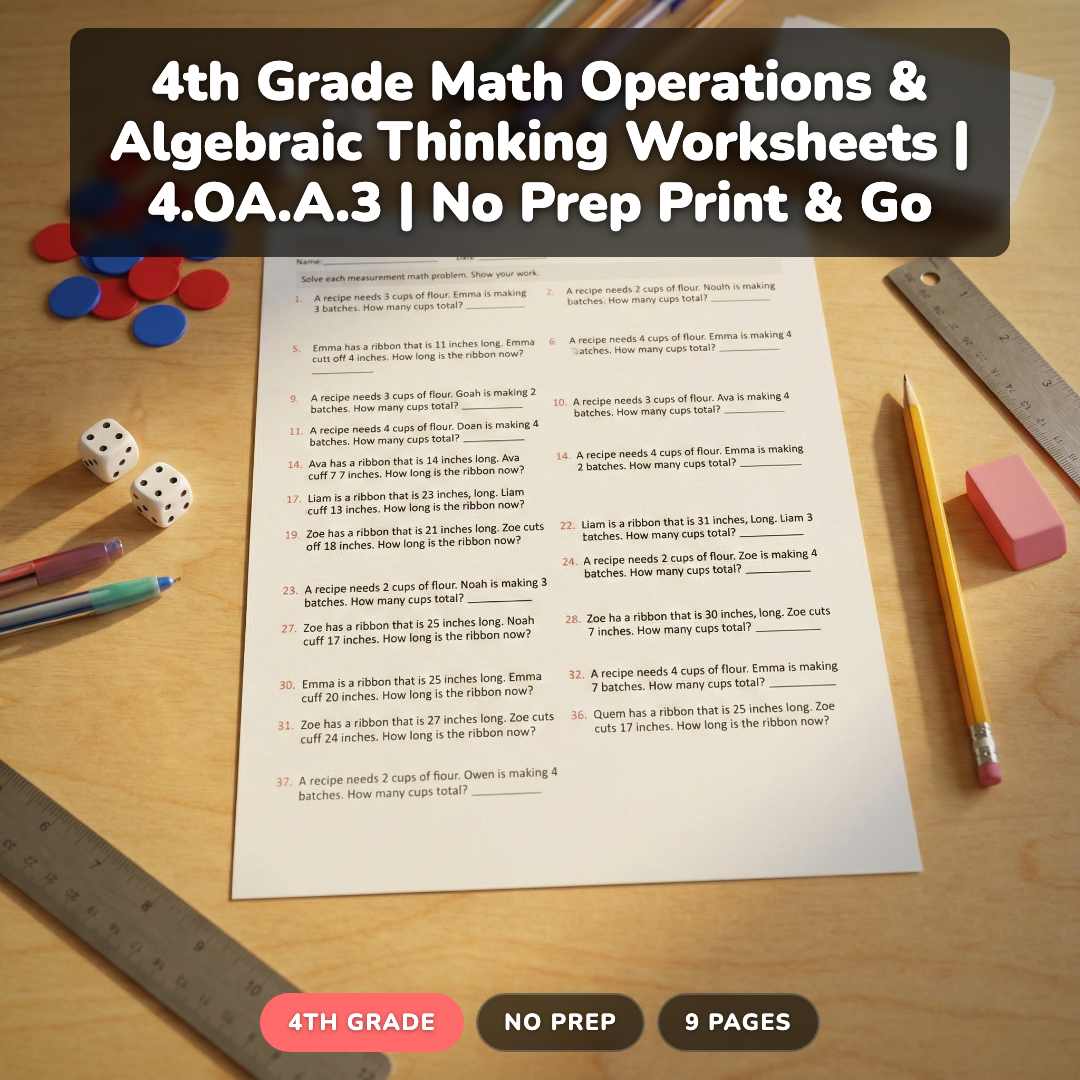
After years of creating my own differentiated word problems, I developed a comprehensive resource that saves hours of prep time while ensuring every student gets appropriate practice. This 4th Grade Operations & Algebraic Thinking pack includes 132 carefully crafted problems across three difficulty levels, all aligned to CCSS.Math.Content.4.OA.A.3.
The resource includes 37 practice problems for building foundational skills, 50 on-level problems for grade-appropriate challenge, and 45 advanced problems for students ready to stretch. Each level focuses on different aspects of the standard — from basic multistep problems to complex remainder interpretation and algebraic representation. Answer keys and teaching notes help you implement the problems effectively.
What makes this different from other word problem collections is the intentional progression and authentic contexts. Problems move from concrete situations students understand to more abstract mathematical relationships, building the algebraic thinking skills they’ll need in 5th grade and beyond.
The pack covers everything from basic two-step problems to complex multistep challenges, with clear differentiation and detailed answer explanations.
Grab a Free Word Problem Sample to Try
Want to see how these strategies work in action? I’ve created a free sample pack with one problem from each difficulty level, plus a step-by-step teaching guide. Drop your email below and I’ll send it right over.
Frequently Asked Questions About Teaching Multistep Word Problems
When should I introduce multistep word problems in 4th grade?
Begin multistep word problems after students demonstrate fluency with single-step problems and basic multiplication/division facts, typically in October or November. Start with two-step problems using addition and subtraction before introducing multiplication and division combinations.
How do I help students who can do the math but struggle with reading the problems?
Use the CUBES method to break down text systematically. Read problems aloud initially, highlight key mathematical vocabulary, and provide problems with familiar contexts. Gradually increase text complexity as mathematical confidence builds.
What’s the difference between writing equations and showing work?
Equations represent the mathematical relationship in the problem (3 × 24 + 15 = n), while showing work demonstrates the solution process. CCSS.Math.Content.4.OA.A.3 specifically requires equation representation with variables, not just computational steps.
How many multistep problems should students practice daily?
Start with 2-3 problems daily during initial instruction, building to 4-5 problems once students demonstrate understanding. Quality discussion about strategies matters more than quantity of problems completed.
When do students need to interpret remainders versus express them as decimals?
In 4th grade, focus on remainder interpretation in whole number contexts (people, objects, groups). Decimal expression of remainders typically appears in 5th grade standards when decimal division is formally introduced.
Teaching multistep word problems successfully comes down to systematic instruction, plenty of modeling, and differentiated practice that meets students where they are. When students learn to analyze problems strategically and represent them algebraically, they develop the mathematical reasoning skills that serve them throughout their academic careers.
What’s your biggest challenge when teaching multistep word problems? Try the CUBES method with your next lesson and see how it changes your students’ confidence!