If your fourth graders still struggle to explain why the digit 3 in 3,456 is worth 3,000 while the 3 in 1,234 is only worth 30, you’re not alone. Place value understanding is the foundation of all multi-digit operations, yet many students reach fourth grade without truly grasping how our number system works. You need concrete strategies that help students visualize and internalize the “ten times” relationship between place values.
Key Takeaway
Students master place value when they can physically manipulate materials to see that one place represents ten times the value of the place to its right.
Why Place Value Matters in Fourth Grade
Fourth grade marks a critical transition in mathematical thinking. Students move from working primarily with two and three-digit numbers to confidently manipulating numbers in the millions. CCSS.Math.Content.4.NBT.A.1 requires students to recognize that each digit’s value depends entirely on its position—a concept that underpins multiplication, division, and decimal operations they’ll encounter later.
Research from the National Council of Teachers of Mathematics shows that students with strong place value understanding in fourth grade demonstrate 40% better performance on standardized assessments through middle school. The standard specifically focuses on the multiplicative relationship between places: each position represents ten times the value of the position immediately to its right.
This understanding typically develops between October and December in most fourth-grade curricula, building on third-grade work with numbers to 1,000 and preparing students for fifth-grade decimal concepts. Students who master this standard show significantly improved performance in multi-digit multiplication and division algorithms.
Looking for a ready-to-go resource? I put together a differentiated place value practice pack with 132 problems across three levels—but first, the teaching strategies that make it work.
Common Place Value Misconceptions in Fourth Grade
Common Misconception: Students think the digit 5 always means “five” regardless of position.
Why it happens: They focus on the digit itself rather than its positional value.
Quick fix: Use place value blocks to show 5 ones versus 5 tens versus 5 hundreds physically.
Common Misconception: Students believe 2,304 has “more numbers” than 15,678 because they count digits.
Why it happens: They confuse quantity of digits with numerical value.
Quick fix: Compare numbers using base-ten blocks or money models to visualize actual quantities.
Common Misconception: Students think moving one place left adds ten to the digit.
Why it happens: They apply additive thinking instead of multiplicative relationships.
Quick fix: Demonstrate with manipulatives that 3 tens becomes 30 ones, not 13 ones.
Common Misconception: Students read 4,056 as “four thousand fifty-six” but write it as 4,506.
Why it happens: They don’t understand that zero holds the tens place.
Quick fix: Use place value charts with physical placeholders for zero positions.
5 Research-Backed Strategies for Teaching Place Value
Strategy 1: Base-Ten Block Trading Games
Students physically trade blocks to understand the ten-to-one relationship between places. This kinesthetic approach helps cement the multiplicative nature of place value through repeated manipulation and exchange.
What you need:
- Base-ten blocks (units, rods, flats, cubes)
- Place value mats
- Dice or number cards
- Trading rules poster
Steps:
- Students roll dice to determine how many units to collect
- When they accumulate 10 units, they trade for 1 rod (ten)
- Continue trading: 10 rods for 1 flat, 10 flats for 1 cube
- Record the number after each trade using standard notation
- Discuss how each trade shows the “ten times” relationship
Strategy 2: Human Place Value Chart
Students become living digits in a floor-sized place value chart, physically moving to demonstrate how position determines value. This full-body experience makes abstract concepts concrete and memorable.
What you need:
- Masking tape to create floor chart
- Large digit cards (0-9)
- Place value labels (ones, tens, hundreds, etc.)
- Clipboard for recording
Steps:
- Create a large place value chart on the floor with tape
- Students hold digit cards and stand in assigned places
- Call out numbers and have students arrange themselves correctly
- Ask the student in tens place: “What’s your value?” (not “What’s your digit?”)
- Have students switch positions to show how the same digit changes value
Strategy 3: Place Value Auction
Students bid on digits for specific positions using play money, reinforcing that position determines worth. This game-based approach motivates engagement while building deep conceptual understanding of positional notation.
What you need:
- Play money (ones, tens, hundreds)
- Digit cards to auction
- Place value boards for each student
- Auction hammer or bell
Steps:
- Give each student $500 in play money
- Auction digit cards for specific positions (“digit 7 for the hundreds place”)
- Students bid based on the digit’s positional value
- Winner places the digit on their place value board
- Continue until students build complete numbers
- Compare final numbers and discuss bidding strategies
Strategy 4: Expanded Form Puzzles
Students match number representations across standard, expanded, and word forms to strengthen connections between different ways of expressing place value. This multi-representational approach builds flexibility in mathematical thinking.
What you need:
- Number cards in standard form
- Expanded form expression cards
- Word form cards
- Timer for added challenge
Steps:
- Create sets of three cards showing the same number in different forms
- Scatter cards face-up on tables
- Students work in pairs to find matching triplets
- Verify matches by reading each form aloud
- Discuss how expanded form shows the “ten times” relationship clearly
Strategy 5: Digital Place Value Slides
Students use sliding number strips to demonstrate how digits shift positions and change values. This visual-kinesthetic tool helps students understand regrouping and the dynamic nature of place value.
What you need:
- Laminated number strips (0-9 for each place)
- Place value frame with slots
- Dry erase markers
- Recording sheets
Steps:
- Students insert digit strips into the place value frame
- Slide strips to create different numbers
- Record each number and identify the value of specific digits
- Challenge: “Make the digit 4 worth exactly 400”
- Discuss how sliding changes digit values without changing the digit itself
How to Differentiate Place Value for All Learners
For Students Who Need Extra Support
Begin with concrete manipulatives and limit work to three-digit numbers initially. Use proportional base-ten blocks where the size difference is obvious. Provide place value mats with clear labels and practice counting by tens, hundreds, and thousands before introducing the standard. Review prerequisite skills like skip counting and basic multiplication facts for 10 and 100. Offer verbal prompts like “What does this digit mean in this house?” to scaffold thinking.
For On-Level Students
Work with four and five-digit numbers as specified in CCSS.Math.Content.4.NBT.A.1. Students should confidently explain that 6,000 is ten times greater than 600 using multiple representations. Provide independent practice with varied problem types including number comparisons, digit identification tasks, and expanded form conversions. Encourage mathematical discourse using precise vocabulary like “place value,” “digit,” and “positional notation.”
For Students Ready for a Challenge
Extend learning to six and seven-digit numbers, introducing millions place. Connect place value understanding to real-world contexts like population data or astronomical distances. Challenge students to explore patterns when multiplying by powers of ten and introduce basic decimal concepts as preview for fifth grade. Provide open-ended tasks like “Create the largest possible number using digits 2, 0, 5, 8, 1 exactly once.”
A Ready-to-Use Place Value Resource for Your Classroom
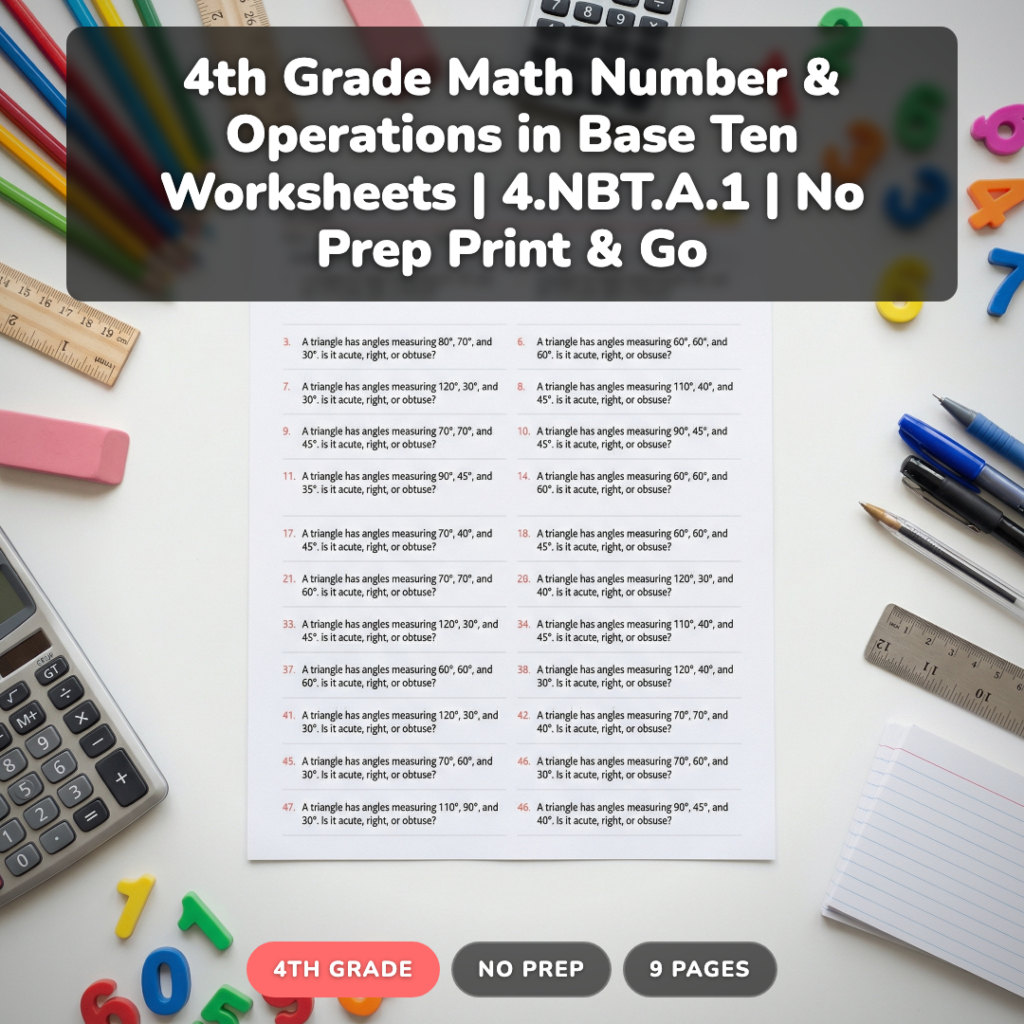
After years of creating place value materials from scratch, I developed a comprehensive practice pack that addresses every aspect of CCSS.Math.Content.4.NBT.A.1. This 9-page resource includes 132 carefully crafted problems across three differentiation levels: Practice (37 problems), On-Level (50 problems), and Challenge (45 problems).
What makes this resource different is the systematic progression from concrete digit identification to abstract place value reasoning. The Practice level focuses on basic digit recognition and simple comparisons. On-Level problems require students to explain the multiplicative relationship between places. Challenge problems integrate place value with problem-solving scenarios and multi-step reasoning.
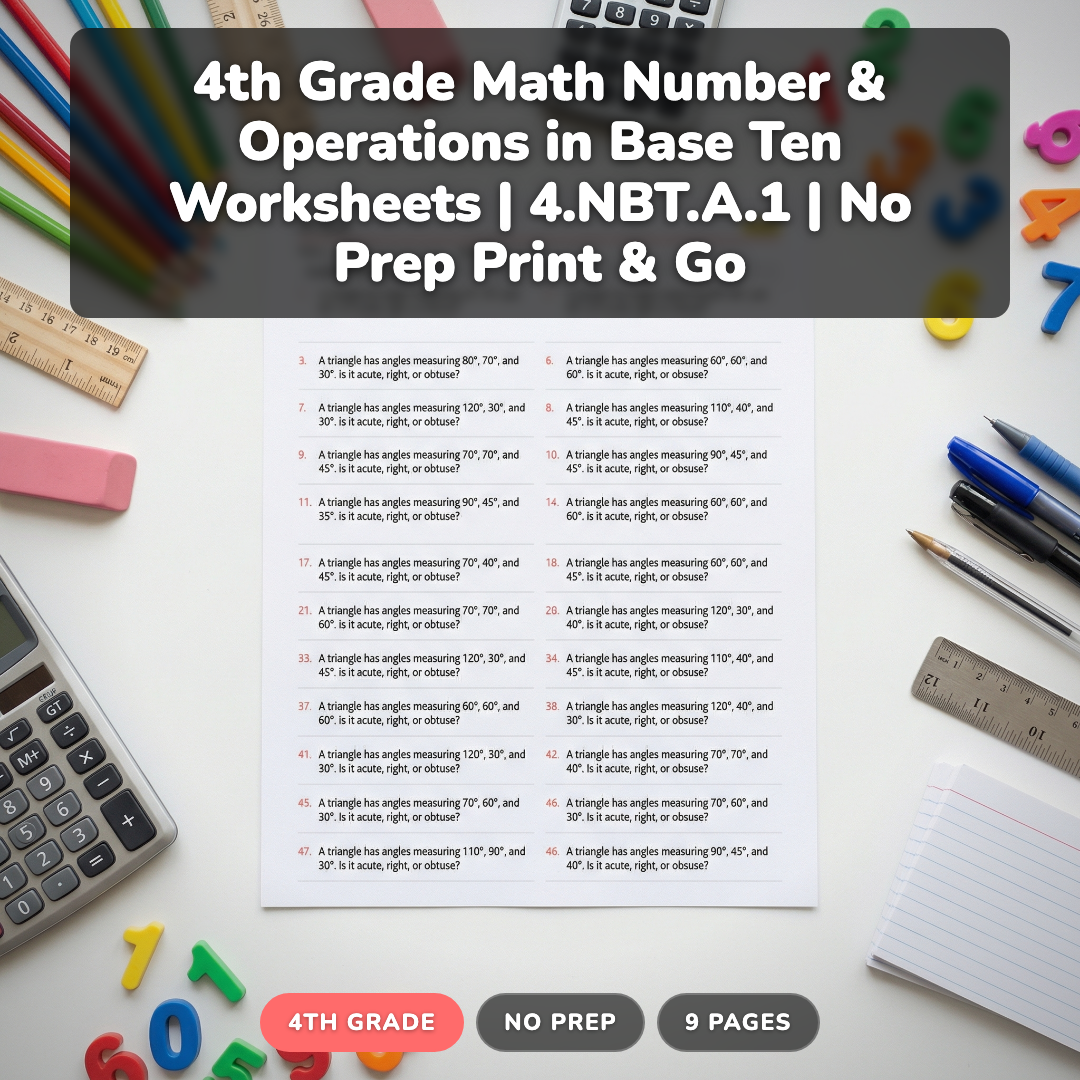
Each level includes complete answer keys with explanations, making it perfect for independent work, math centers, or homework assignments. The problems align perfectly with common assessment formats while building genuine conceptual understanding.
You can grab this time-saving resource that covers everything above—no prep required, just print and go.
Grab a Free Place Value Practice Sheet to Try
Want to see the quality before you buy? I’ll send you a free sample worksheet with 10 problems across all three levels, plus the answer key. Perfect for testing with your students first.
Frequently Asked Questions About Teaching Place Value
When should students master CCSS.Math.Content.4.NBT.A.1?
Most students should demonstrate proficiency with this standard by mid-December of fourth grade. The standard builds throughout the fall semester, typically introduced in October after reviewing three-digit place value concepts from third grade.
What’s the difference between teaching place value and digit identification?
Digit identification asks “What digit is in the tens place?” while place value understanding asks “What does the 7 mean in 4,732?” True place value mastery requires students to explain that 7 represents 700, not just identify the digit seven.
How do I help students who still count by ones for large numbers?
Use grouping activities with physical objects like beans or blocks. Have students group by tens, then hundreds, showing that counting groups is more efficient than counting individual items. Practice skip counting daily and connect it to place value positions.
Should I teach place value before or after teaching multi-digit addition?
Always teach place value first. Students need solid understanding of positional notation before they can successfully regroup in addition and subtraction algorithms. Place value is the conceptual foundation for all multi-digit operations.
What manipulatives work best for place value instruction?
Base-ten blocks are ideal because they show proportional relationships clearly. Money models also work well since students understand that ten pennies equal one dime. Avoid non-proportional manipulatives like colored chips where all pieces look identical.
Teaching place value effectively sets your students up for success in all future math concepts. The key is providing multiple concrete experiences before moving to abstract thinking. Remember to emphasize the multiplicative relationship—each place is ten times the value of the place to its right.
What’s your favorite hands-on activity for teaching place value? I’d love to hear what works in your classroom!
Don’t forget to grab your free sample worksheet above—it’s a great way to see how these strategies work with your specific students before diving into the full resource.