If your 4th graders freeze when they see fractional measurements on a line plot, you’re not alone. Line plots with fractions challenge students to combine their understanding of data representation, fraction concepts, and measurement skills all at once. The good news? With the right teaching strategies, your students will confidently create line plots and solve problems using the data they collect.
Key Takeaway
Successful line plot instruction starts with concrete measurement experiences before moving to abstract data representation and problem-solving.
Why Line Plots Matter in 4th Grade Math
Line plots bridge the gap between hands-on measurement and abstract data analysis, making them a crucial skill in 4th grade mathematics. This topic typically appears in the spring semester, after students have developed solid fraction foundations and basic measurement skills. The CCSS.Math.Content.4.MD.B.4 standard requires students to create line plots using fractional measurements (halves, fourths, and eighths) and solve addition and subtraction problems using the plotted data.
Research from the National Council of Teachers of Mathematics shows that students who engage in data collection before graphing demonstrate 40% better comprehension of line plot concepts. This hands-on approach helps students understand that line plots represent real measurements, not just abstract numbers. The standard connects directly to fraction operations (4.NF.B.3) and measurement concepts (4.MD.A.1), making it an essential bridge between these mathematical domains.
Looking for a ready-to-go resource? I put together a differentiated line plot practice pack with 132 problems across three levels — but first, the teaching strategies that make it work.
Common Line Plot Misconceptions in 4th Grade
Common Misconception: Students plot whole numbers instead of fractions when measuring.
Why it happens: They round measurements to the nearest whole number because fractions feel too complex.
Quick fix: Start with objects that naturally measure to exact fractions, like paper strips cut to 1/2 inch or 3/4 inch lengths.
Common Misconception: Students think each X represents one object, regardless of the measurement.
Why it happens: They confuse line plots with bar graphs where height shows frequency.
Quick fix: Emphasize that each X represents one measurement, and multiple objects can have the same measurement.
Common Misconception: Students add fractions incorrectly when solving line plot problems.
Why it happens: They apply whole number addition rules to fractions (adding numerators and denominators separately).
Quick fix: Review equivalent fractions and common denominators before introducing line plot problem-solving.
Common Misconception: Students place fractions in the wrong order on the number line.
Why it happens: They don’t understand that 3/8 comes between 1/4 and 1/2.
Quick fix: Use fraction strips or number lines to show equivalent fractions before creating line plots.
5 Research-Backed Strategies for Teaching Line Plots
Strategy 1: Measurement Collection with Real Objects
Start line plot instruction by having students collect actual measurements using rulers marked in fractions. This concrete experience builds understanding before moving to abstract data representation.
What you need:
- Rulers marked in 1/8 inch increments
- Collection of small objects (pencils, crayons, paper clips)
- Recording sheets
- Sticky notes
Steps:
- Give each student 10 similar objects (like crayons) to measure to the nearest 1/8 inch
- Have them record measurements on sticky notes and place them on a class number line
- Discuss patterns in the data before transferring to a formal line plot
- Model how each measurement becomes one X on the line plot
Strategy 2: Human Line Plot Formation
Transform your classroom into a giant line plot where students physically position themselves based on their measurements. This kinesthetic approach helps students understand spacing and frequency.
What you need:
- Masking tape for floor number line
- Index cards with fraction labels
- Measurement data from previous activity
Steps:
- Create a number line on the floor using masking tape, marking fractions from 0 to 6 inches in 1/4 increments
- Students hold their measurement cards and stand above the corresponding fraction on the floor line
- Observe how students stack when measurements are the same
- Transfer the human line plot to paper, with each student becoming one X
Strategy 3: Line Plot Detective Work
Present students with completed line plots and challenge them to determine what was measured and solve problems using the data. This develops analytical thinking and problem-solving skills.
What you need:
- Pre-made line plots with realistic measurement scenarios
- Question cards for each line plot
- Calculator (optional for checking)
Steps:
- Show a line plot of pencil lengths measured in 1/4 inches
- Ask students to determine the total length if all pencils were lined up end-to-end
- Have them find the difference between the longest and shortest pencils
- Challenge them to identify which measurement occurred most frequently
Strategy 4: Fraction Line Plot Construction
Teach students to build line plots systematically, focusing on proper fraction placement and scale creation. This strategy emphasizes the mathematical precision required for accurate data representation.
What you need:
- Graph paper or line plot templates
- Fraction strips for reference
- Measurement data sets
- Colored pencils
Steps:
- Model how to determine the range of data and choose appropriate scale increments
- Show students how to mark fractions in order, using equivalent fractions when needed
- Demonstrate plotting each data point as an X above the correct measurement
- Practice reading the completed line plot to answer questions
Strategy 5: Line Plot Problem-Solving Stations
Set up rotating stations where students practice different aspects of line plot work, from data collection to problem-solving. This provides multiple exposures to the concept while maintaining engagement.
What you need:
- 4-5 station setups
- Various measuring tools
- Pre-made line plots for analysis
- Problem-solving task cards
Steps:
- Station 1: Measure and record classroom objects
- Station 2: Create line plots from given data sets
- Station 3: Solve addition/subtraction problems using line plots
- Station 4: Compare different line plots and make observations
- Station 5: Create word problems based on line plot data
How to Differentiate Line Plots for All Learners
For Students Who Need Extra Support
Begin with concrete manipulatives and simplified fractions. Use pre-drawn number lines with clearly marked increments, focusing initially on halves and fourths only. Provide fraction strips as visual references and allow students to use calculators for addition and subtraction problems. Break down multi-step problems into smaller chunks, and consider using real-world contexts that connect to students’ experiences, like measuring favorite snacks or school supplies.
For On-Level Students
These students should work with the full range of fractional measurements required by CCSS.Math.Content.4.MD.B.4, including eighths. They can create their own number lines and scales, collect original measurement data, and solve multi-step problems involving addition and subtraction of fractions. Encourage them to explain their problem-solving strategies and make connections between line plots and other fraction work they’ve done in class.
For Students Ready for a Challenge
Advanced students can work with mixed numbers in their measurements, create line plots with more complex scales, and solve problems involving multiplication and division concepts. Challenge them to design their own measurement investigations, compare multiple data sets, or explore how changing the measurement tool affects the line plot appearance. They might also investigate real-world applications like weather data or sports statistics.
A Ready-to-Use Line Plot Resource for Your Classroom
After teaching line plots for several years, I created a comprehensive resource that addresses all the challenges teachers face with this standard. This differentiated practice pack includes 132 problems across three distinct levels, ensuring every student gets appropriate practice with fractional measurements and line plot problem-solving.
The resource includes 37 practice problems for students building foundational skills, 50 on-level problems that align perfectly with grade-level expectations, and 45 challenge problems for students ready to extend their thinking. Each level focuses on the core skills: creating line plots with fractional measurements, interpreting data, and solving addition and subtraction problems using the plotted information. The problems use realistic measurement scenarios that students can relate to, from measuring plant growth to comparing jumping distances.
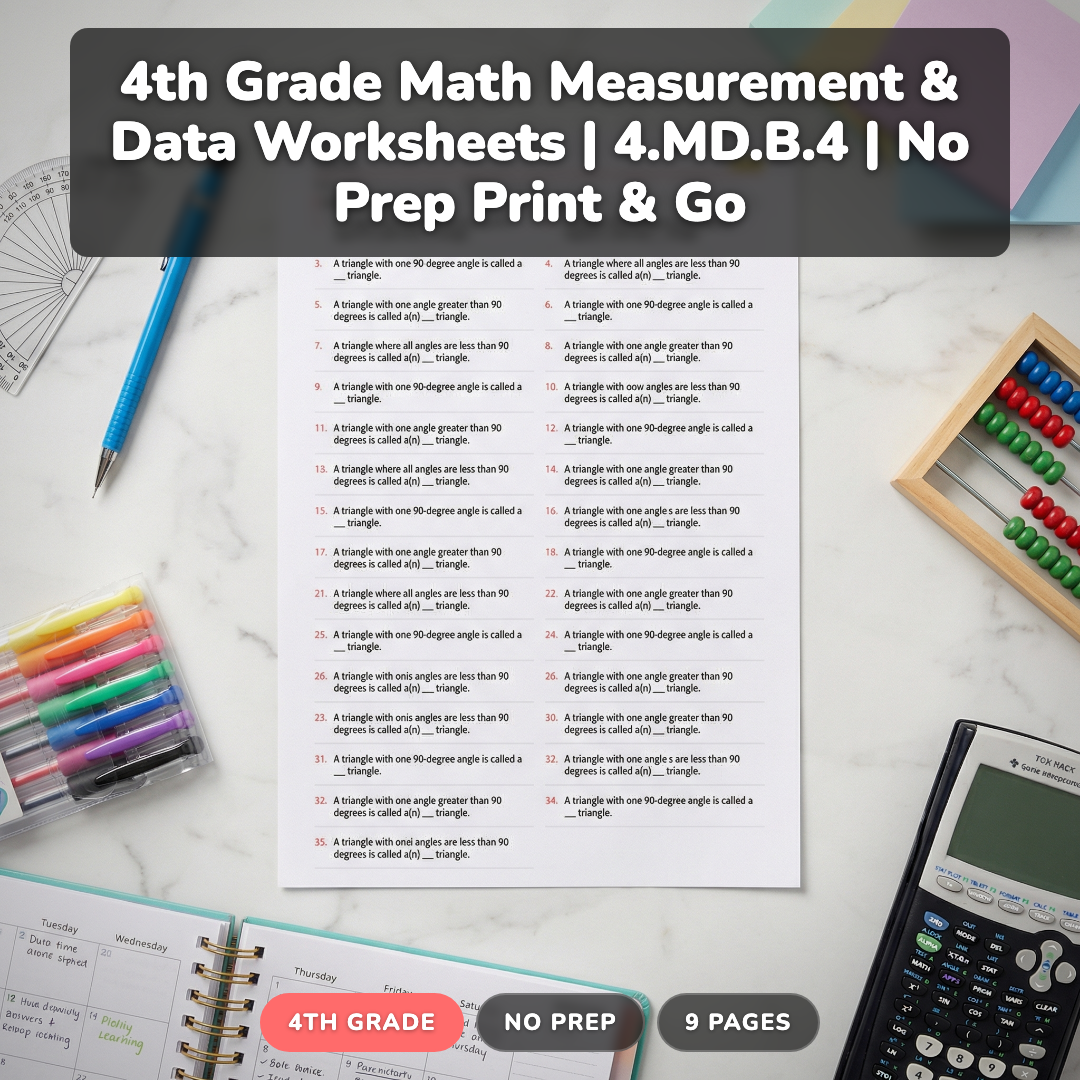
What makes this resource different is the careful progression within each level and the inclusion of detailed answer keys that show step-by-step problem-solving. You’ll save hours of prep time while ensuring your students get the targeted practice they need to master this challenging standard.
Grab a Free Line Plot Practice Sheet to Try
Want to see how differentiated line plot practice works in your classroom? I’ll send you a free sample worksheet that includes problems from each level, plus teaching tips for introducing fractional measurements on line plots.
Frequently Asked Questions About Teaching Line Plots
When should I introduce line plots with fractions in 4th grade?
Introduce line plots with fractions after students have solid understanding of equivalent fractions and can add/subtract fractions with like denominators. This typically happens in late winter or early spring, following CCSS.Math.Content.4.NF.B.3 instruction on fraction operations.
What’s the difference between a line plot and a bar graph?
Line plots show individual data points as X’s above a number line, while bar graphs use rectangular bars to show frequency or quantity. Line plots work best for measurement data with many possible values, especially when using fractional measurements.
How do I help students who struggle with fraction placement on number lines?
Use fraction strips or folded paper to show equivalent fractions visually. Start with halves and fourths only, then gradually introduce eighths. Provide number lines with pre-marked increments until students can create their own accurate scales.
What real-world measurement activities work best for line plot data collection?
Measure student heights, pencil lengths, book thicknesses, or plant growth over time. Choose objects that naturally result in fractional measurements and ensure all students can participate safely in the measuring process.
How do I assess student understanding of line plot problem-solving?
Look for accurate data plotting, correct fraction operations when solving problems, and clear explanations of problem-solving strategies. Students should demonstrate understanding that each X represents one measurement and show work when adding or subtracting fractions from the plot.
Teaching line plots with fractional measurements doesn’t have to be overwhelming. Start with concrete experiences, build understanding gradually, and provide plenty of practice with real-world applications. Your students will develop confidence with both data representation and fraction operations. What measurement activities have worked best in your classroom? Don’t forget to grab your free line plot practice sheet above to get started!