If your fourth graders freeze when they see fractions with denominators of 10 and 100, you’re not alone. Converting between these denominators and adding them together challenges even confident math students. You need concrete strategies that make this abstract concept click — and that’s exactly what you’ll find here.
Key Takeaway
Students master CCSS.Math.Content.4.NF.C.5 when they see the pattern: multiplying both numerator and denominator by 10 creates equivalent fractions.
Why This Fraction Skill Matters in Fourth Grade
Standard CCSS.Math.Content.4.NF.C.5 bridges concrete fraction understanding with decimal concepts students will encounter in fifth grade. When students express 3/10 as 30/100, they’re building the foundation for understanding that 0.3 equals 0.30.
This skill typically appears in February or March, after students have mastered equivalent fractions with smaller denominators. Research from the National Council of Teachers of Mathematics shows that students who struggle with denominators 10 and 100 often lack a strong understanding of place value in whole numbers — the same conceptual foundation needed here.
According to the 2019 NAEP results, only 34% of fourth graders demonstrated proficiency with fraction equivalence involving larger denominators. The key is connecting this work to base-ten blocks and place value charts students already know.
Looking for a ready-to-go resource? I put together a differentiated 4.NF.C.5 practice pack that covers everything below — but first, the teaching strategies that make it work.
Common Fraction Misconceptions in Fourth Grade
Common Misconception: Students think 3/10 + 4/100 equals 7/110 by adding denominators.
Why it happens: They apply whole number addition rules to fractions without understanding equivalent parts.
Quick fix: Use visual models showing tenths and hundredths as same-sized pieces.
Common Misconception: Students believe 30/100 is larger than 3/10 because 30 is bigger than 3.
Why it happens: They focus on numerator size rather than fraction value.
Quick fix: Compare using decimal grids to show both fractions shade identical amounts.
Common Misconception: Students think you can only convert 10 to 100, not recognizing 100 can become 10.
Why it happens: They memorize one direction instead of understanding the relationship.
Quick fix: Practice both conversions using the same visual model.
Common Misconception: Students add 3/10 + 4/100 by converting to 30/100 + 4/100 = 34/10.
Why it happens: They mix up which denominator to use in the final answer.
Quick fix: Always convert to the larger denominator (100) and check with visual models.
5 Research-Backed Strategies for Teaching Denominators 10 and 100
Strategy 1: Base-Ten Block Bridge Building
Connect fraction work to familiar base-ten concepts by using blocks to represent tenths and hundredths. Students physically see how 10 hundredths equals 1 tenth.
What you need:
- Base-ten blocks (flats and small cubes)
- Fraction notation cards
- Recording sheet
Steps:
- Show a base-ten flat as “one whole” and small cubes as hundredths
- Have students build 3/10 using 30 small cubes arranged in 3 groups of 10
- Write both 3/10 and 30/100 next to the same model
- Practice building and recording 5-6 different tenths as hundredths
- Reverse the process: show 40/100 and ask students to group into tenths
Strategy 2: Decimal Grid Visual Connections
Use 10×10 grids to make the relationship between tenths and hundredths crystal clear. Students shade the same amount two different ways.
What you need:
- Printed 10×10 grids (at least 4 per student)
- Two different colored pencils
- Fraction-decimal conversion chart
Steps:
- Give students two identical grids for the same problem
- On grid one, shade 4/10 by coloring 4 complete columns
- On grid two, shade 40/100 by coloring 40 individual squares
- Compare the shaded amounts — they’re identical
- Record the equivalence: 4/10 = 40/100
- Practice with 6-8 different fraction pairs
Strategy 3: Pattern Detective Investigation
Students discover the “multiply by 10” rule through guided exploration rather than memorizing it. This builds deeper understanding of why the pattern works.
What you need:
- Equivalence recording sheet
- Calculators (optional)
- Pattern observation chart
Steps:
- Present pairs: 1/10 = ?/100, 2/10 = ?/100, 3/10 = ?/100
- Students solve using any method (grids, blocks, reasoning)
- Record answers: 10/100, 20/100, 30/100
- Ask: “What pattern do you notice in the numerators?”
- Guide discovery: numerator times 10, denominator times 10
- Test the pattern with 7/10, 9/10, and 5/10
Strategy 4: Addition Through Common Denominators
Teach adding fractions with denominators 10 and 100 by converting to common denominators first. Students see why this step is necessary.
What you need:
- Fraction addition problems written on cards
- Two-column recording sheet
- Visual fraction strips
Steps:
- Present: 2/10 + 3/100
- Ask: “Can we add these directly? Why or why not?”
- Convert 2/10 to twentieths: 2/10 = 20/100
- Now add: 20/100 + 3/100 = 23/100
- Verify with visual models or grids
- Practice with 8-10 similar problems
- Include problems going both directions (some start with 100ths + 10ths)
Strategy 5: Real-World Money Connections
Connect fractions to dollars and cents, making the 10 and 100 relationship concrete and meaningful. Students already understand that 10 cents equals $0.10.
What you need:
- Play money (dollars, dimes, pennies)
- Price tags with fraction labels
- Shopping scenario cards
Steps:
- Show 3 dimes and explain this is 3/10 of a dollar
- Count the same amount in pennies: 30 pennies = 30/100 of a dollar
- Create shopping problems: “Buy items costing 2/10 + 15/100 of a dollar”
- Students solve using money, then translate to fraction notation
- Connect to decimal notation: 2/10 + 15/100 = 35/100 = $0.35
How to Differentiate Fractions for All Learners
For Students Who Need Extra Support
Start with concrete manipulatives and limit practice to denominators 10 and 100 only. Use base-ten blocks for every problem and provide visual fraction strips as reference tools. Focus on 1/10, 2/10, 3/10, and 4/10 equivalences before moving to addition. Give students pre-drawn grids where they only need to shade, not create the model from scratch.
For On-Level Students
Students work with all tenths from 1/10 through 9/10 and their hundredths equivalents. They solve addition problems like 4/10 + 23/100 and 67/100 + 2/10 with visual model support as needed. Practice includes both converting directions and checking answers using different methods. Students explain their thinking in writing for 2-3 problems per lesson.
For Students Ready for a Challenge
Extend to mixed numbers like 1 3/10 + 45/100 and three-addend problems such as 2/10 + 15/100 + 3/10. Connect to decimal notation and early percentage concepts (30/100 = 30%). Students create their own word problems involving money or measurement contexts. Challenge them to find multiple ways to express the same sum using different equivalent fractions.
A Ready-to-Use 4.NF.C.5 Resource for Your Classroom
Teaching fractions with denominators 10 and 100 requires extensive practice at multiple levels. You need problems that start simple and gradually increase in complexity, plus answer keys that save your prep time.
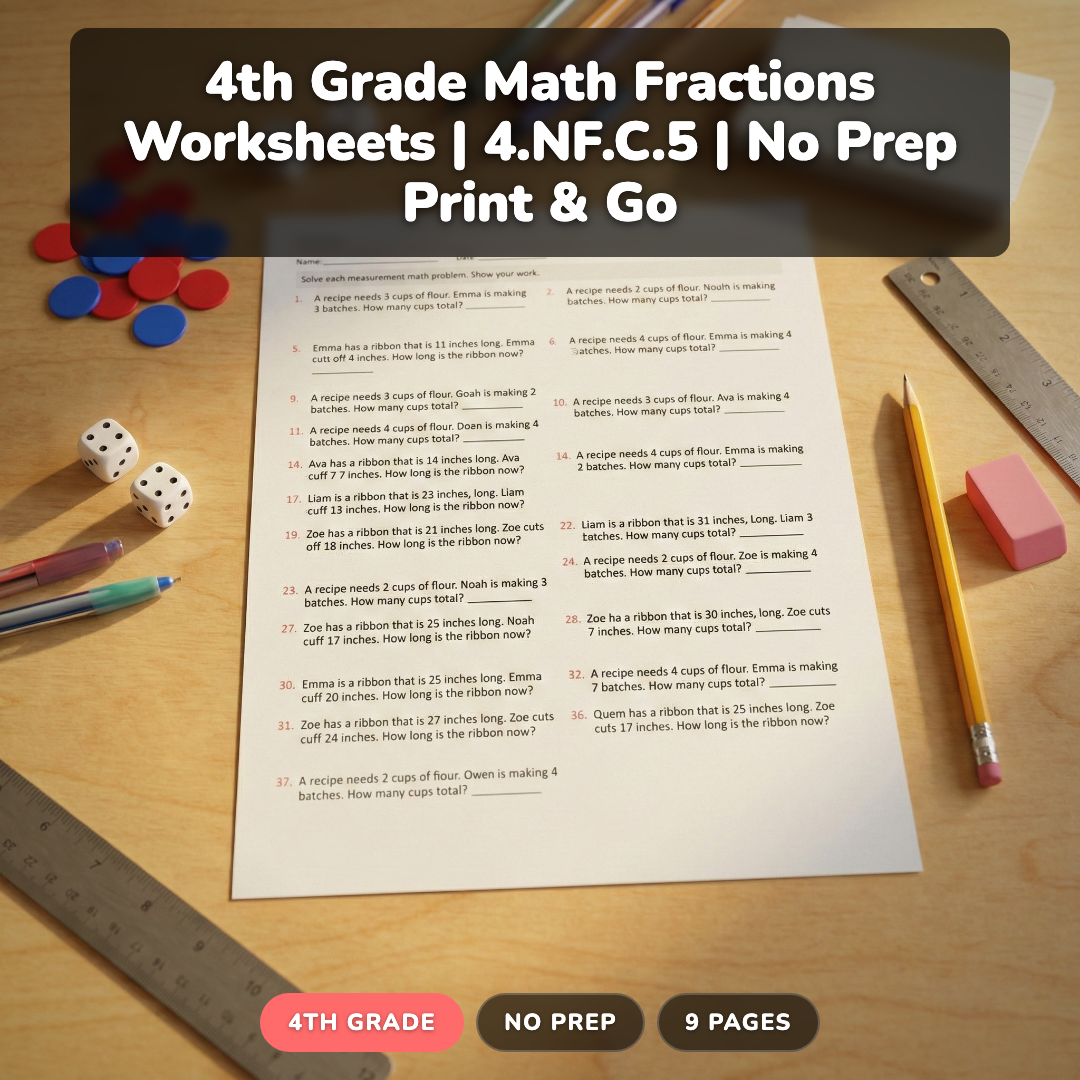
This differentiated fraction practice pack includes 132 problems across three difficulty levels. The Practice level focuses on basic equivalence (37 problems), On-Level covers standard addition and conversion (50 problems), and Challenge extends to mixed numbers and multi-step problems (45 problems). Each level includes complete answer keys and covers every aspect of CCSS.Math.Content.4.NF.C.5.
What makes this resource different is the careful progression within each level. Students aren’t thrown into complex problems immediately — they build confidence with simpler equivalences first. The Challenge level connects to real-world contexts and prepares students for fifth-grade decimal work.
All 9 pages are print-ready with clear directions and consistent formatting. No prep required — just print and go.
Grab a Free Fraction Sample to Try
Want to see the quality and format before purchasing? I’ll send you a free 2-page sample with problems from each difficulty level, plus answer keys. Perfect for testing with your students first.
Frequently Asked Questions About Teaching 4.NF.C.5
When should I teach fractions with denominators 10 and 100?
Most fourth-grade curricula introduce CCSS.Math.Content.4.NF.C.5 in February or March, after students master equivalent fractions with smaller denominators. Students need solid understanding of place value and basic fraction equivalence first.
What’s the biggest mistake students make with these fractions?
Students often add denominators when solving 3/10 + 4/100, getting 7/110. They need extensive practice with visual models showing why common denominators are necessary before attempting addition problems.
How does this connect to decimal work in fifth grade?
Understanding 3/10 = 30/100 directly prepares students for decimal equivalence: 0.3 = 0.30. The same place value reasoning applies to both fraction and decimal notation systems.
Should I teach the “multiply by 10” rule or let students discover it?
Guide students to discover the pattern through examples rather than stating the rule first. When students see 1/10 = 10/100, 2/10 = 20/100, they develop deeper understanding than memorizing the multiplication shortcut.
How many practice problems do students typically need?
Most students need 40-60 problems spread across 2-3 weeks: 15-20 for equivalence practice, 20-30 for addition, and 10-15 for mixed review. Struggling students may need additional visual model practice first.
Mastering fractions with denominators 10 and 100 sets your students up for success with decimals and percentages in upper elementary grades. The key is building understanding through visual models before moving to abstract computation.
What’s your go-to strategy for helping students see the connection between tenths and hundredths? I’d love to hear what works in your classroom!
Don’t forget to grab your free fraction sample above — it’s a great way to test these strategies with your students before diving into the full resource.