If your fourth graders freeze when asked to break apart fractions like 5/8 into smaller pieces, you’re not alone. Teaching fraction decomposition—the skill of breaking one fraction into a sum of unit fractions or smaller parts—challenges even confident math students.
You’ll walk away from this post with five research-backed strategies that make fraction decomposition click, plus differentiation tips for every learner in your classroom.
Key Takeaway
Students master fraction decomposition when they can visualize the process using concrete models before moving to abstract equations.
Why Fraction Decomposition Matters in 4th Grade
Fraction decomposition sits at the heart of fourth grade math because it bridges concrete fraction understanding with algebraic thinking. When students can break 6/8 into 3/8 + 3/8 or 4/8 + 2/8, they’re developing the foundation for adding and subtracting fractions with unlike denominators in fifth grade.
The timing matters too. Most curricula introduce CCSS.Math.Content.4.NF.B.3b in late fall or early winter, after students have solid experience with equivalent fractions and comparing fractions. Research from the National Council of Teachers of Mathematics shows that students who master decomposition perform 23% better on fraction operations assessments.
This standard specifically requires students to “decompose a fraction into a sum of fractions with the same denominator in more than one way, recording each decomposition by an equation.” The key phrase is “more than one way”—students must see that 5/6 can become 1/6 + 4/6 OR 2/6 + 3/6 OR 1/6 + 1/6 + 3/6.
Looking for a ready-to-go resource? I put together a differentiated fraction decomposition pack that covers everything below — but first, the teaching strategies that make it work.
Common Fraction Decomposition Misconceptions in 4th Grade
Common Misconception: Students think they can only break fractions into two equal parts.
Why it happens: Early fraction instruction emphasizes halving and splitting equally.
Quick fix: Show multiple decompositions side by side using visual models.
Common Misconception: Students change the denominator when decomposing (writing 4/8 = 2/4 + 2/4).
Why it happens: They confuse decomposition with equivalent fractions.
Quick fix: Emphasize that the “whole” stays the same size—only the number of pieces changes.
Common Misconception: Students think 3/5 + 2/5 = 5/10 instead of 5/5.
Why it happens: They add both numerators and denominators separately.
Quick fix: Use the phrase “same-size pieces” and model with fraction strips.
Common Misconception: Students believe there’s only one correct way to decompose each fraction.
Why it happens: Traditional worksheets often show single solutions.
Quick fix: Challenge students to find three different ways to break the same fraction.
5 Research-Backed Strategies for Teaching Fraction Decomposition
Strategy 1: Fraction Strip Decomposition
Students physically manipulate fraction strips to see how one fraction breaks into smaller parts. This concrete approach builds the visual foundation students need before working with abstract equations.
What you need:
- Fraction strips (halves through twelfths)
- Recording sheets
- Different colored pencils
Steps:
- Give students a fraction strip showing 6/8
- Challenge them to cover it using smaller pieces with the same denominator
- Record each solution as an equation (6/8 = 4/8 + 2/8)
- Find at least three different decompositions
- Share solutions and justify using the visual model
Strategy 2: Circle Model Decomposition
Drawing circles divided into equal parts helps students visualize fraction decomposition while developing their mathematical communication skills. This strategy works especially well for students who need to see the “whole” clearly.
What you need:
- Pre-drawn circle templates
- Colored pencils or crayons
- Recording sheets for equations
Steps:
- Show a circle divided into eighths with 5/8 shaded
- Ask students to color different sections using two colors
- Count each color separately (3 blue pieces + 2 red pieces)
- Write the equation: 5/8 = 3/8 + 2/8
- Try different color combinations for new decompositions
Strategy 3: Number Line Decomposition Jumps
Students use number lines to “jump” from zero to their target fraction in multiple ways. This strategy builds number sense while preparing students for adding and subtracting fractions on number lines in later units.
What you need:
- Number lines marked in equal increments
- Different colored pencils
- Recording sheets
Steps:
- Draw a number line from 0 to 1, marked in eighths
- Start at 0 and jump to 7/8 in two jumps
- Record the first path: 0 + 3/8 + 4/8 = 7/8
- Try a different jumping pattern: 0 + 1/8 + 6/8 = 7/8
- Find at least three different jumping sequences
Strategy 4: Fraction Equation Puzzles
Students solve missing addend problems where they must find different ways to complete fraction equations. This approach develops algebraic thinking while reinforcing decomposition concepts.
What you need:
- Equation puzzle worksheets
- Fraction manipulatives for checking
- Partner recording sheets
Steps:
- Present an incomplete equation: 5/6 = ___/6 + ___/6
- Students work with partners to find multiple solutions
- Use manipulatives to verify each answer
- Record all valid decompositions
- Share strategies with the class
Strategy 5: Real-World Decomposition Scenarios
Students apply fraction decomposition to authentic problems involving pizza slices, time intervals, or craft projects. This strategy builds mathematical modeling skills while making abstract concepts concrete.
What you need:
- Real-world scenario cards
- Manipulatives or drawings
- Recording sheets for equations
Steps:
- Present a scenario: “You ate 7/10 of a pizza. Show two different ways you could have eaten it.”
- Students model the situation with drawings or manipulatives
- Write equations for each scenario (7/10 = 3/10 + 4/10 or 7/10 = 5/10 + 2/10)
- Justify their decomposition using the context
- Create their own scenarios for classmates to solve
How to Differentiate Fraction Decomposition for All Learners
For Students Who Need Extra Support
Start with unit fractions (1/4, 1/6, 1/8) and build toward larger numerators gradually. Provide fraction manipulatives for every problem and use consistent visual models. Focus on denominators of 4, 6, and 8 initially, as these create clear visual patterns. Review prerequisite skills like identifying numerators and denominators, and ensure students can represent fractions concretely before moving to equations.
For On-Level Students
Work with CCSS.Math.Content.4.NF.B.3b expectations using denominators through 12. Students should find at least two decompositions for each fraction and record equations accurately. Incorporate both visual models and abstract reasoning. Practice with fractions where the numerator is close to the denominator (like 5/6 or 7/8) to build flexibility in thinking about fraction relationships.
For Students Ready for a Challenge
Extend to improper fractions and mixed numbers, requiring students to decompose fractions greater than one. Introduce three-addend decompositions (5/8 = 1/8 + 2/8 + 2/8) and connect to real-world measurement problems. Challenge students to find the maximum number of different decompositions for a given fraction, and explore patterns in their findings.
A Ready-to-Use Fraction Decomposition Resource for Your Classroom
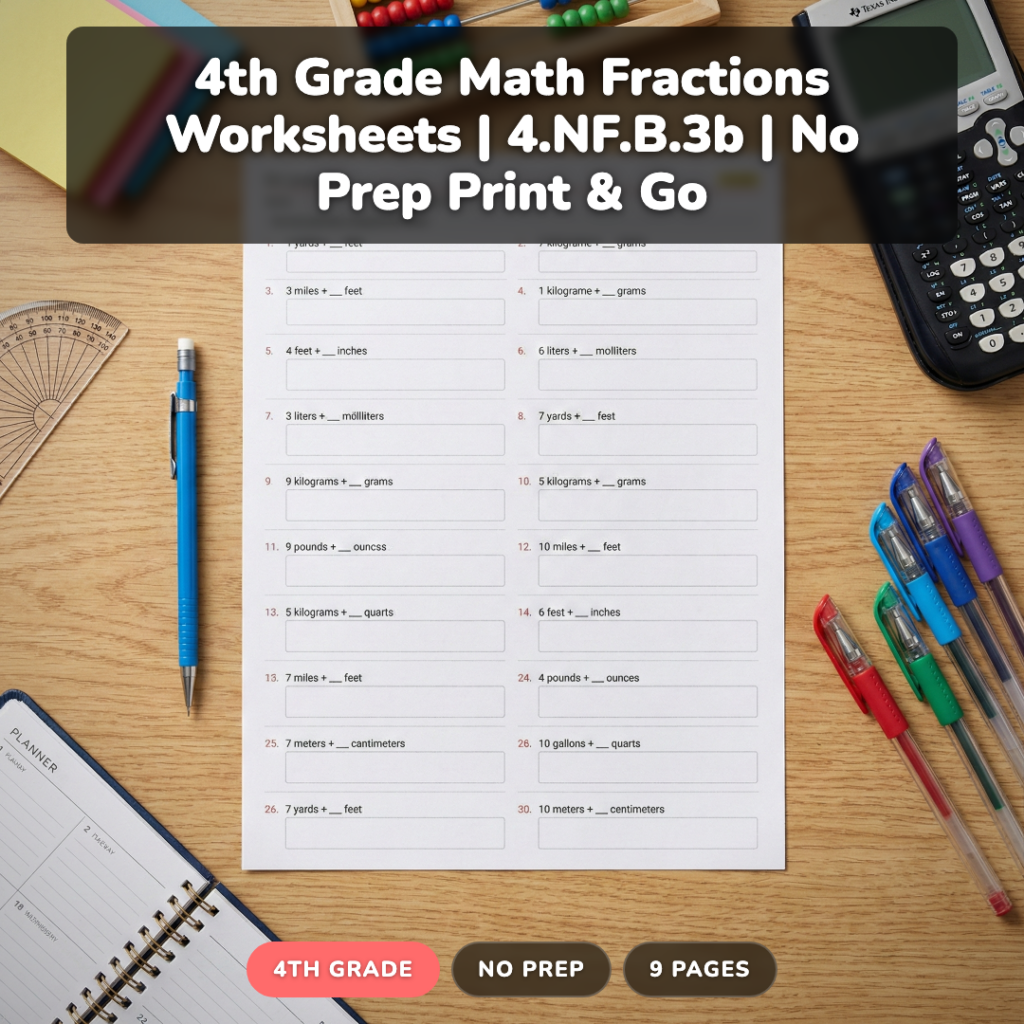
After using these strategies with hundreds of fourth graders, I created a comprehensive fraction decomposition resource that saves you hours of prep time. This 9-page pack includes 132 differentiated problems across three levels: Practice (37 problems), On-Level (50 problems), and Challenge (45 problems).
What makes this resource different is the systematic progression from concrete visual models to abstract equations, plus built-in reflection questions that help students justify their thinking—exactly what CCSS.Math.Content.4.NF.B.3b requires. Each level includes answer keys and can be used for independent practice, math centers, or homework.
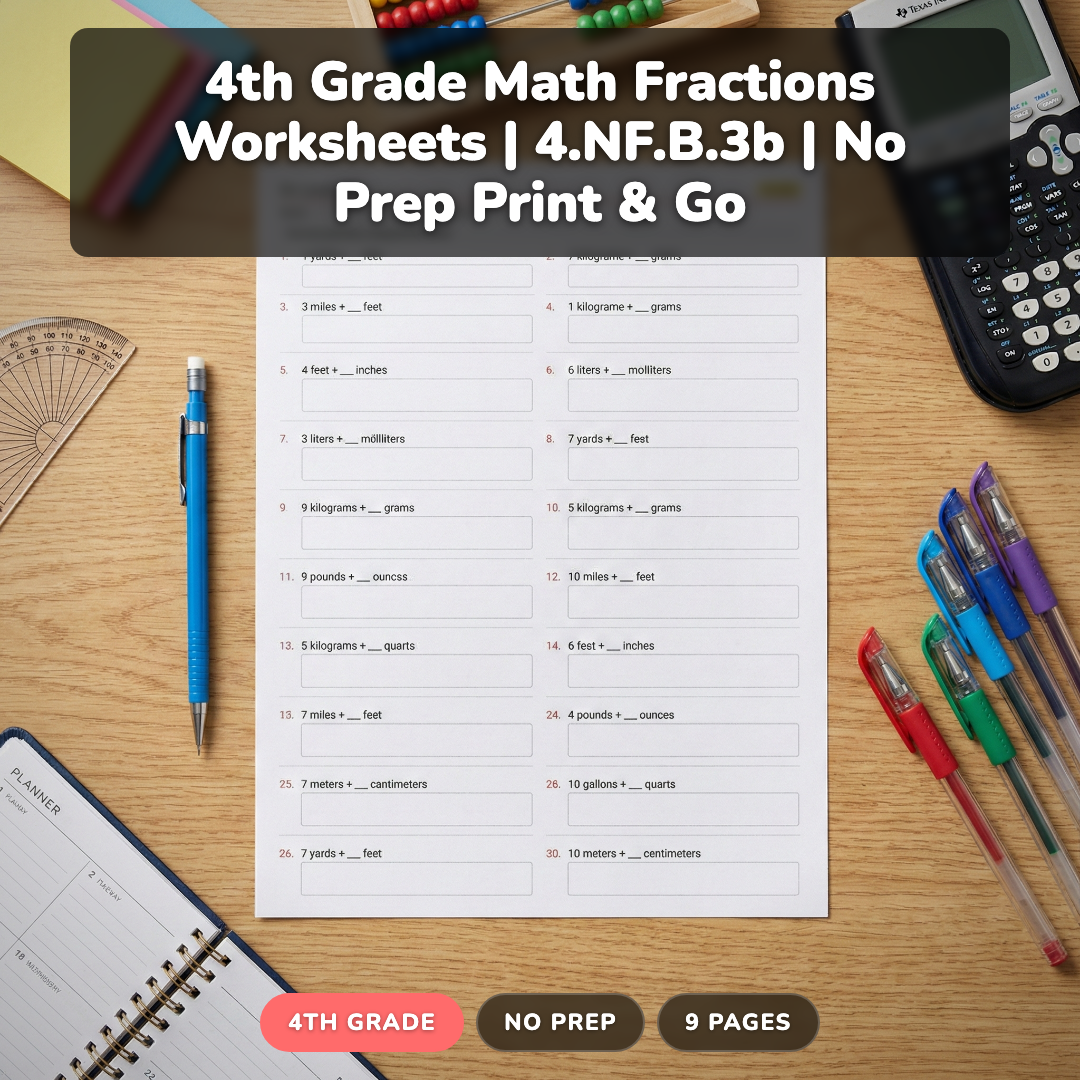
The pack covers everything from basic two-addend decompositions to complex three-addend challenges, with visual supports throughout.
Grab a Free Fraction Decomposition Sample to Try
Want to see how these strategies work in practice? I’ll send you a free sample page from each differentiation level, plus a quick-reference guide for teaching fraction decomposition. Drop your email below and I’ll send it right over.
Frequently Asked Questions About Teaching Fraction Decomposition
When should I introduce fraction decomposition in 4th grade?
Introduce fraction decomposition after students master equivalent fractions and fraction comparison, typically in November or December. Students need solid foundation with fraction concepts before learning to break fractions apart systematically.
What’s the difference between fraction decomposition and fraction addition?
Fraction decomposition breaks one fraction into smaller parts (5/8 = 3/8 + 2/8), while fraction addition combines separate fractions into one sum. Decomposition teaches the reverse process and builds conceptual understanding for addition.
How do I help students who keep changing the denominator?
Use consistent language about “same-size pieces” and provide visual models for every problem initially. Emphasize that decomposition keeps the same denominator because we’re breaking the same-sized whole into same-sized pieces.
Should students memorize decomposition facts like addition facts?
Focus on understanding patterns rather than memorization. Students should recognize that any fraction can be decomposed multiple ways and develop flexibility in thinking about fraction relationships rather than memorizing specific decompositions.
How does fraction decomposition connect to 5th grade standards?
Strong decomposition skills directly support adding and subtracting fractions with unlike denominators in 5th grade. Students who understand decomposition more easily grasp finding common denominators and fraction operations.
Teaching fraction decomposition successfully comes down to helping students see that fractions are flexible—they can be broken apart and recombined in multiple ways while maintaining their mathematical relationships. Start with concrete models, build to visual representations, and finish with abstract equations.
What’s your biggest challenge when teaching fraction decomposition? Try the free sample activities and let me know how they work in your classroom.