If your 4th graders freeze when they see a division problem like 2,847 ÷ 6, you’re not alone. Teaching multi-digit division feels overwhelming when students haven’t mastered the foundational concepts. But here’s what I’ve learned after years of teaching this skill: success comes from building understanding step by step, not rushing to the algorithm.
Key Takeaway
Fourth graders learn division best when they understand place value relationships and can connect division to multiplication through concrete models before moving to abstract algorithms.
Why 4th Grade Division Matters
Standard CCSS.Math.Content.4.NBT.B.6 asks students to find whole-number quotients and remainders with up to four-digit dividends and one-digit divisors. This isn’t just about memorizing steps—it’s about developing number sense and mathematical reasoning that will serve students through high school and beyond.
Research from the National Council of Teachers of Mathematics shows that students who understand division conceptually before learning algorithms perform 40% better on problem-solving assessments. The key timing? Introduce this standard in late fall after students have solid multiplication facts and place value understanding.
This standard connects directly to fraction work (4.NF) and prepares students for decimal division in 5th grade. Students need to visualize what division means—fair sharing, repeated subtraction, and the inverse relationship with multiplication.
Looking for a ready-to-go resource? I put together a differentiated division pack that covers everything below — but first, the teaching strategies that make it work.
Common Division Misconceptions in 4th Grade
Common Misconception: Students think the remainder must be smaller than the dividend.
Why it happens: They confuse the remainder rule with the overall problem size.
Quick fix: Emphasize “remainder must be smaller than the divisor” with concrete examples.
Common Misconception: Students believe division always makes numbers smaller.
Why it happens: Early exposure focuses on dividing by numbers greater than 1.
Quick fix: Include problems like 24 ÷ 1 = 24 to show division by 1 keeps numbers the same.
Common Misconception: Students think you can’t divide a smaller number by a larger number.
Why it happens: They haven’t connected division to fractions yet.
Quick fix: Show 3 ÷ 4 = 0 remainder 3, preparing for fraction understanding.
Common Misconception: Students reverse dividend and divisor when writing equations.
Why it happens: The language “divide 12 by 3” sounds like 3 ÷ 12.
Quick fix: Always connect to sharing language: “12 divided into 3 groups.”
5 Research-Backed Strategies for Teaching Division
Strategy 1: Area Model Foundation
Area models help students visualize division as breaking apart rectangles, connecting directly to multiplication understanding. This concrete approach builds number sense before introducing algorithms.
What you need:
- Grid paper or whiteboards
- Base-ten blocks
- Colored pencils
Steps:
- Start with a problem like 84 ÷ 4
- Draw a rectangle and label one side “4”
- Break 84 into friendly numbers: 80 + 4
- Create two rectangles: 4 × ? = 80 and 4 × ? = 4
- Solve: 4 × 20 = 80 and 4 × 1 = 4
- Add the partial quotients: 20 + 1 = 21
Strategy 2: Partial Quotients Method
This strategy breaks division into manageable chunks, allowing students to use multiplication facts they know confidently rather than guessing digits.
What you need:
- Multiplication fact charts
- Scratch paper
- Hundreds chart
Steps:
- Write the problem: 156 ÷ 6
- Ask: “What’s an easy multiple of 6 I can subtract?”
- Try 6 × 10 = 60. Subtract: 156 – 60 = 96
- Record the 10 above the division bracket
- Continue: 6 × 10 = 60. Subtract: 96 – 60 = 36
- Continue: 6 × 6 = 36. Subtract: 36 – 36 = 0
- Add partial quotients: 10 + 10 + 6 = 26
Strategy 3: Base-Ten Block Division
Physical manipulation with base-ten blocks makes abstract division concrete, especially powerful for students who need to see and touch mathematical concepts.
What you need:
- Base-ten blocks (hundreds, tens, ones)
- Small containers or paper plates
- Recording sheets
Steps:
- Model the dividend with blocks: 248 = 2 hundreds, 4 tens, 8 ones
- Set up containers equal to the divisor (3 containers for 248 ÷ 3)
- Distribute hundreds first: 2 hundreds can’t be shared equally among 3 groups
- Trade hundreds for tens: 2 hundreds = 20 tens, plus 4 tens = 24 tens
- Share tens: 24 tens ÷ 3 = 8 tens per group
- Share ones: 8 ones ÷ 3 = 2 ones per group, remainder 2
- Record: 248 ÷ 3 = 82 R2
Strategy 4: Repeated Subtraction Games
Turn division practice into an engaging game where students compete to solve problems using strategic repeated subtraction, building fluency while having fun.
What you need:
- Division problem cards
- Timer
- Score sheets
- Calculators for checking
Steps:
- Partners draw a division card (example: 294 ÷ 7)
- Each player chooses their subtraction strategy
- Player 1 might subtract 7 × 40 = 280, leaving 14
- Player 2 might subtract 7 × 30 = 210, leaving 84
- Continue until reaching zero or a remainder less than the divisor
- Player with fewer subtraction steps wins the round
- Check answers with calculators
Strategy 5: Real-World Problem Solving
Connect division to authentic situations students can relate to, making the mathematics meaningful and showing why these skills matter beyond the classroom.
What you need:
- Real-world scenario cards
- Play money or counters
- Calculators
- Graph paper for organizing work
Steps:
- Present a scenario: “The school ordered 1,248 pencils for 6 classrooms”
- Students identify the division: 1,248 ÷ 6
- Choose their preferred solving method (area model, partial quotients, etc.)
- Solve and interpret the remainder: 208 pencils per classroom
- Discuss: “What if there were 1,250 pencils instead?”
- Connect to multiplication check: 208 × 6 = 1,248 ✓
How to Differentiate Division for All Learners
For Students Who Need Extra Support
Begin with concrete division using manipulatives and two-digit dividends. Focus on division as “fair sharing” with physical objects before introducing symbolic notation. Provide multiplication fact charts and allow calculator use for fact checking. Use problems without remainders initially, then introduce remainders with concrete contexts (“How many full teams can you make?”). Review skip counting and basic multiplication facts daily through games and songs.
For On-Level Students
Students working at grade level should master CCSS.Math.Content.4.NBT.B.6 with three- and four-digit dividends and one-digit divisors. They should fluently use at least two division strategies and explain their reasoning. Provide mixed practice with and without remainders, emphasizing the connection between multiplication and division. Include word problems that require interpretation of remainders in context.
For Students Ready for a Challenge
Extend learning with two-digit divisors, decimal dividends, or multi-step word problems. Challenge students to find the most efficient strategy for each problem and explain their choice. Introduce division patterns (dividing by 10, 100, 1000) and connect to scientific notation concepts. Have them create their own word problems and teach division strategies to younger students.
A Ready-to-Use Division Resource for Your Classroom
After years of creating division materials from scratch, I developed a comprehensive worksheet pack that addresses every aspect of CCSS.Math.Content.4.NBT.B.6. This resource includes 132 carefully crafted problems across three differentiation levels.
The Practice level (37 problems) focuses on building conceptual understanding with visual models and guided steps. The On-Level section (50 problems) provides grade-appropriate practice with varied problem types and remainder situations. The Challenge level (45 problems) extends learning with complex scenarios and multi-step thinking.
What makes this different from other division worksheets? Each level includes detailed answer keys with multiple solution strategies shown, so you can see exactly how students might approach each problem. The problems progress systematically from concrete to abstract, supporting the learning progression research recommends.
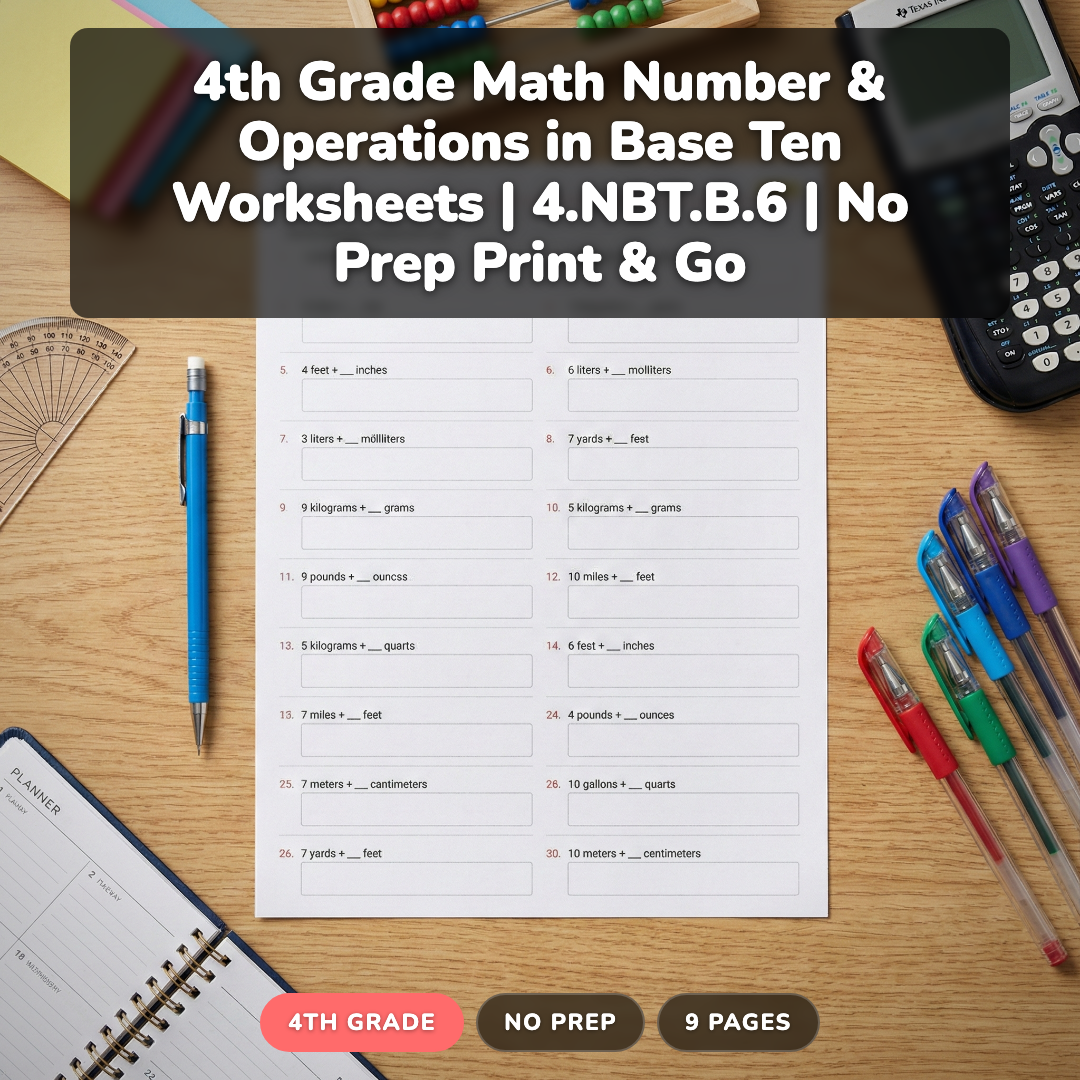
This no-prep resource saves hours of planning time while ensuring every student gets appropriately challenging practice. The clear formatting and consistent structure help students focus on the mathematics, not decoding directions.
Grab a Free Division Sample to Try
Want to see how these strategies work in practice? I’ll send you a free sample pack with one worksheet from each differentiation level, plus my division strategy reference sheet that students love. Perfect for trying these techniques with your class before diving into the full resource.
Frequently Asked Questions About Teaching 4th Grade Division
When should I introduce the standard division algorithm?
Introduce the algorithm only after students understand division conceptually through area models, partial quotients, and base-ten blocks. Research shows students who learn strategies before algorithms retain understanding better and make fewer procedural errors.
How do I help students who struggle with remainders?
Use concrete contexts where remainders make sense: “27 students, 4 per table, how many tables needed?” Connect remainders to real situations before practicing abstract problems. Emphasize that remainders must be smaller than the divisor through physical demonstrations.
What multiplication facts do students need for division success?
Students need automatic recall of multiplication facts through 10 × 10 for division fluency. Focus especially on facts for 6, 7, 8, and 9, which appear frequently in division problems. Provide fact charts during initial learning, then gradually remove supports.
How long should I spend teaching this standard?
Plan 3-4 weeks for initial instruction, with ongoing practice throughout the year. Spend the first week on conceptual understanding with manipulatives, second week on strategy development, and remaining time on fluency building and problem solving applications.
Should students memorize division facts like multiplication facts?
Focus on understanding the relationship between multiplication and division rather than memorizing division facts separately. When students know 7 × 8 = 56, they automatically know 56 ÷ 7 = 8. This connection is more powerful than isolated fact memorization.
Teaching division doesn’t have to feel overwhelming when you build understanding step by step. Start with concrete models, help students see the connection to multiplication, and provide plenty of practice with real-world contexts. What’s your favorite strategy for helping students understand division? Don’t forget to grab that free sample pack above—it’s a great way to try these approaches with your students right away.