If your 4th graders freeze when they see angle problems or think every angle is either 90 degrees or “big,” you’re not alone. Teaching angle measurement and the additive property is one of those skills that seems straightforward until you watch students try to solve for unknown angles. You’ll discover practical, research-backed strategies that help students truly understand how angles work together, plus differentiation tips for every learner in your classroom.
Key Takeaway
Students master angle measurement when they understand that angles are additive — the whole equals the sum of its parts — through hands-on decomposition and visual representation.
Why Angle Measurement Matters in 4th Grade
Angle measurement in 4th grade builds the foundation for geometry concepts students will use through high school. CCSS.Math.Content.4.MD.C.7 specifically requires students to recognize that angle measure is additive and solve for unknown angles using equations. This standard bridges concrete measurement skills with algebraic thinking.
Research from the National Council of Teachers of Mathematics shows that students who master angle relationships in elementary grades perform 23% better on geometric reasoning tasks in middle school. The timing matters too — this standard typically appears in the second half of the school year, after students have solid foundations in multiplication, division, and basic fraction concepts.
Fourth graders need to move beyond simply measuring angles with protractors to understanding how angles combine and separate. They’re developing spatial reasoning skills that connect to real-world applications like construction, navigation, and design. The additive property of angles becomes crucial when students encounter more complex geometric proofs in later grades.
Looking for a ready-to-go resource? I put together a differentiated angle measurement pack with 132 problems across three difficulty levels — but first, the teaching strategies that make it work.
Common Angle Misconceptions in 4th Grade
Common Misconception: Students think angle size depends on the length of the rays.
Why it happens: They focus on what they can see rather than the amount of rotation between rays.
Quick fix: Use paper plates with moveable rays to show different lengths creating identical angles.
Common Misconception: All angles are either 90 degrees, 45 degrees, or “really big.”
Why it happens: Limited exposure to varied angle measures in their environment.
Quick fix: Create an “angle hunt” around the classroom measuring doors, book corners, and desk edges.
Common Misconception: When solving for unknown angles, students guess rather than using the additive property.
Why it happens: They don’t see the connection between angle parts and wholes.
Quick fix: Start every problem by having students identify the whole angle first, then find the parts.
Common Misconception: Students think angles in different orientations are different sizes.
Why it happens: They rely on visual position rather than measuring the opening between rays.
Quick fix: Practice measuring the same angle rotated to different positions on the board.
5 Research-Backed Strategies for Teaching Angle Measurement
Strategy 1: Paper Plate Angle Builders
Students create physical angles using paper plates and brass fasteners, making the additive property concrete and manipulable. This hands-on approach helps students see how smaller angles combine to form larger ones.
What you need:
- Paper plates (2 per student)
- Brass fasteners
- Scissors
- Protractors
- Angle measurement recording sheet
Steps:
- Cut one plate in half. Attach both halves to a whole plate with brass fasteners at the center.
- Demonstrate creating a 60-degree angle with one moveable piece.
- Add the second piece to create an additional 30-degree angle.
- Have students measure both parts (60° and 30°) and the whole (90°).
- Record findings: 60° + 30° = 90°.
- Repeat with different combinations, always verifying that parts equal the whole.
Strategy 2: Angle Detective with Real-World Problems
Students solve angle puzzles embedded in real-world contexts, developing both measurement skills and algebraic thinking as required by the standard.
What you need:
- Photos of real objects with angle markings
- Angle detective worksheet
- Calculators
- Protractors for verification
Steps:
- Present a photo problem: “A door opens to create a 110° angle. If the first part measures 45°, what’s the second part?”
- Students identify the whole angle (110°) and known part (45°).
- Write the equation: 45° + ? = 110°
- Solve: ? = 110° – 45° = 65°
- Verify by checking that 45° + 65° = 110°.
- Connect to the real-world context: “The door opened 65° more.”
Strategy 3: Angle Equation Match Game
Students match angle diagrams with corresponding equations, strengthening the connection between visual representations and algebraic expressions.
What you need:
- Angle diagram cards (showing decomposed angles)
- Equation cards (showing addition/subtraction problems)
- Answer key for self-checking
- Timer for partner competitions
Steps:
- Create diagram cards showing angles split into 2-3 parts with some measurements given.
- Create equation cards like “x + 35° = 90°” or “125° – 78° = y”.
- Students work in pairs to match diagrams with equations.
- Partners explain their reasoning: “This 90° angle minus the 35° part equals the unknown part.”
- Self-check using answer keys and discuss any mismatches.
- Switch roles and repeat with new card sets.
Strategy 4: Interactive Angle Decomposition on the Board
Using dynamic visual demonstrations, students see angles being built and taken apart in real-time, reinforcing the additive property through multiple representations.
What you need:
- Interactive whiteboard or document camera
- Large protractor
- Colored markers or tape
- Pre-drawn angle templates
Steps:
- Draw a large angle (like 120°) on the board without revealing the measurement.
- Ask students to estimate the angle size.
- Use colored tape to divide the angle into two parts.
- Measure each part with the class: perhaps 80° and 40°.
- Verify: 80° + 40° = 120°.
- Repeat the process, asking students to predict what happens if you change one part.
Strategy 5: Angle Story Problems with Visual Models
Students create and solve their own angle story problems, demonstrating deep understanding of both the mathematical concept and real-world applications.
What you need:
- Story problem template sheets
- Drawing materials
- Real-world angle photos for inspiration
- Peer review checklist
Steps:
- Students choose a real-world context (playground equipment, building corners, sports plays).
- Create a story problem involving unknown angles: “A soccer player kicks the ball at a 130° angle. The first part of the kick goes 85°. What angle does the second part cover?”
- Draw a diagram showing the angle decomposition.
- Write and solve the equation: 85° + x = 130°, so x = 45°.
- Peers solve each other’s problems and provide feedback.
- Share favorite problems with the whole class.
How to Differentiate Angle Measurement for All Learners
For Students Who Need Extra Support
Start with concrete manipulatives and benchmark angles. Use angle builders with 30°, 45°, 60°, and 90° increments. Provide number lines showing angle relationships and always begin with the whole angle clearly identified. Review prerequisite skills like basic addition and subtraction within 180. Use color-coding to distinguish between known and unknown angle measures in problems.
For On-Level Students
Focus on the standard expectations from CCSS.Math.Content.4.MD.C.7: solving addition and subtraction problems to find unknown angles using equations with symbols. Practice with angles in various orientations and real-world contexts. Students should comfortably work with angles up to 180° and create equations like x + 65° = 135°. Emphasize checking answers by verifying that parts add up to the whole.
For Students Ready for a Challenge
Introduce problems with three or more angle parts, reflex angles greater than 180°, and complex real-world applications. Students can explore angle relationships in polygons, create their own measurement tools, and investigate how angle measurement connects to fractions and decimal concepts. Challenge them to find multiple solutions or create problems for classmates to solve.
A Ready-to-Use Angle Measurement Resource for Your Classroom
After years of teaching angle measurement, I’ve learned that students need varied practice at multiple difficulty levels to truly master this concept. That’s why I created a comprehensive worksheet pack that takes the guesswork out of differentiation.
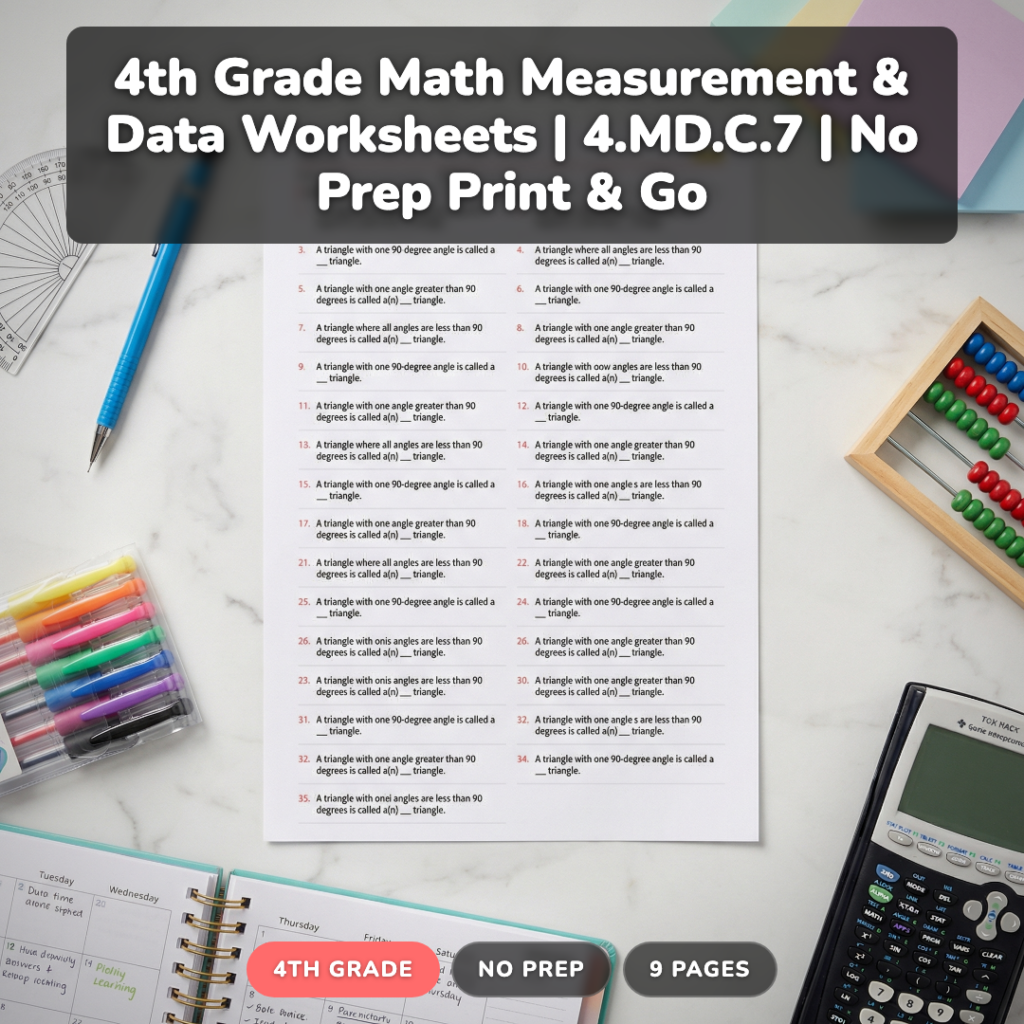
This resource includes 132 carefully crafted problems across three distinct levels: Practice (37 problems), On-Level (50 problems), and Challenge (45 problems). Each level targets different student needs while maintaining focus on the additive property of angles. The problems progress from simple two-part decompositions to complex real-world applications, giving you flexibility to meet every learner where they are.
What makes this resource different is the intentional scaffolding. Practice level uses benchmark angles and clear visual cues, On-Level aligns perfectly with grade 4 standards, and Challenge level pushes students toward 5th grade geometric reasoning. Answer keys are included for quick grading, and the no-prep format means you can use these immediately.
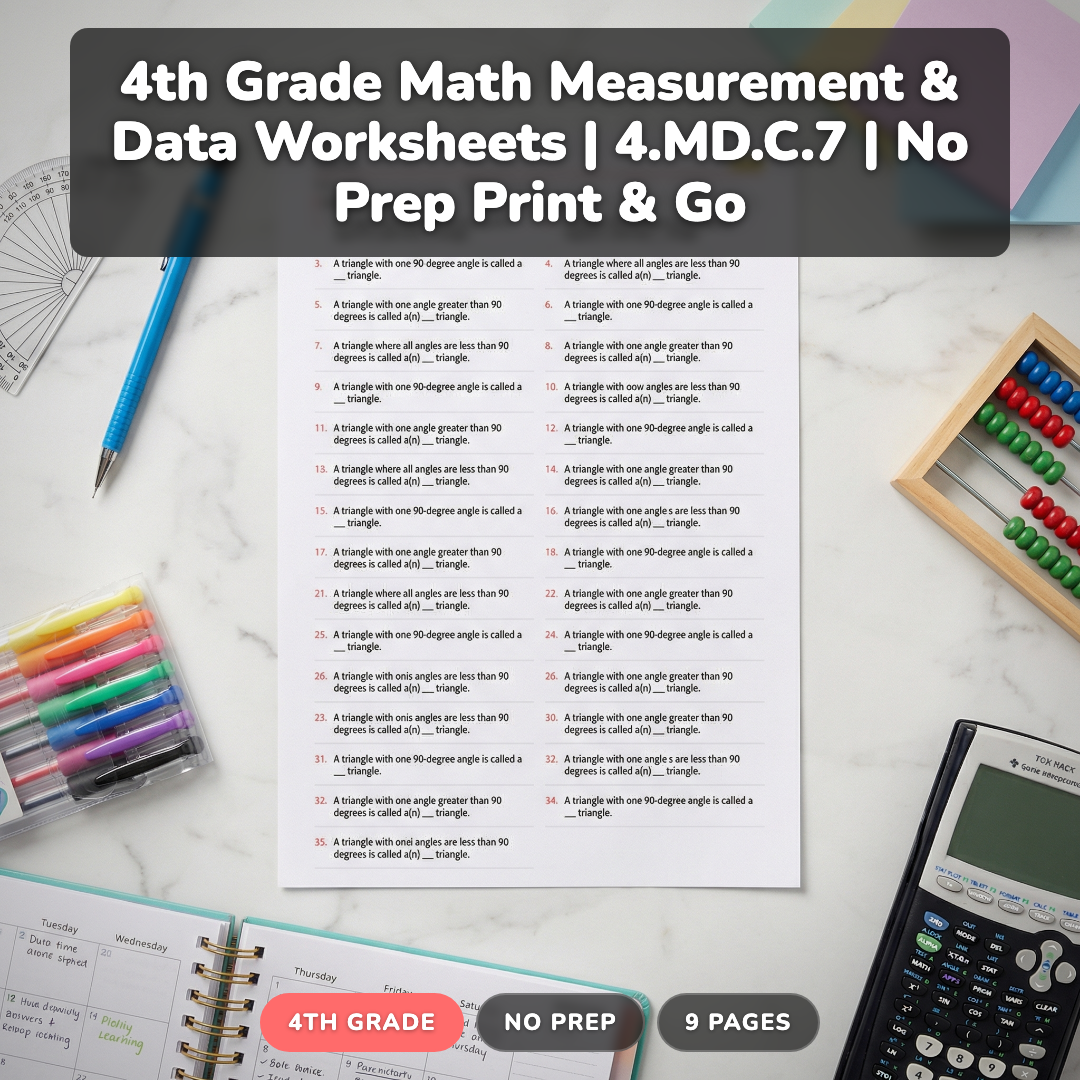
The pack saves you hours of problem creation while ensuring your students get the targeted practice they need to master angle measurement and the additive property.
Grab a Free Angle Measurement Sample to Try
Want to see the quality and differentiation levels before you buy? I’ll send you a free sample with problems from each difficulty level, plus my angle measurement anchor chart that students love. Perfect for trying out these strategies in your classroom.
Frequently Asked Questions About Teaching Angle Measurement
When should I teach angle measurement in 4th grade?
Angle measurement typically comes in the second half of the school year, after students have mastered multiplication and division. CCSS.Math.Content.4.MD.C.7 builds on earlier measurement standards, so students need solid foundations in degrees as a unit of measure before tackling the additive property.
What’s the most common mistake students make with unknown angles?
Students often guess at unknown angle measures instead of using the additive property systematically. They’ll estimate “about 50 degrees” rather than setting up equations like x + 45° = 120°. Teaching the equation-writing process explicitly prevents this guessing habit from developing.
How do I help students who struggle with protractor use?
Start with paper plate angle builders before introducing protractors. Students need to understand what they’re measuring (the opening between rays) before learning the tool. Practice with benchmark angles like 30°, 45°, 60°, and 90° helps students recognize when their protractor readings make sense.
Should 4th graders work with angles larger than 180 degrees?
The standard focuses on angles up to 180°, but advanced students can explore reflex angles as enrichment. Keep the core instruction within the 0°-180° range to align with CCSS.Math.Content.4.MD.C.7 expectations while offering extensions for students ready for more complexity.
How does angle measurement connect to other 4th grade math topics?
Angle measurement reinforces algebraic thinking through equation solving and connects to fraction concepts when discussing parts of a whole. Students use addition and subtraction skills while developing spatial reasoning that supports geometry throughout elementary school and beyond.
Teaching angle measurement successfully means helping students see angles as measurable quantities that follow predictable rules. When students understand that angles are additive and can write equations to find unknown measures, they’ve mastered a crucial geometric concept that serves them well in future math courses.
What’s your go-to strategy for helping students visualize angle relationships? The hands-on approaches above work well, but every classroom is different. Don’t forget to grab your free angle measurement sample to try these strategies with your students.