If your first graders think the equal sign means “find the answer,” you’re not alone. This misconception shows up in nearly every first-grade classroom and can derail algebraic thinking for years if not addressed early. You’ll discover five research-backed strategies that help students truly understand what the equal sign means, plus differentiation tips for every learner in your classroom.
Key Takeaway
Teaching the equal sign as a balance symbol — not an action command — builds the foundation for algebraic thinking that students need throughout their math education.
Why Equal Sign Understanding Matters in First Grade
The equal sign is the gateway to algebraic thinking, yet research shows that 70% of middle school students still misunderstand its meaning. CCSS.Math.Content.1.OA.D.7 requires first graders to understand the meaning of the equal sign and determine if equations are true or false — a skill that directly impacts their success with algebra years later.
This standard typically appears in the second half of first grade, after students have developed fluency with addition and subtraction facts to 10. It bridges concrete arithmetic and abstract algebraic reasoning, making it one of the most important conceptual shifts in elementary mathematics.
Research from the National Council of Teachers of Mathematics shows that students who develop a relational understanding of the equal sign in first grade perform significantly better on algebraic tasks in later grades. The key is moving beyond “the equal sign means the answer goes here” to “the equal sign means both sides have the same value.”
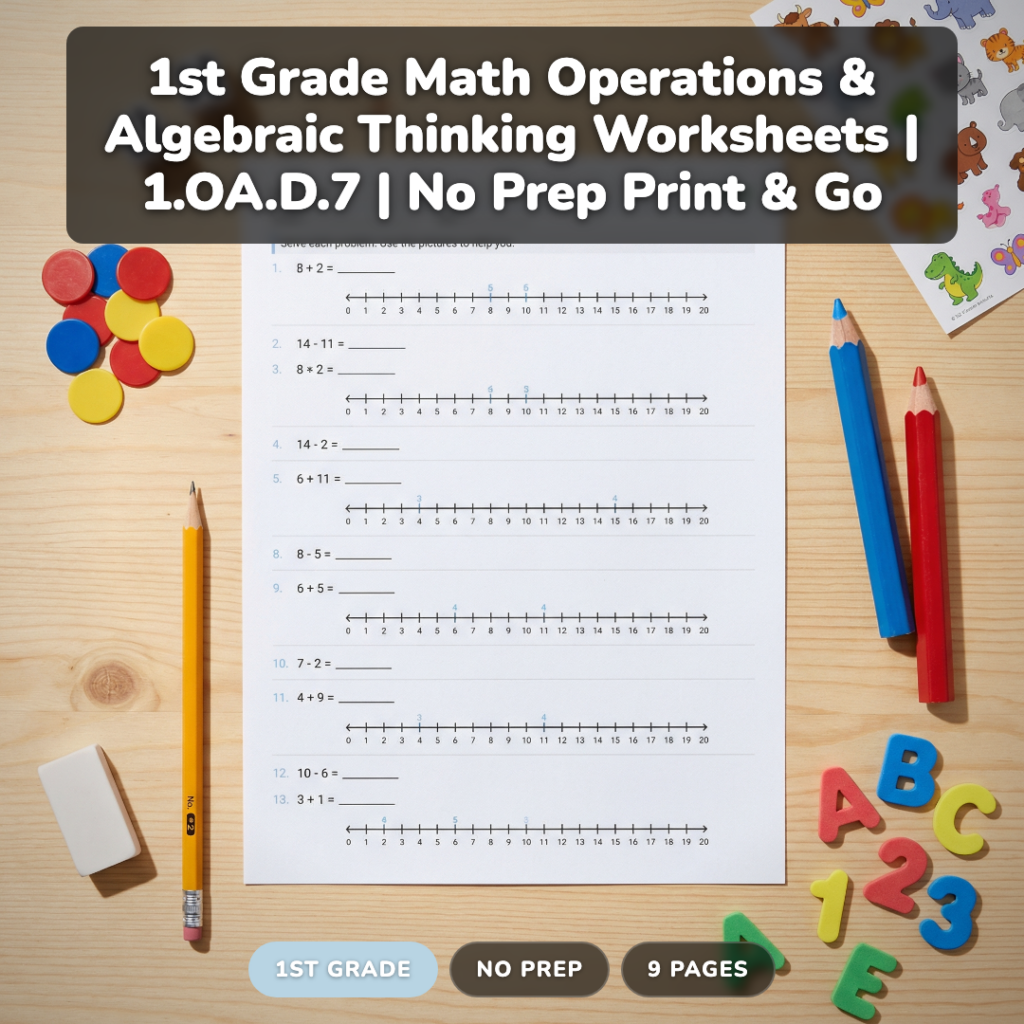
Looking for a ready-to-go resource? I put together a differentiated equal sign practice pack that covers everything below — but first, the teaching strategies that make it work.
Common Equal Sign Misconceptions in First Grade
Understanding why students struggle with the equal sign helps you address these misconceptions before they become entrenched patterns of thinking.
Common Misconception: The equal sign means “find the answer” or “the answer goes here.”
Why it happens: Students see equations like 3 + 4 = ___ and think the equal sign is a command to calculate.
Quick fix: Start with true/false equations like 5 = 5 or 3 + 2 = 4 + 1 instead of fill-in-the-blank problems.
Common Misconception: Numbers must be in order from smallest to largest (3 = 1 + 2 looks “wrong”).
Why it happens: Students expect to see the “answer” on the right side of the equation.
Quick fix: Use balance scales to show that 3 pennies weighs the same as 1 penny + 2 pennies, regardless of which side they’re on.
Common Misconception: All equations must have operations (thinking 7 = 7 is “incomplete”).
Why it happens: Students associate math problems with “doing something” to numbers.
Quick fix: Use real objects to show that 7 blocks equals 7 blocks — no operation needed.
Common Misconception: The equal sign only works with addition (struggling with 8 – 3 = 2 + 3).
Why it happens: Most early math exposure focuses on addition equations.
Quick fix: Introduce mixed operations using concrete manipulatives before moving to abstract equations.
5 Research-Backed Strategies for Teaching Equal Signs
Strategy 1: Balance Scale Exploration
The balance scale provides the perfect concrete representation of equality. Students can physically see and feel when both sides have the same value, making the abstract concept of “equal” tangible and memorable.
What you need:
- Balance scale (or simple coat hanger balance)
- Counting bears, blocks, or pennies
- Small cups or containers
- Recording sheet
Steps:
- Place 5 bears on the left side of the balance scale
- Ask students: “How many bears do I need on the right side to make it balance?”
- Have students add bears one at a time until the scale balances
- Record the equation: 5 = 5
- Try unequal amounts and discuss why the scale tips
- Progress to combinations: 3 + 2 on one side, 5 on the other
- Record: 3 + 2 = 5, emphasizing that both sides have the same value
Strategy 2: True or False Equation Sorting
This strategy develops critical thinking about equality by having students evaluate whether equations are correct before solving anything. It shifts focus from computation to relationship analysis.
What you need:
- Equation cards (mix of true and false statements)
- Two sorting mats labeled “True” and “False”
- Manipulatives for verification
- Timer (optional for engagement)
Steps:
- Present equation cards like: 4 + 1 = 5, 3 + 2 = 6, 7 = 4 + 3, 2 + 2 = 8 – 4
- Students read each equation without calculating
- They predict whether it’s true or false and place it on the appropriate mat
- Use manipulatives to verify their predictions
- Discuss why false equations are incorrect
- Challenge: Create their own true and false equations
Strategy 3: Number Bond Equation Building
Number bonds help students see the relationship between parts and wholes, making it easier to understand that different combinations can equal the same total. This visual approach supports the relational understanding of equality.
What you need:
- Number bond mats (circles connected by lines)
- Dry erase markers
- Dice or number cards
- Equation recording sheet
Steps:
- Roll a die to get the “whole” number (e.g., 6)
- Write 6 in the whole circle of the number bond
- Find different ways to make 6 using two parts (4 + 2, 5 + 1, 3 + 3)
- Write each combination in the part circles
- Record the equations: 6 = 4 + 2, 6 = 5 + 1, 6 = 3 + 3
- Discuss how all equations are true because they equal 6
- Create comparison equations: 4 + 2 = 5 + 1
Strategy 4: Pan Balance Equation Theater
Acting out equations with body movements helps kinesthetic learners understand equality while engaging the whole class. Students become the “weights” in human balance scales, making abstract concepts physical and memorable.
What you need:
- Large space for movement
- Number cards or vests
- Masking tape for “balance beam”
- Equation cards
Steps:
- Create a “balance beam” on the floor with tape
- Give students number cards to wear
- Call out an equation like “3 + 2 = 5”
- Students with cards 3 and 2 stand on the left side
- Student with card 5 stands on the right side
- Class determines if the “scale” would balance
- Act out the balancing by having students adjust positions
- Try false equations and discuss why they don’t balance
Strategy 5: Equal Sign Detective Work
This problem-solving approach turns students into mathematical detectives who investigate whether equations are true or false. It develops analytical thinking and helps students articulate their mathematical reasoning.
What you need:
- “Detective” magnifying glasses (real or pretend)
- Equation “case files” (cards with equations to investigate)
- Evidence recording sheets
- Manipulatives for proof
Steps:
- Present an equation “case” like: Is 4 + 3 = 2 + 5 true?
- Students use their “detective tools” (manipulatives) to investigate
- They record their evidence: “Left side: 4 + 3 = 7, Right side: 2 + 5 = 7”
- Conclusion: “True! Both sides equal 7”
- Students present their findings to the class
- Create a “solved cases” bulletin board
- Challenge: Students create mystery equations for classmates
How to Differentiate Equal Sign Learning for All Students
For Students Who Need Extra Support
Begin with concrete manipulatives for every equation. Use identical amounts first (3 = 3) before introducing combinations. Provide visual supports like number lines and ten frames. Focus on numbers to 5 initially, and always allow students to use manipulatives to verify their thinking. Consider using picture equations before introducing numerical symbols.
For On-Level Students
Students work with equations involving sums to 10, including true/false statements and missing addend problems. They can move between concrete and abstract representations as needed. Encourage them to explain their reasoning using mathematical language. Practice includes both addition and subtraction equations following CCSS.Math.Content.1.OA.D.7 expectations.
For Students Ready for a Challenge
Introduce three-addend equations like 2 + 3 + 1 = 4 + 2. Explore equations with larger numbers or mixed operations. Challenge them to create their own true and false equations for classmates to solve. Connect to real-world situations where equality matters, such as fair sharing or balanced teams.
A Ready-to-Use Equal Sign Resource for Your Classroom
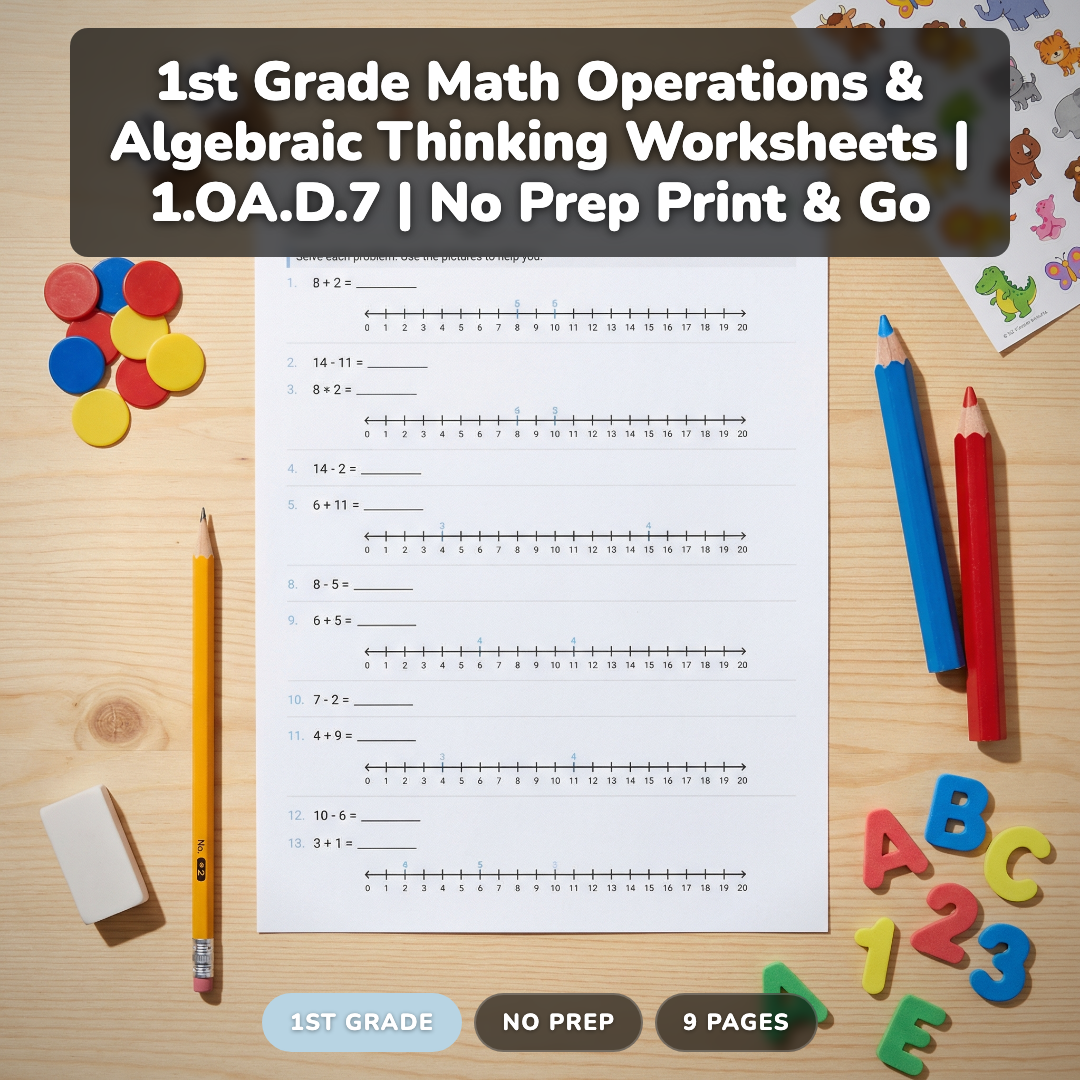
After using these strategies in my classroom for years, I created a comprehensive resource that saves you prep time while providing exactly the practice your students need. This differentiated pack includes 106 problems across three levels — from foundational practice with simple equations to challenging multi-step problems.
The resource includes 30 practice problems for students who need extra support with concrete representations, 40 on-level problems that align perfectly with first-grade standards, and 36 challenge problems for advanced learners. Each level includes answer keys and can be used for independent work, math centers, or homework.
What makes this different from other equal sign worksheets is the intentional progression from concrete to abstract thinking, plus the variety of equation types that address common misconceptions. Students work with true/false statements, missing numbers, and comparison equations — not just fill-in-the-blank problems.
You can grab this time-saving resource and start using it tomorrow in your classroom.
Grab a Free Equal Sign Activity to Try
Want to test these strategies before diving in? I’ll send you a free equal sign balance activity that you can use with your students this week. It includes the manipulative setup, recording sheet, and differentiation tips.
Frequently Asked Questions About Teaching Equal Signs
When should I introduce the equal sign concept in first grade?
Introduce equal sign understanding after students are fluent with addition and subtraction facts to 10, typically in January or February. Students need computational confidence before focusing on relational thinking about equality.
How do I help students who think the equal sign means “find the answer”?
Start with true/false equations like 5 = 5 or 3 + 2 = 4 + 1 instead of fill-in-the-blank problems. Use balance scales to show that equal means “the same as,” not “calculate this.”
What’s the difference between 1.OA.D.7 and 1.OA.D.8?
CCSS.Math.Content.1.OA.D.7 focuses on understanding equality and evaluating true/false equations. Standard 1.OA.D.8 involves finding unknown numbers in equations, which builds on the equal sign understanding from 1.OA.D.7.
Should first graders work with equations where the answer isn’t on the right side?
Yes! Equations like 7 = 4 + 3 help students understand that equal sign shows relationship, not direction. Start with concrete manipulatives to make this concept clear before moving to abstract symbols.
How can I assess if students truly understand the equal sign?
Present mixed true/false equations without asking students to solve anything. If they can identify 6 + 1 = 8 as false and 4 + 2 = 3 + 3 as true, they understand equality relationally rather than operationally.
Teaching the equal sign as a relationship rather than a command sets your students up for algebraic success throughout their mathematical journey. Start with concrete experiences, address misconceptions directly, and give students plenty of practice with varied equation types.
What’s your biggest challenge when teaching equal signs to first graders? I’d love to hear about your experiences and any strategies that work well in your classroom. Don’t forget to grab that free balance activity above — it’s a great place to start building true understanding of equality.