Planning a full year of first grade math can feel overwhelming. You need activities for 24 different standards across four major domains — geometry, measurement, number operations, and algebraic thinking. Each standard requires differentiated practice, engaging review games, and materials that work for your diverse learners. What if you could get everything you need for the entire year in one comprehensive bundle?
This complete guide breaks down every domain in first grade math, shares proven teaching strategies for each area, and shows you exactly how to cover all 24 Common Core standards with confidence. By the end, you’ll have a clear roadmap for the whole year plus access to ready-to-use resources that make lesson planning effortless.
Key Takeaway
First grade math covers 24 standards across four domains, building foundational skills in counting, addition, subtraction, shapes, and measurement that prepare students for more complex mathematical thinking.
1st Grade Math: What Students Need to Master This Year
First grade is where mathematical thinking truly begins to take shape. Your students transition from informal counting and shape recognition to formal mathematical operations and problem-solving strategies. This year builds the foundation for everything they’ll learn in elementary math.
The Common Core framework organizes first grade math into four essential domains: Operations & Algebraic Thinking (8 standards) focuses on addition and subtraction strategies within 20. Number & Operations in Base Ten (9 standards) develops place value understanding and two-digit number work. Measurement & Data (4 standards) introduces length measurement, telling time, and organizing information. Geometry (3 standards) explores 2D and 3D shapes and their attributes.
Students enter first grade with kindergarten skills like counting to 100, basic shape recognition, and informal addition concepts. By year’s end, they’ll fluently add and subtract within 20, understand place value to 120, measure objects using standard units, and analyze geometric shapes by their defining attributes. This dramatic growth requires systematic instruction across all domains.
Developmentally, six and seven-year-olds learn best through hands-on exploration, visual representations, and concrete manipulatives. They need multiple exposures to concepts through different modalities — worksheets for independent practice, games for engaging review, and interactive activities that make abstract concepts concrete.
Need ready-to-go resources for every standard below? I put together a complete 1st grade math bundle with worksheets and review games for each one — but first, here’s your domain-by-domain guide.
Operations & Algebraic Thinking: What 1st Grade Students Learn
Operations & Algebraic Thinking forms the heart of first grade math, covering addition and subtraction within 20 plus early algebraic reasoning. Students master key standards including CCSS.Math.Content.1.OA.A.1 (word problems), CCSS.Math.Content.1.OA.B.3 (commutative property), and CCSS.Math.Content.1.OA.C.6 (addition and subtraction fluency).
Operations & Algebraic Thinking: Building Addition & Subtraction Fluency
Students develop strategies for adding and subtracting within 20, understand the relationship between addition and subtraction, and solve word problems using various representations.
The biggest challenge students face is transitioning from counting strategies to more efficient methods. Many rely on counting all objects rather than counting on from the larger number. Systematic practice with number bonds, fact families, and mental math strategies helps students develop fluency. Interactive games make this repetitive practice engaging while worksheets provide focused skill reinforcement.
Word problems present another common struggle. Students need explicit instruction in identifying key information, choosing appropriate operations, and representing their thinking through pictures, numbers, and words. Start with simple result unknown problems before introducing change unknown and start unknown problem types.
Your worksheet sets should include varied problem types, visual supports like ten frames and number lines, and progressive difficulty levels. Review games work perfectly for fact fluency practice, allowing students to build speed and accuracy in a low-pressure environment.
Number & Operations in Base Ten: What 1st Grade Students Learn
Number & Operations in Base Ten introduces place value concepts and extends counting skills to 120. Key standards include CCSS.Math.Content.1.NBT.A.1 (counting to 120), CCSS.Math.Content.1.NBT.B.2 (understanding tens and ones), and CCSS.Math.Content.1.NBT.C.4 (adding within 100).
Number & Operations in Base Ten: Developing Place Value Understanding
Students learn that two-digit numbers represent tens and ones, count and write numbers to 120, and add two-digit numbers using place value strategies.
Place value understanding proves challenging because it requires students to think about numbers in a completely new way. They must understand that the digit 3 in 34 represents 30, not just 3. This conceptual shift takes time and multiple exposures through different representations.
Students also struggle with teen numbers because the verbal names don’t match the written forms. Thirteen sounds like it should be written as 31, not 13. Explicit instruction comparing number names, written forms, and base ten representations helps clarify these confusions.
Effective worksheets include place value charts, base ten block representations, and opportunities to decompose numbers in multiple ways. Games that focus on number recognition, place value identification, and number comparisons provide engaging practice with these foundational concepts.
For detailed strategies and free resources for each standard, see our posts on subtracting tens in first grade.
Measurement & Data: What 1st Grade Students Learn
Measurement & Data introduces students to measuring length, telling time, and organizing information. Essential standards include CCSS.Math.Content.1.MD.A.1 (ordering objects by length), CCSS.Math.Content.1.MD.B.3 (telling time), and CCSS.Math.Content.1.MD.C.4 (organizing and interpreting data).
Measurement & Data: Making Sense of Time, Length, and Information
Students learn to measure objects using non-standard and standard units, tell time to the hour and half-hour, and create simple graphs to organize data.
Measurement concepts challenge students because they require understanding of units, iteration, and conservation of length. Many students don’t realize that measurement units must be identical and placed end-to-end without gaps or overlaps. Hands-on practice with various measuring tools builds this understanding.
Telling time presents difficulties because analog clocks are increasingly unfamiliar to digital natives. Students need extensive practice reading clock faces, understanding the relationship between hour and minute hands, and connecting time to daily activities and routines.
Data analysis seems abstract until connected to student interests and classroom experiences. Collecting data about favorite foods, pets, or playground activities makes graphs meaningful and engaging.
Worksheets should provide measuring practice with both standard and non-standard units, clock reading exercises with real-world contexts, and data collection activities tied to student experiences. Games that involve time recognition and measurement comparisons make practice interactive and memorable.
For detailed strategies and free resources for each standard, see our posts on teaching measurement in first grade, length measurement strategies, telling time in first grade, and teaching data and graphs.
Geometry: What 1st Grade Students Learn
Geometry develops spatial reasoning through 2D and 3D shape analysis and composition. Key standards include CCSS.Math.Content.1.G.A.1 (distinguishing shape attributes), CCSS.Math.Content.1.G.A.2 (composing shapes), and CCSS.Math.Content.1.G.A.3 (partitioning shapes).
Geometry: Exploring Shapes and Spatial Relationships
Students identify defining and non-defining attributes of shapes, combine shapes to create new shapes, and partition shapes into equal shares.
Shape identification challenges students when they encounter shapes in different orientations or sizes. A triangle rotated 90 degrees might not look like a triangle to a first grader. Systematic exposure to shapes in various positions and sizes builds flexible thinking about geometric attributes.
Composing and decomposing shapes requires spatial visualization skills that develop gradually. Students need hands-on experience with pattern blocks, tangrams, and other manipulatives to understand how shapes fit together and can be taken apart.
Partitioning shapes into equal parts introduces early fraction concepts, though formal fraction notation isn’t introduced until later grades. Students focus on understanding equal shares and using vocabulary like halves and fourths.
Quality worksheets include shape sorting activities, composition challenges, and partitioning practice with visual supports. Games that involve shape recognition and attribute identification provide engaging practice with geometric reasoning skills.
For detailed strategies and free resources for each standard, see our posts on distinguishing shape attributes, composing 2D and 3D shapes, and partitioning shapes into equal shares.
What’s in the 1st Grade Complete Math Bundle?
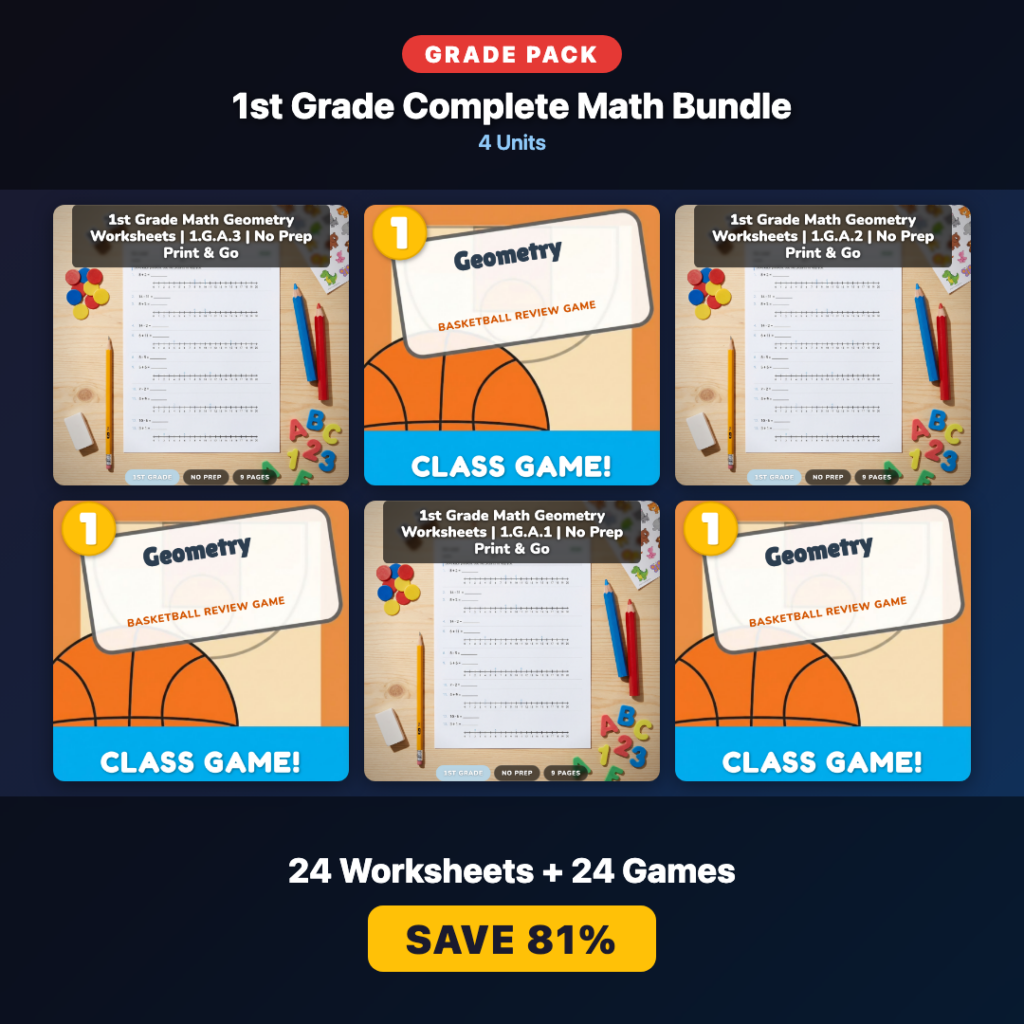
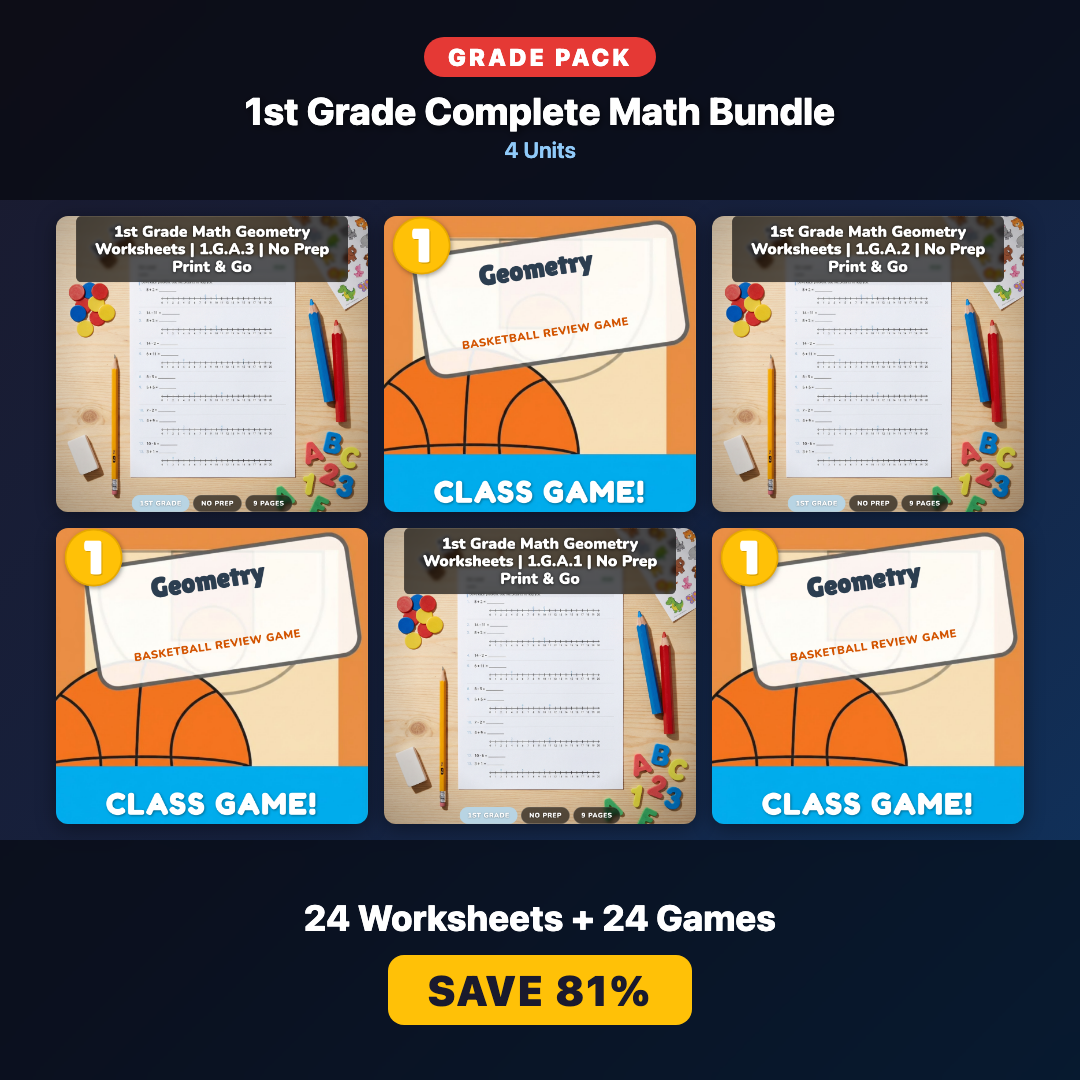
24 Differentiated Worksheet Sets
Each worksheet set targets one specific Common Core standard with three difficulty levels to meet every learner’s needs. You get full-color PDFs for projection, black-and-white versions for copying, complete answer keys for quick grading, and Google Slides versions for digital learning. Every set includes 4-6 pages of practice, totaling over 120 pages of comprehensive math practice.
The differentiation levels ensure success for all students: Level 1 provides extra scaffolding with visual supports and smaller numbers, Level 2 offers grade-level practice with standard expectations, and Level 3 extends learning with challenge problems and higher numbers. This structure lets you assign appropriate work to each student while maintaining the same learning objective.
24 Interactive Basketball Review Games
Each game corresponds to one Common Core standard and includes three difficulty levels matching your worksheet sets. Built in HTML5, these games work seamlessly on Smartboards, Chromebooks, and iPads without any downloads or plugins. Students compete in teams, answering questions to score basketball shots in an exciting tournament format.
With over 1,440 questions across all games, you have extensive review content for the entire year. Each game includes 20 questions per difficulty level, providing 60 questions per standard. Try the free demo game to see how engaging these reviews become for your students.
Bundle Savings
Purchasing each worksheet set and game individually would cost $144.00. The complete bundle costs just $27.00 — that’s 81% savings and only $1.13 per standard. For schools needing multiple licenses, the school license option costs $40.50, still providing significant savings while covering your entire grade level team.
5 Ways to Use This Bundle All Year Long
1. Daily Practice & Warm-Ups
Use worksheet pages as daily warm-up activities or exit tickets. The three difficulty levels let you assign appropriate practice to different groups while covering the same standard. Rotate through standards systematically to provide ongoing review and reinforcement throughout the year.
2. Test Prep & Review
Launch review games before unit assessments or standardized tests. The competitive format motivates students while providing intensive practice with specific standards. Use the question results to identify areas needing additional instruction before the actual test.
3. Math Centers & Stations
Set up Chromebook stations with review games while other students work on worksheet practice. The self-paced nature of both resources makes them perfect for independent center work. Students can repeat games or try different difficulty levels based on their needs.
4. Sub Plans
Leave a review game and corresponding worksheet for easy substitute coverage. The clear instructions and engaging format keep students on task while providing meaningful math practice. No prep needed — just leave the login information and standard you want covered.
5. Differentiated Small Groups
Use the three difficulty levels to target instruction during guided math groups. Struggling students start with Level 1 worksheets and games, while advanced students jump to Level 3 challenges. This targeted approach maximizes learning for every student.
Supporting Every Learner in 1st Grade Math
For Struggling Students
Start with Level 1 materials that include extra visual supports, manipulative suggestions, and smaller numbers. The worksheet scaffolds break complex problems into manageable steps, while Level 1 games provide success experiences that build confidence. Consider pairing struggling students with math buddies during game time for additional support.
For On-Level Students
Level 2 materials provide grade-appropriate practice that aligns directly with Common Core expectations. These students can work independently on worksheets and participate fully in game competitions. Use their performance on Level 2 activities to gauge readiness for more challenging work.
For Advanced Students
Challenge advanced learners with Level 3 materials that include higher numbers, multi-step problems, and extension activities. Encourage these students to explain their thinking, help classmates, or create their own similar problems. Level 3 games provide the challenge they need while keeping them engaged.
Get the Complete 1st Grade Math Bundle
Transform your math instruction with 24 worksheet sets and 24 interactive games covering every first grade standard. This comprehensive bundle provides everything you need for differentiated practice, engaging review, and confident lesson planning all year long.
✓ 24 differentiated worksheet sets (120+ pages)
✓ 24 interactive basketball review games (1,440+ questions)
✓ All 24 Common Core standards covered
✓ Three difficulty levels for every learner
✓ Works on all devices — Smartboards, Chromebooks, iPads
✓ Complete answer keys and Google Slides versions included
✓ School license available for team use
Get the Complete Bundle on TpT
Individual value: $144.00 | Bundle price: $27.00 | You save: 81%
Try a Free Sample First
Not sure if this bundle is right for your classroom? Try our free demo game and get a sample worksheet pack to see the quality and format for yourself. Drop your email below and I’ll send you a free first grade math worksheet set plus access to additional teaching resources.
Frequently Asked Questions About 1st Grade Math Resources
What standards does this bundle cover?
This bundle covers all 24 Common Core standards for first grade math across four domains: Operations & Algebraic Thinking (8 standards), Number & Operations in Base Ten (9 standards), Measurement & Data (4 standards), and Geometry (3 standards). Each standard gets its own dedicated worksheet set and review game.
How do the basketball review games work?
Students compete in teams answering math questions to score basketball shots. Each correct answer advances their team toward a basket, while incorrect answers give the opposing team a chance. Games include 60 questions per standard across three difficulty levels, with automatic scoring and celebration animations.
Can I use these on Chromebooks and iPads?
Yes! The games are built in HTML5 and work on any device with a web browser — Chromebooks, iPads, Smartboards, and computers. No downloads or plugins required. Worksheets come as PDFs for printing and Google Slides for digital use on any device.
Is there a school license option?
Absolutely! The school license costs $40.50 and allows unlimited use by all teachers in your building. This covers your entire first grade team plus specialists, interventionists, and administrators. It’s perfect for schools wanting consistent math resources across all classrooms.
Do the worksheets include answer keys?
Yes, every worksheet set includes complete answer keys for quick grading and feedback. You also get both color and black-and-white versions, plus Google Slides versions for digital distribution. This gives you maximum flexibility for different teaching situations and technology access.
What if my students need extra practice with specific standards?
The three difficulty levels in each set provide built-in differentiation and extra practice opportunities. Students can repeat games at different levels or work through multiple difficulty levels of worksheets for the same standard. This ensures mastery before moving on to new concepts.
First grade math sets the foundation for everything your students will learn in elementary school. With 24 standards to cover across four major domains, having comprehensive, differentiated resources makes the difference between struggling to find materials and confidently delivering effective instruction every day.
What’s your biggest challenge when teaching first grade math? Have you found games and worksheets that truly engage your students while building essential skills? Try the free demo game and see how interactive review can transform your math instruction.