If your first graders are still counting on their fingers for every math problem, you’re not alone. Building fluency with addition and subtraction within 20 is one of the biggest challenges in first grade — but with the right strategies, you can help your students move from counting everything to thinking mathematically. Here’s exactly how to teach these essential skills using research-backed methods that actually work in the classroom.
Key Takeaway
First grade addition and subtraction fluency develops through systematic strategy instruction, moving from concrete counting to mental math strategies like making ten and using number relationships.
Why Operations & Algebraic Thinking Matters in First Grade
Addition and subtraction within 20 forms the foundation for all future math learning. According to research from the National Research Council, students who don’t develop fluency with basic facts by second grade often struggle with multi-digit operations and fractions later on. The CCSS.Math.Content.1.OA.C.6 standard specifically targets this critical skill, requiring students to add and subtract within 20 while demonstrating fluency within 10.
This standard typically appears in the second half of first grade, after students have mastered counting and basic number sense. The timing is crucial — students need solid understanding of numbers to 20 before they can manipulate them efficiently. Research shows that explicit strategy instruction, combined with plenty of practice, helps 85% of first graders achieve fluency by year’s end.
The standard emphasizes specific strategies: counting on, making ten, decomposing numbers, using addition-subtraction relationships, and creating equivalent sums. These aren’t just random techniques — they’re the mental pathways that lead to automatic recall and mathematical reasoning.
Looking for a ready-to-go resource? I put together a differentiated operations pack with 106 problems across three levels — but first, the teaching strategies that make it work.
Common Addition & Subtraction Misconceptions in First Grade
Common Misconception: Students always start counting from one, even for problems like 8 + 3.
Why it happens: They haven’t learned that counting on from the larger number is more efficient.
Quick fix: Model starting from 8 and counting up three more: “8… 9, 10, 11.”
Common Misconception: Students think subtraction means “take away” only and struggle with missing addend problems like 7 + __ = 12.
Why it happens: They haven’t connected addition and subtraction as inverse operations.
Quick fix: Use the same manipulatives to show both 7 + 5 = 12 and 12 – 7 = 5.
Common Misconception: Students avoid making ten because they don’t see why 8 + 6 = 8 + 2 + 4.
Why it happens: They haven’t internalized that you can break apart numbers without changing the total.
Quick fix: Use two-color counters to physically show breaking apart the 6 into 2 and 4.
Common Misconception: Students get different answers when solving the same problem with different strategies.
Why it happens: They’re making counting errors or misapplying strategies they don’t fully understand.
Quick fix: Always verify answers using a second strategy or manipulatives.
5 Research-Backed Strategies for Teaching Addition & Subtraction
Strategy 1: Ten Frame Fluency Building
Ten frames provide the visual structure students need to see number relationships and develop making-ten strategies. This concrete-to-abstract approach helps students visualize problems before solving them mentally.
What you need:
- Large ten frames for demonstration
- Individual ten frames for each student
- Two-color counters or beans
- Dry erase markers
Steps:
- Start with addition facts to 10 using one ten frame
- Show 7 + 2 by filling seven spaces, then adding two more
- Progress to problems crossing ten using two ten frames
- For 8 + 5, fill one frame with 8, then show how 2 more makes 10, with 3 left over
- Practice daily with 5-10 problems, gradually removing the visual support
Strategy 2: Number Line Counting Strategies
Number lines help students develop counting on and counting back strategies while building number sense. The visual representation shows the distance between numbers and supports mental math development.
What you need:
- Floor number line (0-20)
- Individual number lines for desks
- Small game pieces or counters
- Sticky notes for covering numbers
Steps:
- Begin with counting on for addition: start at the larger number
- For 9 + 4, place counter on 9 and hop four spaces forward
- Introduce counting back for subtraction: 13 – 5 means start at 13, hop back 5
- Practice missing addend problems: 8 + __ = 15 by counting from 8 to 15
- Gradually fade the number line as students internalize the patterns
Strategy 3: Decomposition and Recomposition Games
Teaching students to break apart and recombine numbers flexibly is essential for mental math. This strategy directly supports the making-ten approach required by CCSS.Math.Content.1.OA.C.6.
What you need:
- Linking cubes in two colors
- Number bond mats
- Dice or number cards
- Recording sheets
Steps:
- Start with number bonds for numbers 5-10 using manipulatives
- Show all the ways to make 8: 0+8, 1+7, 2+6, 3+5, 4+4
- Apply to addition: for 7 + 5, break 5 into 3 + 2, making 7 + 3 + 2 = 10 + 2
- Practice with partner games: roll two dice, find the sum using making-ten
- Extend to subtraction: 14 – 6 becomes 14 – 4 – 2 = 10 – 2 = 8
Strategy 4: Addition-Subtraction Fact Family Connections
Helping students see the relationship between addition and subtraction doubles their fact knowledge and builds algebraic thinking. This strategy directly addresses the inverse operation requirement in the standard.
What you need:
- Fact family triangles
- Dominoes
- Three-number cards
- Fact family recording sheets
Steps:
- Introduce with concrete objects: 6 red cubes + 4 blue cubes = 10 total
- Show four related facts: 6+4=10, 4+6=10, 10-6=4, 10-4=6
- Use fact family triangles with the sum at top, addends at bottom
- Practice covering one number and solving for the missing part
- Apply to word problems involving both operations
Strategy 5: Mental Math Strategy Choice Boards
Teaching students multiple strategies and helping them choose the most efficient one builds mathematical flexibility and confidence. This metacognitive approach improves problem-solving skills.
What you need:
- Strategy choice posters
- Individual strategy cards
- Practice problems on cards
- Recording sheets for strategy tracking
Steps:
- Introduce 3-4 strategies explicitly: counting on, making ten, doubles, fact families
- Model choosing strategies: “For 9+2, I’ll count on. For 8+7, I’ll use doubles plus one.”
- Give students choice boards with strategy options for each problem
- Have students explain their strategy choice to a partner
- Track which strategies work best for different problem types
How to Differentiate Addition & Subtraction for All Learners
For Students Who Need Extra Support
Students struggling with basic facts need more concrete experiences and systematic progression. Start with manipulatives for every problem, focusing on sums to 10 before moving to 20. Provide number lines and ten frames as permanent supports, not temporary aids. Break multi-step strategies into smaller chunks — teach counting on thoroughly before introducing making ten. Use consistent language and visual cues. These students benefit from extra practice with prerequisite skills like number recognition and one-to-one correspondence.
For On-Level Students
Grade-level students should master fluency within 10 and work toward fluency within 20 using multiple strategies. They can handle the full range of problems in CCSS.Math.Content.1.OA.C.6, including making ten, decomposition, and fact family connections. Provide a mix of concrete and abstract practice, gradually fading manipulatives. These students should explain their thinking and begin choosing efficient strategies independently. Word problems should include both result unknown and change unknown types.
For Students Ready for a Challenge
Advanced students can explore patterns in addition and subtraction, work with larger numbers, and tackle complex word problems involving multiple steps. Introduce early algebraic thinking with missing addend problems in various positions: __ + 7 = 15, 8 + __ = 12, 6 = __ – 4. These students can investigate multiple solution paths and explain why different strategies work. Connect to second grade standards by exploring addition and subtraction within 100 using place value understanding.
A Ready-to-Use Operations & Algebraic Thinking Resource for Your Classroom
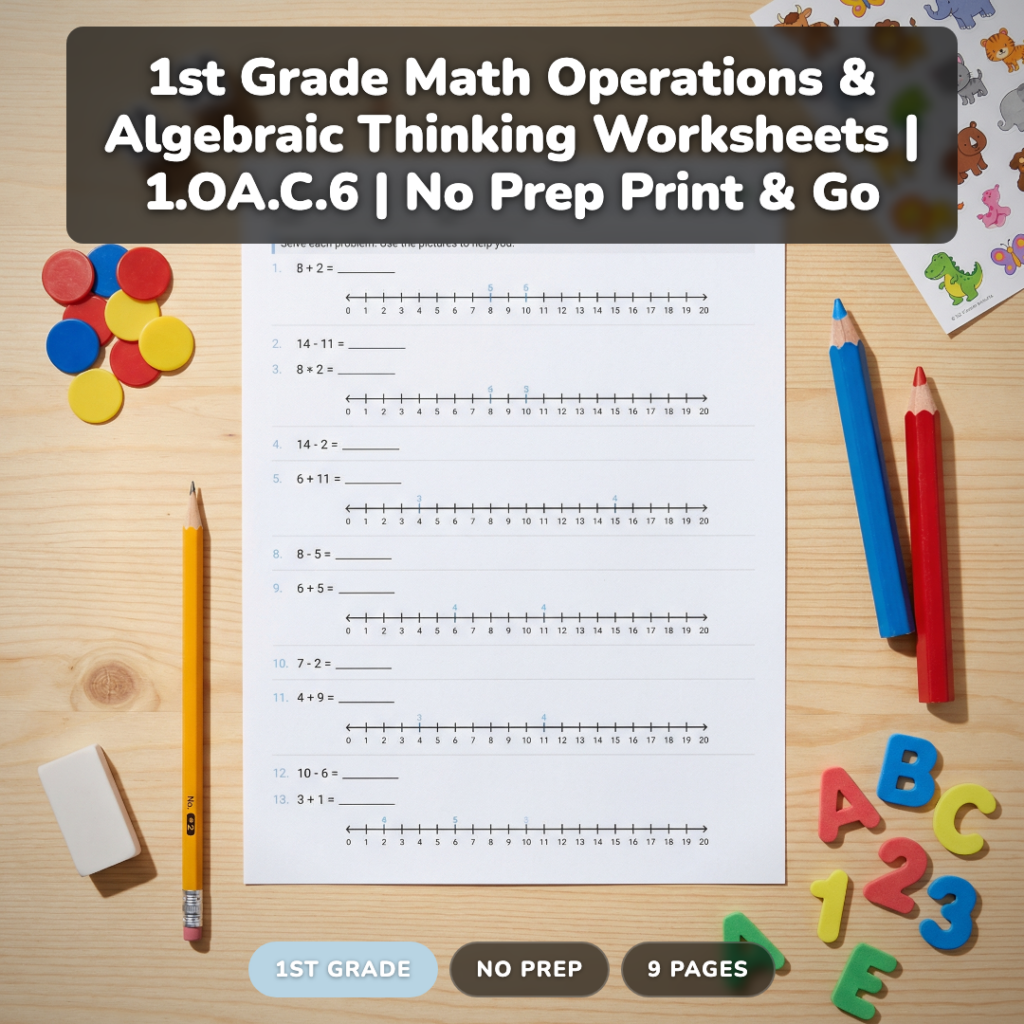
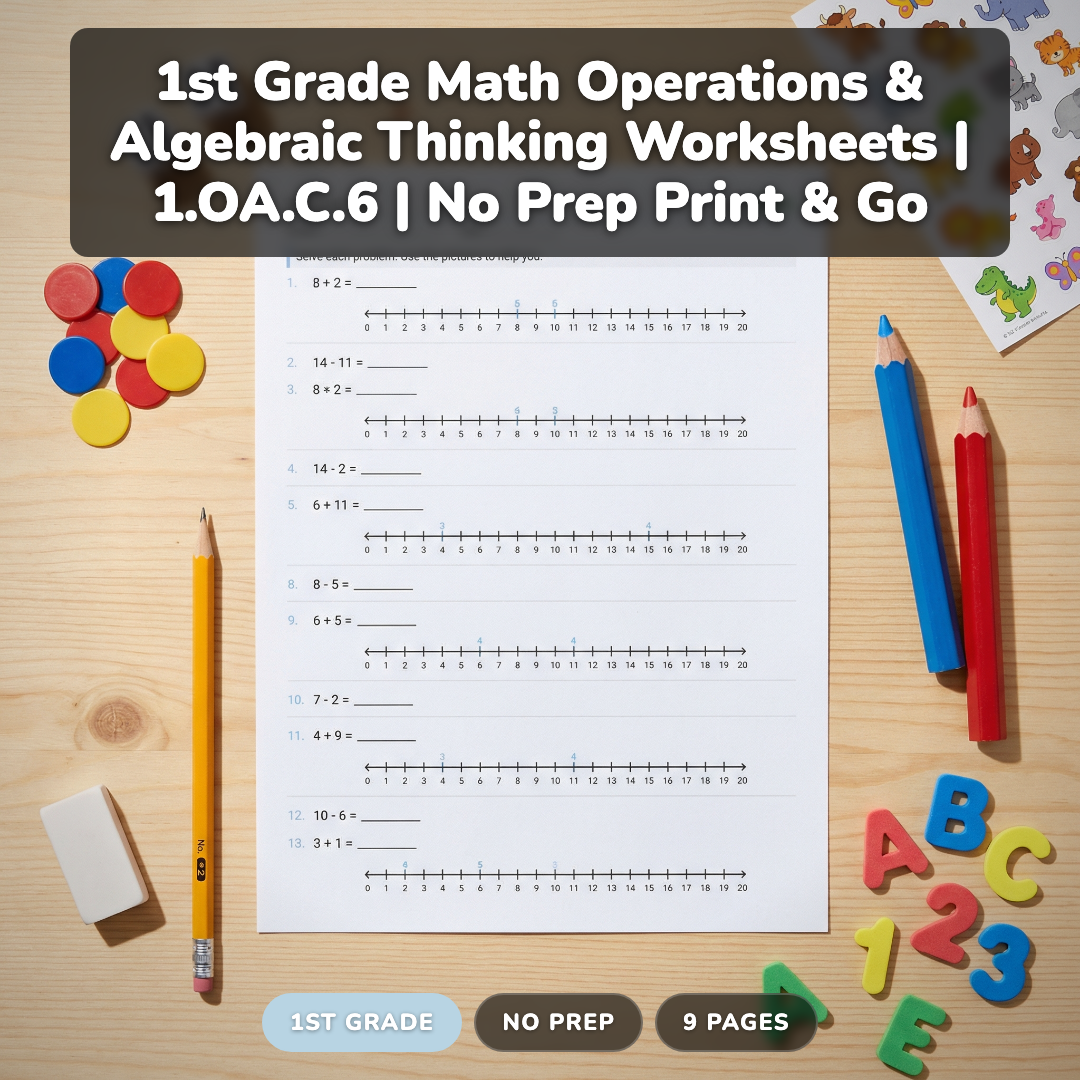
Teaching addition and subtraction strategies effectively requires lots of differentiated practice — more than most teachers have time to create from scratch. That’s exactly why I developed this comprehensive CCSS.Math.Content.1.OA.C.6 resource pack that covers everything we’ve discussed above.
The pack includes 106 carefully crafted problems across three differentiation levels: 30 practice problems for students needing extra support, 40 on-level problems for grade-level expectations, and 36 challenge problems for advanced learners. Each level targets the specific strategies outlined in the standard — making ten, decomposing numbers, using fact families, and counting on — with problems designed to build fluency systematically.
What makes this resource different is the intentional progression within each level. Problems start with visual supports and gradually move toward mental math, exactly how you’d teach it in class. The practice level includes ten frame supports, the on-level problems mix strategies, and the challenge level pushes students to explain their thinking and find multiple solution paths.
All 9 pages are completely no-prep — just print and go. Perfect for math centers, homework, morning work, or assessment preparation. The variety keeps students engaged while building the automaticity they need for future math success.
Grab a Free Addition & Subtraction Sample to Try
Want to see the quality and differentiation before you buy? I’ll send you a free sample with problems from each level, plus a strategy reference sheet you can use with any addition and subtraction lesson. Perfect for trying out the format with your students.
Frequently Asked Questions About Teaching Addition & Subtraction
When should first graders be fluent with addition and subtraction facts?
CCSS.Math.Content.1.OA.C.6 requires fluency within 10 by the end of first grade, with strategies for problems within 20. Most students achieve this between February and May with consistent practice and strategy instruction.
Should I teach all addition and subtraction strategies or focus on one?
Research shows students need multiple strategies to develop true fluency. Teach counting on, making ten, doubles, and fact families systematically, allowing students to choose their preferred method for different problem types.
How do I help students who still count on their fingers for everything?
Finger counting isn’t wrong, but it needs to evolve. Teach counting on from the larger number first, then introduce ten frames and number lines as more efficient tools. Gradually fade physical supports as mental strategies develop.
What’s the difference between fluency and memorization in first grade math?
Fluency means solving problems accurately, efficiently, and flexibly using multiple strategies. Memorization is just rote recall. Focus on strategy development first — automatic recall naturally follows with sufficient practice and understanding.
How can I assess whether students really understand addition and subtraction strategies?
Ask students to solve problems using two different strategies and explain their thinking. True understanding shows when they can choose appropriate strategies, catch their own errors, and connect addition and subtraction as inverse operations.
Building Strong Math Foundations
Teaching addition and subtraction within 20 sets the stage for all future math learning. When students master these strategies in first grade, they’re ready for place value, multi-digit operations, and algebraic thinking in the years ahead. The key is systematic instruction that builds from concrete to abstract, with plenty of practice at each level.
What’s your go-to strategy for building addition and subtraction fluency? I’d love to hear what works best in your classroom! And don’t forget to grab that free sample above — it’s a great way to see these strategies in action with your students.