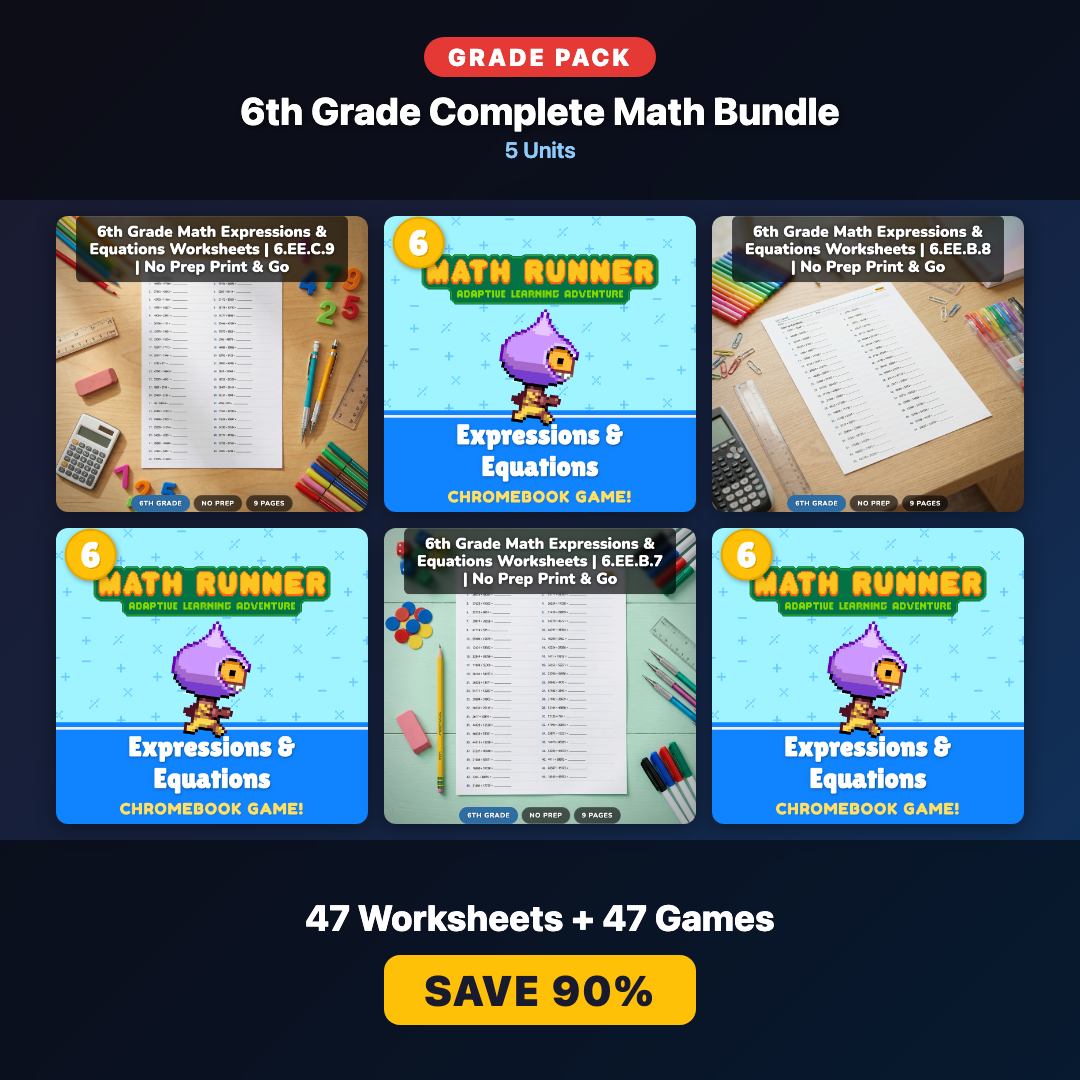
Planning a full year of kindergarten math can feel overwhelming. You’re covering 25 different standards across five major domains — from teaching tiny humans to count to 20 all the way to comparing shapes and understanding addition concepts. Each standard needs differentiated practice, review activities, and engaging reinforcement that keeps five-year-olds focused.
What if you had ready-to-go resources for every single kindergarten math standard? This complete guide walks you through each domain with specific teaching strategies, then shows you how to streamline your planning with worksheets and interactive games that cover the entire year.
Key Takeaway
Kindergarten math covers 25 standards across 5 domains, requiring concrete manipulatives, visual supports, and plenty of practice to build number sense and foundational skills.
Kindergarten Math: What Students Need to Master This Year
Kindergarten mathematics is all about building number sense and foundational understanding through hands-on exploration. Students develop counting skills, recognize and write numbers, understand basic addition and subtraction concepts, and explore shapes and measurement. This year lays the groundwork for all future math learning.
The Common Core framework organizes kindergarten math into five key domains:
- Counting & Cardinality (CC): Counting to 100, number recognition, and understanding quantity
- Operations & Algebraic Thinking (OA): Addition and subtraction within 10
- Number & Operations in Base Ten (NBT): Working with numbers 11-19
- Measurement & Data (MD): Describing and comparing objects
- Geometry (G): Identifying and describing shapes
At this developmental stage, students learn best through concrete experiences, visual representations, and plenty of repetition. They’re transitioning from pre-mathematical thinking to understanding that numbers represent quantities and that operations change those quantities.
Need ready-to-go resources for every standard below? I put together a complete kindergarten math bundle with worksheets and review games for each one — but first, here’s your domain-by-domain guide.
Counting & Cardinality: What Kindergarten Students Learn
Counting & Cardinality forms the foundation of all kindergarten math. Students learn to count to 100 by ones and tens, recognize written numerals, understand that numbers represent quantities, and compare numbers. This domain includes 10 standards that build from basic rote counting to deep number sense.
Counting & Cardinality: Building Number Sense Through Practice
Key standards include CCSS.Math.Content.K.CC.A.1 (counting to 100), CCSS.Math.Content.K.CC.A.3 (number sequence), CCSS.Math.Content.K.CC.B.4 (one-to-one correspondence), and CCSS.Math.Content.K.CC.C.6 (number comparison).
Students often struggle with the abstract concept that numbers represent quantities. They might count accurately but not understand that “5” means five objects. Use concrete manipulatives like counting bears, then transition to pictures, then to abstract numerals. The progression from concrete to pictorial to abstract is crucial.
Worksheets reinforce counting practice and number recognition, while games make skip counting and number comparison exciting. Students need hundreds of exposures to number patterns before they internalize them.
For detailed strategies and free resources for each standard, see our posts on kindergarten counting sequence strategies, one-to-one correspondence teaching methods, and number comparison strategies that work.
Operations & Algebraic Thinking: What Kindergarten Students Learn
Operations & Algebraic Thinking introduces kindergarteners to addition and subtraction within 10. Students represent problems with objects and drawings, solve word problems, and begin to understand that addition means “putting together” while subtraction means “taking apart.” This domain covers 5 standards that build computational thinking.
Operations & Algebraic Thinking: Making Math Concrete
Key standards include CCSS.Math.Content.K.OA.A.1 (addition and subtraction word problems), CCSS.Math.Content.K.OA.A.2 (solving problems with objects), and CCSS.Math.Content.K.OA.A.5 (fluently adding within 5).
The biggest challenge here is helping students understand what addition and subtraction actually mean. Many kindergarteners can memorize “2 + 3 = 5” without understanding the concept. Use story contexts constantly: “Maria had 2 stickers. Her friend gave her 3 more. How many does she have now?”
Manipulatives are non-negotiable at this level. Students need to physically move objects together (addition) or take them away (subtraction) hundreds of times before the operations make sense. Worksheets provide structured practice once concepts are solid, while games make fact practice fun.
Common struggles include confusing addition and subtraction signs, counting incorrectly when solving problems, and not understanding that the equals sign means “the same as.” Address these through consistent use of manipulatives and clear mathematical language.
Number & Operations in Base Ten: What Kindergarten Students Learn
Number & Operations in Base Ten focuses on understanding numbers 11-19 as ten ones and some more ones. This single standard CCSS.Math.Content.K.NBT.A.1 is crucial for future place value understanding. Students compose and decompose these teen numbers in multiple ways.
Number & Operations in Base Ten: Foundation for Place Value
Students learn that 14 is the same as 10 + 4, building understanding that will support multi-digit arithmetic in later grades.
Many students struggle to see teen numbers as anything other than individual counting numbers. They might count “11, 12, 13, 14” without recognizing the pattern of ten plus extras. Use base ten blocks consistently — a ten rod plus individual units makes this concept visual and concrete.
Worksheets help students practice decomposing teen numbers in different ways (15 = 10 + 5 = 8 + 7 = 9 + 6), while games reinforce quick recognition of teen number patterns. This foundation prevents place value confusion in first grade.
Measurement & Data: What Kindergarten Students Learn
Measurement & Data introduces kindergarteners to describing and comparing measurable attributes. Students classify objects, compare lengths and weights, and sort objects into categories. This domain includes 3 standards that develop analytical thinking and comparison skills.
Measurement & Data: Developing Comparison Skills
Key standards include CCSS.Math.Content.K.MD.A.1 (describing measurable attributes), CCSS.Math.Content.K.MD.A.2 (comparing objects), and CCSS.Math.Content.K.MD.B.3 (classifying and counting).
Students often confuse different attributes when comparing. They might say a tall, thin container holds more than a short, wide one without considering volume. Provide lots of hands-on experiences comparing length, weight, and capacity using direct comparison first, then indirect comparison.
The classification standard involves sorting objects and counting how many are in each category. This builds data analysis skills and connects to graphing in later grades. Students need practice with various sorting rules and explaining their thinking.
Worksheets provide structured practice with measurement vocabulary and comparison tasks, while games make sorting and classifying interactive and fun.
Geometry: What Kindergarten Students Learn
Geometry helps kindergarteners identify and describe shapes in their environment. Students name shapes, describe their attributes, analyze and compare shapes, and create composite shapes. This domain includes 6 standards that develop spatial reasoning and geometric vocabulary.
Geometry: Building Spatial Reasoning
Key standards include CCSS.Math.Content.K.G.A.1 (describing shapes), CCSS.Math.Content.K.G.A.2 (naming shapes), CCSS.Math.Content.K.G.B.4 (analyzing shapes), and CCSS.Math.Content.K.G.B.6 (composing shapes).
Many students can identify shapes in perfect orientations but struggle when shapes are rotated or appear in different sizes. Use shape hunts around the classroom and school to find triangles, rectangles, and circles in various orientations. Emphasize that a triangle is still a triangle even when it’s upside down.
The composite shapes standard (combining shapes to make new shapes) is particularly challenging. Students need hands-on experience with pattern blocks and tangrams to understand how shapes fit together. This builds spatial reasoning crucial for future geometry success.
Common struggles include confusing rectangles and squares (help students understand that squares are special rectangles), not recognizing shapes in different orientations, and focusing only on familiar examples. Address these through varied examples and attribute discussions.
For detailed strategies and free resources for each standard, see our posts on kindergarten counting cardinality strategies and counting cardinality teaching methods.
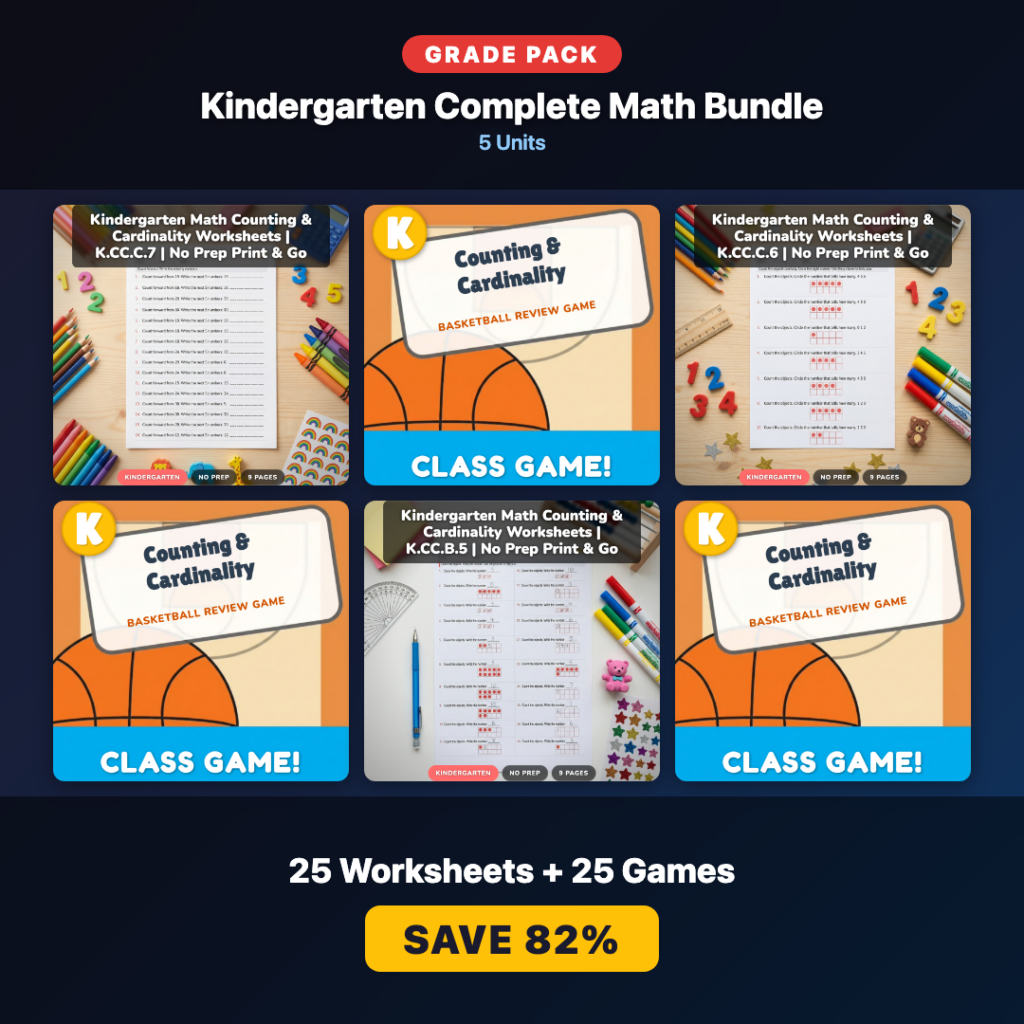
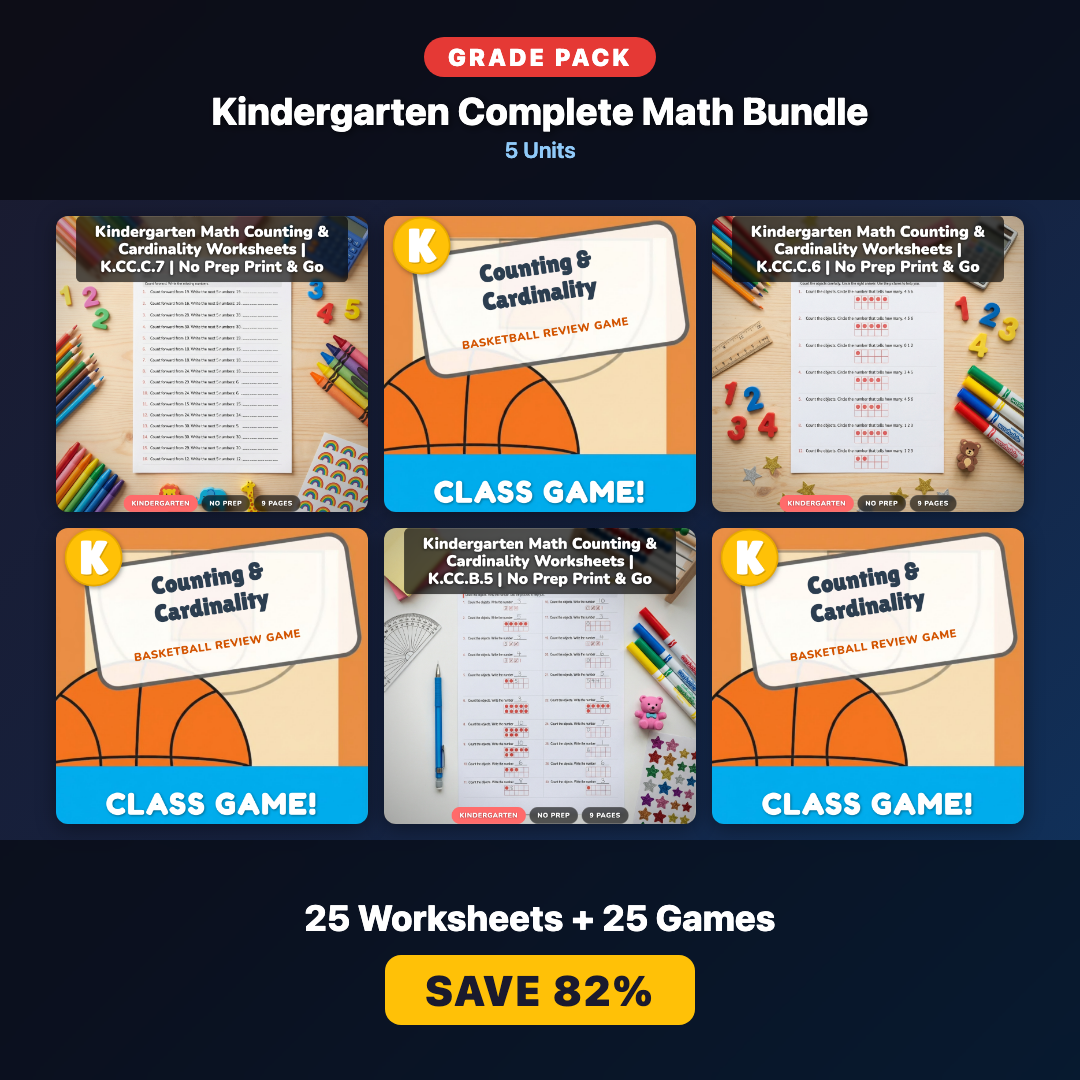
What’s in the Kindergarten Complete Math Bundle?
25 Differentiated Worksheet Sets
Each standard includes a complete worksheet set with color PDF, black-and-white version, answer keys, and Google Slides format. Every set offers three difficulty levels to meet diverse learner needs. With over 500 total pages, you’ll have enough practice materials for the entire school year plus review and reinforcement.
25 Interactive Basketball Review Games
Every standard includes an HTML5 basketball review game with three difficulty levels and 2-team competition mode. These games work perfectly on Smartboards, Chromebooks, and iPads without any downloads or plugins. With over 1,499 total questions across all games, students get engaging practice that feels like play. Try the free demo game to see how they work.
Bundle Savings
Purchasing each resource individually would cost $150.00, but the complete bundle is just $27.00 — that’s 82% savings and only $1.08 per standard. A school license option is available for $40.50, allowing use across multiple classrooms in your building.
5 Ways to Use This Bundle All Year Long
1. Daily Practice & Warm-Ups
Use worksheets for morning work and math warm-ups. The three difficulty levels let you differentiate instantly — struggling students get level 1, on-grade students get level 2, and advanced students get level 3.
2. Test Prep & Review
Before assessments, use the basketball games for fun review sessions. Students love the competition element, and you can quickly see which concepts need more practice based on their performance.
3. Math Centers & Stations
Set up Chromebook stations with different games running. Students rotate through centers practicing various standards while you work with small groups. The games are self-paced and provide immediate feedback.
4. Sub Plans
Leave a basketball game and corresponding worksheet for easy substitute coverage. Everything is self-contained and requires minimal explanation, making your absence stress-free for everyone.
5. Differentiated Small Groups
Use the three difficulty levels to target instruction precisely. Pull struggling students for level 1 practice while independent workers tackle level 3 challenges. The range supports every learner in your classroom.
Supporting Every Learner in Kindergarten Math
For Struggling Students
Start with level 1 worksheets and provide extra manipulatives for every concept. Use the basketball games on easy mode to build confidence. Focus on concrete experiences before moving to pictorial representations. Consider one-on-one support during number recognition and counting activities.
For On-Level Students
Level 2 worksheets provide appropriate challenge without overwhelming difficulty. Use basketball games on medium mode for engaging practice. Encourage mathematical discussions and explanation of thinking. These students often benefit from peer partnerships during problem-solving.
For Advanced Students
Challenge these learners with level 3 worksheets that include extension problems and cross-domain connections. Use basketball games on hard mode and encourage them to explain strategies to classmates. Consider having them create their own word problems or teach concepts to struggling peers.
Get the Complete Kindergarten Math Bundle
Transform your kindergarten math instruction with 25 differentiated worksheet sets and 25 interactive basketball review games covering every Common Core standard. Save 82% compared to individual purchases and get everything you need for successful math instruction all year long.
Get the Complete Bundle on TpT
Want to try before you buy? Play the free demo game and see how engaging these review activities can be.
Try a Free Sample First
Not ready to commit? Drop your email below and I’ll send you a free kindergarten math worksheet pack to try in your classroom. You’ll get sample worksheets from three different standards plus tips for implementation.
Frequently Asked Questions About Kindergarten Math Resources
What standards does this bundle cover?
The bundle covers all 25 kindergarten Common Core math standards across five domains: Counting & Cardinality (10 standards), Operations & Algebraic Thinking (5 standards), Number & Operations in Base Ten (1 standard), Measurement & Data (3 standards), and Geometry (6 standards).
How do the basketball review games work?
Each game presents math problems in a fun basketball context. Students answer questions to score points for their team. Games include three difficulty levels, 2-team competition mode, and immediate feedback. They’re HTML5-based and work on any device with a web browser.
Can I use these on Chromebooks and iPads?
Yes! All basketball games are HTML5-based and work perfectly on Chromebooks, iPads, computers, and interactive whiteboards. No downloads, plugins, or special software required. Just click and play in any web browser.
Is there a school license option?
Yes, the school license costs $40.50 and allows unlimited use across all classrooms in your building. This is perfect for grade-level teams, math coaches, or administrators purchasing for multiple teachers.
Do the worksheets include answer keys?
Every worksheet set includes complete answer keys for quick grading. You’ll also get both color and black-and-white versions of each worksheet, plus Google Slides format for digital distribution.
Are these resources aligned to Common Core standards?
Absolutely. Each worksheet set and basketball game is specifically designed to address individual Common Core math standards for kindergarten. Every resource includes the standard code and learning objective clearly labeled.
Ready to simplify your kindergarten math planning? This complete bundle gives you everything you need for successful math instruction — 25 worksheet sets, 25 interactive games, and coverage of every standard for just $27. Try the free demo game and see the difference engaging math practice makes.
What kindergarten math concept do your students struggle with most? I’d love to hear about your experiences in the comments below.