If your kindergarteners can recite numbers 1-20 but freeze when you ask “how many blocks are there?” — you’re not alone. Many students can count by rote but struggle with cardinality, the understanding that the last number counted represents the total quantity. You’ll discover five research-backed strategies that bridge this gap and help your students truly understand what numbers mean.
Key Takeaway
Teaching cardinality requires explicit instruction connecting counting sequences to quantity meaning — students need to understand that the last number counted answers “how many?”
Why Counting & Cardinality Matters in Kindergarten
Counting and cardinality forms the foundation for all future math learning. The CCSS.Math.Content.K.CC.B.5 standard requires students to count to answer “how many?” questions about up to 20 objects in organized arrangements and up to 10 objects in scattered configurations. This skill typically develops between ages 4-6, with most kindergarteners mastering it by mid-year.
Research from the National Research Council shows that cardinality understanding predicts math achievement through elementary school. Students who grasp that counting tells us “how many” perform significantly better on number sense assessments and word problems. The timing matters too — introducing cardinality concepts in fall kindergarten, when students are developmentally ready, leads to stronger number sense by spring.
This standard bridges two critical concepts: one-to-one correspondence (matching each object to exactly one number word) and cardinality principle (the last number counted represents the total). Students must coordinate these skills across different spatial arrangements — from neat lines to scattered groups to circular patterns.
Looking for a ready-to-go resource? I put together a differentiated counting & cardinality pack that covers everything below — but first, the teaching strategies that make it work.
Common Counting & Cardinality Misconceptions in Kindergarten
Common Misconception: Students recount from 1 when asked “how many?” after already counting a set.
Why it happens: They don’t understand that the final number in their counting sequence already answers the question.
Quick fix: Explicitly teach “the last number tells us how many” and practice pointing to the last counted object while stating the total.
Common Misconception: Students count objects multiple times or skip objects in scattered arrangements.
Why it happens: They lack strategies for tracking which objects they’ve counted in unorganized groups.
Quick fix: Teach them to move counted objects to a “finished” pile or mark them with a finger as they count.
Common Misconception: Students believe larger objects represent bigger numbers.
Why it happens: They confuse physical size with quantity — a common developmental phase.
Quick fix: Use identical objects (like counting bears) and explicitly discuss how size doesn’t change the count.
Common Misconception: Students think rearranging objects changes the total count.
Why it happens: They haven’t developed conservation of number — understanding that quantity remains constant regardless of arrangement.
Quick fix: Count the same set in different arrangements, emphasizing “still 7 blocks” each time.
5 Research-Backed Strategies for Teaching Counting & Cardinality
Strategy 1: The Count-and-Touch Method with Emphasis Pause
This foundational strategy teaches students to connect each number word with exactly one object while building cardinality awareness through deliberate pacing.
What you need:
- Sets of 5-10 identical manipulatives (counting bears, blocks, or buttons)
- Small containers or mats for organizing
Steps:
- Model touching each object while saying its number, moving in a consistent direction (left to right)
- After counting the last object, pause for 2 seconds while pointing to it
- Ask “How many bears do we have?” and point back to the last counted object
- Emphasize: “When we count, the last number tells us how many”
- Have students practice with their own sets, using the same pause-and-point technique
- Gradually increase set size from 5 to 10, then to 15 objects
Strategy 2: Move-It-and-Count for Scattered Sets
This kinesthetic approach helps students track their counting in unorganized arrangements while reinforcing one-to-one correspondence.
What you need:
- Small objects that can be easily moved (coins, erasers, or manipulatives)
- Two distinct areas: “not counted yet” and “already counted”
- Optional: small bowls or paper plates to define the areas
Steps:
- Place 6-10 objects randomly in the “not counted yet” area
- Model picking up one object, saying “one” and moving it to “already counted”
- Continue until all objects are moved, counting aloud with each transfer
- Point to the moved pile and ask “How many objects did we count?”
- Repeat with students doing the moving while you guide their counting
- Progress to students working independently with scattered sets
Strategy 3: Array Counting with Row-by-Row Method
This visual strategy helps students count organized rectangular arrangements systematically while building early multiplication concepts.
What you need:
- Square tiles or blocks that can form neat arrays
- Grid paper or ten-frames for structure
- Pointer or finger for tracking
Steps:
- Create a simple 2×3 array (2 rows of 3 objects each)
- Model counting the top row: “1, 2, 3” while pointing to each object
- Continue with the bottom row: “4, 5, 6” maintaining the counting sequence
- Emphasize: “We counted 6 blocks total in our rectangle”
- Practice with different array sizes (2×4, 3×3, 2×5)
- Have students create their own arrays and count them
Strategy 4: Circle Counting with Start-and-Stop Markers
This strategy teaches students to count circular arrangements without double-counting by establishing clear starting and ending points.
What you need:
- Objects that can form circles (blocks, toys, or cutouts)
- Special marker object (different color or shape)
- Large paper circles as guides (optional)
Steps:
- Arrange 8-12 objects in a circle with one special “start” object (different color)
- Point to the start object and say “We’ll begin counting here”
- Count clockwise: “1, 2, 3…” until returning to the start object
- Stop before recounting the start object: “We’re back where we started”
- Ask “How many objects are in our circle?” and review the final count
- Practice with students taking turns being the “counter” and “pointer”
Strategy 5: Count-Out Practice with Number Cards
This reverse-counting activity strengthens cardinality by having students create sets to match given numbers, reinforcing the connection between numerals and quantities.
What you need:
- Number cards 1-20 (start with 1-10)
- Container of small manipulatives (at least 25 objects)
- Small plates or mats for organizing counted sets
Steps:
- Show a number card (start with 7) and read it together
- Say: “Can you count out 7 bears for me?”
- Watch as the student counts objects one by one onto their mat
- When they finish, ask: “How many bears did you count out?”
- Confirm: “Yes, 7 bears matches the number 7 on our card”
- Repeat with different numbers, mixing easier and harder values
- Progress to having students work independently with multiple number cards
How to Differentiate Counting & Cardinality for All Learners
For Students Who Need Extra Support
Begin with numbers 1-5 using large, easy-to-manipulate objects like blocks or toy cars. Focus on one-to-one correspondence first — ensure they can touch each object once while counting before introducing cardinality questions. Use consistent language: “The last number we said tells us how many.” Provide physical supports like number lines or ten-frames to organize counting. Practice the same skill across multiple days with different materials to build automaticity.
For On-Level Students
Work with numbers 1-15 in various arrangements as outlined in CCSS.Math.Content.K.CC.B.5. Students should practice counting linear arrangements, rectangular arrays, circles, and scattered groups with equal confidence. Introduce simple word problems: “Count out 8 crackers for snack time.” Encourage them to explain their counting strategies and check their work by recounting. Use both concrete objects and pictorial representations to build flexibility.
For Students Ready for a Challenge
Extend to numbers 16-20 and introduce more complex arrangements like overlapping circles or L-shaped patterns. Challenge them to count the same set in multiple ways (by 1s, then by 2s if appropriate) and compare results. Introduce early addition concepts: “We have 6 red blocks and 4 blue blocks. How many blocks altogether?” Have them create their own counting challenges for classmates and explain why their counting strategies work.
A Ready-to-Use Counting & Cardinality Resource for Your Classroom
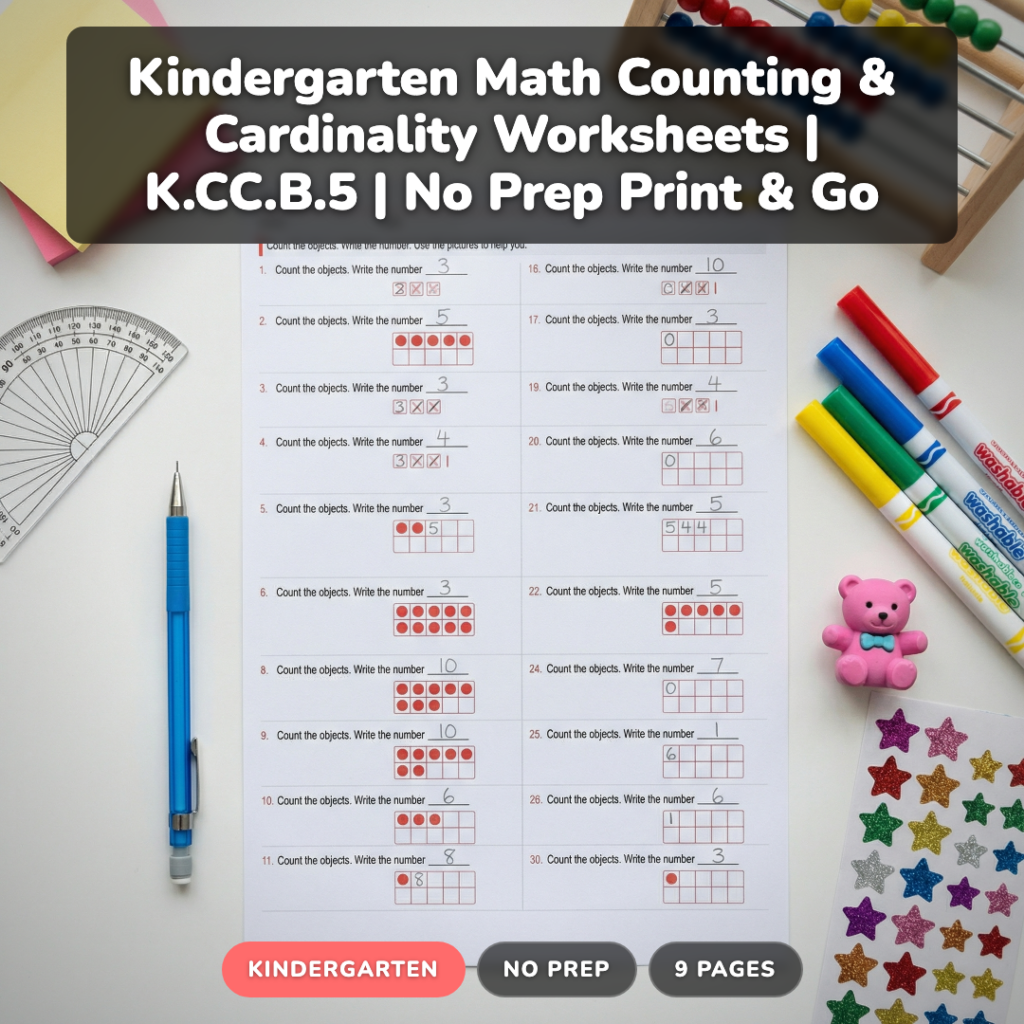
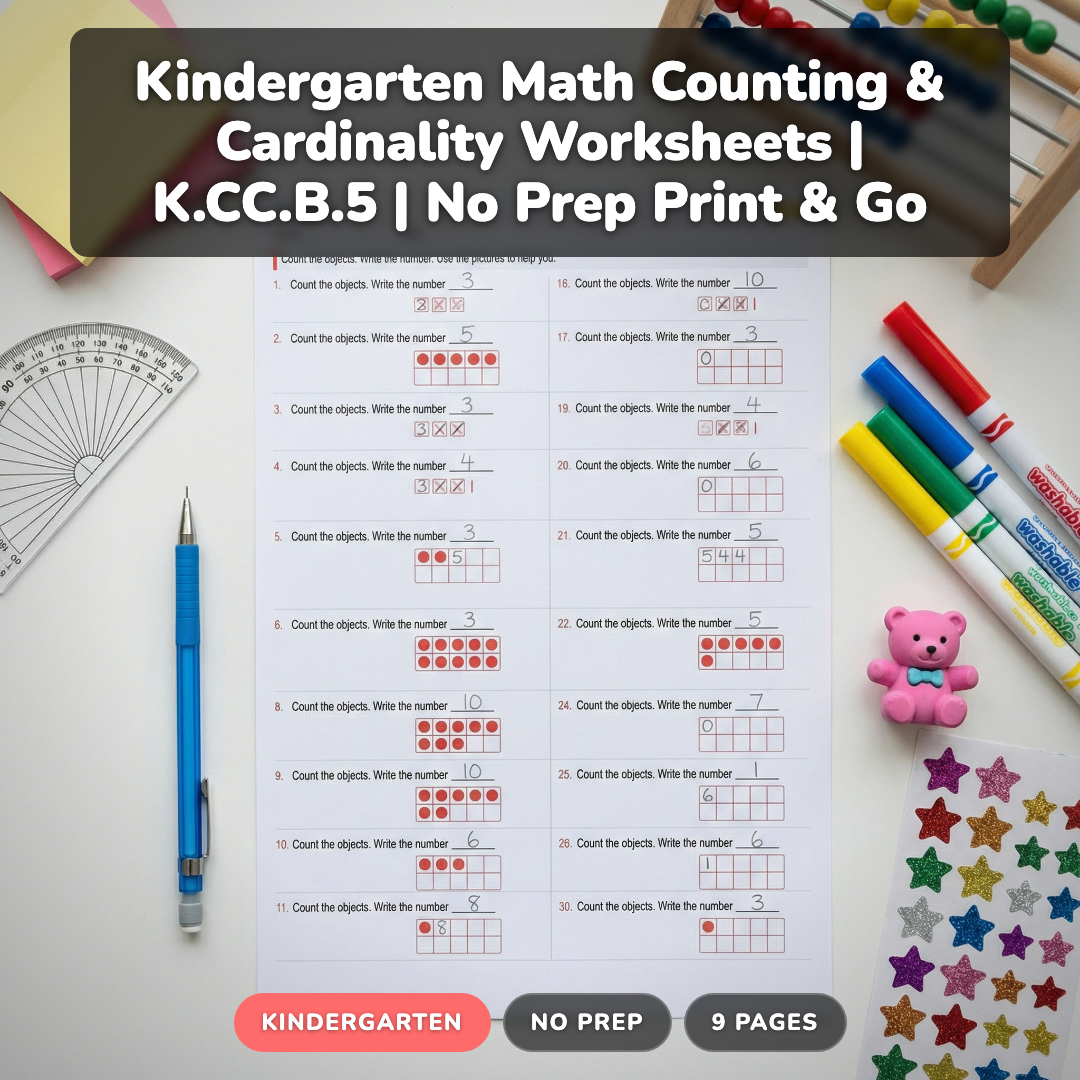
Teaching cardinality effectively requires consistent practice across multiple difficulty levels, which means creating lots of differentiated materials. This can eat up hours of prep time that you simply don’t have. That’s exactly why I created this comprehensive counting and cardinality worksheet pack.
This resource includes 79 carefully designed problems across three differentiation levels: 22 practice problems for students who need extra support, 30 on-level problems aligned perfectly with kindergarten expectations, and 27 challenge problems for early finishers. Each level targets the same core skills — counting organized and scattered arrangements, answering “how many?” questions, and counting out specific quantities — but adjusts the complexity appropriately.
What sets this pack apart is the intentional progression within each level. Problems start with simple linear arrangements and gradually introduce scattered groups, arrays, and circular patterns. The challenge level includes multi-step problems and real-world scenarios that connect counting to daily experiences. Everything is print-and-go ready with clear instructions and answer keys included.
You can grab this time-saving resource and have differentiated counting practice ready for tomorrow’s math centers.
Grab a Free Counting Sample to Try
Want to see how these differentiated counting activities work in your classroom? I’ll send you a free sample pack with problems from each difficulty level, plus my quick reference guide for teaching cardinality concepts.
Frequently Asked Questions About Teaching Counting & Cardinality
What’s the difference between counting and cardinality?
Counting is the ability to recite number words in sequence (1, 2, 3…), while cardinality is understanding that the last number counted represents the total quantity. Students can often count to 20 but still struggle with cardinality concepts.
When should kindergarteners master CCSS.Math.Content.K.CC.B.5?
Most students master counting to 10 objects in scattered arrangements by mid-kindergarten and counting to 20 objects in organized arrangements by late kindergarten. However, individual timelines vary based on prior experience and development.
Why do some students recount after I ask “how many?”
This indicates they haven’t connected counting with cardinality yet. They know how to count but don’t understand that counting answers the “how many?” question. Use explicit instruction emphasizing “the last number tells us how many.”
Should I correct students who count in the “wrong” direction?
Direction doesn’t matter for cardinality as long as they count each object exactly once. However, teaching left-to-right counting builds habits that support reading and more advanced math concepts later.
How can I help students who struggle with scattered arrangements?
Teach explicit strategies like moving counted objects to a separate area or marking them with their finger. Start with smaller sets (5-7 objects) and gradually increase complexity as their tracking skills improve.
Remember, cardinality understanding develops through repeated practice with meaningful connections between counting and quantity. Use these strategies consistently, celebrate small wins, and watch your students build the number sense foundation they’ll need for all future math learning.
What’s your go-to strategy for helping students connect counting with “how many?” questions? And don’t forget to grab that free counting sample pack above — it’s perfect for trying these ideas in your classroom tomorrow.