If your kindergarteners count objects but can’t tell you “how many” there are total, you’re seeing a classic cardinality struggle. They might count “1, 2, 3, 4, 5” while touching each crayon, then look at you blankly when you ask “So how many crayons are there?” You’re not alone — this is one of the trickiest concepts in early math because it requires understanding that the final number represents the whole group.
Key Takeaway
Cardinality develops when students connect counting actions to quantity understanding through repeated practice with concrete objects and intentional questioning.
Why Counting & Cardinality Matters in Kindergarten
Counting and cardinality forms the foundation for all future math learning. CCSS.Math.Content.K.CC.B.4b specifically targets the understanding that the last number said represents the total quantity, regardless of how objects are arranged or counted. Research from the National Research Council shows that students who master cardinality by the end of kindergarten are 2.5 times more likely to succeed in first-grade addition and subtraction.
This standard typically appears in the first quarter of kindergarten, building on basic counting skills (K.CC.A.1) and connecting to number recognition (K.CC.A.3). Students need approximately 6-8 weeks of consistent practice to internalize that counting tells “how many” rather than just being a recitation of number names.
The cognitive leap required here is significant: students must understand that each number in the counting sequence represents one more than the previous number, and that the final number encompasses all the objects counted. Without this foundation, place value, addition, and subtraction become meaningless memorization rather than conceptual understanding.
Looking for a ready-to-go resource? I put together a differentiated counting & cardinality pack that covers everything below — but first, the teaching strategies that make it work.
Common Counting & Cardinality Misconceptions in Kindergarten
Common Misconception: Students recount from 1 when asked “how many” after already counting the objects.
Why it happens: They view counting as separate from quantity — counting is just saying number words, not determining amount.
Quick fix: Emphasize the last number by having them repeat it: “You counted to 4, so how many bears? Yes, 4!”
Common Misconception: Students think rearranging objects changes the quantity.
Why it happens: They rely on visual patterns rather than understanding that quantity stays constant.
Quick fix: Count the same objects in different arrangements, emphasizing that the number stays the same.
Common Misconception: Students skip objects or count the same object twice when items aren’t in a line.
Why it happens: They haven’t developed systematic counting strategies for scattered arrangements.
Quick fix: Teach them to move counted objects to a “finished” pile or mark them with their finger.
Common Misconception: Students think bigger objects mean more, regardless of actual count.
Why it happens: They confuse size with quantity, a natural developmental stage.
Quick fix: Use identical objects (like counting bears) before introducing varied sizes and shapes.
5 Research-Backed Strategies for Teaching Counting & Cardinality
Strategy 1: The Count-and-Grab Method
This concrete strategy builds the connection between counting actions and quantity by having students physically separate counted objects from uncounted ones. It addresses the core challenge of CCSS.Math.Content.K.CC.B.4b by making the “how many” answer obvious through physical manipulation.
What you need:
- Small manipulatives (counting bears, blocks, buttons)
- Two containers or spaces labeled “Not Counted” and “Counted”
- Recording sheets for documentation
Steps:
- Place 3-7 objects in the “Not Counted” space
- Student counts “1” while moving one object to “Counted” space
- Continue until all objects are moved and counted
- Ask “How many objects did you count?” while pointing to the “Counted” pile
- Have student repeat the final number: “I counted 5 objects”
- Record the number on paper to reinforce the connection
Strategy 2: Conservation Counting Circles
This visual strategy demonstrates that quantity remains constant regardless of arrangement, directly addressing the standard’s requirement that “the number of objects is the same regardless of their arrangement.” Students see the same objects in multiple configurations while maintaining the same count.
What you need:
- 6-8 identical objects per student
- Large paper or floor space for arranging
- Documentation chart for recording arrangements
Steps:
- Start with objects in a neat line and count together
- Ask “How many?” and record the number
- Rearrange the same objects in a circle without adding or removing any
- Count again, emphasizing one-to-one correspondence
- Ask “How many now?” and compare to the first count
- Repeat with scattered arrangement, then clustered groups
- Conclude: “Same objects, same number, different arrangements”
Strategy 3: Number Story Acting
This kinesthetic approach combines storytelling with counting to make cardinality meaningful and memorable. Students become the objects being counted, creating a physical understanding of what each number represents within the total.
What you need:
- Simple props (animal masks, colored scarves, or name tags)
- Open space for movement
- Number cards 1-10
Steps:
- Tell a simple story: “Bears are going to the honey tree”
- Call students one by one to “become” bears in the story
- Count each bear as they join: “1 bear, 2 bears, 3 bears”
- When all bears are gathered, ask the group “How many bears went to the honey tree?”
- Have bears count off to verify, then show the matching number card
- Repeat with different scenarios and numbers
Strategy 4: Touch-and-Count Anchor Charts
This visual-kinesthetic strategy creates lasting reference tools while building systematic counting habits. Students learn to organize their counting in ways that prevent skipping or double-counting, essential skills for accurate cardinality understanding.
What you need:
- Large chart paper
- Velcro dots or magnetic strips
- Moveable counting objects
- Markers in different colors
Steps:
- Create a chart with objects attached in various arrangements
- Demonstrate touching each object while counting aloud
- Use a different colored marker to circle each counted object
- Write the final number prominently at the bottom
- Practice with students taking turns at the chart
- Create multiple charts with different arrangements but same quantities
Strategy 5: Counting Collections Assessment
This authentic assessment strategy reveals student thinking while building cardinality skills through meaningful counting experiences. Students count real collections of interesting objects, making the math relevant to their world while you observe their counting strategies.
What you need:
- Small collections of interesting objects (shells, buttons, toy cars)
- Recording sheets with space for drawings and numbers
- Observation checklist for assessment
Steps:
- Give each student a collection of 4-8 objects
- Ask them to find out “how many” and show their thinking
- Observe their counting strategies without intervening
- Ask “How did you know there were [X] objects?”
- Have them record their count and draw the collection
- Rotate collections so students practice with different arrangements
How to Differentiate Counting & Cardinality for All Learners
For Students Who Need Extra Support
Start with quantities of 3-5 objects using identical manipulatives like counting bears or blocks. Provide physical supports such as number lines, ten frames with only the first few spaces, or containers that help organize counting. Use consistent language: “Count with me: 1, 2, 3. How many? 3!” Practice the same quantity multiple times before increasing. Focus on the connection between the counting sequence and the final answer through repetitive questioning and celebration of correct responses.
For On-Level Students
Work with quantities of 5-8 objects using varied manipulatives and arrangements. Students should demonstrate understanding that rearranging doesn’t change quantity and can count objects regardless of starting position. They should answer “how many” questions confidently after counting and begin to subitize (instantly recognize) small quantities of 1-4 without counting. Provide opportunities to count mixed objects and explain their thinking process.
For Students Ready for a Challenge
Extend to quantities of 8-12 objects with complex arrangements or mixed object types. Challenge students to count by 2s or find creative ways to organize objects for efficient counting. Introduce early addition concepts: “You have 4 red bears and 3 blue bears. How many bears altogether?” Have them predict quantities before counting and explain why their prediction was close or far off. Connect counting to real-world problem solving and data collection.
A Ready-to-Use Counting & Cardinality Resource for Your Classroom
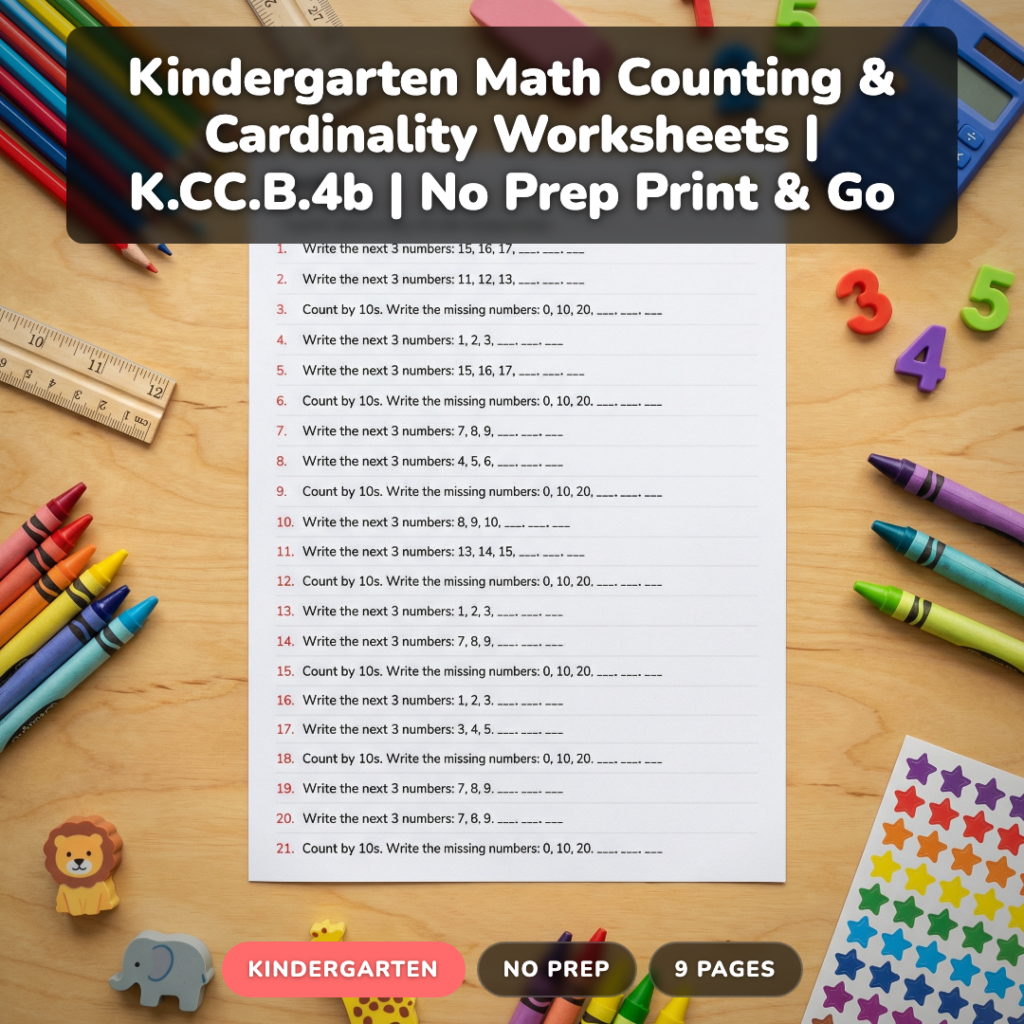
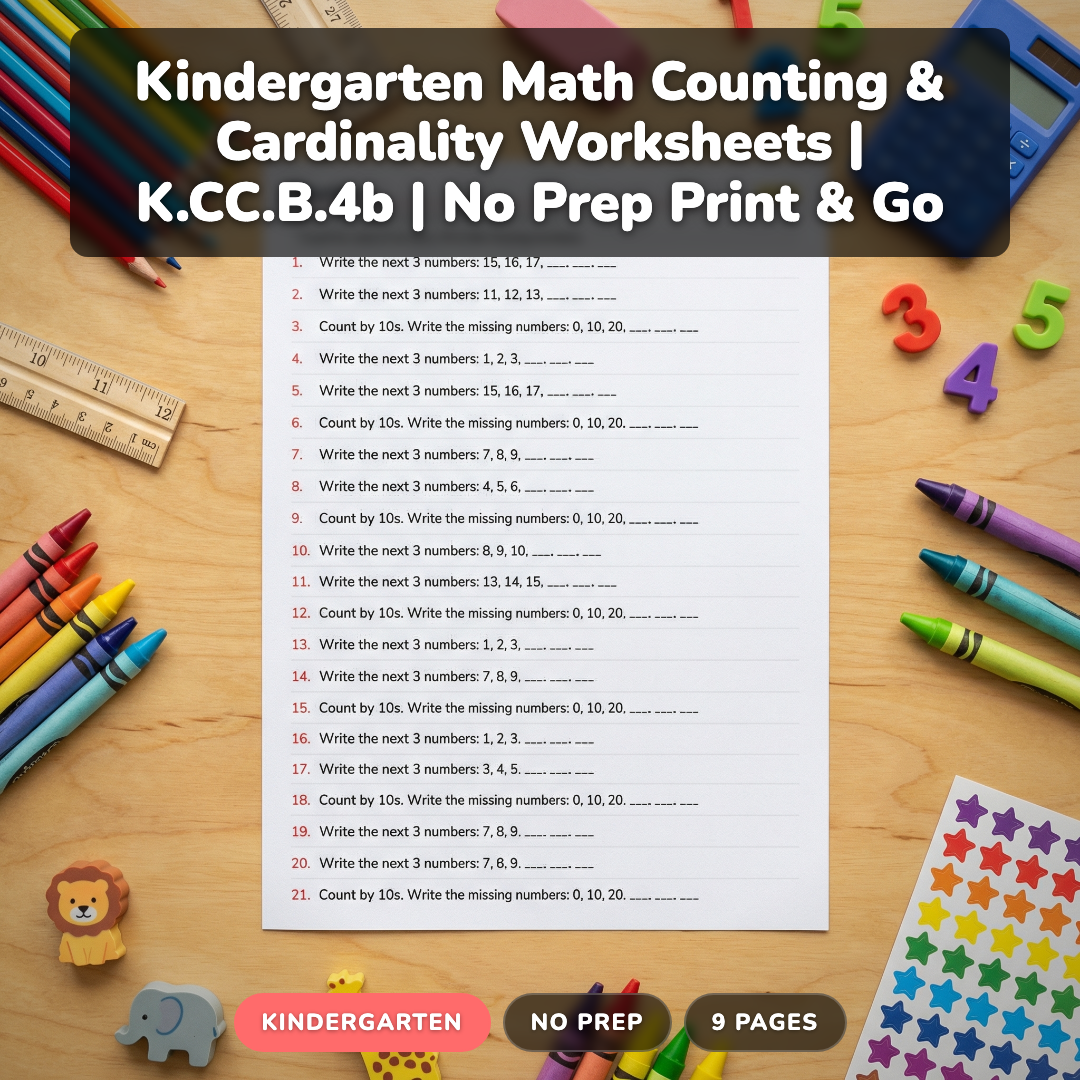
After years of teaching kindergarten and watching students struggle with this foundational concept, I created a comprehensive resource that takes the guesswork out of cardinality instruction. This 9-page pack includes 79 carefully crafted problems across three differentiation levels, ensuring every student gets appropriate practice with CCSS.Math.Content.K.CC.B.4b.
The Practice level (22 problems) focuses on quantities 1-5 with clear, organized arrangements perfect for students just learning to connect counting with quantity. The On-Level section (30 problems) challenges students with quantities up to 8 in varied arrangements, building flexibility in counting strategies. The Challenge level (27 problems) pushes students to count up to 10 objects in complex arrangements while maintaining accuracy and understanding.
What makes this resource different is the intentional progression and visual design. Each page builds systematically on the previous one, and the problems specifically address common misconceptions like arrangement confusion and double-counting. Answer keys are included for quick assessment, and the no-prep format means you can differentiate instantly based on daily observations.
Whether you’re introducing cardinality for the first time or reinforcing it with students who need extra practice, this resource provides the structured support that makes the difference between confusion and confidence.
Grab a Free Counting Sample to Try
Want to see how these strategies work in action? I’ll send you a free sample page from the resource plus my “Cardinality Quick Check” assessment that reveals exactly where each student stands with this crucial skill.
Frequently Asked Questions About Teaching Counting & Cardinality
When should kindergarteners master cardinality?
Most kindergarteners develop solid cardinality understanding by mid-year (January-February) with consistent practice. However, some students need until spring to fully grasp that the last number counted represents the total quantity, especially for larger sets of 6-10 objects.
What’s the difference between counting and cardinality?
Counting is saying number words in sequence (1, 2, 3, 4), while cardinality is understanding that the last number represents the total quantity. Students can count perfectly but still not understand “how many” there are without recounting from the beginning.
How do I help students who keep double-counting objects?
Teach systematic strategies like moving objects to a “finished” pile, using the touch-and-move method, or marking counted objects with small stickers. Practice with objects in organized lines before moving to scattered arrangements that require more sophisticated counting strategies.
Should I correct students when they count out of order?
Focus on one-to-one correspondence first — each object gets one number name. The sequence matters less than ensuring they count each object exactly once. Gradually introduce counting from left to right as an organizational strategy, but don’t let sequence errors overshadow cardinality understanding.
How many objects should kindergarteners count accurately?
By the end of kindergarten, students should accurately count and determine cardinality for sets of 1-10 objects as required by CCSS.Math.Content.K.CC.B.4b. Start with 3-5 objects and gradually increase as students demonstrate consistent success with smaller quantities.
Cardinality is truly the gateway to mathematical thinking — when students understand that counting tells us “how many,” they’re ready for addition, subtraction, and place value. The strategies above work because they make abstract concepts concrete and give students multiple ways to experience the same mathematical truth.
What’s your biggest challenge when teaching cardinality? I’d love to hear about your classroom experiences and any creative strategies you’ve discovered. And don’t forget to grab that free sample above — it’s a great way to try these ideas with your students right away.