If your kindergarteners can count to 10 but freeze when you ask “Which group has more?” you’re not alone. Comparing quantities is one of the trickiest skills in early math because it requires students to move beyond rote counting to truly understand what numbers mean.
This post breaks down exactly how to teach counting and cardinality comparison skills using research-backed strategies that work in real kindergarten classrooms. You’ll get concrete activities, differentiation tips, and solutions for the most common misconceptions.
Key Takeaway
Students master quantity comparison when they use multiple strategies: one-to-one correspondence, visual matching, and counting with understanding that the last number counted represents the total amount.
Why Counting & Cardinality Comparison Matters in Kindergarten
Standard CCSS.Math.Content.K.CC.C.6 asks students to identify whether the number of objects in one group is greater than, less than, or equal to the number of objects in another group. This foundational skill bridges counting and number sense, setting the stage for addition, subtraction, and place value in first grade.
Research from the National Council of Teachers of Mathematics shows that students who master cardinality principles in kindergarten demonstrate significantly stronger number sense throughout elementary school. The key insight: students must understand that counting tells us “how many,” not just the sequence of number words.
This skill typically develops between January and May of kindergarten, after students have solid counting skills to 10. Students need to coordinate three cognitive processes: counting accurately, understanding that the last number represents the total, and comparing those totals meaningfully.
Looking for a ready-to-go resource? I put together a differentiated counting & cardinality pack that covers everything below — but first, the teaching strategies that make it work.
Common Counting & Cardinality Misconceptions in Kindergarten
Common Misconception: Students count correctly but can’t tell you which group has more.
Why it happens: They see counting as a recitation activity, not a way to determine quantity.
Quick fix: Always ask “How many?” after counting and have them touch the last object counted.
Common Misconception: Students think the group that takes up more space has more objects.
Why it happens: They rely on visual area rather than actual quantity.
Quick fix: Use identical objects and vary spacing to highlight that arrangement doesn’t change quantity.
Common Misconception: Students can match one-to-one but can’t explain which group has more when objects are left over.
Why it happens: They understand the matching process but haven’t connected it to quantity comparison.
Quick fix: Explicitly count the leftover objects and connect to “more.”
Common Misconception: Students think “greater than” and “less than” are too abstract.
Why it happens: The vocabulary is new and the concept requires comparing two separate counts.
Quick fix: Start with “more,” “fewer,” and “same” before introducing formal mathematical language.
5 Research-Backed Strategies for Teaching Counting & Cardinality
Strategy 1: One-to-One Correspondence Matching
This foundational strategy helps students visually see quantity relationships by physically matching objects from each group. Students develop understanding that when objects are left over, that group has more.
What you need:
- Two sets of identical objects (blocks, counters, crayons)
- Two different colored plates or mats
- Objects in quantities 3-8 for beginners
Steps:
- Place different quantities on two mats (start with 4 and 6 objects)
- Have students take one object from each mat and place them together
- Continue until one mat is empty
- Count the leftover objects and identify which mat “has more”
- Repeat with the student predicting first, then checking
Strategy 2: Visual Line-Up Comparison
Students arrange objects in parallel lines to create a visual representation of quantity differences. This strategy builds on natural spatial reasoning while reinforcing counting skills.
What you need:
- Unifix cubes or other stackable/alignable objects
- Two strips of paper or tape lines on the table
- Different colored objects for each group
Steps:
- Give students two different quantities of objects
- Have them line up each group on separate strips, one object per space
- Align the strips so students can see which line extends further
- Count each line together, emphasizing the final count
- Introduce language: “The red line has more because it has 6 and the blue line has 4”
Strategy 3: The “Count, Compare, Conclude” Routine
This structured approach teaches students a systematic method for quantity comparison that they can use independently. The routine builds metacognitive awareness of the comparison process.
What you need:
- Various small objects (buttons, beans, toys)
- Two containers or circles drawn on paper
- Anchor chart with the three-step process
Steps:
- Count: Students count each group separately and say the total
- Compare: Students look at both numbers and decide which is bigger/smaller
- Conclude: Students state their finding using complete sentences
- Model the language: “I counted 5 bears and 3 cars. 5 is more than 3, so the bears group has more.”
- Practice with students leading the routine
Strategy 4: Number Story Comparisons
Students connect quantity comparison to real-world scenarios through storytelling. This strategy builds mathematical reasoning while making abstract concepts concrete and meaningful.
What you need:
- Small toys or manipulatives that fit story themes
- Simple story scenarios (written or verbal)
- Recording sheet for student drawings
Steps:
- Present a simple story: “There are 4 dogs at the park and 6 cats. Are there more dogs or cats?”
- Students act out the story with manipulatives
- Count each group together
- Discuss the comparison using story language
- Students create their own comparison stories with objects
Strategy 5: Interactive Comparison Games
Game-based learning motivates students while providing repeated practice with quantity comparison. The competitive element encourages careful counting and comparison.
What you need:
- Dice (regular or dot dice for beginners)
- Two colors of counting bears or blocks
- Recording sheet or whiteboard
Steps:
- Partners take turns rolling dice and collecting that many objects
- After both roll, they compare quantities using one-to-one matching
- The player with more keeps both sets of objects
- Play continues for 5 rounds, then count total collections
- Discuss strategies: “How did you know you had more?”
How to Differentiate Counting & Cardinality for All Learners
For Students Who Need Extra Support
Focus on quantities 1-5 and use highly visual strategies. Provide objects that are easy to manipulate and count, such as large buttons or blocks. Use consistent language like “more,” “fewer,” and “same” before introducing mathematical terms. Practice one-to-one correspondence extensively with physical matching before moving to visual comparison. Consider using number lines or ten frames to support counting accuracy.
For On-Level Students
Work with quantities 3-8 and introduce formal vocabulary gradually. Students should master the “Count, Compare, Conclude” routine and explain their thinking. Practice with various object types and arrangements to build flexible thinking. Introduce recording sheets where students draw their comparisons and write numbers. Connect to standard CCSS.Math.Content.K.CC.C.6 by using matching and counting strategies interchangeably.
For Students Ready for a Challenge
Extend to quantities up to 10 and introduce three-group comparisons. Challenge students to find multiple ways to prove which group has more (counting, matching, visual arrangement). Introduce early inequality symbols (>, <, =) with concrete objects. Connect to addition concepts by asking "How many more?" when comparing groups. Encourage students to create their own comparison problems for classmates.
A Ready-to-Use Counting & Cardinality Resource for Your Classroom
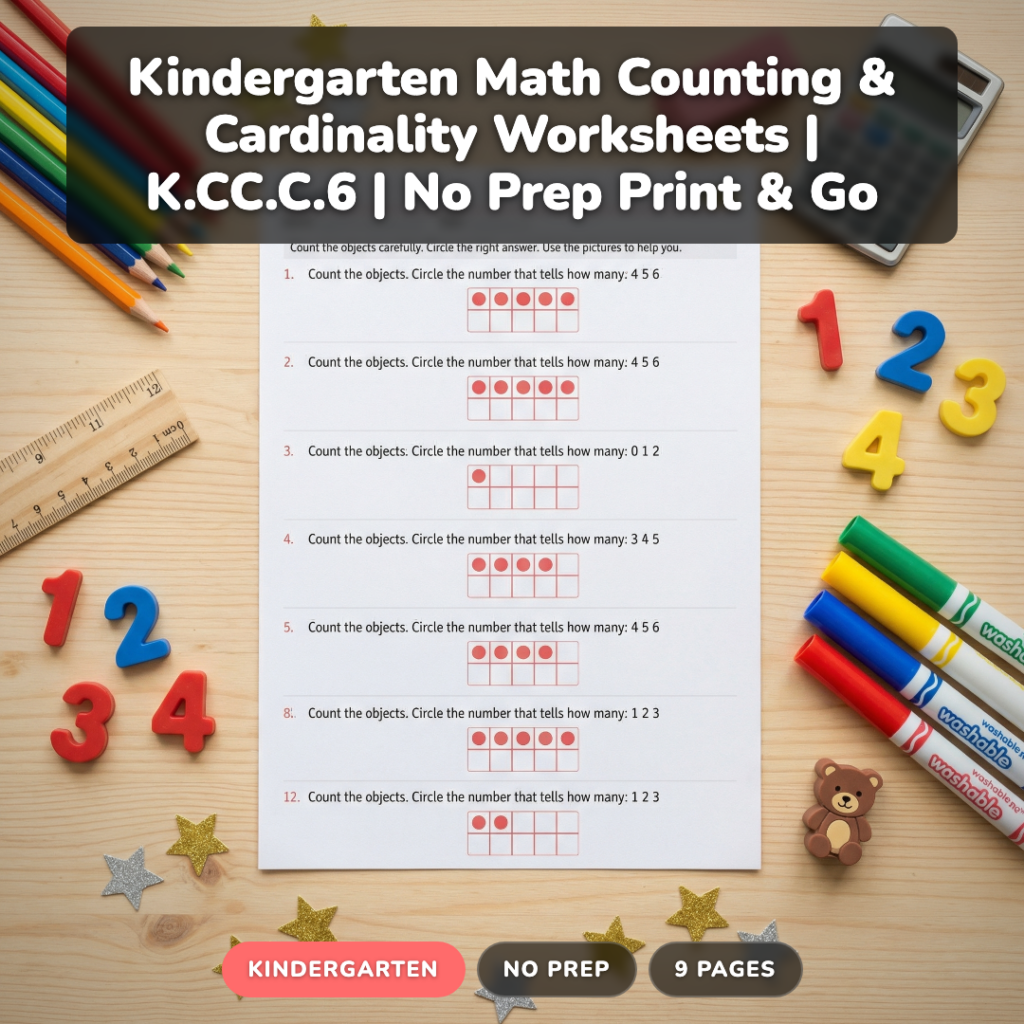
After years of creating these activities from scratch, I put together a comprehensive resource that saves hours of prep time while providing exactly the differentiated practice students need. This counting and cardinality worksheet pack includes 79 problems across three difficulty levels, specifically designed for standard K.CC.C.6.
The resource includes 22 practice problems for students building foundational skills, 30 on-level problems for grade-appropriate practice, and 27 challenge problems for advanced learners. Each level uses clear visuals and scaffolded support, so you can meet every student where they are without creating multiple resources.
What makes this different from generic worksheets is the intentional progression and visual clarity. Problems move from concrete object comparison to more abstract representations, building the exact skills kindergarteners need for first-grade success.
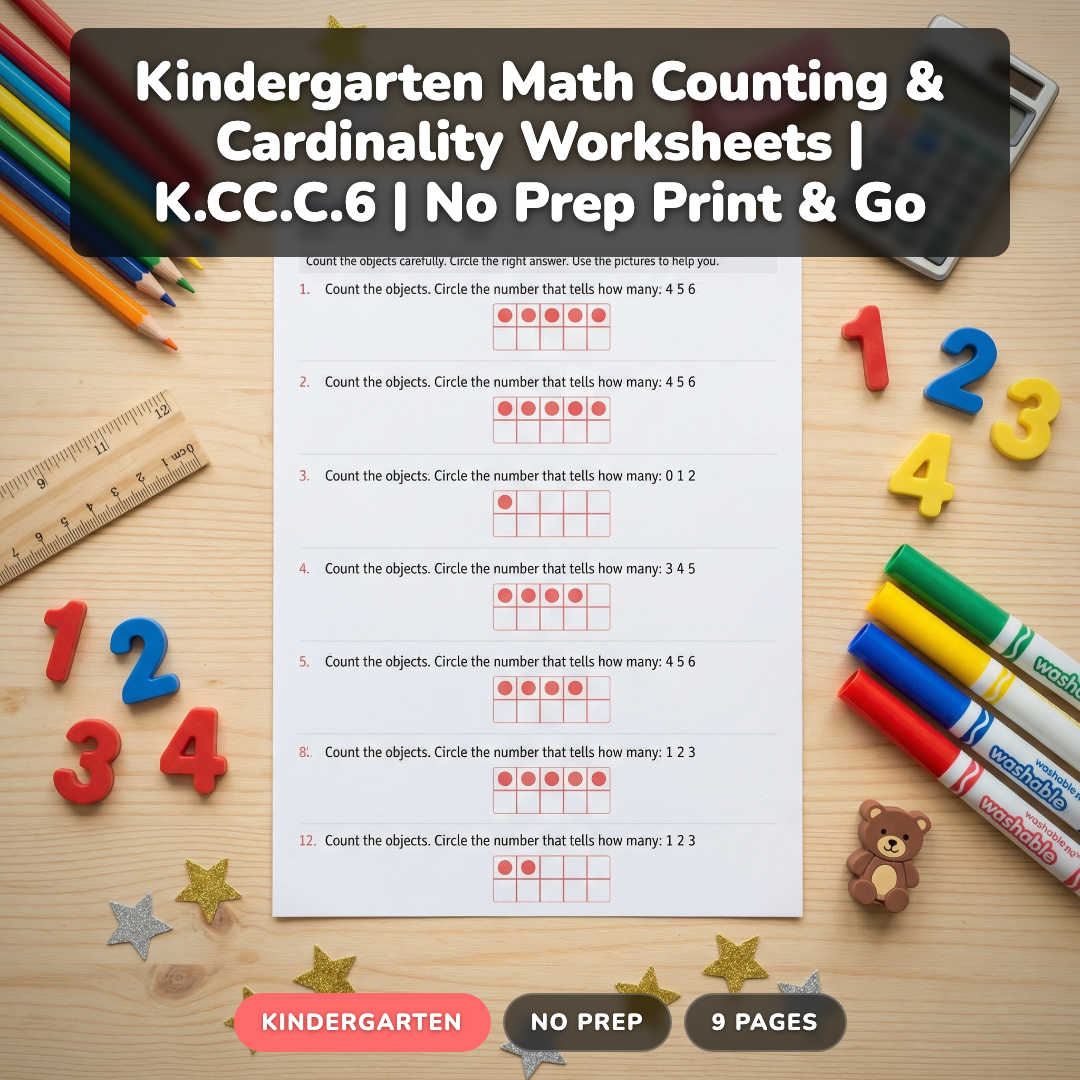
The pack covers everything from basic “more/fewer” comparisons to advanced three-group challenges, with answer keys included for quick grading. Perfect for math centers, homework, or assessment preparation.
Grab a Free Counting Comparison Sample to Try
Want to see how these strategies work in practice? I’ll send you a free sample page from each difficulty level, plus a quick reference guide for the “Count, Compare, Conclude” routine. Perfect for trying these techniques before diving into the full resource.
Frequently Asked Questions About Teaching Counting & Cardinality
When should kindergarten students master quantity comparison skills?
Most students develop solid comparison skills between January and May of kindergarten, after mastering counting to 10. Students need consistent practice with quantities 1-8 before tackling larger numbers. The key milestone is understanding that counting tells us “how many,” not just reciting number sequences.
What’s the difference between counting and cardinality?
Counting is the ability to recite number words in sequence, while cardinality means understanding that the last number counted represents the total quantity. Students often count accurately but struggle with cardinality, which is essential for quantity comparison and future math success.
How do I help students who can count but can’t compare quantities?
Focus on one-to-one correspondence activities and always ask “How many?” after counting. Use physical matching strategies before visual comparison. Emphasize that the last number counted tells us the total amount. Practice with concrete objects before moving to pictures or abstract representations.
Should I teach “greater than” and “less than” symbols in kindergarten?
Standard K.CC.C.6 focuses on identifying relationships using matching and counting strategies, not formal symbols. Start with “more,” “fewer,” and “same” language. Introduce symbols only after students master the conceptual understanding, typically late in kindergarten or early first grade.
What manipulatives work best for teaching quantity comparison?
Use identical objects that are easy to count and move, such as counting bears, unifix cubes, or large buttons. Avoid objects that are too small or detailed. Two-color sets help students distinguish between groups while maintaining focus on quantity rather than object differences.
Teaching quantity comparison successfully comes down to helping students understand that numbers represent actual amounts, not just words in a sequence. When you combine concrete manipulation, visual strategies, and consistent language, students develop the deep number sense they need for mathematical success.
What’s your favorite strategy for helping kindergarteners master quantity comparison? Try the free sample activities above and see which approaches work best with your students.