If your kindergarteners stare blankly when you ask “Which is bigger, 6 or 4?” you’re not alone. Number comparison is one of those foundational skills that seems simple to adults but requires careful scaffolding for 5-year-olds. You need concrete strategies that help students truly understand quantity, not just memorize number order.
Key Takeaway
Kindergarten number comparison builds on one-to-one correspondence and counting fluency — students must see numbers as quantities, not just symbols.
Why Number Comparison Matters in Kindergarten
Number comparison forms the foundation for all future math learning. When students master CCSS.Math.Content.K.CC.C.7 — comparing two numbers between 1 and 10 presented as written numerals — they’re developing number sense that directly supports addition, subtraction, and place value concepts in first grade.
Research from the National Mathematics Advisory Panel shows that students who struggle with early number concepts like comparison often continue struggling with math throughout elementary school. This skill typically emerges in the second half of kindergarten, after students have solid counting skills and can recognize written numerals 1-10.
The timing matters. Most kindergarteners can count to 10 by October, recognize numerals by December, and are ready for systematic comparison work by January. Students need about 6-8 weeks of consistent practice to internalize this concept.
Looking for a ready-to-go resource? I put together a differentiated number comparison pack that covers everything below — but first, the teaching strategies that make it work.
Common Number Comparison Misconceptions in Kindergarten
Understanding why students make mistakes helps you address the root cause, not just the symptom. Here are the four most common misconceptions I see in kindergarten classrooms:
Common Misconception: Students think the number that comes first when counting is always “bigger.”
Why it happens: They confuse counting order with quantity comparison.
Quick fix: Use concrete objects to show that 3 comes before 7 in counting, but 7 represents more things.
Common Misconception: Students choose the number that “looks bigger” physically.
Why it happens: Font size or bold text influences their choice over actual quantity.
Quick fix: Always use identical fonts and sizes when presenting number comparison problems.
Common Misconception: Students think single-digit numbers are always smaller than two-digit numbers.
Why it happens: They see “more digits” as “more quantity” without understanding place value.
Quick fix: Stick to numbers 1-10 as required by the standard until place value is formally taught.
Common Misconception: Students memorize comparison facts without understanding quantity.
Why it happens: Too much drill without conceptual foundation.
Quick fix: Always connect numerals back to concrete quantities using manipulatives.
5 Research-Backed Strategies for Teaching Number Comparison
These strategies move students from concrete understanding to abstract symbol comparison. Use them in order for best results.
Strategy 1: Concrete Object Racing
Students physically count and compare groups of objects before seeing any numerals. This builds the foundational understanding that numbers represent quantities.
What you need:
- Small manipulatives (counting bears, blocks, beans)
- Two paper plates or circles
- Number cards 1-10
Steps:
- Give students two groups of objects (start with numbers 1-5)
- Have them count each group aloud while touching each object
- Ask “Which group has more?” and let them explain their thinking
- Introduce the corresponding numeral cards only after they identify the larger group
- Practice with 3-4 different combinations per session
Strategy 2: Number Line Visualization
A floor number line helps students see that numbers farther to the right are greater. This bridges concrete counting to abstract comparison.
What you need:
- Masking tape for floor number line 1-10
- Two different colored bean bags or markers
- Large numeral cards
Steps:
- Create a number line on the floor using tape, spacing numbers about 12 inches apart
- Place two bean bags on different numbers
- Have students identify which bean bag is “farther down the line”
- Explicitly teach: “Numbers farther to the right are bigger”
- Let students take turns placing bean bags and comparing positions
Strategy 3: Ten Frame Comparison
Ten frames provide visual structure that makes quantity differences obvious. Students can instantly see which number fills more spaces.
What you need:
- Laminated ten frames (two per student)
- Two-color counters or small manipulatives
- Dry erase markers
Steps:
- Give students two ten frames and a pile of counters
- Call out two numbers (e.g., “Show me 6 and 4”)
- Students fill their ten frames with the correct quantities
- Ask “Which ten frame has more counters filled in?”
- Connect back to numerals: “So 6 is greater than 4”
Strategy 4: Numeral Symbol Comparison Games
Once students understand quantity comparison, they’re ready to work directly with written numerals. Games keep this practice engaging.
What you need:
- Deck of numeral cards 1-10 (two sets)
- “Greater than” and “less than” symbol cards
- Timer (optional)
Steps:
- Students work in pairs, each drawing one numeral card
- They place cards side by side and determine which is greater
- Winner keeps both cards (or students just practice without competition)
- Introduce > and < symbols after students are fluent with "greater/less" language
- Play for 10-15 minutes during math centers
Strategy 5: Real-World Application Scenarios
Students apply comparison skills to meaningful contexts, deepening understanding and showing practical relevance.
What you need:
- Classroom scenarios (snack time, supplies, etc.)
- Simple word problem cards
- Chart paper for recording
Steps:
- Present real classroom situations: “We have 7 glue sticks and 4 scissors. Which do we have more of?”
- Students solve using any strategy (counting, number line, ten frames)
- Record solutions on chart paper with both pictures and numerals
- Create a class book of comparison problems from daily life
- Students suggest their own comparison scenarios
How to Differentiate Number Comparison for All Learners
For Students Who Need Extra Support
Start with quantities 1-5 and use very different numbers (1 vs 5, 2 vs 6). Provide physical manipulatives for every comparison. Review one-to-one correspondence and counting skills daily. Use consistent language: “more,” “less,” “same.” Allow extra time for counting and recounting. Partner struggling students with patient, supportive classmates during games.
For On-Level Students
Work with numbers 1-10 as outlined in CCSS.Math.Content.K.CC.C.7. Include numbers that are close together (6 vs 7, 3 vs 4). Introduce mathematical vocabulary: “greater than,” “less than,” “equal to.” Practice both concrete and abstract representations. Expect students to explain their reasoning using complete sentences.
For Students Ready for a Challenge
Compare three numbers at once (“Put 4, 7, and 2 in order from least to greatest”). Introduce inequality symbols > and < with careful explanation. Connect to addition concepts: "How many more is 8 than 5?" Use numbers slightly above 10 occasionally. Have students create their own comparison problems for classmates.
A Ready-to-Use Number Comparison Resource for Your Classroom
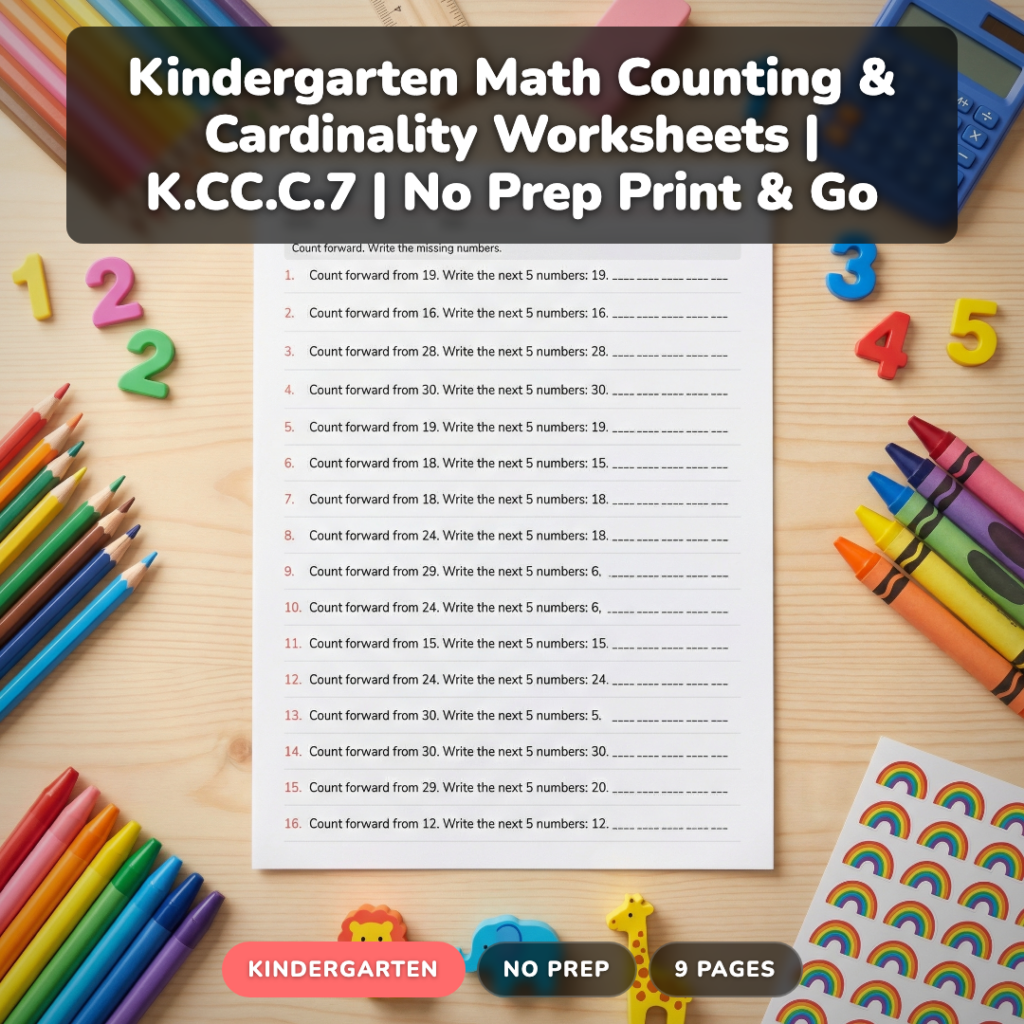
After years of creating comparison activities from scratch, I developed a comprehensive resource that saves hours of prep time while providing the differentiation kindergarteners need. This number comparison pack includes 79 carefully crafted problems across three difficulty levels.
The Practice level focuses on numbers 1-6 with clear visual supports. On-Level worksheets cover the full 1-10 range required by the Common Core standard. Challenge problems include three-number comparisons and early inequality symbols. Each level includes answer keys and can be used for independent practice, homework, or assessment.
What makes this different from generic worksheets? Every problem connects to the concrete strategies above. Visual ten frames support abstract numerals. Problems progress systematically from simple to complex. The format matches what students see on district assessments.
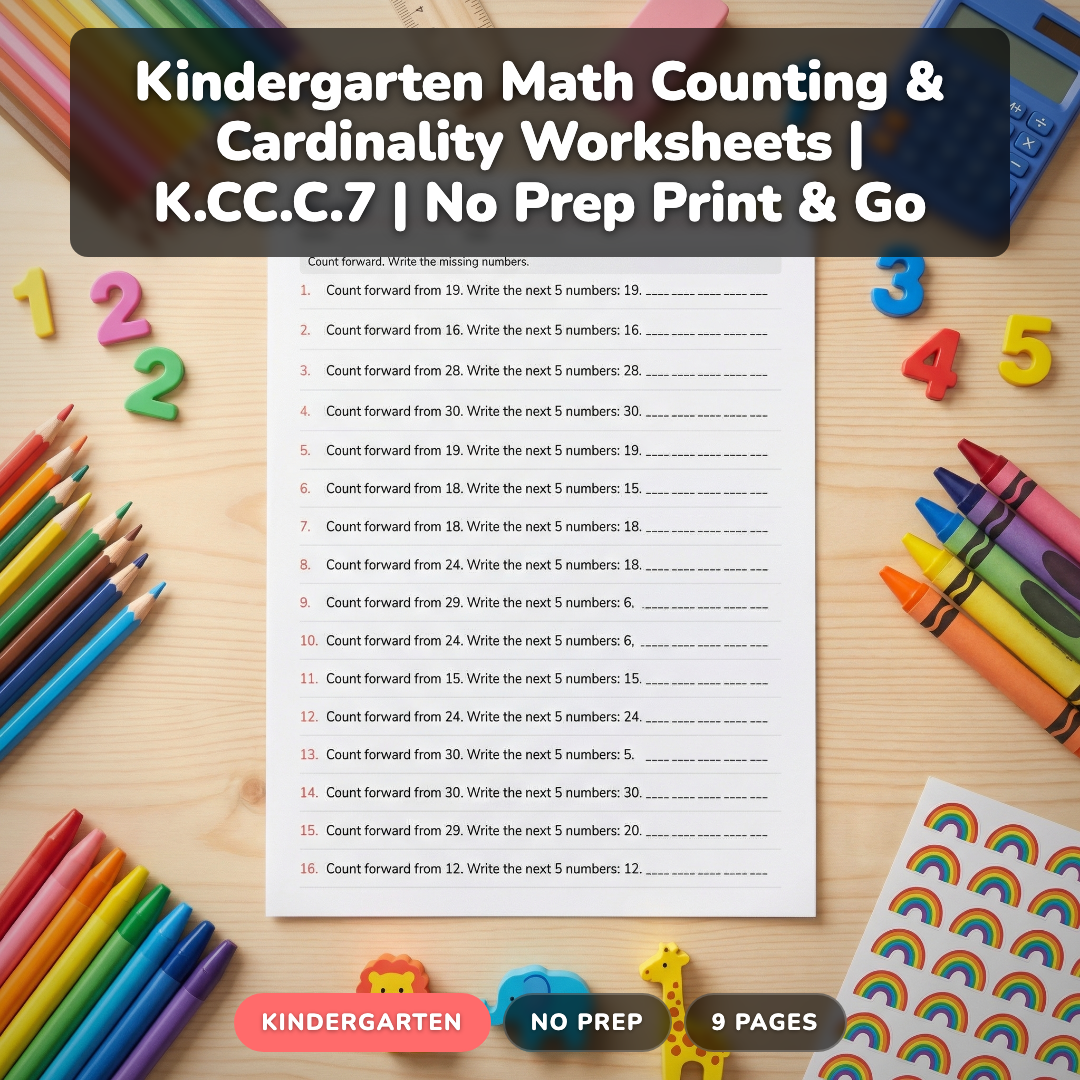
You get 9 ready-to-print pages covering every aspect of kindergarten number comparison, from basic quantity recognition to advanced symbol work.
Grab a Free Number Comparison Sample to Try
Want to see the quality before you buy? I’ll send you a free sample worksheet from the pack, plus my kindergarten math planning calendar that shows exactly when to teach each counting and cardinality skill.
Frequently Asked Questions About Teaching Number Comparison
When should kindergarten students master number comparison?
Most kindergarteners master comparing numbers 1-10 by late winter or early spring. Students need solid counting and numeral recognition first, which typically develops by mid-year. Allow 6-8 weeks of consistent practice after introducing the concept.
Should I teach greater than and less than symbols in kindergarten?
CCSS.Math.Content.K.CC.C.7 focuses on comparing quantities, not symbols. Introduce > and < only after students are fluent with comparison language. Most kindergarteners learn these symbols in first grade when they have stronger abstract thinking skills.
How do I help students who confuse counting order with size?
Use concrete manipulatives to show that 3 comes before 8 when counting, but 8 represents more objects. Practice with ten frames where students can visually see which number fills more spaces. Separate counting practice from comparison practice initially.
What’s the best way to assess number comparison skills?
Use a mix of concrete (“Show me which group has more”) and abstract (“Circle the bigger number”) tasks. Observe students during hands-on activities and ask them to explain their thinking. District assessments typically use written numerals only.
How often should students practice number comparison?
Daily practice for 10-15 minutes works best once the concept is introduced. Use math centers, morning work, or transition activities. Vary the format between games, worksheets, and hands-on activities to maintain engagement.
Number comparison sets the stage for all future math learning in your kindergarteners. When students truly understand that numerals represent quantities they can compare, they’re ready for addition, subtraction, and place value concepts ahead. What’s your favorite way to make number comparison stick with your students?
Don’t forget to grab your free sample worksheet above — it’s a great way to see these strategies in action with your class.