If your kindergarteners can recite numbers to 20 but freeze when you ask “How many blocks are here?” you’re seeing the classic gap between rote counting and true number understanding. That disconnect between saying numbers and knowing what they mean is exactly what cardinality addresses — and it’s the foundation every math skill builds on.
Key Takeaway
Cardinality bridges the gap between reciting numbers and understanding that the last number counted represents the total quantity in a group.
Why Counting & Cardinality Matters in Kindergarten
Counting and cardinality forms the bedrock of all mathematical thinking. When students master CCSS.Math.Content.K.CC.B.4, they understand that numbers represent specific quantities, not just a memorized sequence. This standard requires students to connect counting to cardinality by understanding that the last number said tells the number of objects counted.
Research from the National Research Council shows that students who struggle with cardinality in kindergarten are 3.5 times more likely to have math difficulties in third grade. The concept typically develops between ages 4-6, making kindergarten the critical window for intervention and support.
Timing matters too. Cardinality instruction works best after students can count to 10 reliably (usually October-November) but before introducing addition concepts in spring. Students need this foundation to understand that 5 + 2 means combining quantities, not just following a counting pattern.
Looking for a ready-to-go resource? I put together a differentiated counting & cardinality pack that covers everything below — but first, the teaching strategies that make it work.
Common Counting & Cardinality Misconceptions in Kindergarten
Common Misconception: Students recount from 1 when asked “How many?” after already counting a group.
Why it happens: They view counting and “how many” as separate tasks, not understanding that the last number counted IS the answer.
Quick fix: Emphasize the last number by having students point to it or say it louder during counting practice.
Common Misconception: Students count objects multiple times or skip objects entirely.
Why it happens: They lack one-to-one correspondence skills and systematic counting strategies.
Quick fix: Use the “touch and move” method — physically move each object as they count it.
Common Misconception: Students think bigger objects represent larger numbers.
Why it happens: They confuse size with quantity, a natural developmental phase.
Quick fix: Practice counting groups where small objects outnumber large ones (10 pennies vs 3 quarters).
Common Misconception: Students believe the starting position affects the total count.
Why it happens: They don’t understand that quantity remains constant regardless of counting order.
Quick fix: Count the same group starting from different positions to show the total stays the same.
5 Research-Backed Strategies for Teaching Counting & Cardinality
Strategy 1: The Magic Last Number Routine
This strategy explicitly teaches students that the last number counted holds special meaning — it tells us the total quantity. Students learn to emphasize and remember this “magic” number through repetitive practice with various objects.
What you need:
- Collections of 3-10 small objects (buttons, blocks, crayons)
- “Magic wand” (pencil or pointer)
- Chart paper for recording
Steps:
- Count a small group of objects together, touching each one
- When you reach the last number, wave your “magic wand” and say “The magic number is 5! That means we have 5 buttons.”
- Ask “How many buttons do we have?” and celebrate when students say “5!” without recounting
- Repeat with different quantities and objects
- Have students take turns being the “magic number detective”
Strategy 2: Count, Touch, and Move System
This kinesthetic approach ensures one-to-one correspondence while building cardinality understanding. Students physically manipulate objects as they count, creating a strong connection between the counting sequence and actual quantities.
What you need:
- Two containers or plates per student
- Various countable objects (bears, cubes, pasta)
- Counting mats with designated spaces
Steps:
- Place objects in one container, empty container beside it
- Students touch each object while saying the number
- Immediately move the touched object to the second container
- Continue until all objects are moved and counted
- Ask “How many did you count?” — the answer should come from memory of the last number, not recounting
- Verify by having them look at the moved objects and confirm the total
Strategy 3: Subitizing Bridge Activities
Subitizing — instantly recognizing small quantities without counting — naturally leads to cardinality understanding. Students learn to see groups and connect visual patterns to specific numbers, building automatic number recognition.
What you need:
- Dot cards or dominoes showing 1-6 dots
- Small manipulatives that match dot patterns
- Timer for quick recognition games
Steps:
- Flash a dot card for 2 seconds
- Students say how many dots they see (without counting)
- Reveal the card and count together to verify
- Have students build the same pattern with manipulatives
- Ask “How many objects did you use?” to reinforce cardinality
- Progress from patterns of 3 to patterns of 6
Strategy 4: Number Story Connections
This strategy embeds counting practice within meaningful contexts, helping students understand that numbers represent real quantities in their world. Students count objects within stories and answer cardinality questions about story elements.
What you need:
- Simple picture books with countable elements
- Story props or felt board pieces
- Recording sheets for story problems
Steps:
- Read a story with clear countable elements (“The farmer had some chickens…”)
- Stop at counting opportunities and count story elements together
- Ask cardinality questions: “How many chickens does the farmer have now?”
- Use props to act out the story and recount
- Create simple story problems: “Maria found 4 shells. How many shells did Maria find?”
- Have students retell stories using specific quantities
Strategy 5: Counting Collections Exploration
Students work with varied collections of real objects, practicing systematic counting while building cardinality understanding through hands-on exploration. This strategy mimics how children naturally explore quantities in their environment.
What you need:
- Various collections: shells, buttons, bottle caps, small toys
- Organizing trays or egg cartons
- Recording sheets with numbers and pictures
- Magnifying glasses for detailed observation
Steps:
- Give each student or pair a collection of 5-12 similar objects
- Students explore and organize their collection however they choose
- Demonstrate systematic counting: line up objects and count once
- Students count their organized collection and record the total
- Ask “How many [objects] are in your collection?” and have them respond without recounting
- Students share their totals and verify by counting together
How to Differentiate Counting & Cardinality for All Learners
For Students Who Need Extra Support
Begin with quantities of 3-5 objects using highly structured activities. Provide physical boundaries like egg cartons or ten-frames to organize counting. Use consistent language: “Count with me… 1, 2, 3. We counted 3. How many do we have? 3!” Practice one-to-one correspondence with large, easy-to-manipulate objects before moving to smaller items. Review prerequisite skills like number recognition and counting sequence daily through songs and chants.
For On-Level Students
Work with quantities up to 10-12 objects using varied materials and contexts. Expect students to count independently and answer cardinality questions without prompting. Introduce counting strategies like grouping by 2s or 5s. Practice with both structured arrays and scattered arrangements. Connect counting to simple addition and subtraction situations: “We had 5 crayons, used 2, how many are left?”
For Students Ready for a Challenge
Extend to quantities of 15-20 objects and introduce skip counting patterns. Practice counting backwards and starting from numbers other than 1. Explore cardinality with two-digit numbers and introduce place value concepts. Create complex story problems involving multiple groups: “The class collected 8 rocks and 6 leaves. How many nature items did they find altogether?” Connect to measurement: counting units to find length or area.
A Ready-to-Use Counting & Cardinality Resource for Your Classroom
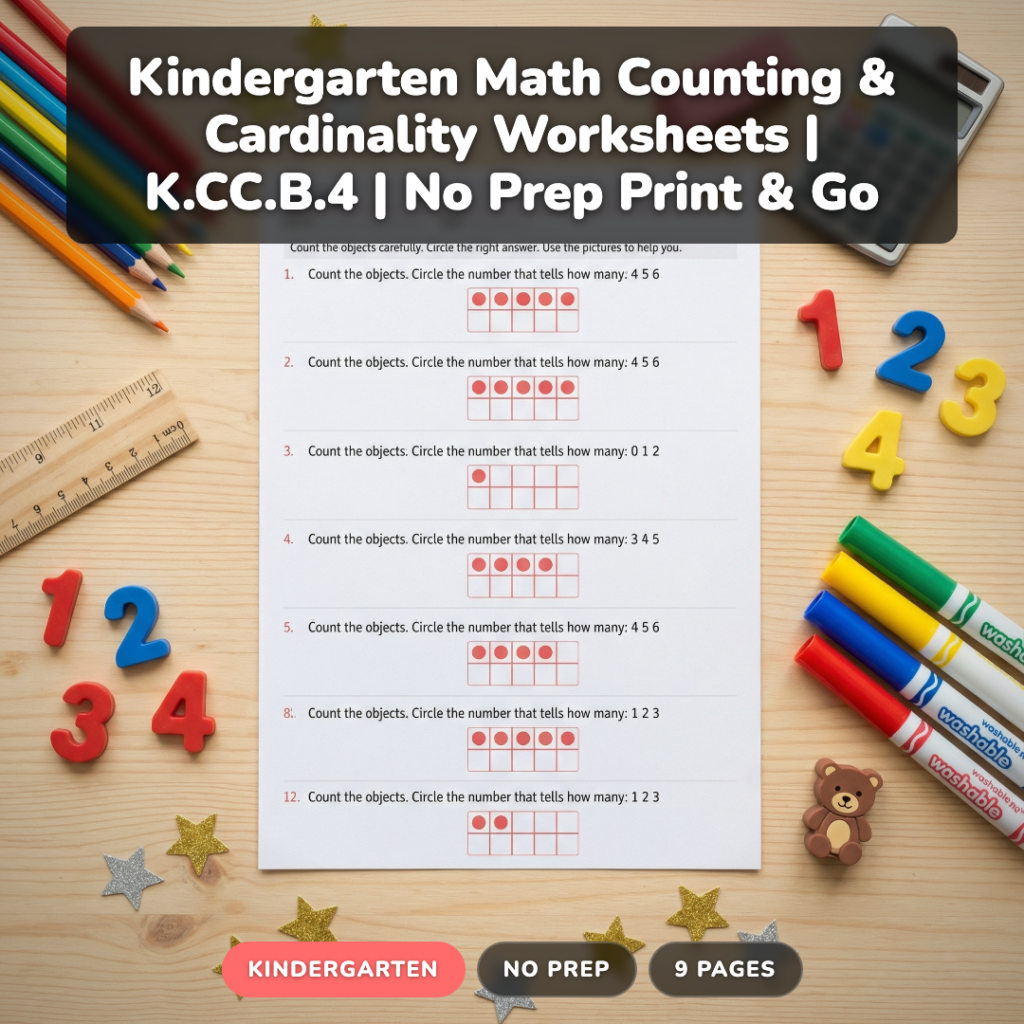
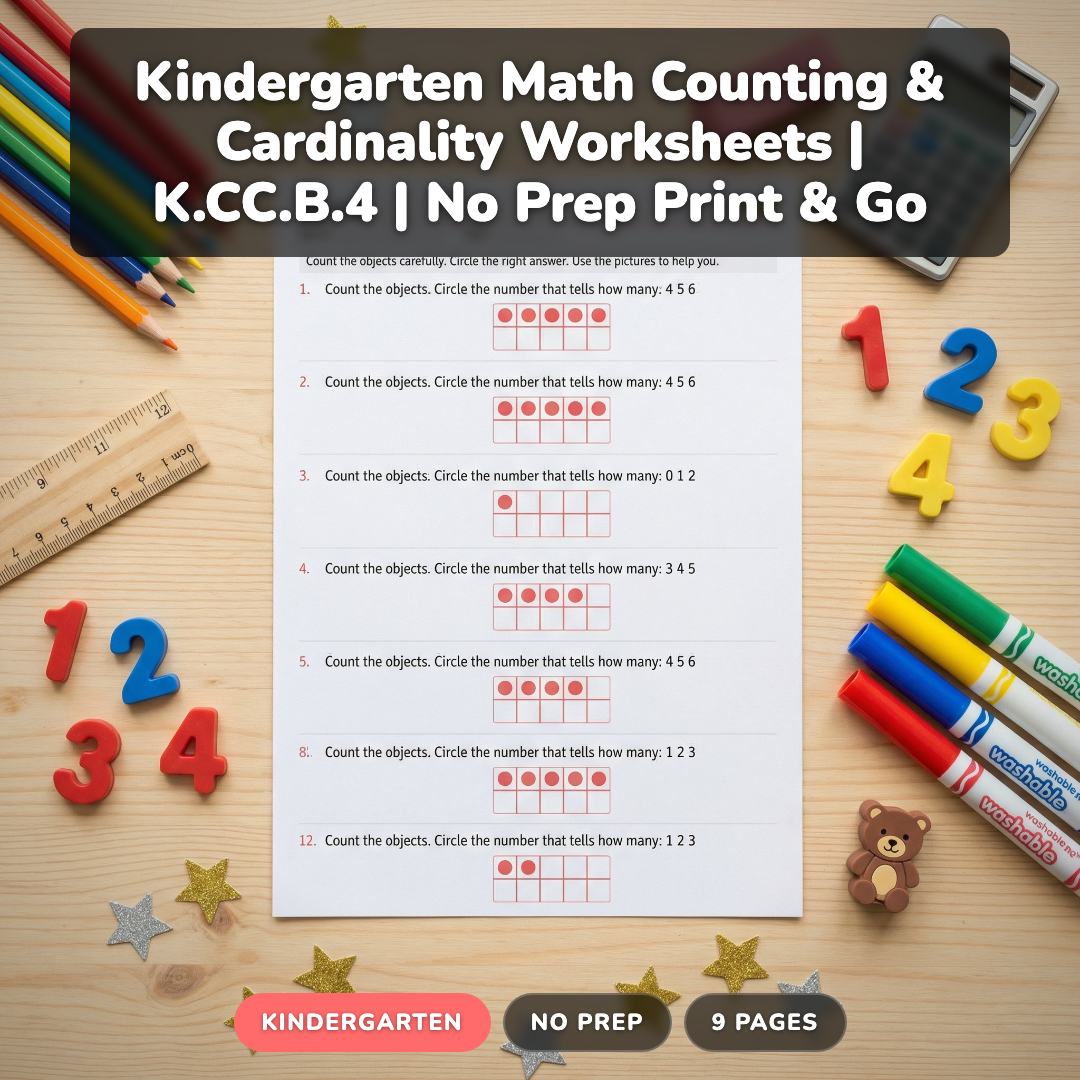
Teaching cardinality effectively requires tons of varied practice — and creating differentiated worksheets for 79 different problems takes hours you don’t have. That’s exactly why I created this comprehensive Kindergarten Counting & Cardinality pack that aligns perfectly with CCSS.Math.Content.K.CC.B.4.
This 9-page resource gives you three distinct difficulty levels: 22 practice problems for students building foundational skills, 30 on-level problems for grade-level expectations, and 27 challenge problems for advanced learners. Each problem focuses on the connection between counting and cardinality, with clear visuals and systematic progression from simple to complex quantities.
What makes this different from generic counting worksheets? Every problem specifically targets the cardinality concept — students don’t just count, they answer “how many” questions and connect counting to quantity understanding. The progression is carefully scaffolded, and answer keys are included for quick assessment.
You can grab this time-saving resource and start using it tomorrow — no prep required.
Grab a Free Counting Sample to Try
Want to see how these cardinality strategies work in practice? I’ll send you a free sample worksheet plus my “Cardinality Question Stems” reference sheet that you can use with any counting activity.
Frequently Asked Questions About Teaching Counting & Cardinality
What’s the difference between counting and cardinality?
Counting is reciting number names in sequence (1, 2, 3, 4, 5). Cardinality is understanding that the last number counted represents the total quantity in the group. Students might count perfectly but still not understand that “5” means there are five objects total.
When should kindergarten students master cardinality according to Common Core?
CCSS.Math.Content.K.CC.B.4 expects mastery by end of kindergarten with quantities up to 20. Most students develop cardinality understanding between ages 4-6, with systematic instruction beginning in fall and solidifying by spring of kindergarten year.
How do I know if a student understands cardinality?
Ask “How many?” immediately after they count a group. Students with cardinality understanding will state the last number counted without recounting. Students without cardinality will recount from 1 or give an incorrect answer despite counting correctly moments before.
What if students can count to 100 but struggle with cardinality?
Rote counting and cardinality are separate skills. Focus on smaller quantities (5-10 objects) with hands-on manipulation rather than large number sequences. Use concrete objects and emphasize the “magic last number” concept until understanding solidifies with small groups.
Should I correct students who recount when asked “how many”?
Gently redirect rather than correct. Say “You already counted and found 6. Can you remember that magic last number?” Celebrate when they recall it. Gradually reduce prompting as students internalize that the last number counted IS the answer to “how many.”
Building Strong Number Foundations
Cardinality understanding transforms kindergarteners from rote counters into mathematical thinkers who truly understand what numbers represent. When students master this connection between counting and quantity, they’re ready for addition, subtraction, and every math concept that follows.
What’s your biggest challenge when teaching cardinality? I’d love to hear about the strategies that work best in your classroom — and don’t forget to grab that free sample to try these techniques with your students tomorrow.