If your kindergarteners can count to 10 but freeze up at 20, or skip straight from 29 to 100, you’re not alone. Teaching counting to 100 is one of those foundational skills that seems simple but requires careful scaffolding. You need strategies that build number sense while keeping five-year-olds engaged and confident.
This post walks you through research-backed approaches that actually work in real kindergarten classrooms, plus differentiation tips for every learner in your room.
Key Takeaway
Successful counting to 100 instruction combines pattern recognition, visual supports, and plenty of practice with both ones and tens sequences.
Why Counting & Cardinality Matters in Kindergarten
Counting to 100 forms the foundation for every math concept your students will encounter. When kindergarteners master CCSS.Math.Content.K.CC.A.1 (counting to 100 by ones and by tens), they’re building number sense that directly impacts addition, subtraction, and place value understanding in first grade.
Research from the National Council of Teachers of Mathematics shows that students who struggle with counting sequences in kindergarten are 3x more likely to have math difficulties in later grades. The counting and cardinality domain isn’t just about reciting numbers—it’s about understanding quantity, sequence, and the base-ten system that governs our number system.
This standard typically gets introduced in the first quarter of kindergarten, with mastery expected by mid-year. Students should count by ones to 100 and by tens to 100, understanding that each number name refers to a specific quantity.
Looking for a ready-to-go resource? I put together a differentiated counting practice pack that covers everything below — but first, the teaching strategies that make it work.
Common Counting Misconceptions in Kindergarten
Common Misconception: Students count “twenty-ten, twenty-eleven, twenty-twelve” instead of continuing to thirty.
Why it happens: They apply the teen pattern (where we say the tens digit first) to all two-digit numbers.
Quick fix: Explicitly teach that after twenty-nine comes thirty, using a hundreds chart to show the visual jump.
Common Misconception: Students skip decade numbers (30, 40, 50) when counting by ones.
Why it happens: Decade transitions require different cognitive processing than within-decade counting.
Quick fix: Practice bridging decades with physical movements—take a big step at each decade change.
Common Misconception: Students think counting by tens means “10, 20, 30” but can’t connect this to “ten ones, twenty ones, thirty ones.”
Why it happens: They memorize the sequence without understanding the underlying base-ten structure.
Quick fix: Use ten-frames or groups of ten objects to show that 30 means “three groups of ten.”
Common Misconception: Students count objects but can’t tell you “how many” without recounting from one.
Why it happens: They haven’t developed cardinality—understanding that the last number counted represents the total quantity.
Quick fix: After counting, always ask “So how many do we have altogether?” and emphasize the final number.
5 Research-Backed Strategies for Teaching Counting to 100
Strategy 1: The Hundreds Chart Dance
Turn your hundreds chart into a kinesthetic learning experience where students physically move through number sequences. This strategy combines visual, auditory, and physical learning to cement counting patterns.
What you need:
- Large floor hundreds chart (or tape individual number cards to the floor)
- Pointer or magic wand
- Upbeat counting songs or chants
Steps:
- Start with counting by ones from 1-30, having students step on each number
- Point out the visual patterns—numbers in the same column end with the same digit
- Practice decade transitions by taking “giant steps” from 19 to 20, 29 to 30, etc.
- Introduce counting by tens using only the bottom row (10, 20, 30…)
- Connect ones and tens counting by showing that 47 comes after 46 but 50 comes after 49
Strategy 2: Number Line Building
Create interactive number lines that students build themselves, helping them understand the sequential nature of counting while providing a visual reference for number relationships.
What you need:
- Sentence strips or index cards
- Markers or number stamps
- Clothespins or tape
- String or yarn for hanging
Steps:
- Give each student 5-10 consecutive numbers to write on cards
- Work together to arrange cards in order on a classroom number line
- Practice counting along the line daily, pointing to each number
- Add new numbers weekly until you reach 100
- Use the line for counting games—”Start at 23, count to 31″
Strategy 3: Ten-Frame Towers
Use ten-frames to build understanding of how numbers relate to groups of ten, making the transition from counting by ones to counting by tens more concrete and visual.
What you need:
- Ten-frame templates (laminated for reuse)
- Counting bears, beans, or other small manipulatives
- Dry erase markers
- Number cards 1-100
Steps:
- Start with numbers 1-20, showing students how to fill ten-frames
- Demonstrate that 13 is “one full ten-frame plus 3 more”
- Practice counting the filled ten-frames by tens, then add the extras
- Build “towers” of ten-frames to show larger numbers (50 = 5 full ten-frames)
- Connect to counting by tens: point to each full ten-frame and count “10, 20, 30…”
Strategy 4: Counting Collections
Provide authentic counting experiences with real objects that students organize, count, and represent in multiple ways. This strategy builds both counting skills and number sense simultaneously.
What you need:
- Collections of small objects (buttons, shells, pasta, etc.)
- Small cups or containers
- Recording sheets
- Crayons or pencils
Steps:
- Give each student or pair a collection of 25-75 objects
- Have them organize objects into groups of 10 (or let them choose their own grouping)
- Count the total by tens, then by ones
- Record their count using pictures, numbers, or ten-frames
- Share strategies: “I made 6 groups of 10 and had 3 left over, so 63 total”
Strategy 5: Choral Counting Routines
Establish daily counting routines that build fluency through repetition while highlighting number patterns. This strategy works especially well for English language learners and students who need extra practice.
What you need:
- Hundreds chart or number line
- Pointer
- Timer (optional)
- Counting songs or chants
Steps:
- Start each math block with 2-3 minutes of choral counting
- Begin with counting by ones from different starting points (not always 1)
- Add counting by tens from 10 to 100
- Incorporate whisper/loud voice patterns to maintain engagement
- Gradually increase speed as students gain fluency
How to Differentiate Counting & Cardinality for All Learners
For Students Who Need Extra Support
Focus on smaller number ranges and provide additional visual supports. Start with counting to 30 before attempting 100. Use physical manipulatives for every counting experience—students need to see and touch quantities, not just recite number names. Provide hundreds charts with some numbers missing so students can fill in patterns rather than generating sequences from memory. Practice decade transitions (19-20, 29-30) extensively with movement and visual cues.
For On-Level Students
These students should master CCSS.Math.Content.K.CC.A.1 through varied practice opportunities. They can count to 100 by ones starting from any number, and count by tens to 100. Provide counting collections between 30-70 objects and expect them to organize efficiently (by tens) and count accurately. Use hundreds charts for pattern recognition and number relationships. These students benefit from counting games and partner activities that maintain engagement while building fluency.
For Students Ready for a Challenge
Extend learning by introducing skip counting by 2s and 5s to 100. Challenge them to count backward from 100 by tens or from smaller numbers by ones. Provide counting collections of 75-100+ objects and ask them to find multiple ways to organize and count (by 2s, 5s, 10s). Introduce early place value concepts by asking them to represent larger numbers with base-ten blocks. Connect counting to real-world scenarios like counting money (by 10s and 1s) or measuring.
A Ready-to-Use Counting & Cardinality Resource for Your Classroom
After years of creating counting activities from scratch, I put together a comprehensive practice pack that saves you hours of prep time while giving your students exactly the differentiated practice they need.
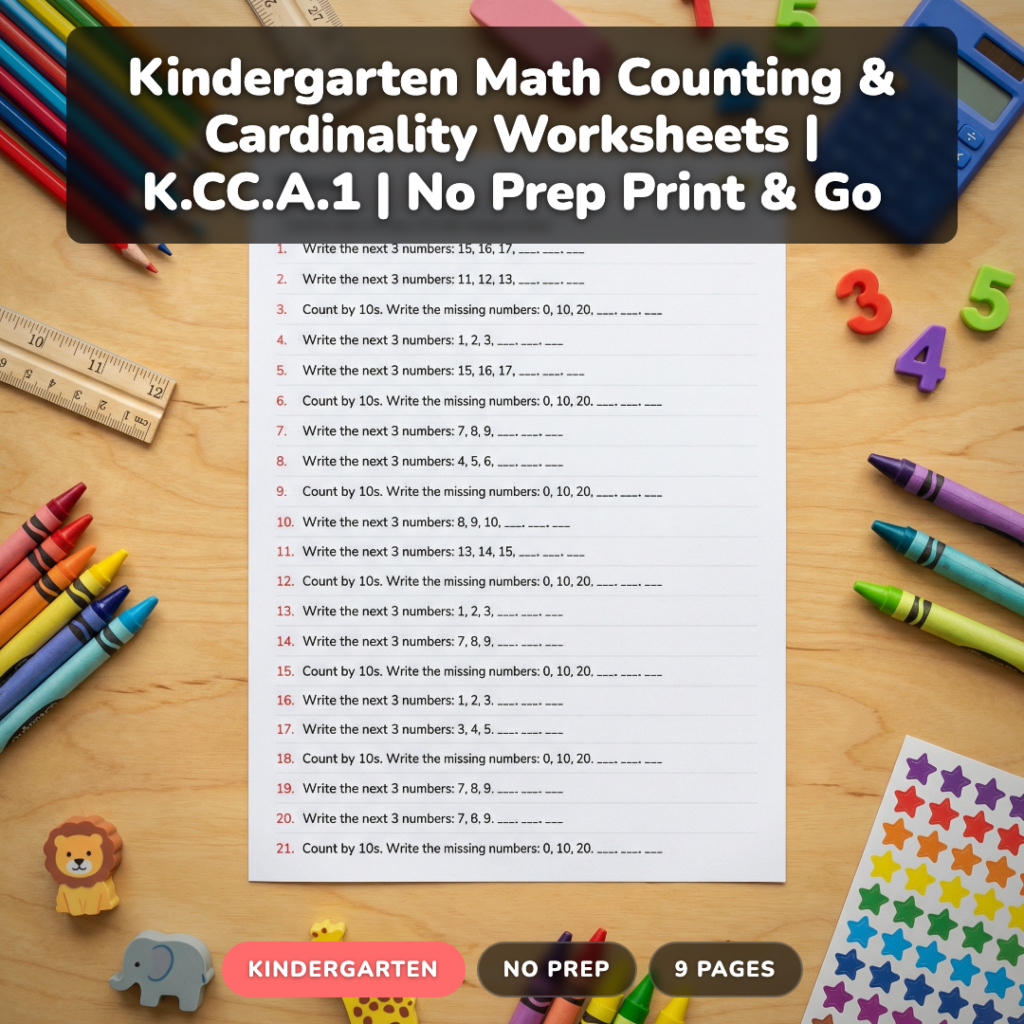
This counting and cardinality worksheet collection includes 79 problems across three difficulty levels. The practice level focuses on counting to 50 and building foundational skills, the on-level worksheets cover the full CCSS.Math.Content.K.CC.A.1 standard with counting to 100 by ones and tens, and the challenge level extends learning with skip counting and number patterns.
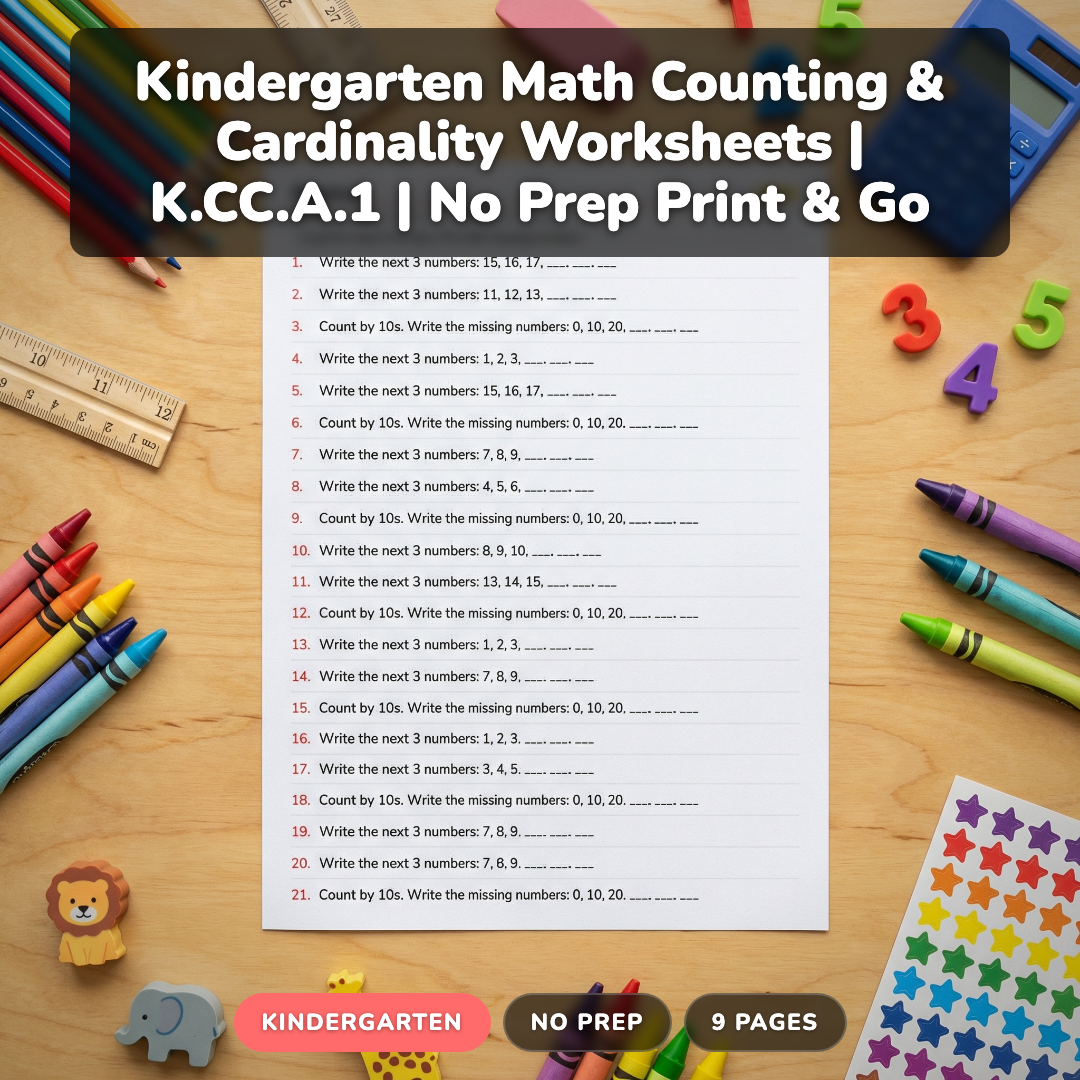
Each worksheet includes visual supports like hundreds charts and ten-frames, plus clear answer keys for quick checking. The problems progress from concrete (counting pictures) to abstract (filling in number sequences), giving students multiple ways to demonstrate their understanding.
You can grab the complete set here and start using it tomorrow—no prep required.
Grab a Free Counting Practice Sheet to Try
Want to see how differentiated counting practice works in your classroom? I’ll send you a free sample worksheet with problems at all three levels, plus a mini hundreds chart for student reference.
Frequently Asked Questions About Teaching Counting & Cardinality
When should kindergarteners master counting to 100?
Most kindergarteners should count to 100 by ones and by tens by mid-year (January-February). However, students develop at different rates—some may master this skill earlier, while others need until spring. Focus on solid understanding rather than speed.
What’s the difference between rote counting and cardinality?
Rote counting is reciting number names in order, while cardinality means understanding that the last number counted represents the total quantity. Students might count “1, 2, 3, 4, 5” but not realize there are 5 objects total without recounting.
Should I teach counting by ones or tens first?
Start with counting by ones to build the foundation, then introduce counting by tens around mid-year. Students need to understand the sequence of number names before they can understand the patterns in skip counting by tens.
How do I help students who skip numbers when counting?
Use visual supports like hundreds charts or number lines so students can see the sequence. Practice problem numbers (like decade transitions) with physical movement. Have students point to each number as they count to maintain one-to-one correspondence.
What if students can count to 100 but can’t start from other numbers?
This indicates they’ve memorized the sequence starting from 1 but don’t understand number relationships. Practice counting from various starting points (“Count from 23 to 35”) using hundreds charts for visual support until they internalize the patterns.
Teaching counting to 100 takes patience and lots of practice, but these strategies will help your kindergarteners build the strong number sense they need for future math success. Remember to celebrate progress—every student who masters this foundational skill is setting themselves up for years of mathematical confidence.
What’s your favorite way to make counting practice engaging? Drop your email above to grab that free counting sheet, and let me know what works best in your classroom!