If your kindergarten students are counting “1, 2, 3, 6, 8” or pointing to the same object twice while counting, you’re not alone. One-to-one correspondence is one of the trickiest foundational math skills to master, but it’s absolutely essential for everything that comes next in mathematics.
This post will walk you through five research-backed strategies that help kindergarteners develop solid counting skills, plus differentiation tips for every learner in your classroom.
Key Takeaway
One-to-one correspondence develops through repeated practice with physical objects, clear modeling, and systematic progression from small to larger quantities.
Why Counting & Cardinality Matters in Kindergarten
Counting and cardinality form the foundation for all future math learning. When students master CCSS.Math.Content.K.CC.B.4a — pairing each object with one and only one number name — they’re building number sense that will support addition, subtraction, and place value concepts in first grade and beyond.
Research from the National Research Council shows that students who struggle with one-to-one correspondence in kindergarten are 3.2 times more likely to have math difficulties in third grade. This skill typically develops between ages 4-6, making kindergarten the critical window for intervention and support.
The Common Core standard CCSS.Math.Content.K.CC.B.4a specifically focuses on the coordination between saying number names in order and pointing to objects systematically. This requires students to manage three complex processes simultaneously: recalling the counting sequence, coordinating physical movement, and tracking which objects have been counted.
Looking for a ready-to-go resource? I put together a differentiated counting & cardinality pack that covers everything below — but first, the teaching strategies that make it work.
Common Counting & Cardinality Misconceptions in Kindergarten
Common Misconception: Students count the same object multiple times or skip objects entirely.
Why it happens: They haven’t developed the motor control to coordinate pointing with counting, or they’re focused on speed rather than accuracy.
Quick fix: Use a “touch and move” strategy where students physically move each object as they count it.
Common Misconception: Students think faster counting means better counting.
Why it happens: They’ve seen older students or adults count quickly and assume speed equals skill.
Quick fix: Model slow, deliberate counting and praise accuracy over speed: “I love how carefully you touched each bear!”
Common Misconception: Students believe the last number they say tells them which object they’re pointing to, not how many total objects there are.
Why it happens: They haven’t yet developed cardinality — understanding that the final count represents the total quantity.
Quick fix: After counting, sweep your hand over all objects and repeat the final number: “1, 2, 3, 4, 5. Five bears altogether!”
Common Misconception: Students restart counting from 1 when they lose track, rather than continuing from where they left off.
Why it happens: They don’t yet understand that counting is cumulative and that each number represents all the objects counted so far.
Quick fix: Use different colored objects or arrange items in a line to make tracking easier.
5 Research-Backed Strategies for Teaching Counting & Cardinality
Strategy 1: Touch and Move Method
This kinesthetic approach helps students develop the physical coordination needed for accurate one-to-one correspondence. Students physically move each object as they count it, creating a clear separation between counted and uncounted items.
What you need:
- Small manipulatives (bears, blocks, buttons)
- Two containers or spaces (“not counted” and “counted”)
- Number cards 1-10
Steps:
- Place 5-8 objects in the “not counted” space
- Model touching each object while saying the number, then moving it to “counted”
- Have students practice with 3-4 objects first
- Gradually increase quantity as they master smaller amounts
- End by having them state the total: “I counted 6 bears”
Strategy 2: Counting Mat Pathways
Visual pathways help students organize their counting and prevent double-counting or skipping objects. This strategy works especially well for students who are visual learners or need extra structure.
What you need:
- Laminated counting mats with numbered circles or boxes
- Small objects that fit in each space
- Dry erase markers for tracing paths
Steps:
- Give each student a mat with 5-10 numbered spaces arranged in a path
- Demonstrate placing one object in each space while counting
- Have students trace the path with their finger while counting empty spaces first
- Then place objects and count again, touching each space
- Practice with different arrangements (line, circle, scattered pattern)
Strategy 3: Counting Collections with Sorting
This strategy combines counting practice with classification skills, helping students organize objects before counting them. It’s particularly effective for developing both mathematical thinking and counting accuracy.
What you need:
- Mixed collections of small objects (different colored bears, shapes, buttons)
- Sorting trays or paper plates
- Recording sheets with pictures and numbers
Steps:
- Give students a mixed collection of 8-12 objects
- Have them sort objects by one attribute (color, shape, size)
- Count each sorted group using touch-and-move method
- Record the count for each group on their sheet
- Count the total collection to check their work
Strategy 4: Interactive Counting Games
Games make counting practice engaging while providing multiple opportunities to practice one-to-one correspondence in a low-pressure environment. Partner games also allow for peer modeling and support.
What you need:
- Dice (dot dice and numeral dice)
- Small counting objects or game pieces
- Game boards with spaces or simple counting mats
Steps:
- Students take turns rolling a die and counting out that many objects
- Partner watches and helps check for accurate counting
- Place objects on game board spaces or counting mat
- After each turn, count all objects together to find the total
- Play until reaching a target number (like 20) or filling the board
Strategy 5: Daily Counting Routines with Real Objects
Embedding counting practice into daily classroom routines helps students see the purpose of counting while getting consistent practice. This strategy connects math to real-world applications students understand.
What you need:
- Classroom supplies (pencils, books, snacks)
- Student helpers chart
- Counting recording sheet or whiteboard
Steps:
- Choose a daily task that requires counting (distributing supplies, taking attendance, snack time)
- Assign student helpers to do the counting using proper one-to-one correspondence
- Have the class count along and verify the helper’s count
- Record the daily count on a class chart or graph
- Compare counts across days and discuss patterns
How to Differentiate Counting & Cardinality for All Learners
For Students Who Need Extra Support
Start with quantities of 1-5 and use larger, distinct objects that are easy to manipulate. Provide hand-over-hand guidance initially, then fade to verbal prompts. Use consistent language: “Touch and count. Move and say.” Create visual supports like number lines at eye level and use songs or chants to reinforce counting sequences. Consider using objects with different textures or colors to help students track their counting progress.
For On-Level Students
Practice with quantities up to 10 regularly, using a variety of objects and arrangements. Encourage independence while providing feedback on accuracy. Introduce counting in different formations (lines, circles, scattered) and begin connecting counting to written numerals. Students at this level should master CCSS.Math.Content.K.CC.B.4a with consistent accuracy and begin developing fluency with counting sequences.
For Students Ready for a Challenge
Extend counting to quantities up to 20, introduce skip counting by 2s and 5s, and connect counting to early addition concepts. Challenge students to count collections quickly and accurately, estimate quantities before counting, or count objects arranged in arrays. Introduce counting backwards from 10 and counting on from numbers other than 1.
A Ready-to-Use Counting & Cardinality Resource for Your Classroom
Teaching one-to-one correspondence effectively requires lots of varied practice, which means lots of prep time creating different worksheets and activities. That’s where a comprehensive resource can save you hours while ensuring your students get the differentiated practice they need.
This counting and cardinality pack includes 79 carefully designed problems across three difficulty levels. The practice level focuses on quantities 1-5 with clear visual supports, the on-level section works with quantities up to 10 in various arrangements, and the challenge level extends to quantities up to 15 with more complex layouts.
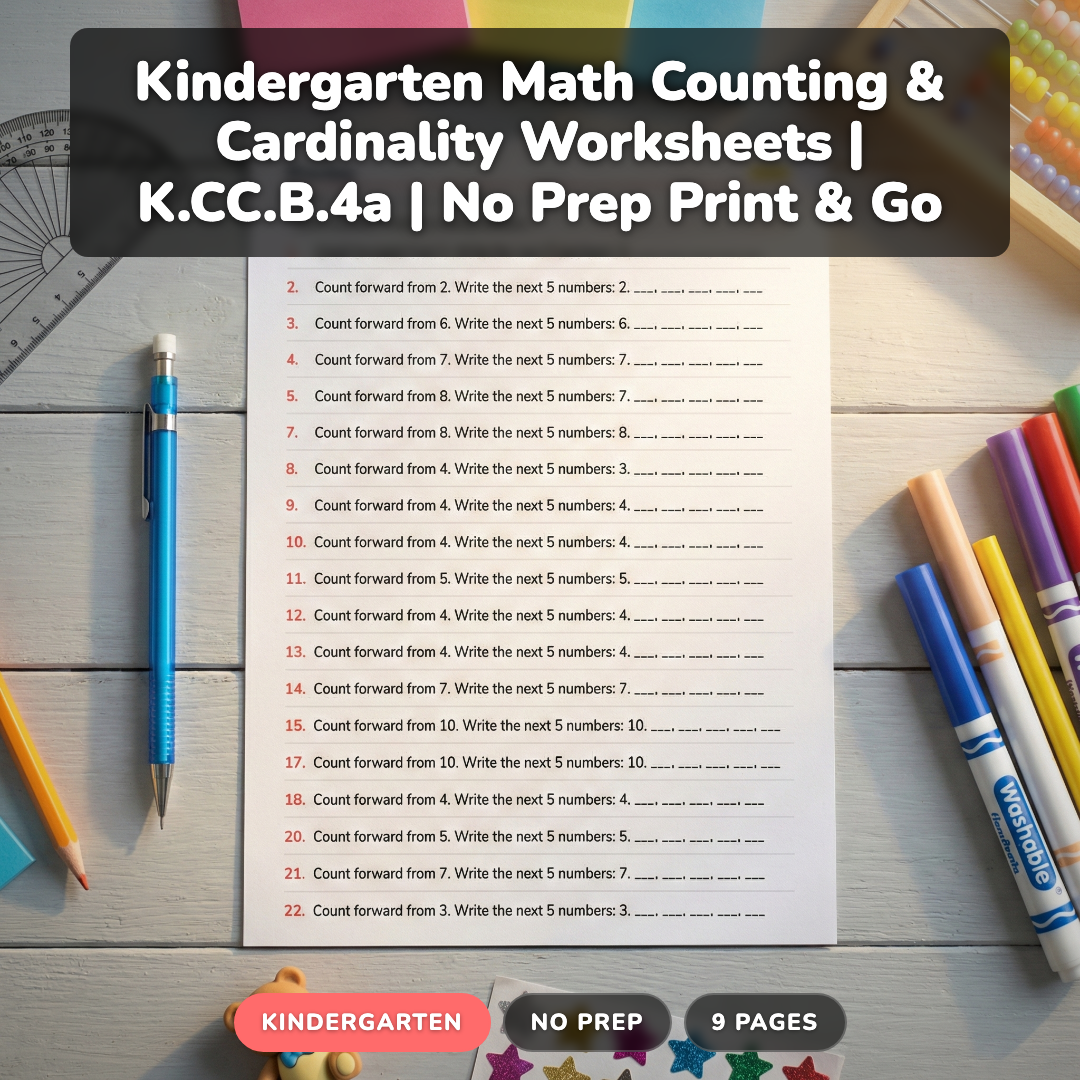
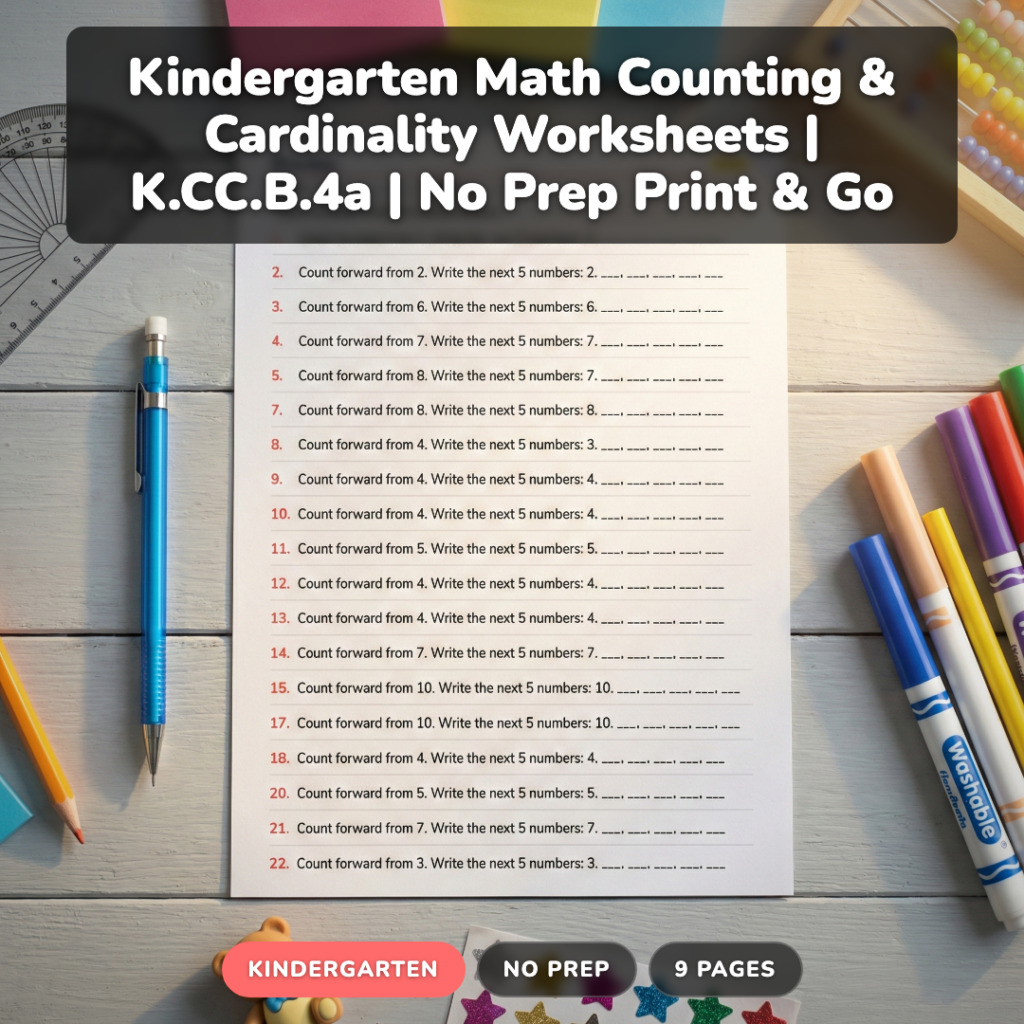
What sets this resource apart is the systematic progression within each level and the variety of object arrangements. Students practice counting objects in lines, groups, scattered patterns, and mixed orientations — exactly the kind of varied practice that builds true mastery of one-to-one correspondence.
The pack includes answer keys for easy checking and can be used for independent practice, small group work, or homework. Each page is designed to print clearly and requires no additional prep — just print and go.
Grab a Free Counting Practice Sheet to Try
Want to see the quality and format before you buy? I’ll send you a free sample counting worksheet that includes all three difficulty levels so you can try it with your students right away.
Frequently Asked Questions About Teaching Counting & Cardinality
What age should children master one-to-one correspondence?
Most children develop reliable one-to-one correspondence between ages 4-6, with kindergarten being the typical mastery year. However, some children may need additional support into first grade, especially for larger quantities beyond 10.
How do I help students who count too fast?
Model slow, deliberate counting and use the “touch and move” method where students physically move each object as they count. Praise careful counting over speed: “I love how you made sure to touch each one!”
Should I correct students immediately when they miscount?
Allow them to finish counting, then say “Let’s count together to check.” Model the correct method without making them feel wrong. Focus on the process rather than just the final answer.
How many objects should kindergarteners be able to count accurately?
By the end of kindergarten, students should accurately count collections of 10-15 objects using one-to-one correspondence. Start with smaller quantities (3-5) and gradually increase as students show mastery.
What’s the difference between counting and cardinality?
Counting is saying number names in order while pointing to objects. Cardinality is understanding that the last number counted tells you how many objects there are total. Both skills develop together through practice.
Mastering counting and cardinality takes time and lots of practice, but these strategies will help your kindergarteners build the strong foundation they need for future math success. Remember to keep practice sessions short, celebrate progress, and provide plenty of hands-on experiences with real objects.
What’s your favorite way to practice counting with your kindergarteners? Try out that free sample worksheet and let me know how it goes with your students!