If your 5th graders freeze when they see problems like 4 ÷ 1/3, you’re not alone. Division of whole numbers by unit fractions is one of those concepts that looks simple on paper but creates genuine confusion in young minds. You’ll walk away from this post with five research-backed strategies that make this skill click, plus differentiation tips for every learner in your classroom.
Key Takeaway
Teaching fraction division becomes clear when students understand they’re finding “how many groups” rather than “sharing equally.”
Why This Fraction Skill Matters in 5th Grade
Division of whole numbers by unit fractions addresses CCSS.Math.Content.5.NF.B.7b, which requires students to interpret and compute quotients when dividing whole numbers by unit fractions like 1/2, 1/3, or 1/4. This standard typically appears in late fall or early winter, after students have mastered basic fraction concepts and equivalent fractions.
Research from the National Mathematics Advisory Panel shows that students who master fraction division in elementary school perform significantly better in algebra. The key insight? This isn’t really about fractions—it’s about understanding multiplication and division relationships. When students grasp that 4 ÷ 1/3 asks “how many thirds are in 4 whole things,” they’re building foundational reasoning for rational number operations.
This skill connects directly to real-world problem solving: How many 1/4-cup servings can you make from 3 cups of juice? How many 1/2-hour sessions fit into a 6-hour day? These contextual applications make the abstract mathematics meaningful.
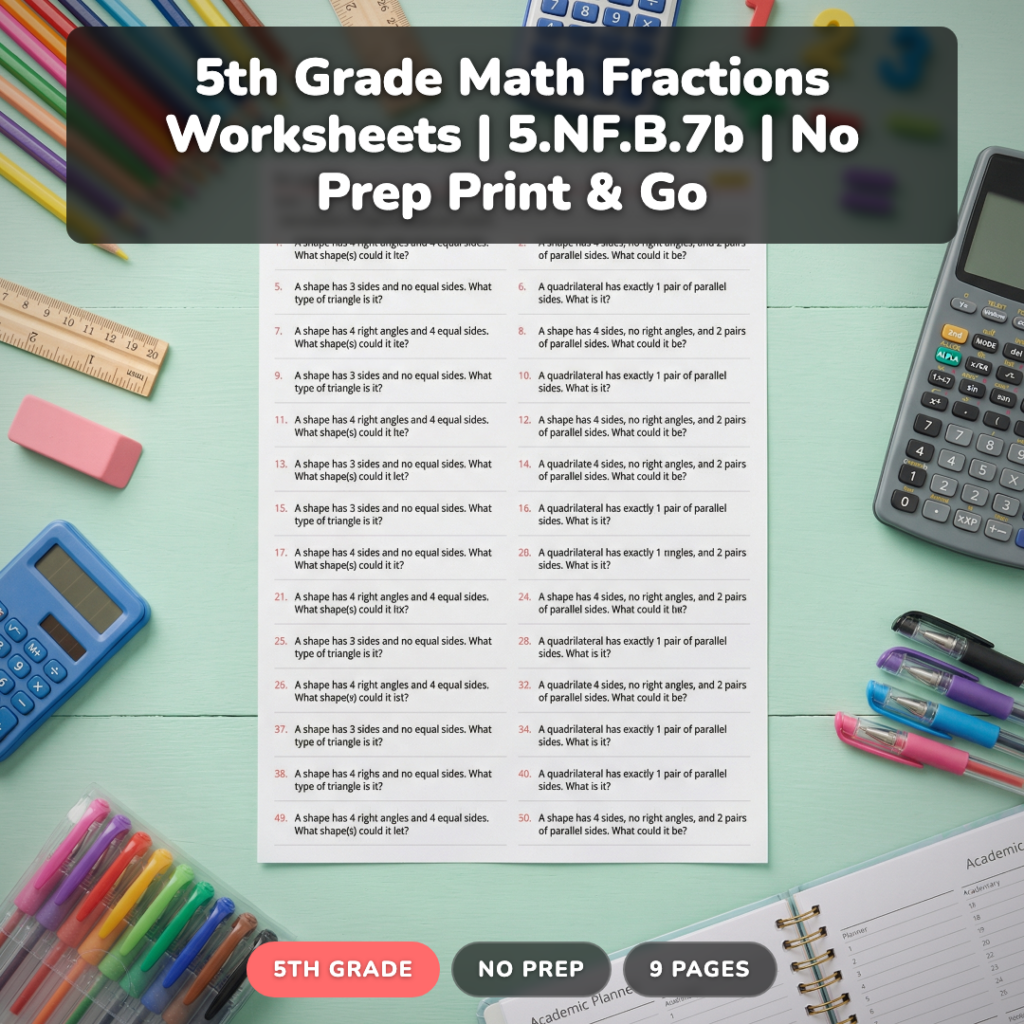
Looking for a ready-to-go resource? I put together a differentiated fraction division pack with 132 problems across three levels — but first, the teaching strategies that make it work.
Common Fraction Division Misconceptions in 5th Grade
Common Misconception: Students think 4 ÷ 1/3 = 4/3 (just putting the numbers together).
Why it happens: They apply whole number division rules without understanding what division by a fraction means.
Quick fix: Always start with concrete models before moving to algorithms.
Common Misconception: Students believe the answer should be smaller than the dividend (4 ÷ 1/3 should be less than 4).
Why it happens: Their experience with whole number division creates the expectation that division makes numbers smaller.
Quick fix: Use the “how many groups” language consistently and connect to multiplication facts they know.
Common Misconception: Students confuse “dividing by 1/3” with “dividing by 3.”
Why it happens: They focus on the denominator and ignore the fraction bar.
Quick fix: Emphasize that 1/3 means “one third of a whole,” not just “three.”
Common Misconception: Students think they need to find a common denominator before dividing.
Why it happens: They overgeneralize from fraction addition and subtraction procedures.
Quick fix: Show that division asks a different question than addition or subtraction.
5 Research-Backed Strategies for Teaching Fraction Division
Strategy 1: Rectangle Area Models with Visual Grouping
This concrete approach helps students visualize exactly what division by a unit fraction means. Students draw rectangles to represent the whole number, then partition them to see how many unit fraction pieces fit inside.
What you need:
- Grid paper or rectangle templates
- Colored pencils or crayons
- Document camera for modeling
Steps:
- Draw 4 rectangles to represent the problem 4 ÷ 1/3
- Divide each rectangle into 3 equal parts (since we’re dividing by thirds)
- Color or circle each 1/3 section
- Count the total number of 1/3 pieces across all rectangles
- Connect to the equation: 4 ÷ 1/3 = 12
Strategy 2: Number Line Jumps and Grouping
Number lines make the “how many groups” question crystal clear. Students mark unit fractions on a number line and count how many jumps it takes to reach the whole number.
What you need:
- Large number line (0-5) on chart paper
- Sticky notes or removable markers
- Individual number line worksheets
Steps:
- Mark 0 and the whole number (like 3) on the number line
- Starting at 0, make jumps of the unit fraction size (1/4 for 3 ÷ 1/4)
- Mark each jump with a sticky note
- Count the total number of jumps to reach 3
- Record the equation: 3 ÷ 1/4 = 12 jumps
Strategy 3: Manipulative Division with Fraction Strips
Physical fraction strips let students literally handle the division process. This kinesthetic approach works especially well for students who need to touch and move objects to understand mathematical relationships.
What you need:
- Fraction strip sets (or paper strips to cut)
- Whole number strips (representing 1 whole each)
- Recording sheets
Steps:
- Lay out the number of whole strips equal to your dividend (5 strips for 5 ÷ 1/2)
- Take unit fraction strips of the divisor size (1/2 strips)
- Place unit fraction strips on top of whole strips to see how many fit
- Count the total number of unit fraction pieces needed
- Record: “5 wholes contain ___ half-pieces”
Strategy 4: Real-World Story Problem Connections
Contextual problems help students understand why we divide whole numbers by unit fractions. The key is using situations where students naturally think “how many groups” rather than “sharing equally.”
What you need:
- Story problem cards with various contexts
- Manipulatives that match the stories (measuring cups, ribbon pieces, etc.)
- Problem-solving graphic organizers
Steps:
- Present a story: “Maya has 6 cups of flour. Each recipe needs 1/3 cup. How many recipes can she make?”
- Have students identify what they’re looking for (number of groups/recipes)
- Model with manipulatives first, then draw pictures
- Write the division equation that matches the story
- Check the answer against the story context
Strategy 5: Multiplication Connection and Fact Family Triangles
Since division and multiplication are inverse operations, students can use known multiplication facts to understand fraction division. This strategy builds on their existing number sense.
What you need:
- Fact family triangle cards
- Multiplication/division relationship posters
- Individual whiteboards for quick checks
Steps:
- Start with a known fact: 12 × 1/3 = 4
- Show the inverse relationship: 4 ÷ 1/3 = 12
- Create fact family triangles with the three numbers (4, 1/3, 12)
- Practice switching between multiplication and division statements
- Apply to new problems using the same reasoning
How to Differentiate Fraction Division for All Learners
For Students Who Need Extra Support
Start with halves and fourths exclusively—these unit fractions connect to students’ prior knowledge of fair sharing. Use whole numbers 2-6 as dividends to keep calculations manageable. Provide sentence frames like “___ wholes contain ___ fourth-pieces” to support mathematical language. Always begin with concrete manipulatives before moving to pictorial representations. Consider reviewing prerequisite skills like identifying unit fractions and understanding “equal groups” versus “equal shares” in division contexts.
For On-Level Students
Students working at grade level should master CCSS.Math.Content.5.NF.B.7b with unit fractions through 1/8, using whole number dividends up to 12. They should move fluidly between concrete models, pictures, and abstract equations. Expect them to solve contextual problems and explain their reasoning using mathematical vocabulary. These students benefit from comparing multiple solution strategies and discussing which approach works best for different types of problems.
For Students Ready for a Challenge
Advanced learners can explore division with unit fractions beyond 1/8, investigate patterns in fraction division (why does dividing by 1/n give the same result as multiplying by n?), and solve multi-step problems involving fraction division. Challenge them to create their own story problems and teach the concept to younger students. They can also begin exploring division of fractions by fractions, setting the foundation for 6th grade standards.
A Ready-to-Use Fraction Division Resource for Your Classroom
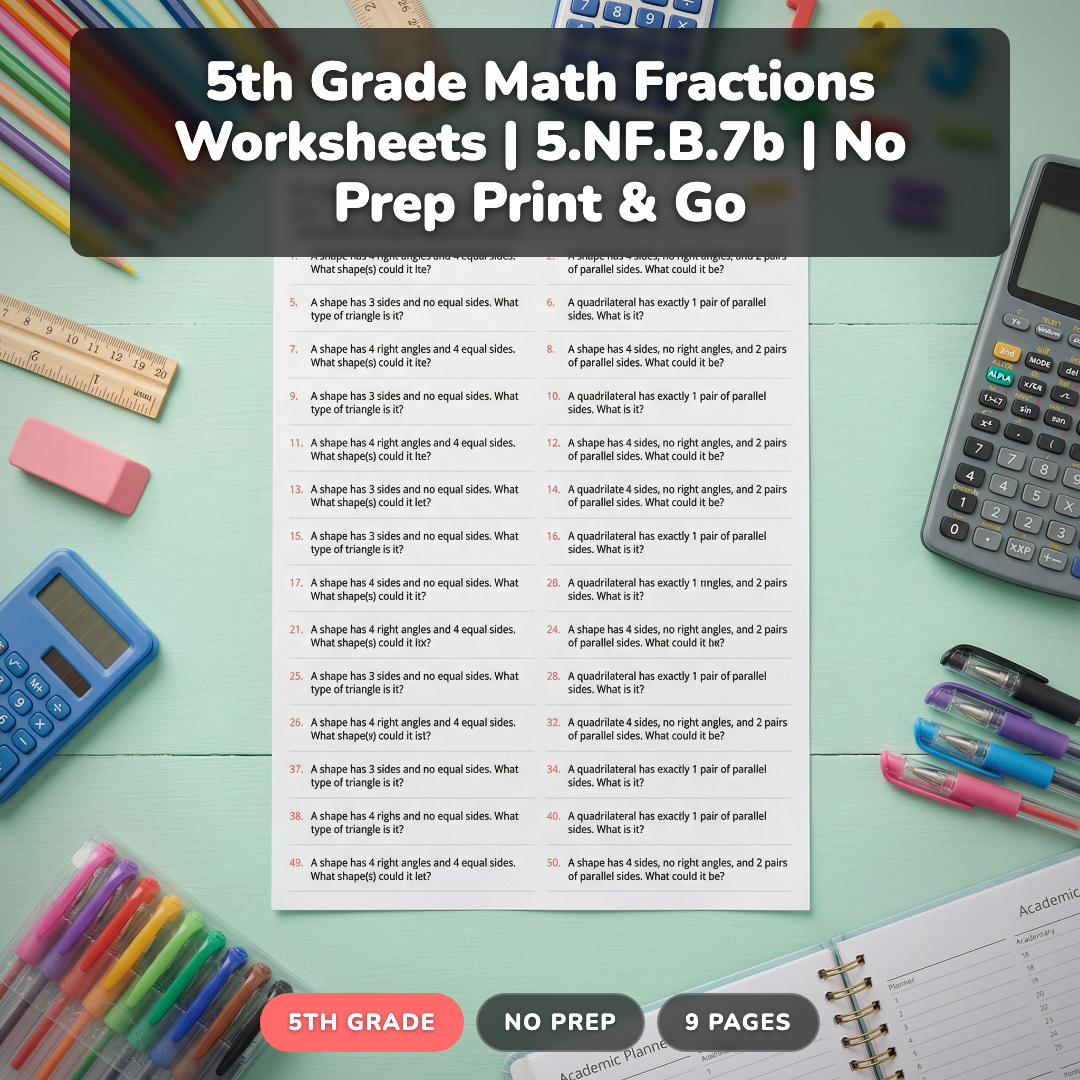
After using these strategies with hundreds of 5th graders, I created a comprehensive fraction division practice pack that saves you hours of prep time. This resource includes 132 carefully crafted problems across three differentiation levels—37 practice problems for students who need extra support, 50 on-level problems for grade-level expectations, and 45 challenge problems for advanced learners.
What makes this resource different? Each problem set uses the visual models and contexts described in the strategies above. The practice level focuses on halves and fourths with smaller whole numbers. The on-level section covers all unit fractions through eighths with realistic story problems. The challenge level pushes students to explain their reasoning and make connections between different solution methods.
The 9-page resource includes complete answer keys and can be used for independent practice, math centers, homework, or assessment. Everything is print-and-go—no prep required.
You can grab this time-saving resource and start using it tomorrow.
Grab a Free Fraction Division Sample to Try
Want to see how these strategies work in practice? I’ll send you a free sample worksheet that includes problems from each differentiation level, plus a quick reference guide for the teaching strategies. Drop your email below and I’ll send it right over.
Frequently Asked Questions About Teaching Fraction Division
When should I introduce division of whole numbers by unit fractions in 5th grade?
Most curricula introduce this concept in late fall or early winter, after students have mastered equivalent fractions and basic fraction operations. Students need solid understanding of what unit fractions represent before tackling division problems involving them.
Why do students struggle more with 6 ÷ 1/2 than with 6 ÷ 2?
Students expect division to make numbers smaller based on whole number experience. When 6 ÷ 1/2 = 12, it violates their intuition. Using “how many groups” language instead of “sharing” helps students understand why the answer is larger than the dividend.
Should I teach the “multiply by the reciprocal” algorithm in 5th grade?
CCSS.Math.Content.5.NF.B.7b emphasizes interpretation and understanding rather than algorithms. Focus on conceptual understanding through models and reasoning. The formal algorithm comes in 6th grade when students have stronger fraction sense.
How do I help students who confuse fraction division with fraction multiplication?
Use different language for each operation. Multiplication asks “what is a part of a whole” while division asks “how many groups fit.” Provide plenty of contextual problems where students must decide which operation matches the situation before solving.
What’s the biggest mistake teachers make when introducing this concept?
Jumping to abstract procedures too quickly. Students need extensive experience with concrete models and visual representations before they can understand why division by a unit fraction works the way it does. Spend more time on the conceptual foundation.
Teaching fraction division doesn’t have to feel overwhelming when you have the right strategies and resources. Focus on helping students understand what division by a unit fraction means, and the computational skills will follow naturally.
What’s your biggest challenge when teaching fraction division? Try the free sample worksheet and let me know how these strategies work in your classroom!