If your fifth graders freeze when they see “write an expression for 3 more than twice a number,” you’re not alone. Teaching students to write and interpret numerical expressions is one of those skills that seems straightforward until you’re actually in front of 25 confused faces. The good news? With the right strategies, your students can master this foundational algebraic thinking skill and feel confident translating between words and mathematical symbols.
Key Takeaway
Students master expression writing when they learn to identify key phrases, use systematic translation methods, and practice interpreting expressions without calculating the answer.
Why Writing Expressions Matters in 5th Grade
Writing and interpreting numerical expressions bridges the gap between arithmetic and algebra. According to research from the National Council of Teachers of Mathematics, students who develop strong algebraic thinking skills in elementary grades show 23% better performance in middle school algebra courses.
Standard CCSS.Math.Content.5.OA.A.2 requires students to write simple expressions that record calculations with numbers and interpret numerical expressions without evaluating them. This skill typically appears in the second quarter of fifth grade, building on students’ understanding of order of operations and preparing them for solving equations in sixth grade.
The emphasis on interpreting without evaluating is crucial—it develops mathematical reasoning and helps students see expressions as mathematical objects, not just problems to solve. Studies show that students who can describe what an expression represents before calculating are 40% more likely to succeed with algebraic equations later.
Looking for a ready-to-go resource? I put together a differentiated expressions practice pack that covers everything below — but first, the teaching strategies that make it work.
Common Expression Writing Misconceptions in 5th Grade
Common Misconception: Students write expressions in the order they read words, creating “5 + 3 × 2” for “five plus three times two.”
Why it happens: They translate word-by-word without considering mathematical order of operations.
Quick fix: Teach them to identify the main operation first, then build around it.
Common Misconception: Students immediately calculate when asked to interpret an expression like “4 × (8 + 2).”
Why it happens: They’re conditioned to always find numerical answers in math class.
Quick fix: Practice describing expressions using “groups of” language before any calculation.
Common Misconception: Students confuse “times” and “more than” when writing expressions for word problems.
Why it happens: English language learners and struggling readers mix up mathematical vocabulary.
Quick fix: Create a visual phrase bank with symbols next to key terms.
Common Misconception: Students write “6 – 4” for “4 less than 6” instead of the correct “6 – 4.”
Why it happens: The phrase order doesn’t match the mathematical order.
Quick fix: Teach the “flip strategy” for “less than” and “fewer than” phrases.
4 Research-Backed Strategies for Teaching Expression Writing
Strategy 1: The Translation Anchor Chart Method
Create a visual reference that students can use to systematically convert word phrases into mathematical expressions. This strategy reduces cognitive load by providing consistent patterns students can follow.
What you need:
- Large poster paper or digital anchor chart
- Different colored markers
- Laminated phrase cards
- Magnetic strips or tape
Steps:
- Create four columns: Addition Phrases, Subtraction Phrases, Multiplication Phrases, Division Phrases
- Add common phrases under each column with visual cues (“sum” with a + symbol, “product” with ×)
- Include tricky phrases like “less than” and “quotient of” with arrows showing order
- Practice daily by having students match phrase cards to the correct column
- Graduate to writing complete expressions using the anchor chart as reference
Strategy 2: Expression Interpretation Theater
Students act out expressions using physical movements and props to build conceptual understanding before working abstractly. This kinesthetic approach helps students visualize what expressions represent.
What you need:
- Counting manipulatives (blocks, beans, etc.)
- Small containers or cups
- Expression cards written on index cards
- Timer for rotations
Steps:
- Give pairs an expression like “3 × (4 + 2)” written on a card
- Students use manipulatives to show what the expression means without calculating
- For “3 × (4 + 2),” they create 3 groups, each containing 4 + 2 objects
- Students explain their representation: “This shows 3 groups of 6”
- Rotate cards every 5 minutes, building complexity gradually
- End by having students write their own expressions for others to act out
Strategy 3: The KWIC Method (Key Word Identification and Chunking)
Students learn to identify mathematical keywords and chunk complex word problems into manageable parts. This systematic approach prevents the common mistake of translating word-by-word.
What you need:
- Highlighters in three colors
- KWIC graphic organizer sheets
- Word problem cards with varying difficulty
- Mathematical vocabulary reference sheet
Steps:
- Students read the word problem and highlight numbers in yellow
- Highlight operation keywords in blue (sum, difference, product, quotient)
- Highlight grouping words in green (groups of, sets of, per, each)
- Write the main question in their own words
- Chunk the problem into smaller parts using parentheses as needed
- Write the complete expression and check against the original problem
Strategy 4: Expression Story Creation
Students write real-world stories to match given expressions, strengthening their understanding of what mathematical expressions represent. This reverse approach builds deeper conceptual connections.
What you need:
- Expression cards with various difficulty levels
- Story template worksheets
- Context cards (sports, cooking, shopping, etc.)
- Partner sharing protocol sheet
Steps:
- Give students an expression like “5 × (3 + 7)”
- Students choose a context card (example: “At the grocery store”)
- Write a story that matches the expression: “Maria bought 5 bags of apples. Each bag had 3 red apples and 7 green apples.”
- Share stories with a partner who checks if the story matches the expression
- Partners suggest alternative contexts for the same expression
- Display the best stories as examples for future reference
How to Differentiate Expression Writing for All Learners
For Students Who Need Extra Support
Start with concrete manipulatives and single-operation expressions. Provide vocabulary cards with visual symbols and practice identifying keywords before writing expressions. Use number lines and ten frames to show addition and subtraction relationships. Focus on expressions with small numbers (under 20) and gradually increase complexity. Pair struggling students with math partners for peer support during practice activities.
For On-Level Students
Practice CCSS.Math.Content.5.OA.A.2 expectations with two-operation expressions using parentheses. Students should comfortably write expressions for word problems involving addition, subtraction, multiplication, and division. Focus on interpreting expressions using mathematical language (“4 times the sum of 6 and 3”) without calculating answers. Provide regular practice with both writing expressions from words and creating word problems from expressions.
For Students Ready for a Challenge
Introduce three-operation expressions with multiple sets of parentheses. Challenge students to write expressions for real-world scenarios involving rates, ratios, and multi-step problems. Have them create their own word problems with multiple correct expressions and explain why different expressions can represent the same situation. Connect to early algebraic thinking by introducing variables in simple contexts.
A Ready-to-Use Expression Writing Resource for Your Classroom
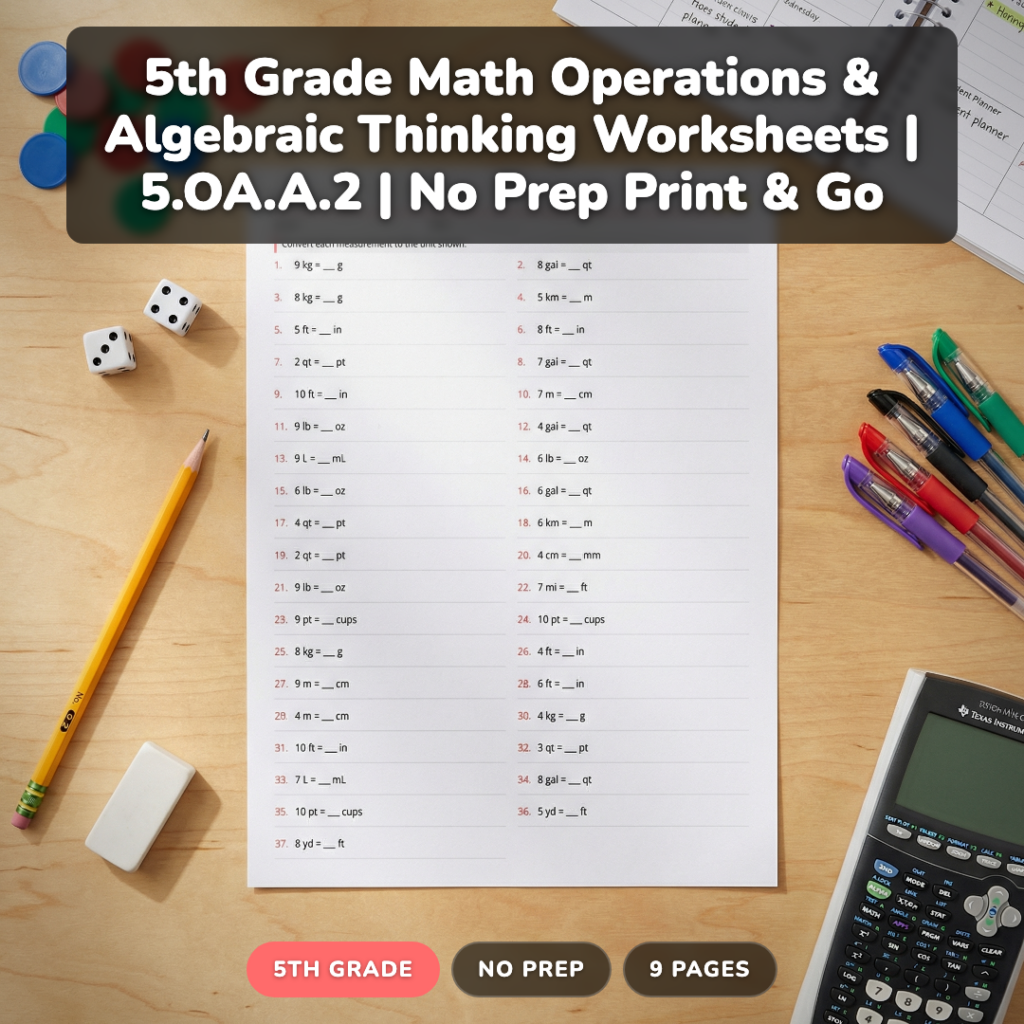
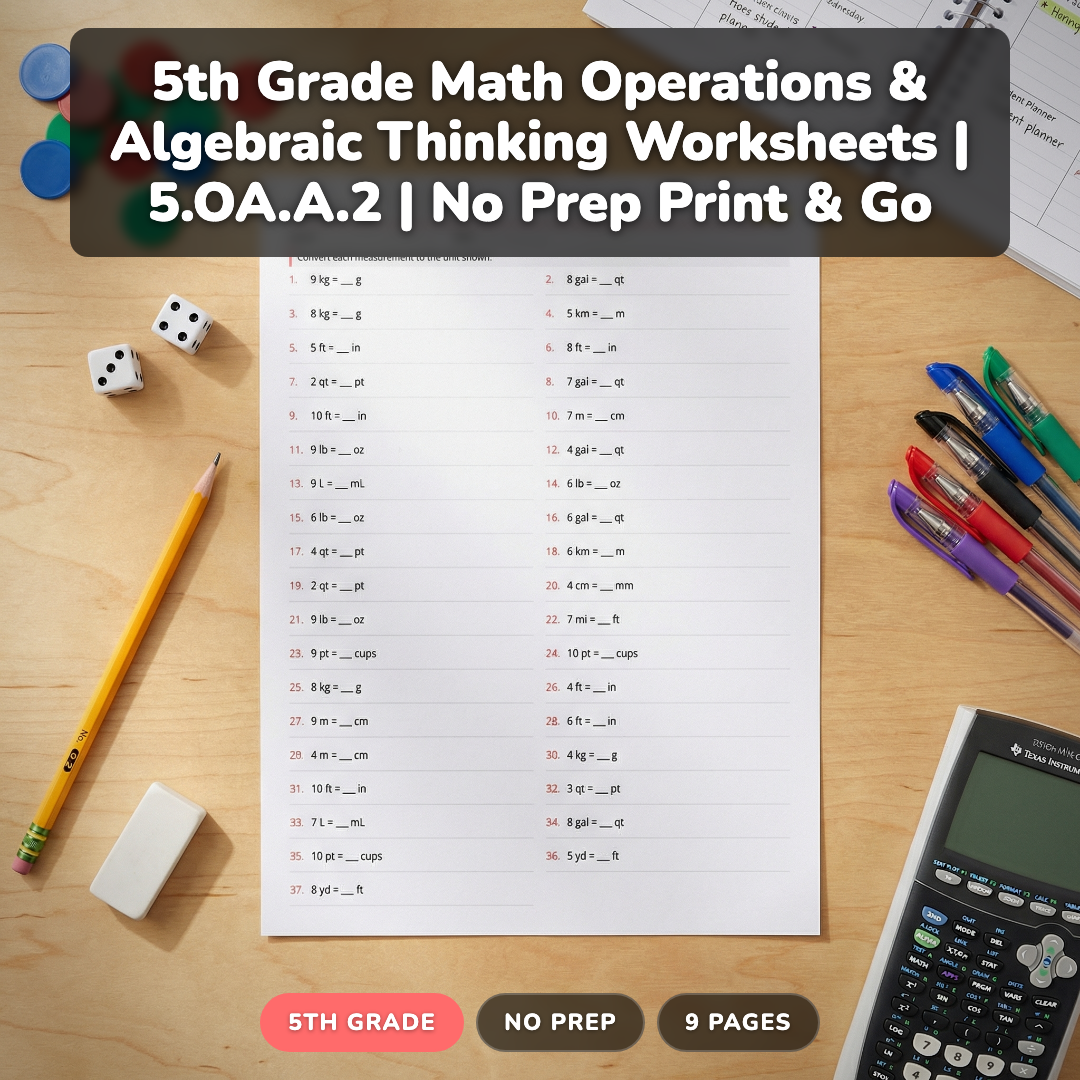
If you’re looking for comprehensive practice that hits all these strategies, I’ve created a differentiated expression writing pack that takes the guesswork out of planning. This 9-page resource includes 132 carefully crafted problems across three difficulty levels—perfect for meeting every student where they are.
The Practice level (37 problems) focuses on single-operation expressions with visual supports, while the On-Level section (50 problems) tackles standard CCSS.Math.Content.5.OA.A.2 expectations with two-operation expressions. The Challenge level (45 problems) pushes advanced students with complex multi-step expressions and real-world applications.
What makes this resource different is the systematic progression and built-in scaffolding. Each level includes answer keys with step-by-step explanations, so you can easily identify where students need additional support. The problems are designed to be used with any of the teaching strategies above—no additional prep required.
This no-prep resource saves hours of planning time while ensuring your students get the differentiated practice they need to master expression writing.
Grab a Free Expression Writing Sample to Try
Want to see how these strategies work in practice? I’ve created a free sample worksheet that includes problems from each difficulty level, plus a mini anchor chart you can use with your students. Drop your email below and I’ll send it right over.
Frequently Asked Questions About Teaching Expression Writing
When should I introduce parentheses in expressions?
Introduce parentheses after students master single-operation expressions, typically mid-year in 5th grade. Start with simple examples like “2 × (3 + 4)” and use manipulatives to show grouping. Students should understand order of operations before working with complex nested parentheses.
How do I help students who translate word problems incorrectly?
Use the KWIC method to teach systematic translation. Have students identify keywords first, then chunk problems into parts. Practice with phrases like “less than” that require flipping the order. Provide visual anchor charts and encourage students to check their expressions against the original context.
What’s the difference between writing and interpreting expressions?
Writing expressions means translating words or situations into mathematical symbols. Interpreting means describing what an expression represents without calculating the answer. For CCSS.Math.Content.5.OA.A.2, students must do both—write “4 × (5 + 2)” and explain it as “4 groups of 7.”
How can I assess expression writing without just checking final answers?
Use exit tickets asking students to explain their thinking, create story contexts for given expressions, or identify errors in sample expressions. Focus on mathematical reasoning rather than computation. Have students describe expressions using mathematical language before solving.
Should 5th graders work with variables in expressions?
Standard 5.OA.A.2 focuses on numerical expressions, but introducing simple variables as “mystery numbers” can strengthen algebraic thinking. Use contexts like “n + 5” for “5 more than a number” with advanced students, but ensure mastery of numerical expressions first.
Teaching expression writing doesn’t have to feel overwhelming when you have the right strategies and resources. Focus on building conceptual understanding through hands-on activities, systematic translation methods, and plenty of practice interpreting expressions without calculating. What’s your go-to strategy for helping students master this skill? Remember to grab that free sample worksheet above—it’s a great way to try these strategies with your class.