If your 5th graders freeze when they see 3 + (4 × 2) – 1 or argue that 6 + 2 × 3 equals 24, you’re not alone. Teaching order of operations is where many students hit their first real mathematical wall. The good news? With the right strategies, you can help them master CCSS.Math.Content.5.OA.A.1 and build confidence with parentheses, brackets, and braces.
Key Takeaway
Students master order of operations when they understand WHY the rules exist, not just memorize PEMDAS.
Why Order of Operations Matters in 5th Grade
Order of operations represents a critical shift in mathematical thinking. Up until now, your students have mostly worked left-to-right through calculations. Standard CCSS.Math.Content.5.OA.A.1 introduces the concept that mathematics has universal rules that create consistency across all calculations.
This standard typically appears in October or November, after students have solidified their multiplication and division facts. Research from the National Council of Teachers of Mathematics shows that 73% of middle school algebra errors stem from weak order of operations foundations established in elementary school.
The timing matters because students need this skill for multi-step word problems, algebraic thinking, and eventually pre-algebra. When students understand that 2 + 3 × 4 always equals 14 (not 20), they’re building the logical reasoning skills that will serve them through high school mathematics.
Looking for a ready-to-go resource? I put together a differentiated order of operations pack that covers everything below — but first, the teaching strategies that make it work.
Common Order of Operations Misconceptions in 5th Grade
Common Misconception: Students work strictly left to right through every expression.
Why it happens: This matches their reading pattern and previous math experience with single operations.
Quick fix: Use the ‘math has special reading rules’ analogy and practice identifying operation types first.
Common Misconception: Multiplication always comes before division, addition always comes before subtraction.
Why it happens: They memorize PEMDAS as a strict sequence rather than understanding same-level operations work left to right.
Quick fix: Teach ‘Please Excuse My Dear Aunt Sally’ as operation families: MD work together, AS work together.
Common Misconception: Parentheses just mean ‘do this first’ without understanding why.
Why it happens: They follow the rule without connecting to mathematical meaning.
Quick fix: Show how parentheses change answers and relate to real-world grouping situations.
Common Misconception: All grouping symbols (parentheses, brackets, braces) work differently.
Why it happens: The different symbols look like they should have different meanings.
Quick fix: Demonstrate that all grouping symbols work the same way — they just help organize complex expressions.
5 Research-Backed Strategies for Teaching Order of Operations
Strategy 1: The Mathematical Reading Strategy
Start by comparing mathematical expressions to sentences with punctuation. Just like commas and periods tell us how to read sentences, mathematical symbols tell us how to ‘read’ expressions.
What you need:
- Sentence strips with punctuation examples
- Mathematical expressions written large
- Different colored markers
Steps:
- Show the sentence: ‘Let’s eat Grandma’ vs ‘Let’s eat, Grandma’ and discuss how punctuation changes meaning
- Present 2 + 3 × 4 and ask students to calculate it two different ways
- Reveal that math needs ‘punctuation rules’ to avoid confusion
- Color-code operation types: multiplication/division in red, addition/subtraction in blue
- Practice identifying operation families before calculating
Strategy 2: The Grouping Symbol Investigation
Help students discover that parentheses, brackets, and braces all serve the same function through hands-on exploration.
What you need:
- Colored paper circles, squares, and triangles
- Expression cards with different grouping symbols
- Calculator (for verification)
Steps:
- Give students the expression (2 + 3) × 4 using circle cutouts to represent parentheses
- Have them physically group the 2 + 3 inside the circle and solve
- Replace circles with square cutouts for [2 + 3] × 4
- Use triangles for {2 + 3} × 4
- Students discover all three give the same answer: 20
- Explain that different symbols help organize complex expressions with multiple groupings
Strategy 3: The Step-by-Step Annotation Method
Teach students to annotate expressions by numbering the order of operations before calculating, creating a visual roadmap.
What you need:
- Laminated worksheets or whiteboards
- Dry erase markers in different colors
- Order of operations anchor chart
Steps:
- Write the expression 3 + 2 × (8 – 5) ÷ 2
- Students use colored markers to circle grouping symbols first
- Number each operation in order: (8 – 5) gets #1, 2 × gets #2, ÷ 2 gets #3, 3 + gets #4
- Solve step by step, rewriting the expression after each step
- Check work by having another student follow the numbered steps
Strategy 4: Real-World Expression Building
Connect order of operations to authentic situations where the sequence of calculations matters for accurate results.
What you need:
- Shopping scenario cards
- Play money or calculators
- Whiteboard for expression building
Steps:
- Present scenario: ‘Buy 3 packs of gum at $2 each, plus a $5 magazine, with a $3 coupon’
- Students write the expression: (3 × 2) + 5 – 3
- Calculate without parentheses: 3 × 2 + 5 – 3 and compare results
- Discuss why grouping matters for accurate totals
- Create additional scenarios with discounts, taxes, and bulk pricing
Strategy 5: The Expression Race Game
Turn practice into engaging competition while reinforcing correct order of operations through peer checking.
What you need:
- Expression cards at three difficulty levels
- Timer
- Answer key for quick checking
- Small prizes or classroom points
Steps:
- Divide class into teams of 3-4 students
- Each team draws an expression card and has 2 minutes to solve
- Teams must show their step-by-step work and agree on the answer
- Other teams check the work using the annotation method from Strategy 3
- Points awarded for correct answers AND proper order of operations steps
- Rotate through increasingly complex expressions
How to Differentiate Order of Operations for All Learners
For Students Who Need Extra Support
Start with expressions containing only two operations and gradually build complexity. Provide PEMDAS reference cards and encourage students to physically cover completed operations. Use expressions like 4 + 2 × 3 before introducing parentheses. Consider providing partially worked examples where students complete the final steps. Review prerequisite skills like basic multiplication facts if needed.
For On-Level Students
Focus on expressions that meet the CCSS.Math.Content.5.OA.A.1 standard with parentheses, brackets, and braces. Practice with 3-4 operation expressions like 2 × (5 + 3) – 4 ÷ 2. Emphasize checking work by working backwards or using a different method. Include word problems that require students to write and solve their own expressions.
For Students Ready for a Challenge
Introduce nested grouping symbols like 3 × [2 + (4 × 1) – 1] + 5. Have them create expression puzzles for classmates to solve. Connect to algebraic thinking by replacing some numbers with variables. Challenge them to write expressions that equal specific target numbers using given digits and operations.
A Ready-to-Use Order of Operations Resource for Your Classroom
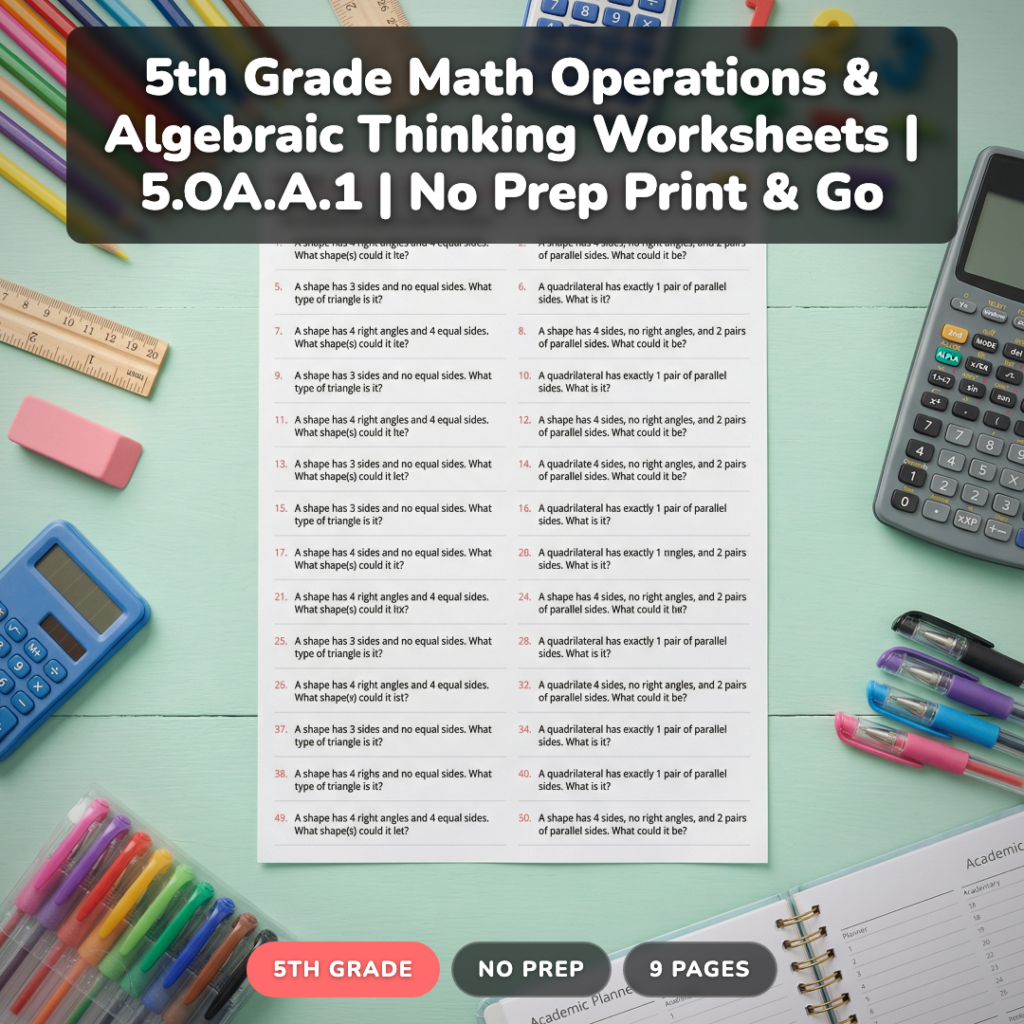
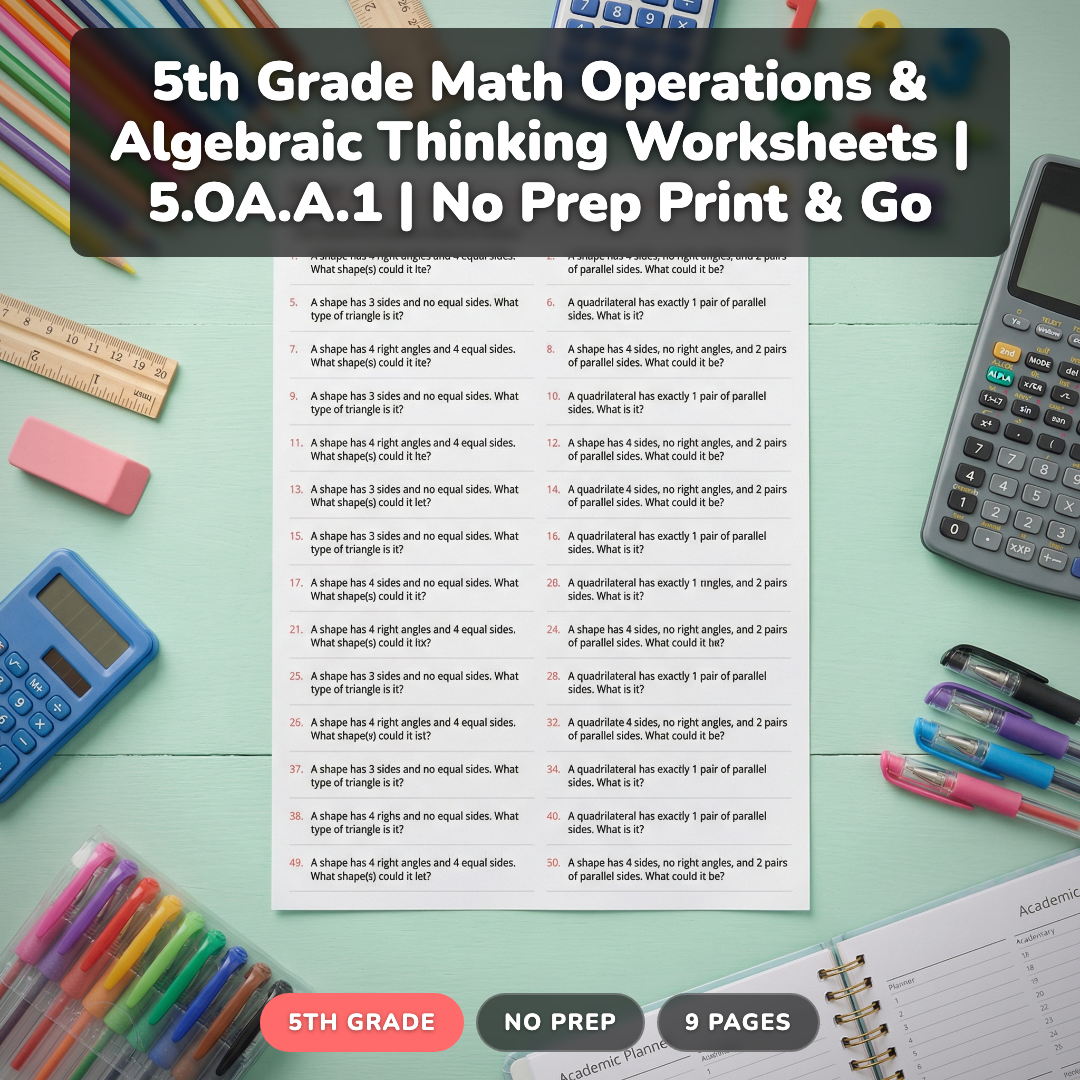
After years of seeing students struggle with this concept, I created a comprehensive order of operations resource that takes the guesswork out of differentiation. This 9-page pack includes 132 carefully crafted problems across three distinct levels.
The Practice level (37 problems) focuses on building foundational understanding with two-operation expressions and simple parentheses. The On-Level section (50 problems) aligns perfectly with grade 5 standards, featuring expressions with multiple grouping symbols and 3-4 operations. The Challenge level (45 problems) pushes thinking with complex nested expressions and real-world applications.
What makes this resource different is the intentional progression within each level. Problems start simple and gradually increase in complexity, so students build confidence while being appropriately challenged. Complete answer keys are included for quick checking, and each level can be used independently or as part of a station rotation.
Grab a Free Order of Operations Sample to Try
Want to see how these differentiated problems work in your classroom? I’ll send you a free sample with problems from each level, plus a quick reference guide for teaching order of operations. Perfect for trying out these strategies before diving into the full resource.
Frequently Asked Questions About Teaching Order of Operations
When should I introduce order of operations in 5th grade?
Introduce order of operations after students have mastered multiplication and division facts, typically in October or November. Students need automatic recall of basic operations to focus on the sequence rules rather than struggling with calculations themselves.
Should I teach PEMDAS or a different mnemonic?
PEMDAS works well, but emphasize that MD and AS are equal-level operations that work left to right. Many teachers prefer ‘GEMDAS’ (Grouping, Exponents, Multiplication/Division, Addition/Subtraction) to clarify that grouping symbols come first, though exponents aren’t required until 6th grade.
How do I help students remember to work inside parentheses first?
Use the analogy that parentheses are like ‘mathematical containers’ that must be emptied first. Practice with physical manipulatives in containers, and have students physically point to or circle grouping symbols before beginning calculations.
What’s the difference between parentheses, brackets, and braces?
In elementary mathematics, parentheses ( ), brackets [ ], and braces { } all function identically as grouping symbols. Different symbols help organize complex expressions with multiple levels of grouping, but they all mean ‘do this operation first.’
How can I connect order of operations to real-world situations?
Use shopping scenarios with discounts and taxes, cooking recipes with multiple ingredients, or sports statistics with averages and totals. These contexts show students why mathematical order matters for getting correct real-world answers.
Building Strong Order of Operations Foundations
Teaching order of operations successfully comes down to helping students understand the ‘why’ behind the rules, not just memorizing PEMDAS. When students see how these conventions create mathematical consistency and connect to real-world problem solving, they develop the logical reasoning skills that will serve them throughout their mathematical journey.
What’s your go-to strategy for helping students remember order of operations? I’d love to hear what works in your classroom!
Don’t forget to grab your free order of operations sample above — it’s a great way to test these strategies with your students before diving into more complex expressions.