If your 5th graders freeze when they see ½ ÷ 3 or struggle to understand why dividing a fraction makes it smaller, you’re not alone. Unit fraction division is one of the most conceptually challenging topics in elementary math, and it’s where many students hit their first real mathematical wall.
This post will give you five research-backed strategies to make unit fraction division click for your students, plus differentiation tips for every learner in your classroom.
Key Takeaway
Unit fraction division requires visual models and real-world contexts before students can successfully work with abstract algorithms.
Why Unit Fraction Division Matters in 5th Grade
Unit fraction division directly addresses CCSS.Math.Content.5.NF.B.7a, which requires students to interpret division of a unit fraction by a non-zero whole number and compute such quotients. This standard appears in Quarter 3 of most 5th grade curricula, building on students’ understanding of fraction multiplication from earlier in the year.
Research from the National Council of Teachers of Mathematics shows that students who master visual fraction division models in 5th grade are 40% more likely to succeed in middle school algebra. The skill connects directly to proportional reasoning, which forms the foundation for ratios, rates, and algebraic thinking in grades 6-8.
This standard specifically focuses on problems like ⅓ ÷ 4 or ½ ÷ 6, where students must understand that dividing a unit fraction means finding equal parts of that fraction. The conceptual leap from “division makes numbers smaller” (true with whole numbers) to “division of fractions follows different rules” challenges students’ existing mental models.
Looking for a ready-to-go resource? I put together a differentiated unit fraction division pack that covers everything below — but first, the teaching strategies that make it work.
Common Unit Fraction Division Misconceptions in 5th Grade
Common Misconception: Students think ½ ÷ 3 equals 1½ because “you can’t divide something smaller than 1.”
Why it happens: They apply whole number division logic without understanding fractional parts.
Quick fix: Start with concrete manipulatives like fraction bars or circles before moving to abstract numbers.
Common Misconception: Students believe dividing always makes numbers smaller, so ¼ ÷ 2 should equal something less than ¼.
Why it happens: Previous experience with whole number division creates a false mental model.
Quick fix: Use the “sharing” context explicitly — “If you share ¼ of a pizza between 2 people, how much does each person get?”
Common Misconception: Students try to convert unit fractions to decimals first, leading to computational errors.
Why it happens: They’re more comfortable with decimal division from 4th grade.
Quick fix: Emphasize that fraction form preserves exact values and connects to the visual models.
Common Misconception: Students confuse ½ ÷ 3 with ½ × 3, especially when working quickly.
Why it happens: The symbols look similar and they haven’t internalized the different meanings.
Quick fix: Use different colors for division and multiplication symbols, and always read problems aloud using “divided by” language.
5 Research-Backed Strategies for Teaching Unit Fraction Division
Strategy 1: Fraction Bar Modeling with Physical Manipulatives
This concrete approach helps students visualize what happens when you divide a unit fraction into equal parts. Students use physical fraction bars to see the division process, making the abstract concept tangible.
What you need:
- Fraction bars or strips (1 whole, ½, ⅓, ¼, ⅕, ⅙)
- Colored pencils or markers
- Chart paper for recording
Steps:
- Start with ½ ÷ 3. Give students a ½ fraction bar and ask them to divide it into 3 equal parts.
- Have students fold or mark the ½ bar into thirds, creating 6 equal sections in the original whole.
- Count the sections: each part is 1/6 of the original whole.
- Record the equation: ½ ÷ 3 = ⅙
- Repeat with different unit fractions and divisors, building pattern recognition.
Strategy 2: Circle Models with Sharing Contexts
Circle models provide an alternative visual representation that connects to real-world sharing situations. This approach helps students understand the “how much does each person get?” interpretation of division.
What you need:
- Paper plates or circle cutouts
- Scissors
- Different colored paper
- Real-world scenario cards
Steps:
- Present a scenario: “You have ⅓ of a pizza and want to share it equally among 4 friends.”
- Students cut a paper circle into thirds and take one piece (the unit fraction).
- Fold or cut that ⅓ piece into 4 equal parts.
- Each part represents 1/12 of the original pizza.
- Connect to the equation: ⅓ ÷ 4 = 1/12
- Practice with different scenarios and unit fractions.
Strategy 3: Number Line Jumps and Intervals
Number lines help students see unit fraction division as finding smaller intervals on a continuous model. This strategy bridges concrete and abstract thinking while building number sense.
What you need:
- Large number line (0 to 1) on chart paper
- Colored sticky notes or tape
- Individual number line worksheets
- Rulers or straightedges
Steps:
- Mark ¼ on a number line from 0 to 1.
- For ¼ ÷ 3, divide the distance from 0 to ¼ into 3 equal parts.
- Use different colored tape to mark each of the 3 sections.
- Identify that each section represents 1/12 of the whole unit.
- Record: ¼ ÷ 3 = 1/12
- Have students practice on individual number lines with different problems.
Strategy 4: Pattern Recognition with Multiplication Connection
This strategy helps students discover the relationship between division by a whole number and multiplication by a unit fraction. Students build understanding through guided pattern observation.
What you need:
- Pattern recording sheets
- Calculators (for verification)
- Colored highlighters
- Anchor chart paper
Steps:
- Create a chart with problems like ½ ÷ 2, ½ ÷ 3, ½ ÷ 4, ½ ÷ 5.
- Solve each using visual models first, then record answers.
- Guide students to notice: ½ ÷ 2 = ¼, ½ ÷ 3 = ⅙, ½ ÷ 4 = ⅛.
- Ask: “What pattern do you see in the denominators?”
- Help students discover: ½ ÷ 3 = ½ × ⅓ = ⅙.
- Practice applying this pattern to other unit fractions.
Strategy 5: Real-World Problem Solving with Multiple Representations
This strategy combines multiple visual models with authentic contexts, helping students choose appropriate strategies and build flexible thinking about unit fraction division.
What you need:
- Real-world scenario cards
- Choice of manipulatives (bars, circles, number lines)
- Recording sheets with multiple representation spaces
- Timer for problem-solving rotations
Steps:
- Present a multi-step problem: “A recipe calls for ⅕ cup of oil. You want to make ⅓ of the recipe. How much oil do you need?”
- Students choose their preferred visual model to solve.
- They record their thinking using pictures, words, and equations.
- Share solutions and compare different approaches.
- Discuss which visual model felt most helpful and why.
- Practice with increasingly complex scenarios.
How to Differentiate Unit Fraction Division for All Learners
For Students Who Need Extra Support
Start with halves divided by 2 before introducing other unit fractions or divisors. Provide pre-made fraction models with fold lines or cut marks already indicated. Use consistent language like “sharing” and “equal parts” rather than varying vocabulary. Offer multiplication fact charts since students need quick access to products for denominator calculations. Practice prerequisite skills like identifying unit fractions and understanding equal parts before moving to division concepts.
For On-Level Students
Students at grade level should master CCSS.Math.Content.5.NF.B.7a by working with unit fractions like ⅓, ¼, ⅕, and ⅙ divided by whole numbers 2-6. They should be able to use at least two different visual models (fraction bars and circles) and explain their reasoning using mathematical vocabulary. Provide mixed practice with both computational problems and word problems to build flexibility.
For Students Ready for a Challenge
Advanced students can explore division of unit fractions by larger whole numbers (like ⅛ ÷ 12) and make connections to equivalent fractions. Challenge them to create their own word problems for classmates to solve, or investigate patterns in unit fraction division tables. Introduce the connection to multiplying by reciprocals as preparation for 6th grade fraction division standards.
A Ready-to-Use Unit Fraction Division Resource for Your Classroom
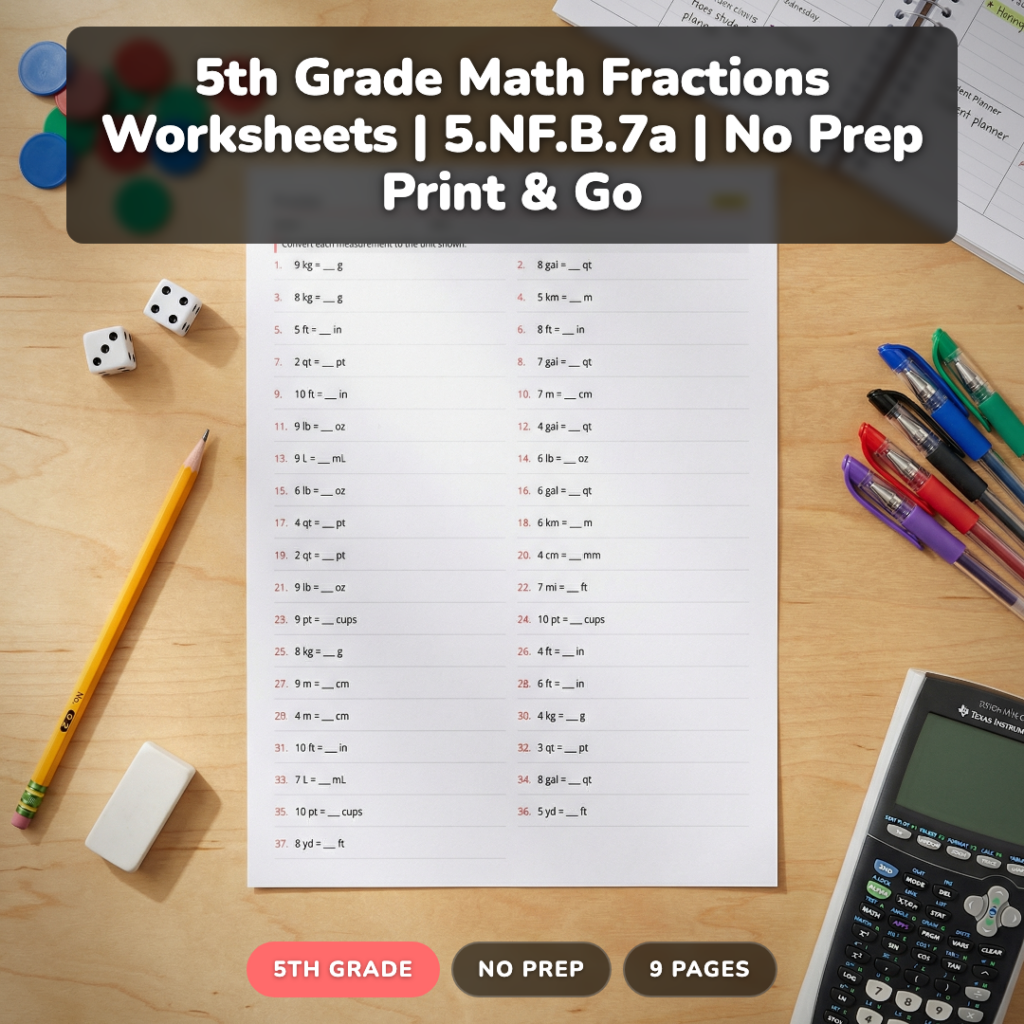
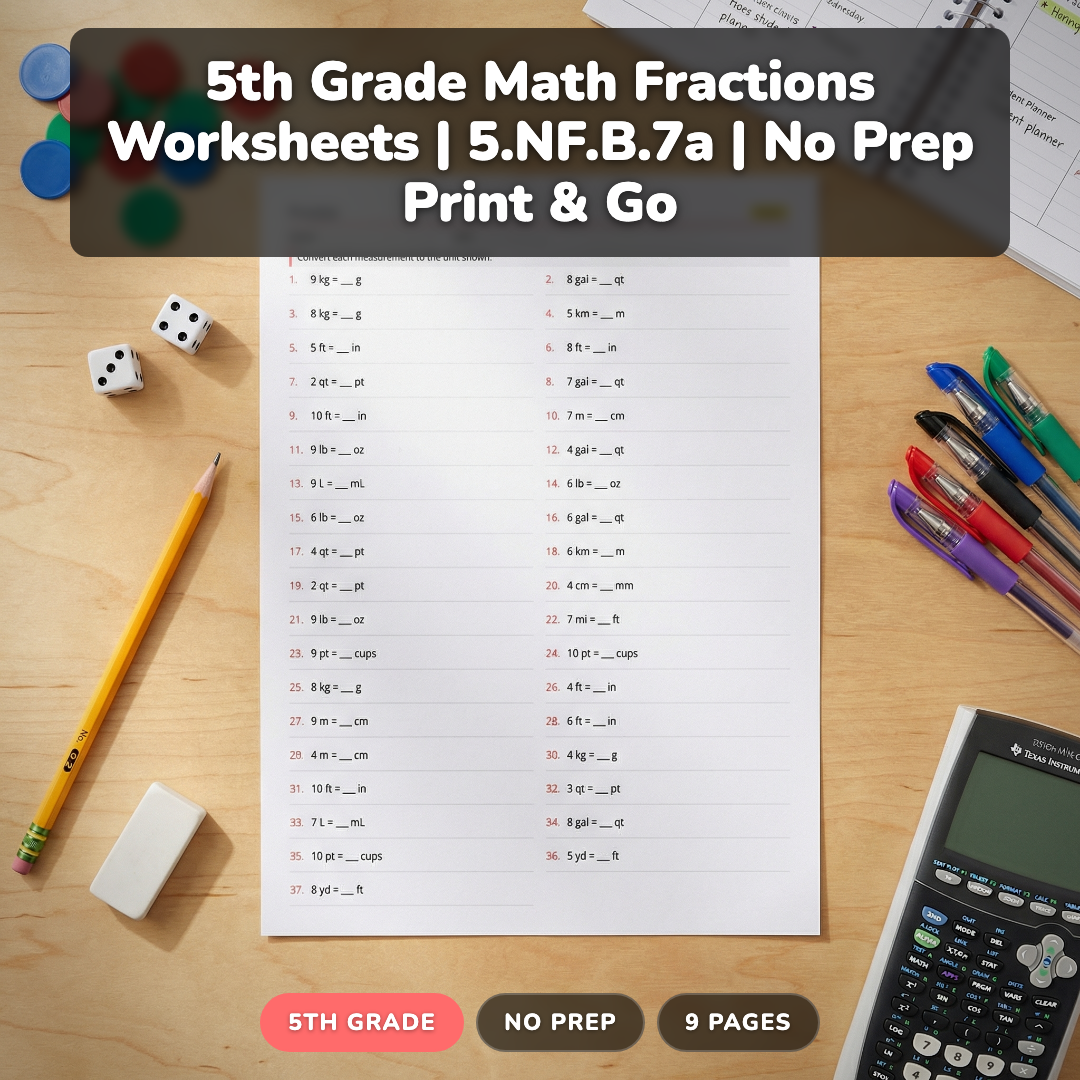
After years of teaching this challenging concept, I created a comprehensive unit fraction division pack that takes the guesswork out of differentiation. The resource includes 132 carefully scaffolded problems across three difficulty levels, so every student in your classroom can practice at their appropriate level.
The Practice level (37 problems) focuses on halves and thirds with smaller divisors, perfect for students building confidence. The On-Level section (50 problems) covers the full scope of CCSS.Math.Content.5.NF.B.7a with mixed unit fractions and word problems. The Challenge level (45 problems) extends learning with complex scenarios and pattern exploration.
What sets this resource apart is the consistent visual model support throughout all levels, plus detailed answer keys that show multiple solution approaches. Each page is designed for easy printing and immediate use — no prep time required.
You can grab the complete differentiated pack and start using it tomorrow in your classroom.
Grab a Free Unit Fraction Division Practice Sheet to Try
Want to see how these strategies work in practice? I’ll send you a free sample worksheet that includes problems from each difficulty level, plus a visual model reference guide your students can use during instruction.
Frequently Asked Questions About Teaching Unit Fraction Division
When should I introduce unit fraction division in 5th grade?
Most curricula introduce unit fraction division in Quarter 3, after students have mastered fraction multiplication. Students need solid understanding of equivalent fractions and fraction-to-decimal conversion before tackling CCSS.Math.Content.5.NF.B.7a. Plan 2-3 weeks for full concept development including visual models and word problems.
What’s the difference between ½ ÷ 3 and ½ ÷ ⅓?
The standard CCSS.Math.Content.5.NF.B.7a only covers division of unit fractions BY whole numbers (like ½ ÷ 3 = ⅙). Division by other fractions (like ½ ÷ ⅓ = 1½) is introduced in 6th grade. Keep 5th grade focused on whole number divisors only.
Should students memorize the “multiply by the reciprocal” rule?
No, not in 5th grade. Focus on visual models and conceptual understanding first. Students should understand WHY ¼ ÷ 3 = 1/12 through pictures and real-world contexts. The algorithmic shortcut can be introduced later once the concept is solid.
How do I help students who confuse division and multiplication symbols?
Use consistent color-coding (blue for ÷, red for ×) and always read problems aloud using full mathematical language. Practice symbol recognition separately from computation. Provide reference cards showing the difference between “groups of” (multiplication) and “shared among” (division) contexts.
What manipulatives work best for visual modeling?
Fraction bars are most effective for beginners because they clearly show the subdivision process. Circle models work well for sharing contexts. Avoid using different manipulative types in the same lesson — consistency helps students focus on the mathematical concept rather than the tool.
Unit fraction division challenges students to think beyond their whole number experiences, but with the right visual models and scaffolded practice, every 5th grader can master this essential skill. Remember to start concrete, build conceptual understanding, and only move to abstract computation once students can explain their reasoning.
What’s your go-to strategy for helping students visualize unit fraction division? And don’t forget to grab that free practice sheet above — it’s a great way to try these strategies with your own students.