If your 5th graders freeze when they see “3/4 × 2/3” and need to determine if the product is larger or smaller than 3/4 without actually multiplying, you’re not alone. This conceptual leap—understanding how fraction multiplication affects size—challenges even strong math students.
You’ll discover four research-backed strategies that help students visualize and reason through fraction comparisons, plus differentiation tips for every learner in your classroom.
Key Takeaway
Students master fraction size comparison by understanding that multiplying by fractions less than 1 makes products smaller, while multiplying by fractions greater than 1 makes products larger.
Why 5th Grade Fraction Comparison Matters
Standard CCSS.Math.Content.5.NF.B.5a requires students to compare the size of a product to one factor based on the size of the other factor—without performing the multiplication. This builds crucial number sense before students tackle complex fraction operations in middle school.
Research from the National Mathematics Advisory Panel shows that students who master conceptual understanding of fraction multiplication perform 40% better on algebraic reasoning tasks in 6th grade. The timing matters too: introduce this skill after students have solid understanding of equivalent fractions (typically January-February) but before diving into fraction division algorithms.
This standard connects directly to proportional reasoning and prepares students for ratio work in 6th grade. Students need to understand that fractions represent both numbers and operations—a critical shift from whole number thinking.
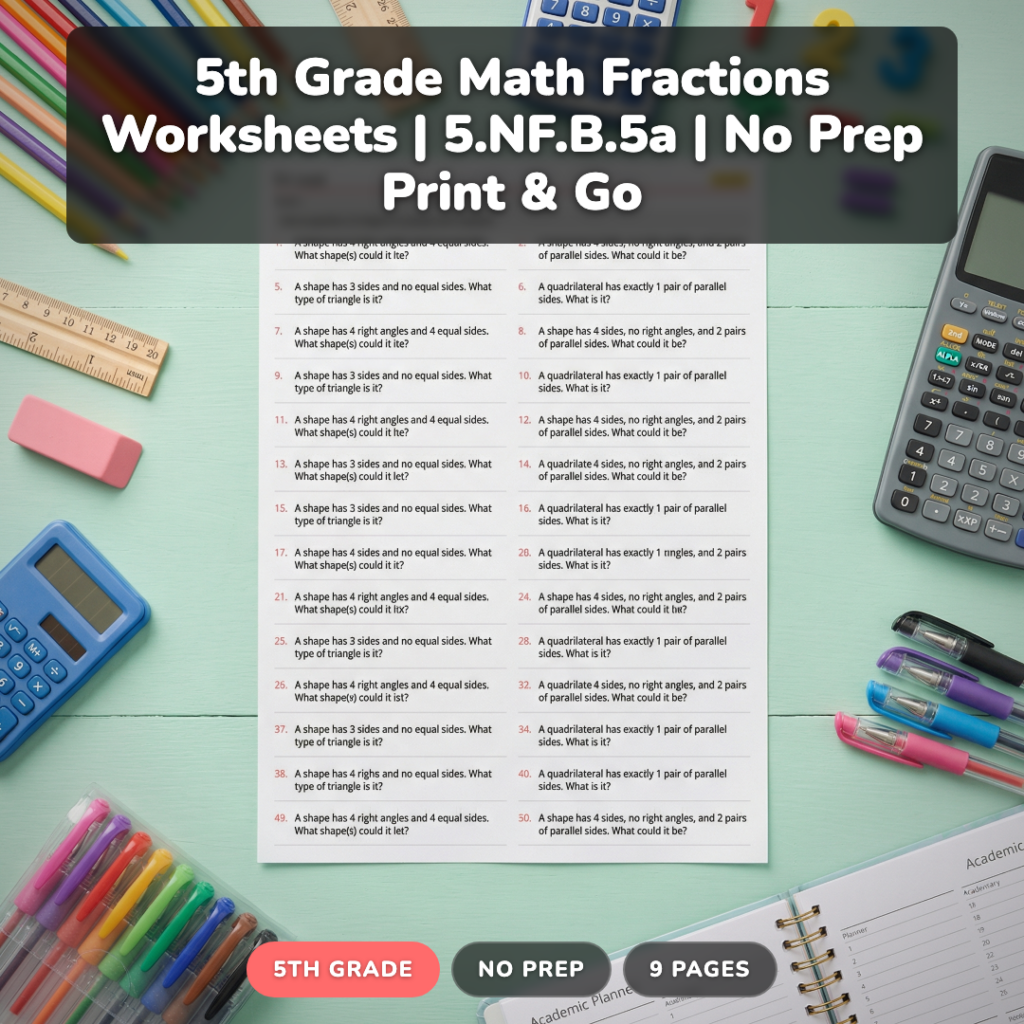
Looking for a ready-to-go resource? I put together a differentiated fraction comparison pack with 132 problems across three levels—but first, the teaching strategies that make it work.
Common Fraction Comparison Misconceptions in 5th Grade
Common Misconception: Students think multiplying always makes numbers bigger.
Why it happens: Years of whole number experience where 5 × 3 = 15 (bigger than 5).
Quick fix: Start with concrete examples using money: “Half of $10 is less than $10.”
Common Misconception: Students believe 1/2 × 3/4 equals something larger than both fractions.
Why it happens: They apply whole number multiplication rules to fractions.
Quick fix: Use the phrase “part of a part” to emphasize taking a portion.
Common Misconception: Students think all fractions make products smaller when multiplying.
Why it happens: Overcompensation after learning that some fractions reduce size.
Quick fix: Compare multiplying by 1/2 versus multiplying by 3/2 using visual models.
Common Misconception: Students can’t distinguish between proper and improper fractions’ effects on products.
Why it happens: Lack of benchmark understanding around the number 1.
Quick fix: Create anchor charts showing fractions less than, equal to, and greater than 1.
4 Research-Backed Strategies for Teaching Fraction Comparison
Strategy 1: The Benchmark Method Using Number Lines
Students use number lines and the benchmark of 1 to predict whether products will be larger or smaller than the original factor. This visual approach builds on students’ spatial reasoning while reinforcing the relationship between fraction size and multiplication effects.
What you need:
- Large number line (0 to 2) posted in classroom
- Individual student number lines
- Colored pencils or markers
- Fraction cards (1/4, 1/2, 3/4, 5/4, 3/2, etc.)
Steps:
- Place the first factor on the number line (e.g., 3/4)
- Identify where the second factor falls relative to 1 (e.g., 2/3 is less than 1)
- Apply the rule: “Less than 1 makes it smaller, greater than 1 makes it larger”
- Mark the approximate location of the product
- Verify reasoning with a different example
Strategy 2: Area Model Visualization
Students use rectangular area models to see how multiplying fractions represents finding “part of a part.” This concrete representation helps students understand why products change size based on the factors involved.
What you need:
- Grid paper or pre-drawn rectangles
- Two different colored pencils per student
- Transparent overlays (optional)
- Document camera for whole-group modeling
Steps:
- Draw a rectangle and shade the first fraction (e.g., shade 3/4 of the rectangle)
- Within that shaded region, shade the second fraction using a different color (e.g., 2/3 of the 3/4)
- Compare the double-shaded area to the original single-shaded area
- Discuss: “Is 2/3 of 3/4 larger or smaller than 3/4?”
- Connect to the rule about multiplying by fractions less than or greater than 1
Strategy 3: Real-World Context Connections
Students apply fraction comparison to familiar situations like cooking, shopping, and time management. These contexts make abstract fraction relationships concrete and memorable while building problem-solving skills.
What you need:
- Recipe cards with fraction ingredients
- Play money and price tags
- Measuring cups (optional)
- Context problem cards
Steps:
- Present a real scenario: “A recipe calls for 3/4 cup flour, but you only want to make 2/3 of the recipe”
- Ask: “Will you use more or less than 3/4 cup flour?”
- Have students explain their reasoning before calculating
- Connect back to the mathematical relationship: 2/3 × 3/4
- Verify with other contexts like “2/3 of a 3/4 hour movie”
Strategy 4: The Comparison Game with Reasoning
Students play a partner game where they draw fraction cards and predict products without calculating. This builds fluency with fraction size relationships while encouraging mathematical discourse and justification.
What you need:
- Two sets of fraction cards per pair
- Recording sheets
- Timer
- “Reasoning stems” poster for sentence starters
Steps:
- Partner A draws two fraction cards and shows Partner B
- Partner B predicts: “The product will be larger/smaller than [first fraction] because…”
- Partners discuss and justify the reasoning
- Record prediction and reasoning on sheet
- Switch roles and repeat
- Check predictions by calculating (optional extension)
How to Differentiate Fraction Comparison for All Learners
For Students Who Need Extra Support
Begin with unit fractions (1/2, 1/3, 1/4) and whole numbers before introducing more complex fractions. Use concrete manipulatives like fraction strips or circles. Provide anchor charts showing “less than 1” and “greater than 1” fractions with visual representations. Focus on the language: “part of” means smaller. Review equivalent fractions and benchmark fractions (1/2, 1/4, 3/4) before starting comparison work.
For On-Level Students
Work with proper fractions, improper fractions, and simple mixed numbers. Students should explain their reasoning using mathematical language and connect multiple representations (number lines, area models, real-world contexts). Expect fluency with CCSS.Math.Content.5.NF.B.5a standards using fractions with denominators up to 12. Practice includes comparing products to both factors in multiplication expressions.
For Students Ready for a Challenge
Introduce complex fractions, decimals mixed with fractions, and multi-step problems. Challenge students to create their own word problems and teach the concept to younger students. Explore connections to proportional reasoning and early algebraic thinking. Have them investigate: “When does multiplying by a fraction make the product exactly half the original number?”
A Ready-to-Use Fraction Comparison Resource for Your Classroom
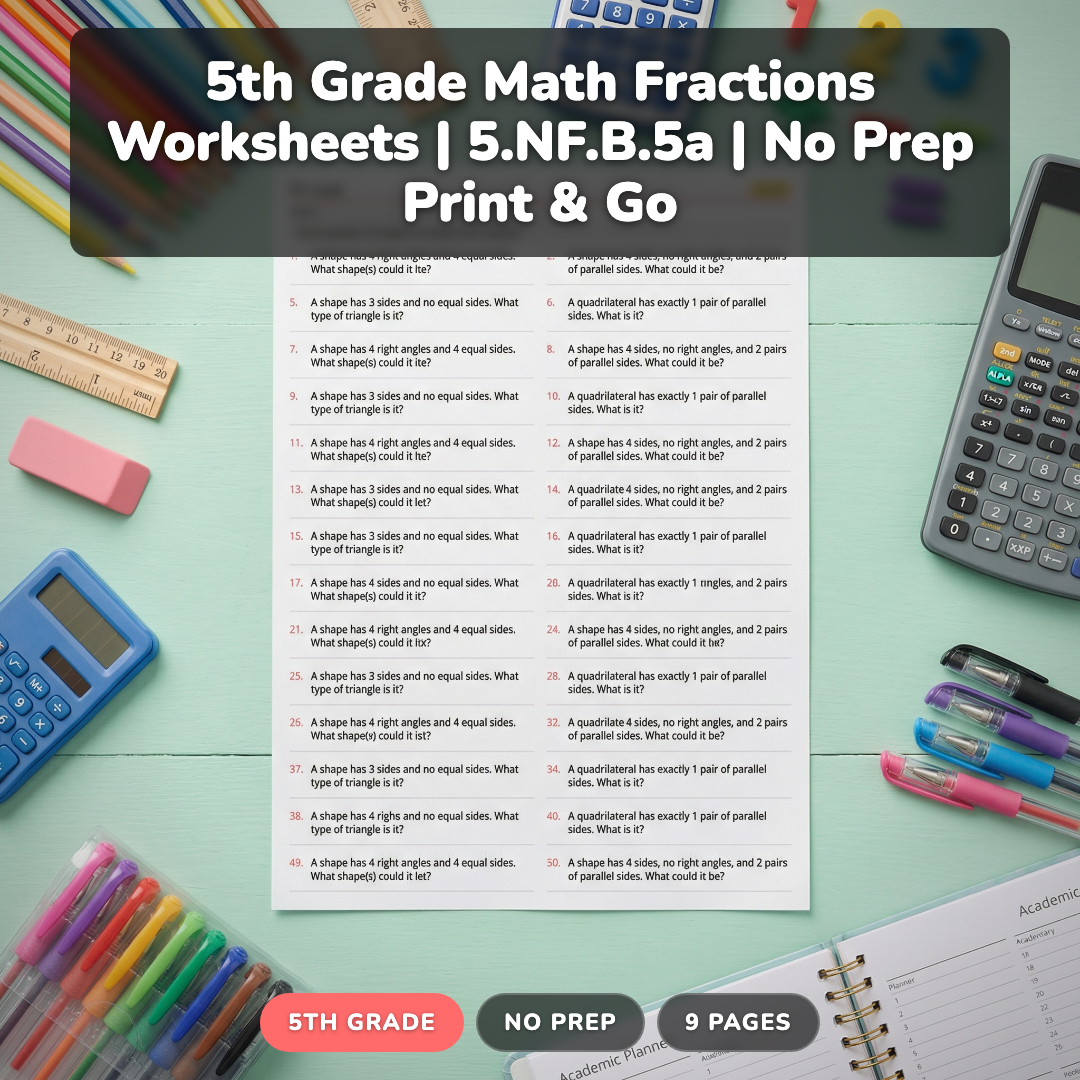
After years of creating fraction materials from scratch, I developed this comprehensive fraction comparison pack that saves hours of prep time while providing exactly the practice students need. The resource includes 132 carefully crafted problems across three differentiation levels.
The Practice level (37 problems) focuses on unit fractions and simple proper fractions with clear visual support. On-Level problems (50 problems) include mixed proper and improper fractions with varied contexts. Challenge problems (45 problems) incorporate complex fractions, mixed numbers, and multi-step reasoning tasks.
Each level includes answer keys with detailed explanations, making it perfect for independent work, math centers, or homework assignments. The problems align directly with CCSS.Math.Content.5.NF.B.5a and progress systematically from concrete to abstract thinking.
What makes this different from generic fraction worksheets? Every problem requires students to justify their reasoning, building the mathematical discourse skills your students need for middle school success.
Grab a Free Fraction Comparison Sample to Try
Want to see how these strategies work in practice? I’ll send you a free sample with 5 problems from each level, plus a quick reference guide for the four teaching strategies above.
Frequently Asked Questions About Teaching Fraction Comparison
When should I introduce CCSS.Math.Content.5.NF.B.5a in my curriculum?
Introduce this standard after students have mastered equivalent fractions and adding/subtracting fractions with like denominators, typically in January or February. Students need solid fraction number sense before tackling conceptual multiplication relationships.
How do I help students remember when products are larger or smaller?
Use the benchmark of 1 as an anchor: “Multiplying by fractions less than 1 makes products smaller, multiplying by fractions greater than 1 makes products larger.” Practice with concrete examples like “half of something” versus “double something.”
What’s the difference between this standard and actually multiplying fractions?
Standard 5.NF.B.5a focuses on reasoning about size relationships without calculating. Students predict and justify whether products will be larger or smaller. Standard 5.NF.B.4 covers the actual multiplication algorithms and calculations.
How can I assess student understanding of fraction comparison concepts?
Use exit tickets asking students to predict and justify: “Will 3/5 × 4/7 be larger or smaller than 3/5?” Look for reasoning that references the size of the second factor relative to 1, not just correct answers.
What should I do if students still think multiplication always makes numbers bigger?
Start with whole number examples they understand: “Half of 10 cookies is 5 cookies—less than 10.” Then connect to fraction notation: “1/2 × 10 = 5.” Use consistent language like “part of” to reinforce the concept.
Teaching fraction comparison builds the foundation for proportional reasoning and algebraic thinking your students will need in middle school. Focus on the conceptual understanding first, and the procedural skills will follow naturally.
What’s your biggest challenge when teaching fraction concepts? Try the free sample above and let me know how these strategies work in your classroom!