If your 5th graders freeze when they see a problem like “What happens when you multiply 3/4 × 2?” you’re not alone. Fraction scaling—understanding how multiplication can make fractions larger or smaller—is where many students hit their first major conceptual roadblock with fractions.
The good news? With the right visual models and concrete experiences, students can master this tricky concept. You’ll walk away with five research-backed strategies that help students see multiplication as resizing, plus differentiation tips for every learner in your classroom.
Key Takeaway
Students understand fraction scaling best when they can visualize and manipulate concrete representations before moving to abstract calculations.
Why Fraction Scaling Matters in 5th Grade
Fraction scaling represents a major conceptual shift for students. Up until now, multiplication has always meant “making bigger.” Suddenly, multiplying by 1/2 makes numbers smaller. This cognitive dissonance is exactly what CCSS.Math.Content.5.NF.B.5 addresses—helping students interpret multiplication as scaling or resizing.
Research from the National Council of Teachers of Mathematics shows that students who master scaling concepts in 5th grade perform significantly better on rational number tasks through middle school. The standard requires students to compare the size of a product to the size of one factor when the other factor is greater than 1, equal to 1, or less than 1.
This skill typically appears in your curriculum around February or March, after students have solid foundations in equivalent fractions and basic fraction operations. It directly prepares them for 6th-grade ratio and proportion work.
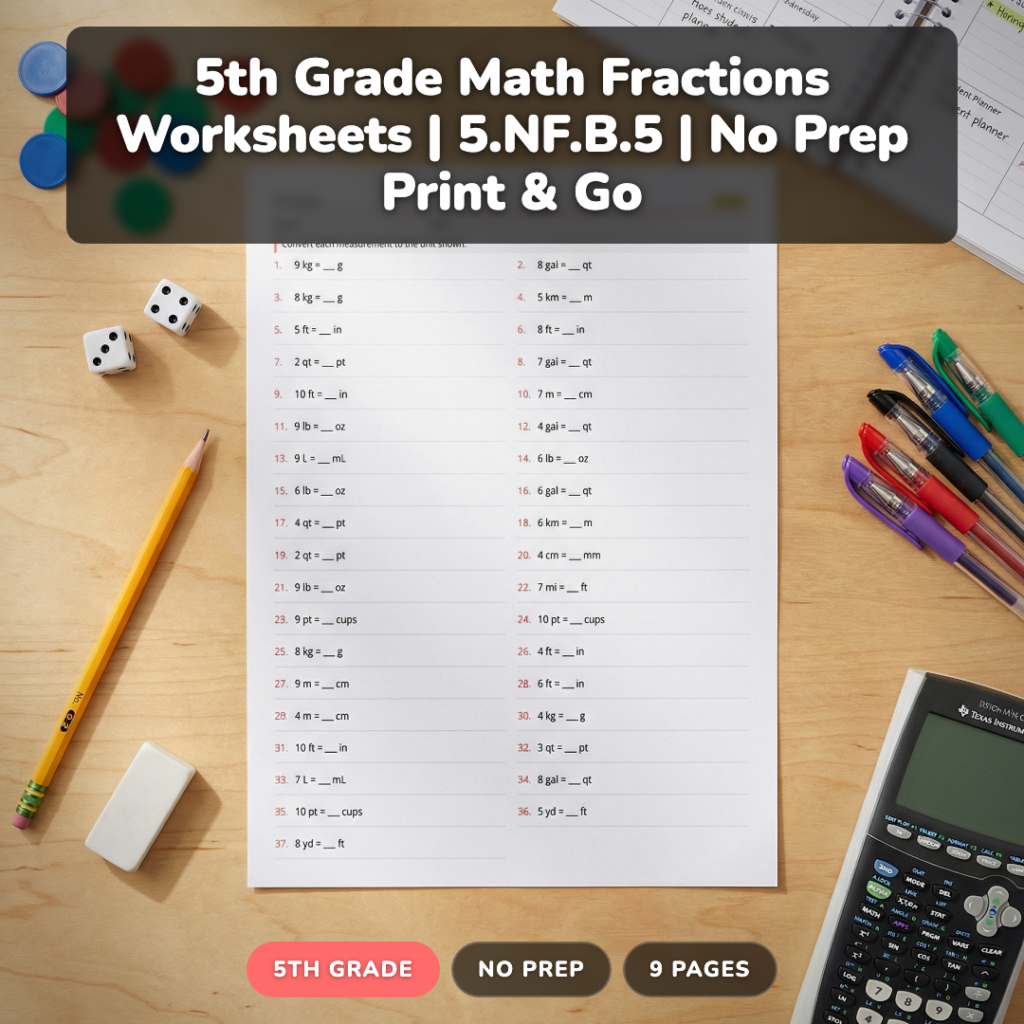
Looking for a ready-to-go resource? I put together a differentiated fraction scaling pack that covers everything below—but first, the teaching strategies that make it work.
Common Fraction Scaling Misconceptions in 5th Grade
Common Misconception: Students think multiplying always makes numbers bigger.
Why it happens: Years of whole number multiplication create this mental model.
Quick fix: Start with scaling familiar objects before introducing fraction symbols.
Common Misconception: Students believe 3/4 × 2 equals 6/4 because “you just multiply across.”
Why it happens: They apply memorized procedures without understanding.
Quick fix: Use visual models to show what “3/4 of something, taken twice” actually means.
Common Misconception: Students think multiplying by 1 changes the number.
Why it happens: They haven’t internalized that 1 is the multiplicative identity.
Quick fix: Demonstrate with concrete examples: 1 group of 5 cookies is still 5 cookies.
Common Misconception: Students can’t predict whether a product will be larger or smaller than the original fraction.
Why it happens: They focus on computation rather than reasoning about size.
Quick fix: Always estimate first—will the answer be bigger or smaller than the original?
5 Research-Backed Strategies for Teaching Fraction Scaling
Strategy 1: Recipe Scaling with Real Ingredients
Students understand scaling intuitively when they work with familiar contexts. Recipe scaling lets them see multiplication as “making more” or “making less” of something concrete.
What you need:
- Simple recipes (trail mix, fruit salad, etc.)
- Measuring cups and spoons
- Ingredients or manipulatives representing ingredients
- Chart paper for recording
Steps:
- Start with a recipe that serves 4 people using simple fractions (1/2 cup nuts, 3/4 cup dried fruit)
- Ask: “What if we want to serve 8 people? 2 people? 6 people?”
- Have students physically measure out ingredients for different group sizes
- Record the mathematical sentence: 3/4 × 2 = 6/4 = 1 1/2
- Connect to the visual: “We took 3/4 cup twice, so we have more than the original amount”
Strategy 2: Number Line Jumps and Stretches
Number lines make scaling visible by showing how fractions move and change size when multiplied by different factors.
What you need:
- Large floor number line or tape
- Colored sticky notes or markers
- Fraction cards
- Multiplication factor cards
Steps:
- Place 3/4 on the number line with a sticky note
- Ask: “If we multiply 3/4 by 2, where will we land?”
- Have students physically jump from 0 to 3/4, then take that same jump again
- Mark the landing spot and write the equation: 3/4 × 2 = 1 1/2
- Repeat with factors less than 1: “What if we take half of that jump?”
- Compare all results: Which factors made the number bigger? Smaller? Same?
Strategy 3: Area Models with Grid Paper
Area models help students visualize exactly what happens when fractions get scaled up or down, making abstract concepts concrete.
What you need:
- Grid paper or fraction tiles
- Colored pencils or crayons
- Laminated grids for reuse
- Dry erase markers
Steps:
- Draw a rectangle representing 1 whole, divided into fourths
- Shade 3/4 of the rectangle
- Ask: “What does 3/4 × 2 look like?”
- Create a second identical rectangle and shade 3/4 again
- Count total shaded parts: 6 fourths = 1 2/4 = 1 1/2
- Try with factors less than 1: “What’s half of our shaded region?”
Strategy 4: Comparison Estimation Before Computing
Teaching students to estimate first builds number sense and prevents computational errors from masking conceptual misunderstandings.
What you need:
- Fraction multiplication problems
- Three sorting bins labeled “Bigger,” “Same,” “Smaller”
- Problem cards
- Estimation recording sheets
Steps:
- Present a problem: 2/3 × 4
- Before any calculation, ask: “Will the answer be bigger than 2/3, smaller than 2/3, or the same?”
- Students justify their thinking: “4 is bigger than 1, so we’re taking 2/3 four times—that’s bigger”
- Sort the problem card into the appropriate bin
- Then solve and verify the estimate was correct
- Reflect: “Our estimate helped us catch that computational error”
Strategy 5: Real-World Scaling Scenarios
Connecting fraction scaling to authentic situations helps students see why this math matters beyond the classroom.
What you need:
- Real-world scenario cards
- Calculators for verification
- Chart paper for problem-solving process
- Timer for gallery walks
Steps:
- Present scenarios: “A paint mixture calls for 3/4 cup blue paint. If you’re painting a mural and need 3 times as much, how much blue paint do you need?”
- Students identify the fraction and scaling factor
- They estimate first, then calculate
- Groups create posters showing their problem-solving process
- Gallery walk to compare strategies and solutions
- Discuss when scaling up vs. scaling down happens in real life
How to Differentiate Fraction Scaling for All Learners
For Students Who Need Extra Support
Start with unit fractions (1/2, 1/3, 1/4) and whole number factors before moving to more complex fractions. Provide concrete manipulatives like fraction tiles or circles for every problem. Use consistent visual models and encourage students to draw pictures before writing equations. Focus on the conceptual understanding that multiplication can make things bigger or smaller, not just the computational procedures.
For On-Level Students
Work with proper fractions and factors including whole numbers, fractions, and mixed numbers as outlined in CCSS.Math.Content.5.NF.B.5. Students should be able to predict whether products will be larger or smaller than the original fraction and explain their reasoning. Encourage multiple solution strategies and connections between visual models and abstract representations.
For Students Ready for a Challenge
Introduce scaling with improper fractions and complex mixed numbers. Have students create their own word problems involving scaling situations. Connect to real-world applications like scale drawings, recipe modifications for large groups, or proportional reasoning. Challenge them to explain why multiplying by fractions less than 1 makes numbers smaller using mathematical vocabulary.
A Ready-to-Use Fraction Scaling Resource for Your Classroom
Teaching fraction scaling effectively requires carefully scaffolded practice that moves students from concrete understanding to abstract mastery. After years of seeing students struggle with this concept, I created a comprehensive resource that addresses every level of learner in your classroom.
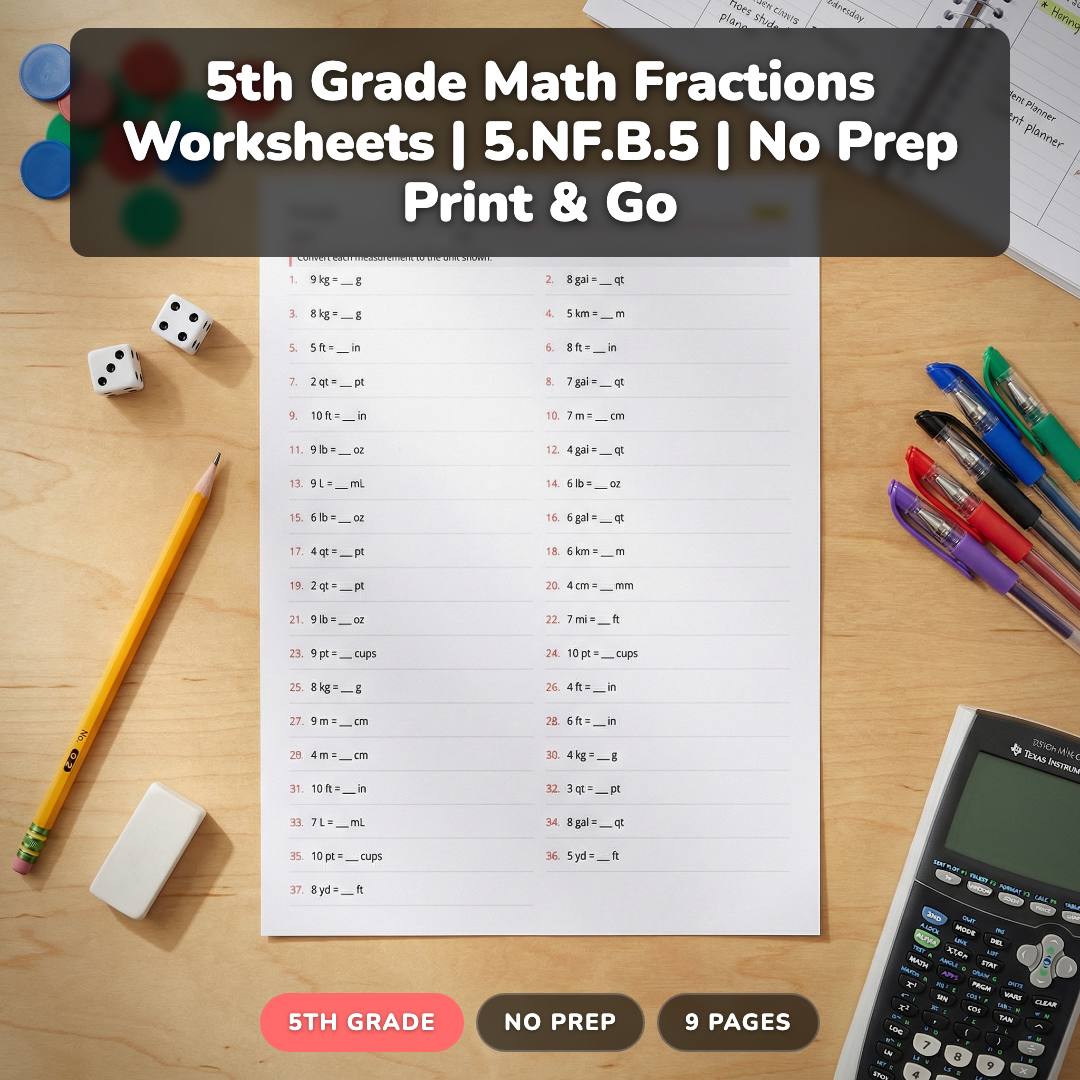
This fraction scaling pack includes 132 problems across three differentiated levels. The Practice level (37 problems) focuses on building conceptual understanding with visual supports. The On-Level section (50 problems) provides grade-appropriate practice aligned to the standard. The Challenge level (45 problems) extends learning with complex scenarios and real-world applications.
What makes this different from typical fraction worksheets? Every problem includes space for estimation before calculation, encouraging the number sense strategies that research shows are crucial for long-term success. The problems progress systematically from concrete contexts to abstract representations, and answer keys include common misconceptions to watch for.
You can save hours of prep time and ensure every student gets appropriately challenging practice.
Grab a Free Fraction Scaling Sample to Try
Want to see how these differentiated problems work in your classroom? I’ll send you a free sample with one problem from each level, plus the answer key with misconception alerts.
Frequently Asked Questions About Teaching Fraction Scaling
When should I teach fraction scaling in 5th grade?
Fraction scaling typically comes after students master equivalent fractions and basic fraction addition/subtraction, usually in February or March. Students need solid understanding of fraction concepts before tackling how multiplication affects fraction size.
Why do students think multiplying always makes numbers bigger?
Students develop this misconception from years of whole number multiplication where the product is always larger. They need explicit instruction and visual models showing that multiplying by fractions less than 1 creates smaller products.
What’s the difference between scaling and regular fraction multiplication?
Scaling emphasizes the conceptual understanding of how multiplication changes the size of quantities, while fraction multiplication focuses on computational procedures. CCSS.Math.Content.5.NF.B.5 specifically targets the scaling interpretation to build number sense.
How can I help students estimate fraction scaling products?
Teach students to compare the multiplier to 1: factors greater than 1 make products larger, factors less than 1 make products smaller, and multiplying by 1 keeps the number the same. Practice with benchmark fractions like 1/2 first.
What manipulatives work best for teaching fraction scaling?
Fraction tiles, area models on grid paper, and number lines are most effective because they clearly show how the original fraction changes size. Avoid manipulatives that don’t clearly represent the scaling relationship, like individual counters or abstract symbols.
Fraction scaling doesn’t have to be the roadblock where students lose confidence in math. With concrete experiences, visual models, and systematic practice, every student can master this crucial 5th-grade concept.
What’s your biggest challenge when teaching fraction scaling? Try the free sample above and see how the right problems can make all the difference in your classroom.