If your 5th graders freeze when they see (3/4) × 8 or start multiplying denominators randomly, you’re not alone. Fraction multiplication with whole numbers is where many students hit their first major math wall. The good news? With the right visual models and concrete understanding, this concept clicks beautifully.
You’ll walk away with five research-backed strategies that help students truly understand what it means to multiply a fraction by a whole number, plus differentiation tips for every learner in your classroom.
Key Takeaway
Students master fraction multiplication when they see it as ‘parts of groups’ rather than abstract number manipulation.
Why Fraction Multiplication Matters in 5th Grade
Fraction multiplication bridges the gap between elementary arithmetic and algebraic thinking. When students understand CCSS.Math.Content.5.NF.B.4a — interpreting (a/b) × q as parts of a partition — they’re building the foundation for ratios, proportions, and eventually algebra.
Research from the National Mathematics Advisory Panel shows that fraction understanding in elementary school is the strongest predictor of algebra success in high school. Students who master the conceptual meaning behind (3/4) × 8 as ‘three parts when 8 is divided into 4 equal groups’ develop number sense that serves them for years.
This standard typically appears in November or December, after students have solid understanding of equivalent fractions and fraction addition. The timing is crucial — students need those prerequisite skills locked in before tackling multiplication.
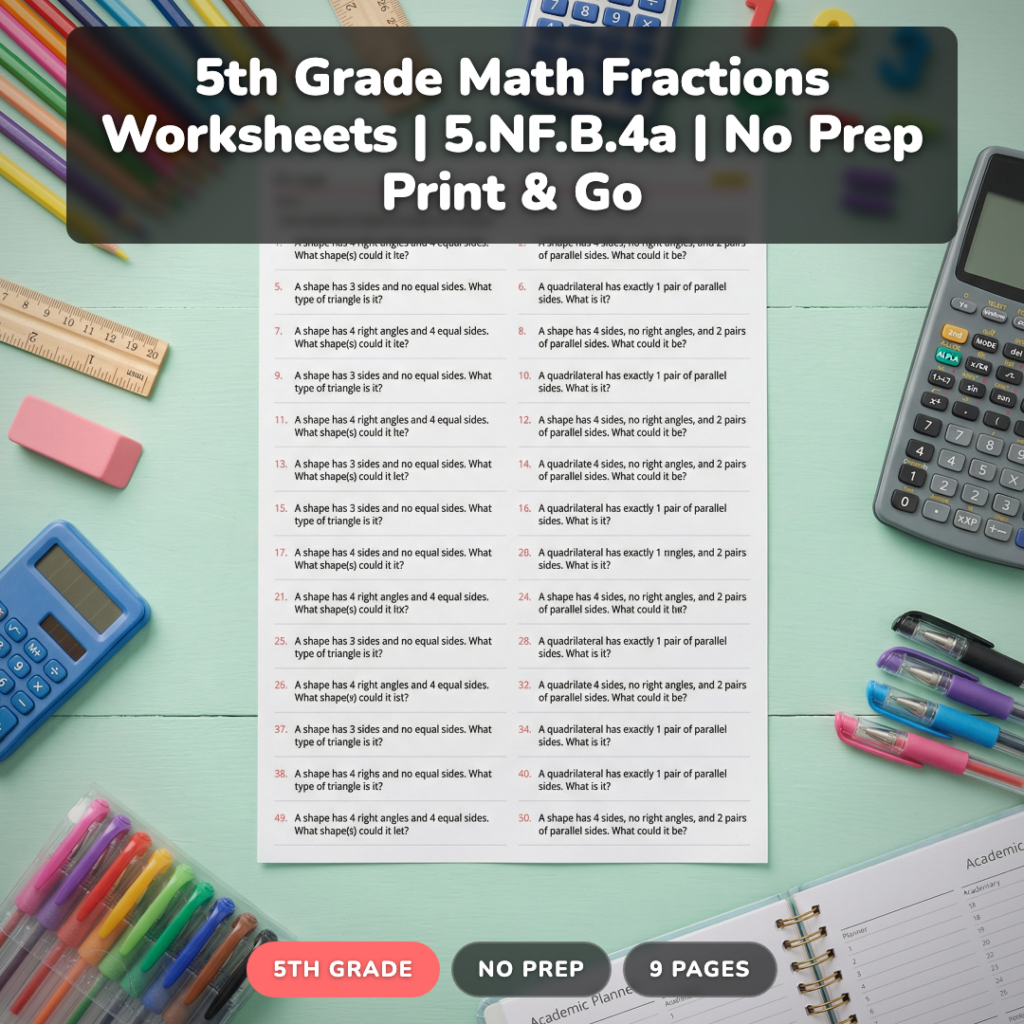
Looking for a ready-to-go resource? I put together a differentiated fraction multiplication pack that covers everything below — but first, the teaching strategies that make it work.
Common Fraction Multiplication Misconceptions in 5th Grade
Common Misconception: Students multiply both numerator and denominator by the whole number.
Why it happens: They overgeneralize from whole number multiplication where ‘multiply everything.’
Quick fix: Use visual models to show only the numerator changes.
Common Misconception: Students think (1/2) × 6 equals 3/2 instead of 3.
Why it happens: They forget to simplify or don’t recognize when the answer is a whole number.
Quick fix: Always connect back to the visual — ‘How many wholes do we have?’
Common Misconception: Students believe multiplication always makes numbers bigger.
Why it happens: All their previous multiplication experience involved whole numbers.
Quick fix: Use the language ‘part of’ consistently — we’re finding part of 6, not making 6 bigger.
Common Misconception: Students confuse (2/3) × 9 with 2/3 ÷ 9.
Why it happens: Both operations can be interpreted as ‘sharing’ in certain contexts.
Quick fix: Emphasize the ‘groups of’ language for multiplication versus ‘shared among’ for division.
5 Research-Backed Strategies for Teaching Fraction Multiplication
Strategy 1: Rectangle Area Models with Grid Paper
Area models make abstract fraction multiplication concrete by showing students exactly what ‘parts of a whole’ means visually.
What you need:
- Grid paper or graph paper
- Colored pencils or crayons
- Document camera for modeling
Steps:
- Draw a rectangle 8 units long and 1 unit wide for (3/4) × 8
- Divide the rectangle into 4 equal sections vertically
- Shade 3 of the 4 sections to represent 3/4
- Count the shaded squares — that’s your answer (6)
- Connect to the algorithm: 3 × 8 = 24, then 24 ÷ 4 = 6
Strategy 2: Number Line Jumps and Partitions
Number lines help students see fraction multiplication as repeated addition and develop mental math strategies.
What you need:
- Large number line (0-10) posted in classroom
- Sticky notes or removable markers
- Individual number lines for students
Steps:
- Start with (1/4) × 8 on a 0-10 number line
- Mark off 8 units from 0 to 8
- Divide this section into 4 equal parts
- Circle 1 of the 4 parts — that’s your answer (2)
- Show how this connects to 8 ÷ 4 = 2
- Extend to (3/4) × 8 by circling 3 of the 4 parts
Strategy 3: Concrete Manipulative Groups
Physical objects help kinesthetic learners understand the ‘parts of groups’ interpretation that CCSS.Math.Content.5.NF.B.4a emphasizes.
What you need:
- Counting bears, blocks, or other small objects
- Small containers or paper plates
- Fraction circles or strips
Steps:
- For (2/5) × 10, give students 10 counting bears
- Have them divide the bears into 5 equal groups (2 bears each)
- Ask them to take 2 of the 5 groups
- Count the total bears in those 2 groups (4)
- Connect to the abstract: ‘We took 2/5 of our 10 bears and got 4’
Strategy 4: Real-World Recipe and Measurement Problems
Context problems help students see why fraction multiplication matters and when they’ll use it outside of math class.
What you need:
- Simple recipe cards or cooking scenarios
- Measuring cups and spoons (optional)
- Chart paper for recording student thinking
Steps:
- Present a scenario: ‘A recipe calls for 3/4 cup of flour, but we’re making 6 batches’
- Ask students to draw or model what this looks like
- Guide them to see this as (3/4) × 6
- Solve using their preferred visual method
- Connect back to real life: ‘We need 4 1/2 cups of flour total’
Strategy 5: Interactive Fraction Multiplication Games
Games build fluency while maintaining the conceptual understanding students developed through visual models.
What you need:
- Deck of fraction cards (or regular cards)
- Dice or number cubes
- Recording sheets
- Timer (optional)
Steps:
- Students draw a fraction card and roll a die
- They multiply the fraction by the number rolled
- Partners check each other’s work using visual models
- Students record both the problem and visual representation
- First to complete 5 problems correctly wins the round
How to Differentiate Fraction Multiplication for All Learners
For Students Who Need Extra Support
Start with unit fractions (1/2, 1/3, 1/4) multiplied by whole numbers that divide evenly. Use manipulatives exclusively before moving to visual models. Provide fraction strips alongside every problem so students can physically see the parts. Review prerequisite skills like identifying equivalent fractions and understanding what denominators represent. Consider using smaller whole numbers (2-6) initially to reduce cognitive load.
For On-Level Students
Work with proper fractions where the numerator is 2-4, using whole numbers from 6-12. Encourage students to use multiple representations (area models, number lines, and manipulatives) to solve the same problem. Focus on connecting visual models to the standard algorithm. Practice estimating answers before solving to build number sense. Include simple real-world contexts to maintain engagement.
For Students Ready for a Challenge
Introduce mixed number multipliers and improper fractions. Challenge students to find multiple ways to solve the same problem and explain which method is most efficient. Include problems where the answer needs to be converted between improper fractions and mixed numbers. Connect to unit rates and proportional reasoning. Have students create their own word problems for classmates to solve.
A Ready-to-Use Fraction Multiplication Resource for Your Classroom
After years of teaching this concept, I’ve learned that students need lots of varied practice at different difficulty levels. That’s why I created a comprehensive fraction multiplication pack that takes the guesswork out of differentiation.
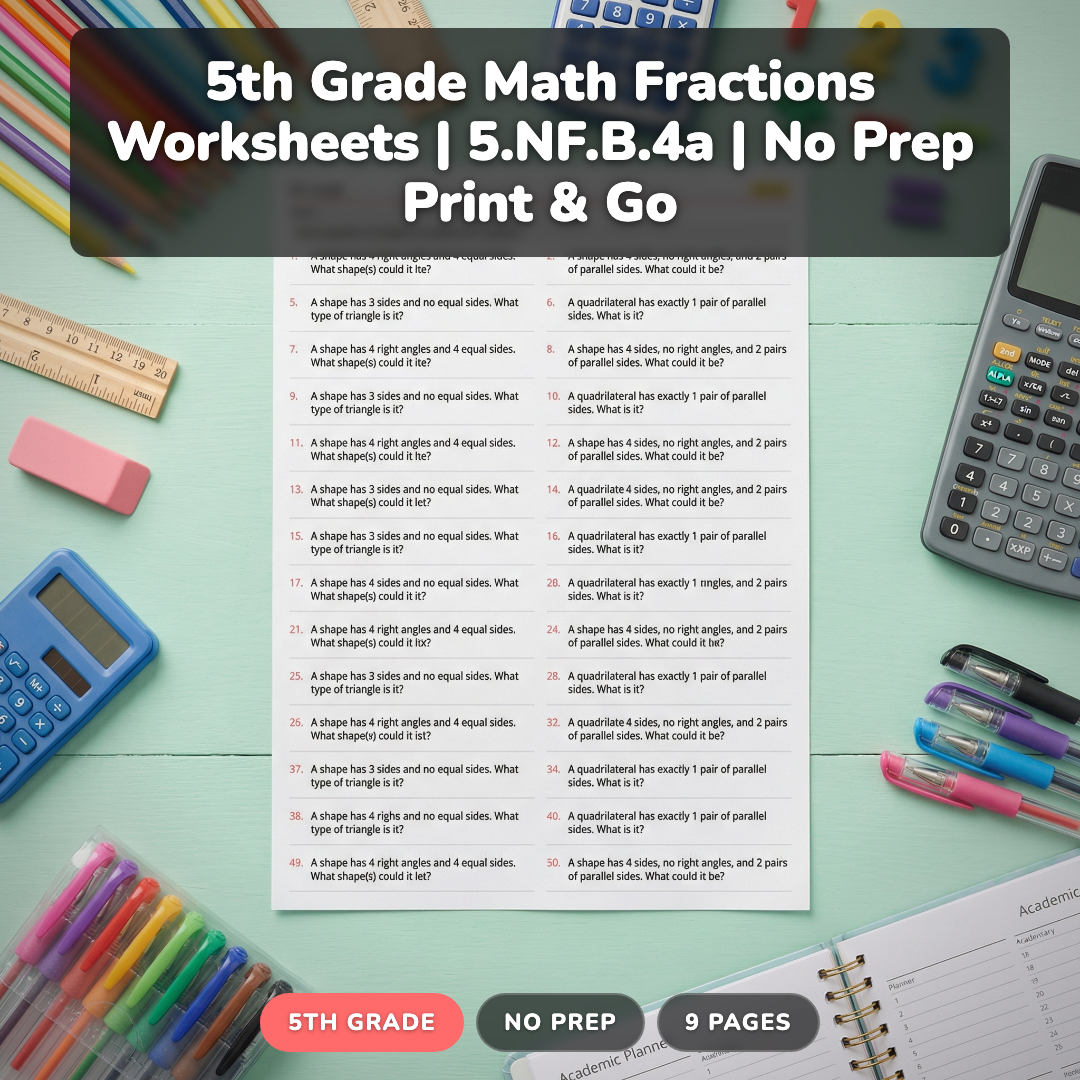
This resource includes 132 carefully crafted problems across three difficulty levels: 37 practice problems for students building foundational understanding, 50 on-level problems for grade-appropriate work, and 45 challenge problems for students ready to extend their thinking. Each level includes visual models, word problems, and computation practice.
The pack covers everything from basic unit fraction multiplication to complex mixed number scenarios. Answer keys are included for every page, and the problems are designed to build conceptual understanding, not just procedural fluency. It’s completely no-prep — just print and go.
Grab a Free Fraction Multiplication Sample to Try
Want to see how these strategies work in practice? I’ll send you a free sample pack with one worksheet from each difficulty level, plus a visual model reference sheet your students can use. Perfect for trying out these approaches with your class!
Frequently Asked Questions About Teaching Fraction Multiplication
When should I introduce the standard algorithm for fraction multiplication?
Introduce the algorithm only after students demonstrate solid conceptual understanding through visual models. Most students are ready for this in late December or January, after 3-4 weeks of concrete and visual work. Always connect the algorithm back to the visual representation.
How do I help students who keep multiplying denominators?
Use area models consistently and ask ‘What stays the same when we take parts of something?’ The whole stays divided into the same number of parts — only the numerator changes. Practice with manipulatives where students physically see the denominator represents group size, not quantity.
What’s the difference between 5.NF.B.4a and 5.NF.B.4b standards?
CCSS.Math.Content.5.NF.B.4a focuses on fraction times whole number, while 5.NF.B.4b covers fraction times fraction. Students need solid understanding of 4a before moving to 4b. The conceptual foundation of ‘parts of groups’ applies to both but gets more complex with fraction multipliers.
How long should I spend on fraction multiplication before moving on?
Plan for 2-3 weeks of intensive instruction, then spiral back throughout the year. Students need time to build conceptual understanding before procedural fluency. Rushing this concept creates gaps that show up in middle school algebra and ratios.
Should students simplify their answers to lowest terms?
Yes, but teach this as a separate step after they understand the multiplication concept. Students should first focus on getting correct answers, then learn to simplify. Connect simplification back to equivalent fractions work from earlier in the year.
Teaching fraction multiplication doesn’t have to be the stumbling block it often becomes. When students understand the ‘parts of groups’ concept through visual models and concrete experiences, the abstract algorithm makes perfect sense.
What’s your biggest challenge when teaching fraction multiplication? I’d love to hear how these strategies work in your classroom — and don’t forget to grab that free sample pack to get started!