If your fifth graders freeze when they see fractions with different denominators, you’re not alone. Adding and subtracting unlike fractions is one of the most challenging concepts in elementary math. The good news? With the right strategies, you can help every student master this essential skill and build confidence for middle school math.
Key Takeaway
Students need to understand equivalent fractions before they can successfully add fractions with unlike denominators — focus on the conceptual understanding first, then move to procedures.
Why Adding Unlike Fractions Matters in 5th Grade
Adding and subtracting fractions with unlike denominators represents a major milestone in mathematical thinking. This skill requires students to coordinate multiple concepts: equivalent fractions, common denominators, and fraction addition rules. According to the National Assessment of Educational Progress, only 24% of 8th graders can successfully solve multi-step fraction problems, highlighting how critical it is to build strong foundations in 5th grade.
The CCSS.Math.Content.5.NF.A.1 standard specifically requires students to “add and subtract fractions with unlike denominators by replacing given fractions with equivalent fractions.” This standard builds directly on 4th grade equivalent fraction work and prepares students for 6th grade algebraic thinking with rational numbers.
Research from the Institute of Education Sciences shows that students who master fraction operations in elementary school are significantly more likely to succeed in algebra. The key is helping students see fractions as numbers on a number line, not just parts of shapes.
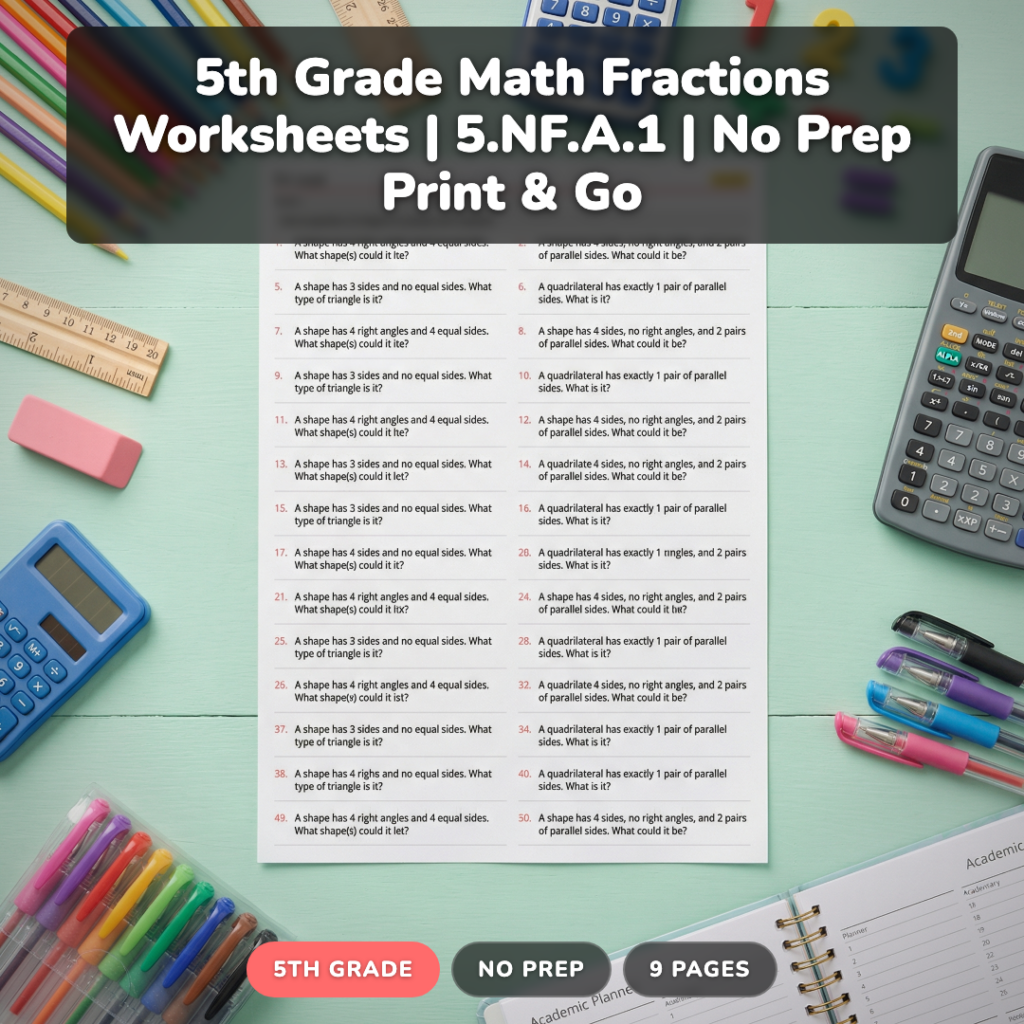
Looking for a ready-to-go resource? I put together a differentiated fraction practice pack that covers everything below — but first, the teaching strategies that make it work.
Common Fraction Addition Misconceptions in 5th Grade
Understanding where students go wrong is crucial for effective instruction. Here are the most persistent misconceptions I’ve encountered:
Common Misconception: Students add numerators and denominators separately (1/3 + 1/4 = 2/7).
Why it happens: They apply whole number addition rules to fractions without understanding what denominators represent.
Quick fix: Use visual models to show why this doesn’t work — two different-sized pieces can’t just be combined.
Common Misconception: Students think the larger denominator is always the common denominator.
Why it happens: They confuse “common” with “largest” and don’t understand least common multiples.
Quick fix: Practice with examples where the LCM isn’t the larger denominator (like 1/6 + 1/4 = 2/12 + 3/12).
Common Misconception: Students can find equivalent fractions but struggle to choose the right common denominator.
Why it happens: They memorize the procedure without understanding why it works.
Quick fix: Always start with concrete models before moving to abstract algorithms.
Common Misconception: Students forget to simplify their final answers.
Why it happens: They focus so hard on getting a common denominator that they forget the final step.
Quick fix: Create a checklist poster: “Find common denominator → Add numerators → Simplify if needed.”
5 Research-Backed Strategies for Teaching Fraction Addition
Strategy 1: Fraction Strip Visualization
Start with concrete visual models before introducing algorithms. Fraction strips help students see why fractions need common denominators and make equivalent fractions tangible.
What you need:
- Fraction strip sets (paper or manipulatives)
- Different colored strips for each fraction
- Whiteboard for recording
Steps:
- Give students the problem 1/3 + 1/6
- Have them lay out 1/3 strip and 1/6 strip
- Ask: “Can we combine these directly?” (No, different sizes)
- Guide them to find strips that match: “What strips are the same size as both?”
- Show that 1/3 = 2/6, so 1/3 + 1/6 = 2/6 + 1/6 = 3/6 = 1/2
- Record the mathematical notation alongside the visual
Strategy 2: Number Line Common Denominators
Number lines help students see fractions as points between whole numbers, reinforcing that fractions are numbers, not just pieces of shapes.
What you need:
- Large number line (0 to 2 works well)
- Sticky notes or fraction cards
- Different colored markers
Steps:
- Draw a number line and mark common fraction points
- For 2/3 + 1/4, have students locate both fractions
- Ask: “How can we mark both fractions using the same-sized parts?”
- Guide them to see that twelfths work: 2/3 = 8/12 and 1/4 = 3/12
- Show the addition by counting: 8/12 + 3/12 = 11/12
- Emphasize that we’re adding distances, not shapes
Strategy 3: Area Model with Grid Paper
Area models on grid paper provide a bridge between concrete manipulatives and abstract algorithms, helping students visualize equivalent fractions systematically.
What you need:
- Grid paper or pre-drawn rectangles
- Colored pencils or crayons
- Calculator for checking
Steps:
- Draw two identical rectangles for the problem 1/4 + 1/3
- Divide the first rectangle into fourths, shade 1/4
- Divide the second rectangle into thirds, shade 1/3
- Ask: “How can we divide both rectangles the same way?”
- Guide students to create a 3×4 grid (12 squares total)
- Show that 1/4 = 3/12 and 1/3 = 4/12
- Combine: 3/12 + 4/12 = 7/12
Strategy 4: Benchmark Fraction Strategy
Teaching students to use benchmark fractions (1/2, 1, 1 1/2) helps them estimate answers and check for reasonableness — a critical problem-solving skill.
What you need:
- Benchmark fraction chart
- Fraction problems on cards
- Timer for quick estimation rounds
Steps:
- Before solving 5/8 + 1/3, ask students to estimate
- Guide thinking: “5/8 is close to 1/2, 1/3 is close to 1/3”
- Estimate: “About 1/2 + 1/3, so close to 5/6”
- Solve: 5/8 + 1/3 = 15/24 + 8/24 = 23/24
- Check: “Is 23/24 close to our estimate of 5/6? Yes!”
- Make this a routine: estimate first, solve, then check
Strategy 5: Factor Tree Common Denominators
For students ready for more systematic approaches, factor trees help find least common multiples efficiently and connect to number theory concepts.
What you need:
- Factor tree templates
- Multiplication charts
- Practice problems with various denominators
Steps:
- For 3/10 + 1/6, create factor trees: 10 = 2×5, 6 = 2×3
- Find LCM by taking highest power of each prime: 2×3×5 = 30
- Convert: 3/10 = 9/30 and 1/6 = 5/30
- Add: 9/30 + 5/30 = 14/30
- Simplify: 14/30 = 7/15
- Connect back to visual models to maintain understanding
How to Differentiate Fraction Addition for All Learners
For Students Who Need Extra Support
Start with unit fractions (numerator of 1) and denominators that are factors of 12. Use fraction strips or circles exclusively before moving to number lines. Provide a reference sheet showing common equivalent fractions. Focus on problems where one denominator is a factor of the other (like 1/2 + 1/4) before introducing true unlike denominators. Review basic fraction concepts: what numerator and denominator mean, how to identify equivalent fractions, and fraction-to-decimal connections.
For On-Level Students
Work with the full range of denominators expected in CCSS.Math.Content.5.NF.A.1, including mixed numbers. Students should fluently move between visual models and abstract algorithms. Include word problems that require choosing the operation and interpreting remainders. Practice with fractions greater than 1 and connecting to decimal equivalents. Students should consistently check answers for reasonableness using benchmark fractions.
For Students Ready for a Challenge
Introduce three-addend problems (1/2 + 1/3 + 1/6). Explore patterns in fraction addition and connect to algebraic thinking. Include complex mixed numbers and problems requiring multiple steps. Challenge students to find multiple common denominators and compare efficiency. Connect fraction operations to real-world applications like cooking, construction, and time management. Introduce early concepts of rational number operations that preview 6th grade standards.
A Ready-to-Use Fraction Addition Resource for Your Classroom
After years of creating fraction materials, I’ve learned that differentiation is everything. Students need practice at their exact level — not too easy, not overwhelming. That’s why I created a comprehensive fraction addition pack that takes the guesswork out of planning.
This resource includes 132 carefully crafted problems across three difficulty levels: 37 practice problems for students building foundational skills, 50 on-level problems aligned to grade expectations, and 45 challenge problems for advanced learners. Each level includes clear answer keys and follows the progression from visual models to abstract thinking that research shows works best.
What sets this apart is the intentional scaffolding — practice problems focus on friendly denominators and visual support, on-level problems include the full range of unlike fractions, and challenge problems incorporate mixed numbers and multi-step thinking. No more wondering if your worksheets match your students’ needs.
Grab a Free Fraction Practice Sheet to Try
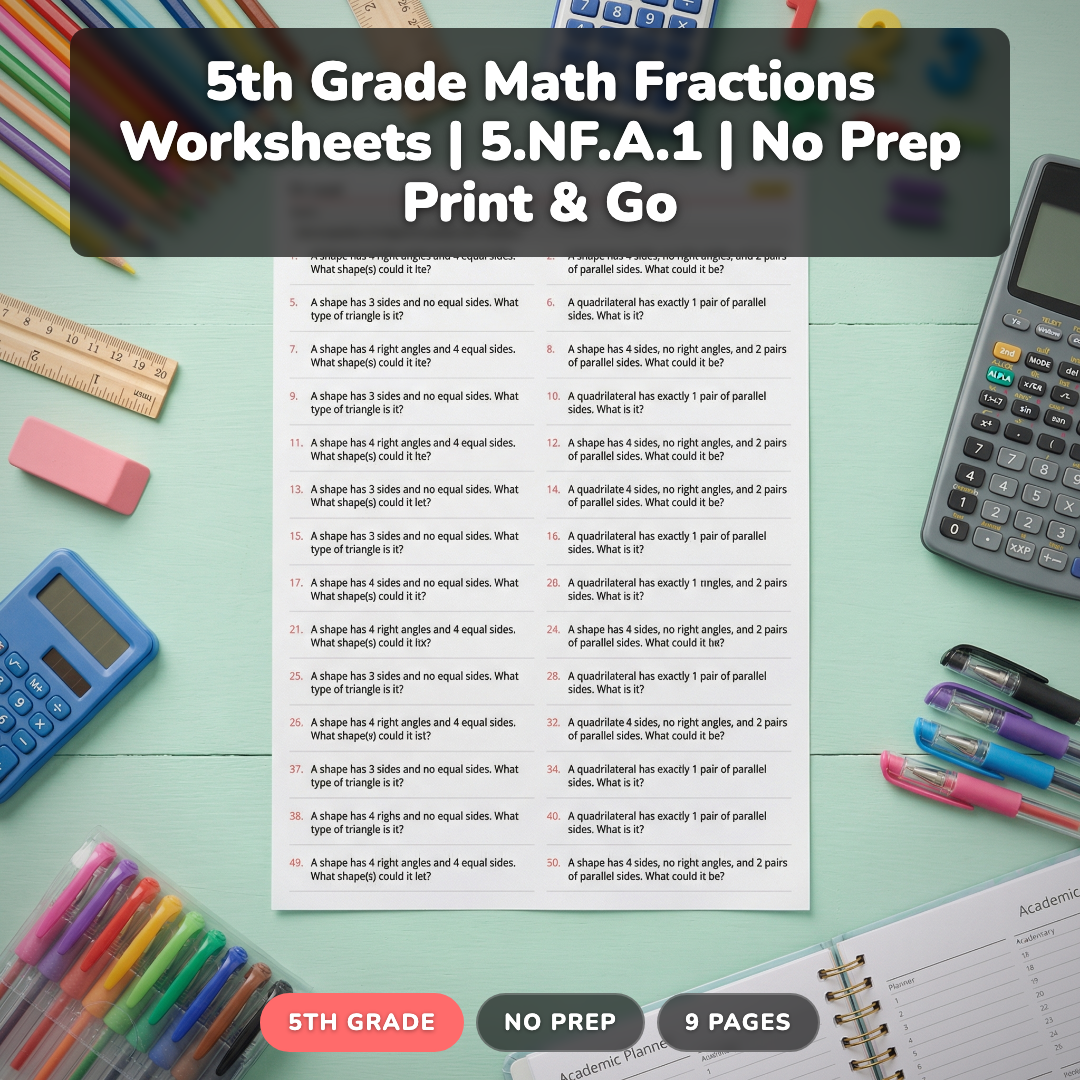
Want to see how differentiated fraction practice works? I’ll send you a free sample with problems from each level, plus my go-to anchor chart for fraction addition. Perfect for seeing what works best with your students before diving into the full resource.
Frequently Asked Questions About Teaching Fraction Addition
When should I introduce adding fractions with unlike denominators?
Introduce unlike fraction addition after students can confidently find equivalent fractions and add like fractions. Most 5th graders are ready in late fall or winter, following CCSS.Math.Content.5.NF.A.1 pacing. Ensure prerequisite skills are solid first.
Should I teach least common denominator or any common denominator first?
Start with any common denominator to build conceptual understanding, then introduce least common denominator for efficiency. Many students find success using denominators they know (like 12 or 24) before learning systematic LCM methods.
How long should students use visual models before moving to algorithms?
Students should use visual models for at least 2-3 weeks of instruction. The key indicator is when they can explain why they need common denominators, not just follow steps. Visual understanding prevents procedural errors later.
What’s the best way to help students who add numerators and denominators?
Use concrete models to show why this doesn’t work. Have students physically try to combine 1/3 and 1/4 pieces — they can’t fit together. Then show how equivalent fractions create same-sized pieces that can combine.
How do I connect fraction addition to real-world applications?
Use cooking measurements (adding 1/3 cup and 1/4 cup), time problems (1/2 hour + 1/6 hour), and craft projects (combining fabric pieces). Real contexts help students see fractions as useful tools, not just school math.
Building Fraction Confidence That Lasts
Teaching fraction addition with unlike denominators successfully comes down to building genuine understanding before introducing procedures. When students can visualize what they’re doing and explain their thinking, they’re prepared for the algebraic reasoning that comes next.
What’s your biggest challenge when teaching fraction addition? I’d love to hear what’s working (or not working) in your classroom. And don’t forget to grab that free practice sheet — it’s a great way to see differentiation in action with your own students.
Remember: every student can learn fractions with the right support and enough time to build understanding. Focus on the conceptual foundation, and the procedures will follow naturally.