If your fifth graders freeze when they see 0.347 or think 0.8 is bigger than 0.75, you’re not alone. Teaching decimals to thousandths is one of those skills that seems straightforward to adults but creates genuine confusion for 10-year-olds who are still solidifying their understanding of place value.
In this post, you’ll get five research-backed strategies that make decimal concepts click, plus differentiation tips for every learner in your classroom. These aren’t just activities — they’re teaching moves that address the specific misconceptions students have about decimal place value and comparison.
Key Takeaway
Students master decimals when they connect decimal notation to concrete place value understanding and visual models, not through memorizing rules.
Why Teaching Decimals to Thousandths Matters in Fifth Grade
Decimal understanding forms the foundation for middle school algebra, scientific notation, and real-world problem solving. The CCSS.Math.Content.5.NBT.A.3 standard requires students to read, write, and compare decimals to thousandths, building directly on their fourth-grade work with decimals to hundredths.
Research from the National Council of Teachers of Mathematics shows that students who develop strong decimal sense in fifth grade are 40% more likely to succeed in pre-algebra concepts like scientific notation and proportional reasoning. This skill typically appears in your curriculum between October and December, after students have solidified whole number place value concepts.
The standard connects to CCSS.Math.Content.5.NBT.A.1 (place value understanding) and CCSS.Math.Content.5.NBT.A.4 (rounding decimals), creating a comprehensive foundation for rational number understanding. Students must move beyond simply identifying decimal places to truly understanding what those places represent in terms of quantity and relative size.
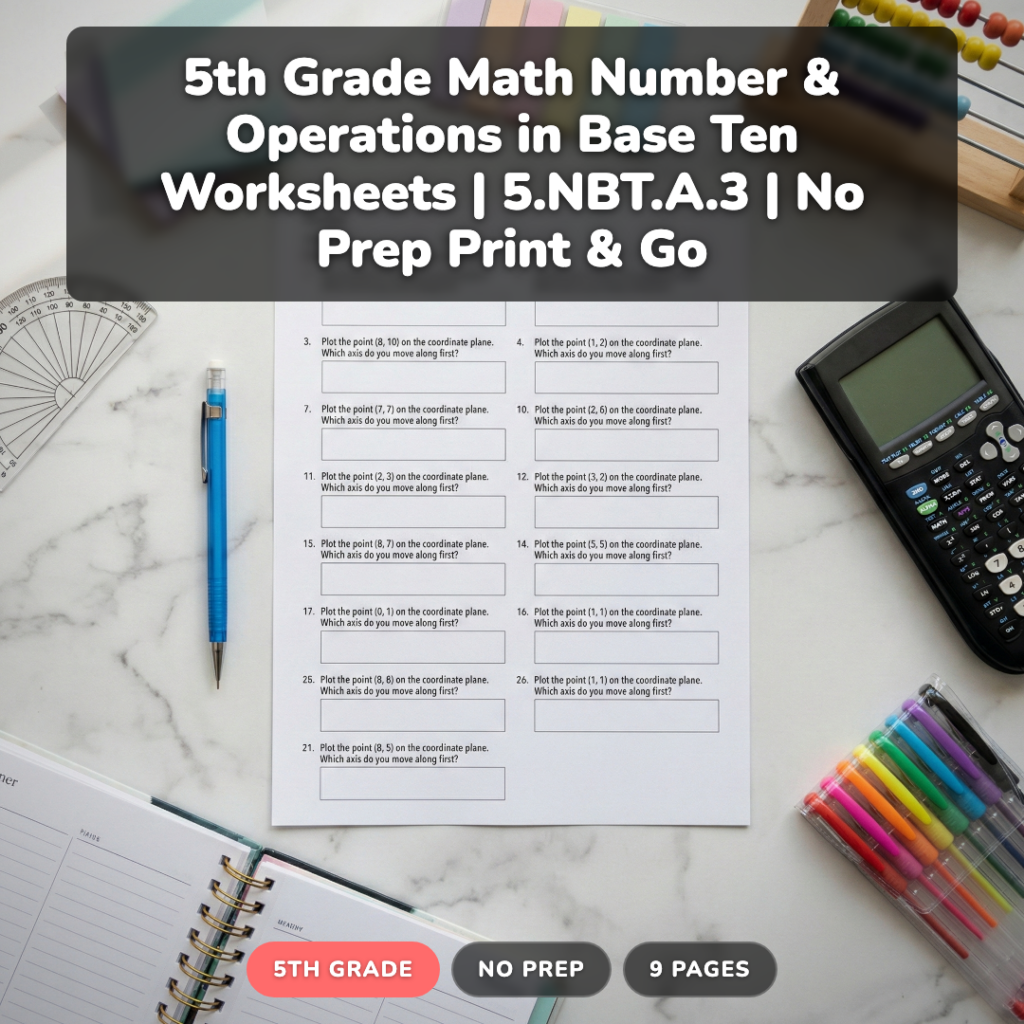
Looking for a ready-to-go resource? I put together a differentiated decimals practice pack with 132 problems across three levels — but first, the teaching strategies that make it work.
Common Decimal Misconceptions in Fifth Grade
Common Misconception: Students think longer decimals are always larger (0.8 < 0.75 because 75 > 8).
Why it happens: They apply whole number thinking where more digits means bigger numbers.
Quick fix: Use money models and place value charts to show equivalent representations.
Common Misconception: Students read 0.347 as “three hundred forty-seven” instead of “three hundred forty-seven thousandths.”
Why it happens: They don’t connect decimal notation to fractional parts of a whole.
Quick fix: Always include the place value name when reading decimals aloud.
Common Misconception: Students think adding zeros changes the value (0.5 ≠ 0.50).
Why it happens: They don’t understand that zeros hold place value without changing quantity.
Quick fix: Use base-ten blocks to show equivalent representations visually.
Common Misconception: Students compare decimals digit by digit from right to left instead of place value order.
Why it happens: They transfer whole number comparison strategies inappropriately.
Quick fix: Teach explicit comparison strategies using place value alignment.
5 Research-Backed Strategies for Teaching Decimals to Thousandths
Strategy 1: Base-Ten Block Decimal Modeling
This concrete strategy helps students visualize decimal place value using manipulatives they already know from whole number work. Students use base-ten blocks where the flat represents one whole, rods represent tenths, and small cubes represent hundredths.
What you need:
- Base-ten blocks (flats, rods, small cubes)
- Decimal place value mats
- Recording sheets
Steps:
- Establish that one flat equals one whole unit
- Show students that one rod equals one-tenth of the flat
- Demonstrate that one small cube equals one-hundredth of the flat
- Have students build decimals like 0.347 using 3 rods, 4 small cubes, and discuss the missing thousandths
- Practice reading the decimal aloud: “three tenths, four hundredths, seven thousandths”
Strategy 2: Number Line Decimal Placement
Number lines provide a visual representation of decimal magnitude and help students understand relative size. This strategy directly addresses the misconception that longer decimals are always larger.
What you need:
- Large number lines marked in tenths
- Decimal cards
- Sticky notes or clips
Steps:
- Start with a number line from 0 to 1, marked in tenths
- Give students decimal cards like 0.3, 0.75, 0.8, 0.347
- Have them place each decimal on the number line
- Discuss why 0.8 comes after 0.75 even though 75 has more digits
- Zoom in on sections to show hundredths and thousandths placement
Strategy 3: Decimal Grid Comparison Game
This engaging partner activity reinforces decimal comparison while providing repeated practice with place value reasoning. Students use 10×10 grids to visualize decimal quantities.
What you need:
- 10×10 grids (hundredths grids)
- Colored pencils
- Decimal comparison cards
Steps:
- Give each pair two decimal numbers like 0.47 and 0.5
- Students shade the first decimal on one grid, second on another
- Compare the shaded amounts visually
- Write the comparison using <, >, or = symbols
- Explain their reasoning using place value language
Strategy 4: Money Connection Method
Connecting decimals to money leverages students’ real-world experience and provides a meaningful context for decimal place value. This strategy works particularly well for tenths and hundredths.
What you need:
- Play money (dollars, dimes, pennies)
- Price tags with decimal amounts
- Shopping scenario cards
Steps:
- Establish that $1.00 equals one whole, $0.10 equals one tenth, $0.01 equals one hundredth
- Give students amounts like $3.47 to represent with play money
- Practice reading amounts: “three dollars and forty-seven cents”
- Compare prices: “Is $2.50 more or less than $2.05?”
- Extend to thousandths using gas prices or scientific measurements
Strategy 5: Decimal Expansion Patterns
This strategy helps students understand the relationship between fractions and decimals while building number sense about decimal equivalencies and place value patterns.
What you need:
- Fraction-decimal equivalency charts
- Calculators
- Pattern recording sheets
Steps:
- Start with familiar fractions: 1/2, 1/4, 3/4, 1/5
- Use calculators to find decimal equivalents
- Record patterns: 1/2 = 0.5 = 0.50 = 0.500
- Discuss why these are equivalent (same value, different representations)
- Explore what happens with fractions like 1/3 (repeating decimals)
How to Differentiate Decimals for All Learners
For Students Who Need Extra Support
Start with concrete manipulatives and limit to tenths initially. Use money connections extensively since most students understand dollars and cents. Provide place value charts with clear labels and practice reading decimals aloud daily. Review fraction concepts like halves and fourths before introducing decimal notation. Use number lines with pre-marked intervals and focus on one skill at a time rather than combining reading, writing, and comparing.
For On-Level Students
Students at grade level should work with decimals to thousandths as outlined in CCSS.Math.Content.5.NBT.A.3. They can handle multiple representations simultaneously and begin making connections between fractions and decimals. Provide practice with real-world contexts like measurements and money. Focus on comparison strategies and place value reasoning. These students benefit from partner work and explaining their thinking to others.
For Students Ready for a Challenge
Extend learning to ten-thousandths and beyond. Explore repeating decimals and irrational numbers like π. Connect to scientific notation and metric measurement conversions. Challenge students to create their own decimal comparison problems or investigate patterns in decimal expansions. Introduce concepts like rounding to specific place values and estimating with decimals.
A Ready-to-Use Decimals Resource for Your Classroom
Teaching decimals effectively requires extensive practice with varied problem types, and creating differentiated materials takes hours you don’t have. That’s why I created a comprehensive decimal practice pack specifically aligned to CCSS.Math.Content.5.NBT.A.3 that saves you prep time while giving every student appropriate challenge.
This 9-page resource includes 132 carefully crafted problems across three difficulty levels: 37 practice problems for students building foundational skills, 50 on-level problems for grade-level expectations, and 45 challenge problems for advanced learners. Each level includes reading, writing, and comparing decimals to thousandths with clear answer keys and step-by-step solutions.
What makes this different from generic worksheets? Every problem is designed around the specific misconceptions students have about decimal place value. The practice level focuses on concrete representations, on-level problems emphasize comparison strategies, and challenge problems extend to real-world applications and pattern recognition.
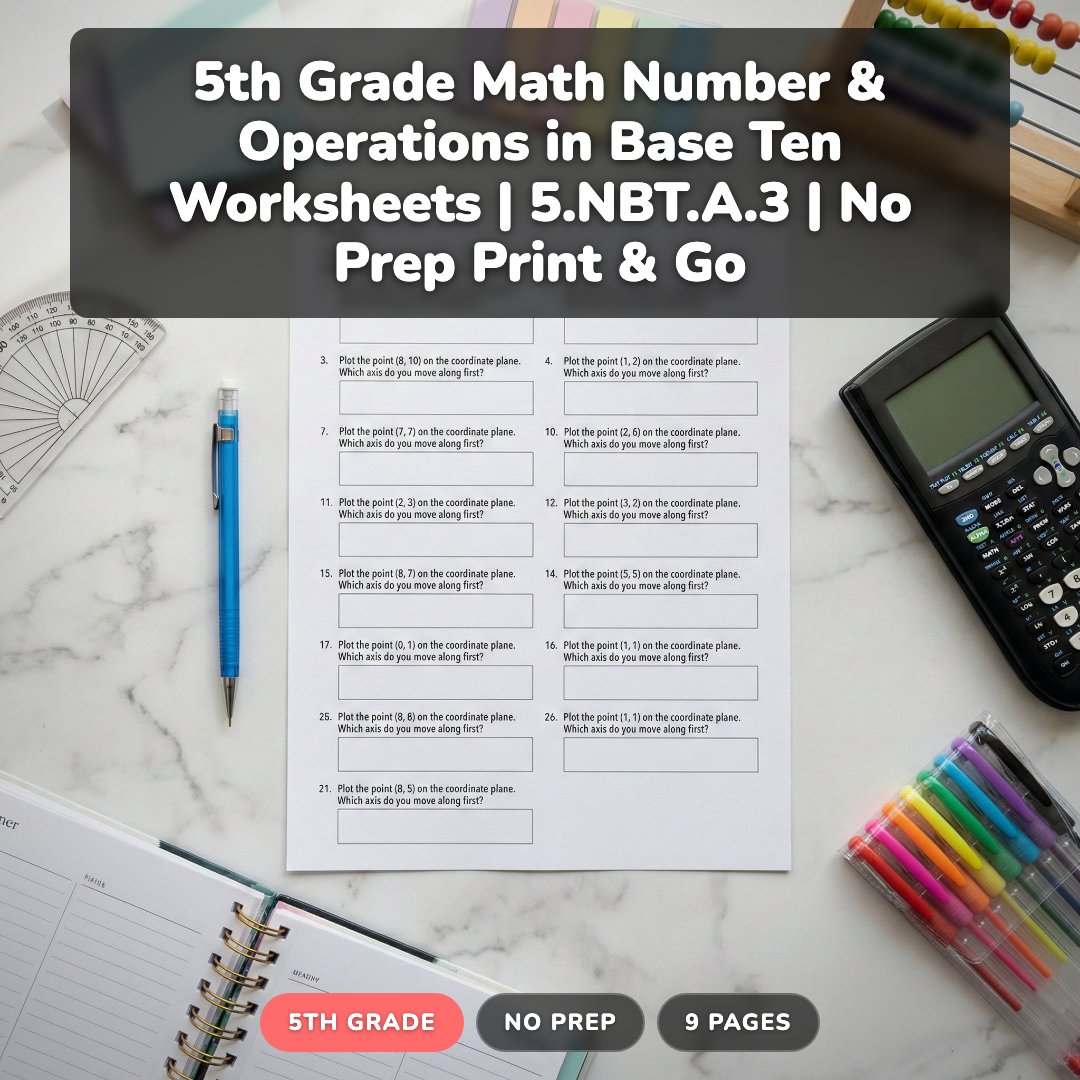
You can grab this time-saving resource and start using it tomorrow — no prep required.
Grab a Free Decimal Practice Sheet to Try
Want to see how these strategies work in practice? I’ll send you a free sample worksheet that includes problems from each difficulty level, plus a quick reference guide for teaching decimal comparison strategies.
Frequently Asked Questions About Teaching Decimals to Thousandths
When should I introduce thousandths in my fifth-grade curriculum?
Introduce thousandths after students are solid with tenths and hundredths, typically in November or December. Students need strong place value foundation before extending to three decimal places. Start with concrete models and gradually move to abstract notation.
What’s the most effective way to help students compare decimals?
Teach students to align place values and compare from left to right, just like whole numbers. Use the strategy: “Line up the decimal points, then compare place by place starting with the largest place value.” Visual models like number lines reinforce this concept.
How do I address the misconception that longer decimals are bigger?
Use concrete models like base-ten blocks or money to show that 0.5 and 0.50 represent the same amount. Have students shade grids to visualize that 0.8 covers more area than 0.75, even though 75 has more digits than 8.
Should I teach decimal-fraction connections in fifth grade?
Yes, but focus on simple connections like 0.5 = 1/2 and 0.25 = 1/4. These connections strengthen number sense and help students understand that decimals and fractions represent the same quantities. Avoid complex conversions that aren’t developmentally appropriate.
What manipulatives work best for teaching decimal place value?
Base-ten blocks are most effective because students already know them from whole number work. Use flats as wholes, rods as tenths, and small cubes as hundredths. Money (dollars, dimes, pennies) also works well for connecting to real-world experience.
Building Strong Decimal Foundation for Middle School Success
Teaching decimals to thousandths isn’t just about meeting a fifth-grade standard — you’re building the foundation for every mathematical concept your students will encounter in middle school and beyond. When students truly understand place value in decimals, they’re ready for scientific notation, algebraic thinking, and proportional reasoning.
Remember to start with concrete experiences, use visual models consistently, and give students plenty of time to talk through their thinking. The strategies above work because they address the specific ways students think about numbers at this developmental stage.
What’s your go-to strategy for helping students compare decimals? I’d love to hear what works in your classroom, and don’t forget to grab that free practice sheet to try these ideas with your students.