If your 5th graders freeze when they see a rectangular prism and need to find its volume, you’re not alone. Volume is one of those abstract concepts that clicks beautifully once students understand it — but getting there requires the right approach. You’ll discover five research-backed strategies that help students truly grasp volume, plus differentiation tips for every learner in your classroom.
Key Takeaway
Students understand volume best when they physically build with unit cubes before moving to formulas — the concrete-to-abstract progression is crucial for lasting comprehension.
Why Volume Matters in 5th Grade Math
Volume instruction in 5th grade represents a critical bridge between basic multiplication facts and advanced geometric reasoning. According to the National Council of Teachers of Mathematics, students who master volume concepts in elementary school show significantly stronger performance in middle school geometry and algebra.
The CCSS.Math.Content.5.MD.C.5a standard specifically requires students to find volume by packing rectangular prisms with unit cubes and connecting this concrete experience to the abstract formula V = l × w × h. This standard typically appears in the final quarter of 5th grade, after students have solidified their understanding of multi-digit multiplication and area formulas.
Research from the Journal of Mathematical Behavior shows that students who experience hands-on volume activities before learning formulas demonstrate 40% better retention of volume concepts compared to those who start with abstract calculations. The key is helping students see that volume measures how much space an object takes up — not just memorizing a formula.
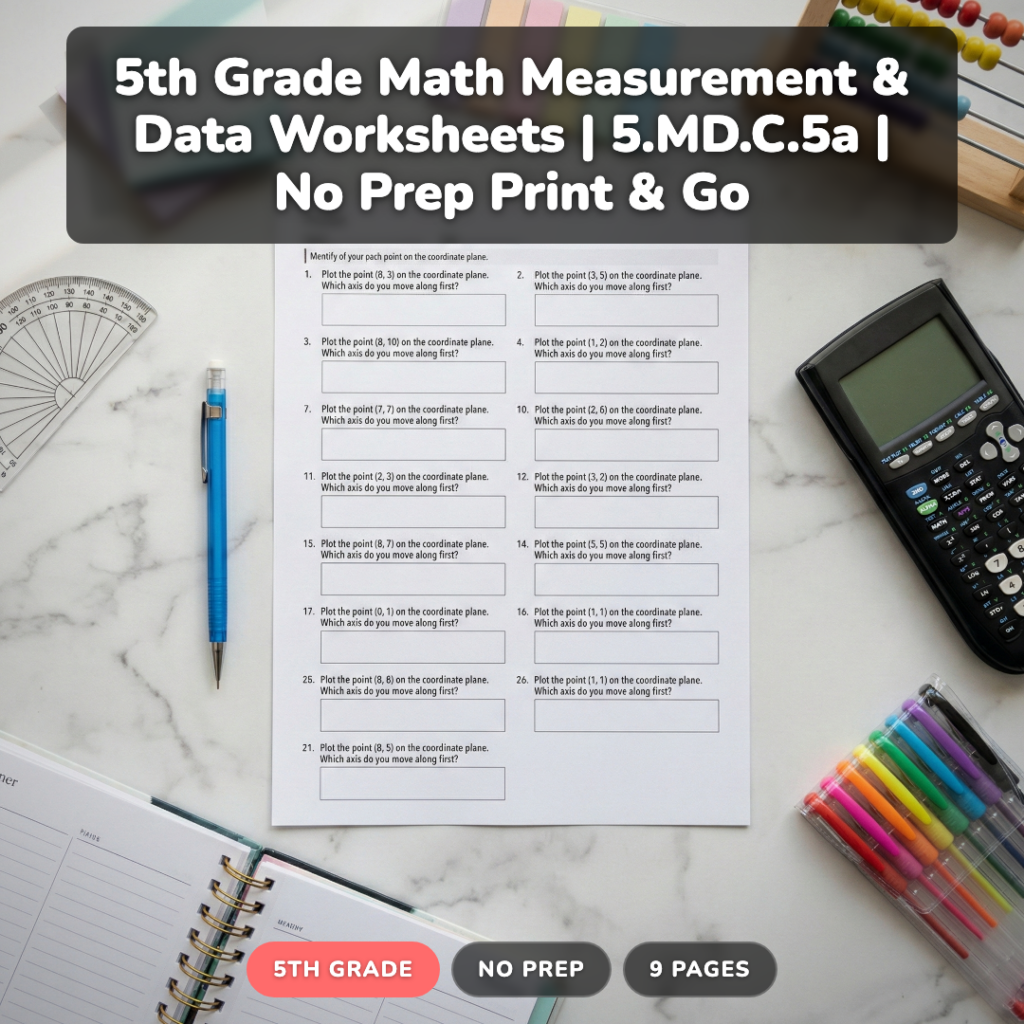
Looking for a ready-to-go resource? I put together a differentiated volume practice pack with 132 problems across three levels — but first, the teaching strategies that make it work.
Common Volume Misconceptions in 5th Grade
Understanding where students typically struggle with volume helps you address these misconceptions before they become entrenched. Here are the four most common volume misconceptions I’ve encountered in 5th grade classrooms:
Common Misconception: Students confuse volume with surface area or perimeter.
Why it happens: All three concepts involve measuring rectangles, but students don’t distinguish between measuring around, across, or inside.
Quick fix: Use the language “how much fits inside” consistently when discussing volume.
Common Misconception: Students think volume is always length × width, ignoring height.
Why it happens: They overgeneralize from area formulas or work with flat representations.
Quick fix: Always start with 3D manipulatives before showing 2D drawings of prisms.
Common Misconception: Students believe bigger-looking shapes always have greater volume.
Why it happens: They rely on visual estimation rather than systematic counting or calculating.
Quick fix: Compare a tall, thin prism with a short, wide prism using actual unit cubes.
Common Misconception: Students think the formula works by magic, not understanding why you multiply three dimensions.
Why it happens: They memorize V = l × w × h without connecting it to the cube-packing experience.
Quick fix: Always demonstrate that l × w gives you the base layer, then multiply by h to stack that many layers.
5 Research-Backed Strategies for Teaching Volume
Strategy 1: Cube Packing with Systematic Counting
Students physically build rectangular prisms using unit cubes, then count systematically to find volume. This concrete experience forms the foundation for understanding why the volume formula works.
What you need:
- Unit cubes (at least 100 per group of 3-4 students)
- Recording sheets with prism outlines
- Small containers or boxes to define prism shapes
Steps:
- Give each group a small rectangular container and enough cubes to fill it
- Students pack the container completely with unit cubes, ensuring no gaps
- Count cubes systematically: first count one layer, then multiply by the number of layers
- Record the dimensions and total volume on their recording sheet
- Repeat with containers of different dimensions
- Look for patterns in their volume calculations
Strategy 2: Base-and-Height Visualization
Students learn to see volume as “base area times height” by building one layer completely, then stacking identical layers. This strategy directly connects to the CCSS.Math.Content.5.MD.C.5a requirement to multiply height by base area.
What you need:
- Unit cubes in two different colors
- Grid paper for recording base patterns
- Transparent containers or plastic bins
Steps:
- Students use one color of cubes to build the base layer of a rectangular prism
- Count the cubes in the base layer and record this as the base area
- Use the second color to build additional identical layers on top
- Count the total number of layers (this is the height)
- Calculate volume by multiplying base area × height
- Verify by counting all cubes to confirm the calculation
Strategy 3: Formula Connection Through Decomposition
Students discover that length × width × height works by breaking down the multiplication into meaningful steps. This strategy helps them understand why the formula produces the same result as cube counting.
What you need:
- Pre-built rectangular prisms of various sizes
- Calculators for verification
- Chart paper for recording discoveries
Steps:
- Present a rectangular prism and have students measure its dimensions
- Guide them to calculate length × width first (“How many cubes fit in the bottom layer?”)
- Multiply that result by height (“How many layers do we need?”)
- Compare this calculation to their cube-counting results from previous activities
- Practice with multiple prisms, always connecting the formula steps to physical meaning
- Introduce the formal notation V = l × w × h once the concept is solid
Strategy 4: Real-World Volume Applications
Students apply volume concepts to solve practical problems involving containers, packaging, and space planning. This strategy helps them see volume as a useful tool, not just an abstract math concept.
What you need:
- Various small boxes and containers
- Rulers or measuring tapes
- Real-world volume problems (shipping, storage, etc.)
Steps:
- Present authentic scenarios: “How many 1-inch cubes fit in this cereal box?”
- Students measure the container dimensions carefully
- Calculate volume using the formula they’ve learned
- When possible, verify by actually packing the container with unit cubes
- Discuss when exact cube packing isn’t possible (irregular shapes, rounded corners)
- Connect to other volume units (cubic feet for rooms, liters for liquids)
Strategy 5: Volume Comparison and Reasoning
Students compare volumes of different rectangular prisms and develop reasoning skills about how changing dimensions affects volume. This strategy builds deeper conceptual understanding beyond basic calculation.
What you need:
- Sets of rectangular prisms with related dimensions
- Recording sheets for comparisons
- Graphing materials for visual representations
Steps:
- Present pairs of prisms where one dimension changes: (2×3×4) vs. (2×3×8)
- Students predict which has greater volume before calculating
- Calculate both volumes and compare results
- Discuss the relationship: “When we doubled the height, what happened to the volume?”
- Explore what happens when multiple dimensions change
- Challenge students to create prisms with specific volume requirements
How to Differentiate Volume Instruction for All Learners
For Students Who Need Extra Support
Begin with smaller rectangular prisms (dimensions no larger than 4) and provide containers with visible grid lines on the bottom. Use manipulatives exclusively for the first week, allowing students to count cubes multiple times before introducing any formulas. Provide sentence frames like “The base layer has ___ cubes” and “There are ___ layers, so the total volume is ___” to support mathematical language development. Consider pairing struggling students with strong spatial thinkers for cube-building activities.
For On-Level Students
Students at grade level should work with rectangular prisms having dimensions up to 10 and practice moving fluidly between cube counting and formula calculations. They should master the standard CCSS.Math.Content.5.MD.C.5a expectations: packing prisms with unit cubes, connecting to the multiplication formula, and representing three-factor products as volumes. Provide mixed practice with both concrete manipulatives and abstract calculations, ensuring they can explain why the volume formula works.
For Students Ready for a Challenge
Advanced students can explore complex rectangular prisms with dimensions up to 15, investigate the associative property of multiplication through volume (showing that 3×4×5 = (3×4)×5 = 3×(4×5)), and solve optimization problems like finding all possible rectangular prisms with a volume of 60 cubic units. Introduce connections to surface area and challenge them to design packaging that minimizes material while maintaining specific volume requirements.
A Ready-to-Use Volume Resource for Your Classroom
After years of teaching volume to 5th graders, I’ve learned that students need extensive, differentiated practice to truly master this concept. That’s why I created a comprehensive volume practice pack that takes the guesswork out of providing appropriate challenges for every student in your classroom.
This resource includes 132 carefully crafted problems across three distinct levels: 37 practice problems for students who need extra support, 50 on-level problems that align perfectly with grade-level expectations, and 45 challenge problems for advanced learners. Each level scaffolds students through the progression from concrete cube-packing to abstract formula application, exactly as the research recommends.
What makes this resource different is its systematic approach to building volume understanding. The practice level focuses on smaller dimensions and includes visual supports, the on-level problems mirror typical state assessment questions, and the challenge level pushes students to apply volume concepts in creative problem-solving scenarios. Answer keys are included for quick checking, and the problems are designed to be used as independent practice, homework, or assessment preparation.
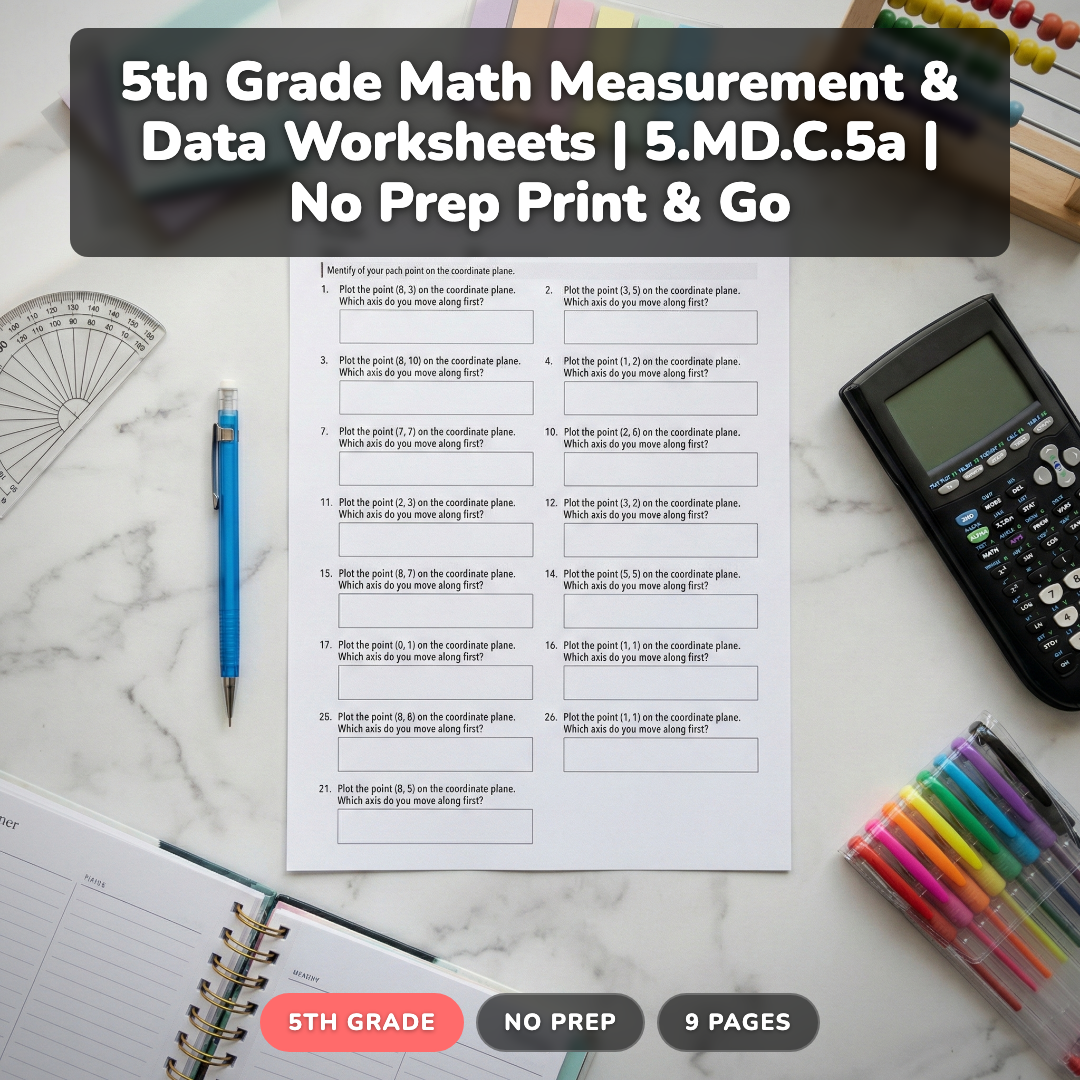
You can grab this time-saving resource and have differentiated volume practice ready for tomorrow’s math block.
Grab a Free Volume Practice Sheet to Try
Want to see how this differentiated approach works in your classroom? I’ll send you a free sample volume worksheet that includes problems from each level, plus a quick reference guide for teaching the cube-packing strategy. Drop your email below and I’ll send it right over.
Frequently Asked Questions About Teaching Volume
When should I introduce the volume formula to 5th graders?
Introduce V = l × w × h only after students have spent at least a week building rectangular prisms with unit cubes and can explain why you multiply three dimensions. The formula should feel like a shortcut for counting, not a mysterious rule. Most students are ready for the formula after 5-7 hands-on lessons with manipulatives.
What’s the difference between volume and capacity?
Volume measures the amount of 3D space an object occupies (measured in cubic units like cubic inches), while capacity measures how much liquid a container can hold (measured in fluid units like cups or liters). In 5th grade, focus primarily on volume with unit cubes, though you can mention that capacity is a real-world application of volume concepts.
How do I help students who confuse volume with area?
Use consistent language: area measures “how much space covers a flat surface” while volume measures “how much fits inside a 3D shape.” Always use 3D manipulatives when teaching volume, and avoid showing 2D drawings until students are solid with the concept. Have students physically trace around shapes for area and fill containers for volume.
What if my students struggle with the multiplication required for volume?
Break volume problems into smaller multiplication steps. For a 4×3×5 prism, have students calculate 4×3=12 first (“cubes in the bottom layer”), then 12×5=60 (“total cubes in all layers”). Provide calculators if multiplication facts are still developing, since the focus should be on understanding volume concepts, not computation speed.
How does 5th grade volume connect to middle school math?
Strong volume understanding in 5th grade directly supports 6th grade work with surface area, 7th grade geometry with more complex 3D shapes, and 8th grade algebra where students work with cubic equations. The spatial reasoning and formula manipulation skills developed through volume instruction are foundational for all future geometry and algebra success.
Teaching volume effectively requires patience and the right progression from concrete to abstract thinking. Start with those unit cubes, let students discover the patterns, and watch as the formula becomes a natural conclusion rather than a memorized rule. What’s your go-to strategy for helping students visualize 3D shapes? Remember to grab your free volume practice sheet above — it’s a great way to see these strategies in action with your students.