If your 5th graders look confused when you mention volume, you’re not alone. Teaching students to relate volume to multiplication and addition while solving real-world problems is one of the trickiest concepts in 5th grade math.
You need concrete strategies that help students visualize three-dimensional space, understand the relationship between volume formulas and actual counting, and apply their learning to authentic problems. This post walks you through six research-backed approaches that make volume concepts click for every learner in your classroom.
Key Takeaway
Students master volume when they move from concrete manipulation to abstract formulas, connecting multiplication patterns to three-dimensional thinking.
Why Volume Matters in 5th Grade Math
Volume instruction in 5th grade represents a critical bridge between basic multiplication facts and advanced geometric reasoning. According to the Van Hiele theory of geometric development, students at this age are transitioning from recognizing shapes to understanding their properties and relationships.
The CCSS.Math.Content.5.MD.C.5 standard requires students to relate volume to multiplication and addition operations while solving real-world problems. This connects directly to earlier work with area (CCSS.Math.Content.5.MD.C.5a) and sets the foundation for middle school geometry standards.
Research from the National Council of Teachers of Mathematics shows that students who develop strong spatial reasoning skills in elementary school perform 23% better on standardized assessments in middle and high school mathematics. Volume concepts specifically strengthen proportional reasoning and algebraic thinking.
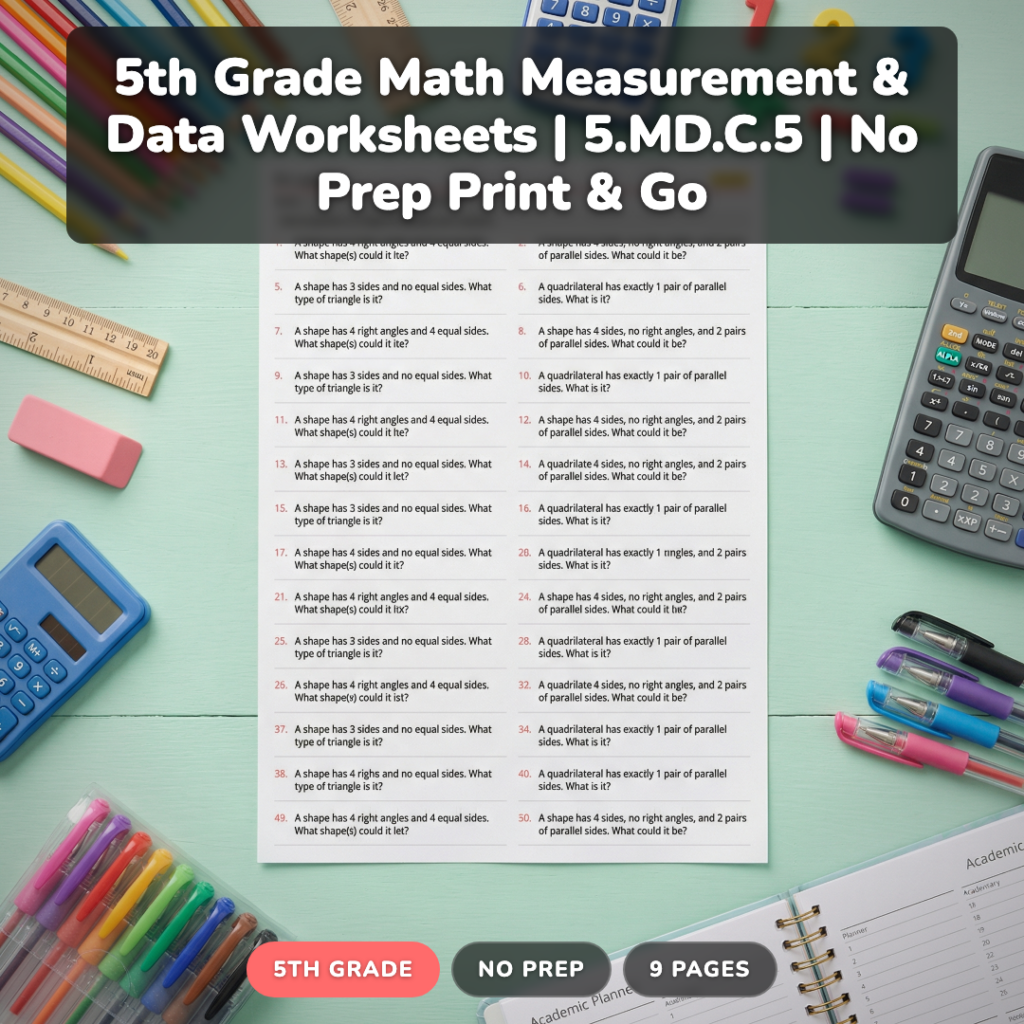
Looking for a ready-to-go resource? I put together a differentiated volume practice pack that covers everything below — but first, the teaching strategies that make it work.
Common Volume Misconceptions in 5th Grade
Understanding where students typically struggle helps you address confusion before it becomes entrenched. Here are the four most frequent volume misconceptions I see in 5th grade classrooms:
Common Misconception: Students think volume and area are the same thing.
Why it happens: Both involve multiplication, and students haven’t developed strong spatial reasoning for three dimensions.
Quick fix: Use physical containers and compare flat shapes to boxes side-by-side.
Common Misconception: Students believe larger-looking shapes always have greater volume.
Why it happens: They rely on visual perception rather than mathematical calculation.
Quick fix: Fill containers with rice or water to demonstrate actual capacity versus appearance.
Common Misconception: Students think they can find volume by adding length + width + height.
Why it happens: They confuse perimeter patterns with volume formulas.
Quick fix: Explicitly contrast addition (perimeter) with multiplication (area and volume) using visual models.
Common Misconception: Students struggle to see the connection between counting unit cubes and using formulas.
Why it happens: They view these as separate procedures rather than equivalent methods.
Quick fix: Build the same rectangular prism with cubes, then calculate using length × width × height to show identical results.
6 Research-Backed Strategies for Teaching Volume
Strategy 1: Unit Cube Building and Counting
Start with concrete manipulation before introducing abstract formulas. Students need to physically handle three-dimensional objects to develop spatial reasoning that supports later mathematical thinking.
What you need:
- Connecting cubes (at least 100 per group)
- Recording sheets for counting patterns
- Various rectangular containers for reference
Steps:
- Give each group 24 cubes and challenge them to build different rectangular prisms
- Have students count total cubes for each arrangement (2×3×4, 1×4×6, etc.)
- Record dimensions and total volume in an organized chart
- Discuss patterns: Why do some arrangements use all 24 cubes while others don’t fit?
- Connect counting to multiplication: ‘We counted 24 cubes, and 2×3×4 also equals 24’
Strategy 2: Layer-by-Layer Volume Visualization
Help students see volume as stacked layers of area, connecting their solid understanding of length × width to three-dimensional thinking.
What you need:
- Transparent containers or glass baking dishes
- Colored paper squares (1-inch grid)
- Centimeter cubes or sugar cubes
Steps:
- Show students a rectangular container and place one layer of paper squares on the bottom
- Count squares in the base layer and record as length × width
- Add a second layer of cubes, asking ‘How many cubes total now?’
- Continue adding layers, calculating total volume after each addition
- Write the pattern: 1 layer = 12, 2 layers = 24, 3 layers = 36
- Connect to formula: base area × height = total volume
Strategy 3: Real-World Volume Problem Solving
Connect mathematical calculations to authentic contexts that students encounter in daily life, strengthening both engagement and retention.
What you need:
- Various containers (cereal boxes, shipping boxes, aquariums)
- Measuring tools (rulers, measuring tape)
- Calculator for checking work
- Real-world problem scenarios
Steps:
- Present authentic problems: ‘How many 1-inch cubes fit in this cereal box?’
- Students measure dimensions and estimate before calculating
- Calculate volume using length × width × height formula
- When possible, verify by actually filling containers with unit cubes
- Discuss why estimates might differ from calculations (irregular shapes, packaging thickness)
- Extend to related problems: ‘If we stack 3 identical boxes, what’s the total volume?’
Strategy 4: Volume and Capacity Connections
Bridge the gap between geometric volume calculations and practical capacity measurements, helping students understand real-world applications.
What you need:
- Measuring cups and containers of known volume
- Water or rice for filling
- Conversion chart (cubic inches to fluid ounces)
Steps:
- Calculate the volume of a rectangular container using dimensions
- Predict how much water it will hold based on volume calculation
- Fill container with water and measure actual capacity
- Compare mathematical volume to practical capacity
- Discuss why they might differ (container thickness, measurement precision)
- Practice converting between cubic units and capacity units
Strategy 5: Decomposing Complex Shapes
Teach students to break down irregular three-dimensional figures into familiar rectangular prisms, building problem-solving flexibility.
What you need:
- Connecting cubes in two different colors
- Graph paper for sketching
- Pre-made L-shaped and T-shaped figures
Steps:
- Present an L-shaped figure built from cubes
- Challenge students to find total volume without counting every cube
- Model breaking the shape into two rectangular sections
- Calculate volume of each section separately
- Add partial volumes to find total volume
- Verify by counting all cubes to check accuracy
Strategy 6: Volume Comparison and Reasoning
Develop students’ ability to compare volumes without calculating, strengthening spatial reasoning and proportional thinking skills.
What you need:
- Sets of rectangular prisms with different dimensions
- Recording sheet for comparisons
- Optional: digital tools for creating virtual manipulatives
Steps:
- Present two rectangular prisms with different dimensions
- Ask students to predict which has greater volume before calculating
- Have students justify their reasoning using mathematical language
- Calculate both volumes to verify predictions
- Discuss surprising results and what they reveal about spatial thinking
- Create additional comparison problems based on student misconceptions
How to Differentiate Volume Instruction for All Learners
For Students Who Need Extra Support
Begin with smaller numbers and concrete materials exclusively. Use 2×2×2 or 3×3×2 arrangements before attempting larger volumes. Provide multiplication fact practice alongside volume work, since students need automatic recall of basic facts to focus on spatial reasoning. Create visual anchor charts showing the step-by-step process: measure length, measure width, measure height, multiply all three numbers. Allow extra time for hands-on exploration before moving to abstract calculations.
For On-Level Students
Focus on the full CCSS.Math.Content.5.MD.C.5 expectations with dimensions up to 10 units. Students should fluently move between concrete models and abstract formulas, solving multi-step problems that involve finding unknown dimensions when volume is given. Emphasize real-world applications like calculating storage space or comparing container capacities. Expect students to explain their reasoning and check answers using multiple methods.
For Students Ready for a Challenge
Introduce non-unit cubes and decimal dimensions, connecting to measurement conversions between different units. Present composite figures that require decomposition strategies and problems with multiple solution paths. Challenge students to create their own volume problems for classmates to solve, and explore how changing one dimension affects total volume proportionally. Connect volume concepts to surface area and introduce early algebraic thinking through problems with unknown dimensions.
A Ready-to-Use Volume Resource for Your Classroom
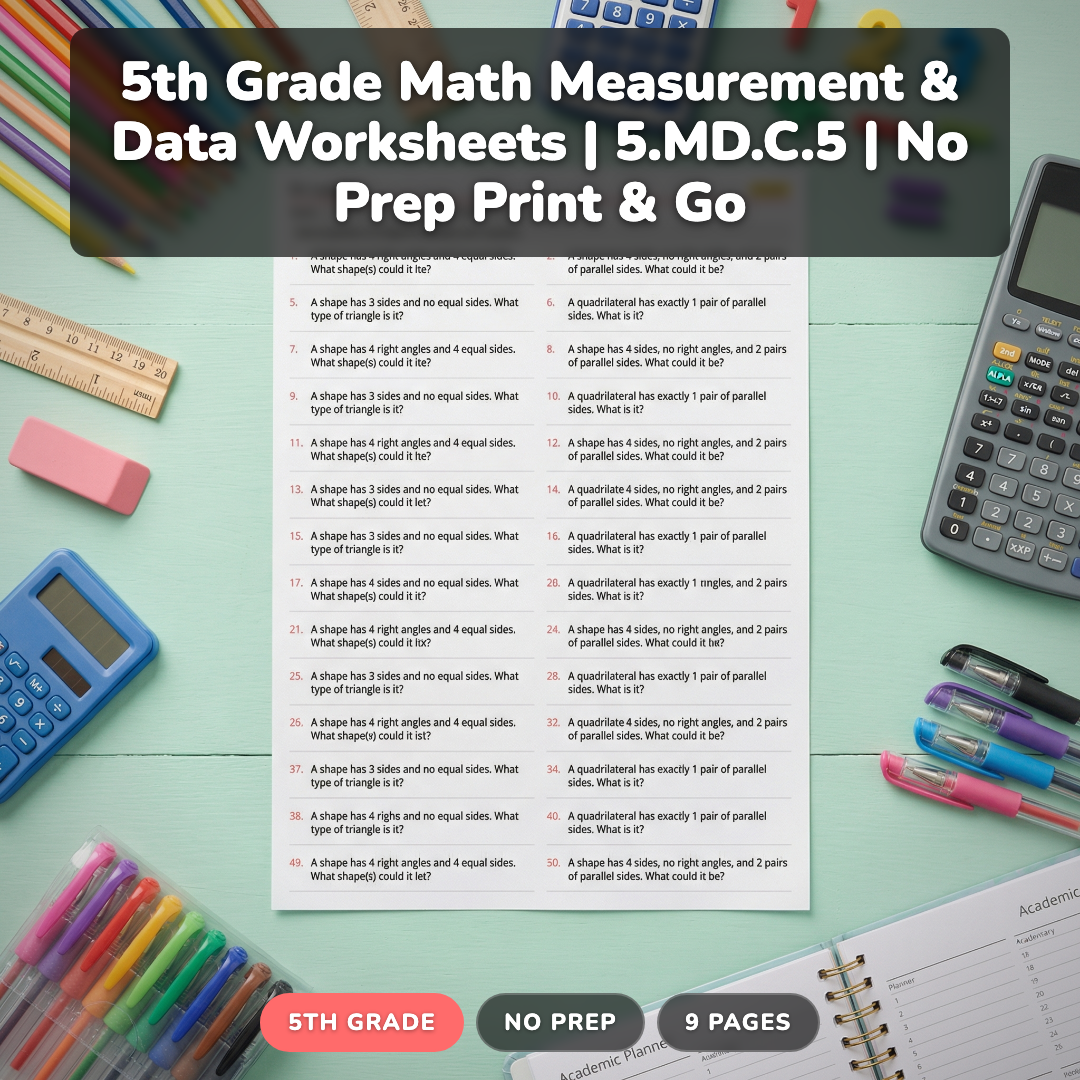
After using these strategies with hundreds of 5th graders, I created a comprehensive volume practice resource that saves you hours of prep time while providing exactly the differentiation your students need.
This 9-page resource includes 132 carefully crafted problems across three difficulty levels: 37 practice problems for students building foundational understanding, 50 on-level problems that align perfectly with CCSS.Math.Content.5.MD.C.5, and 45 challenge problems for students ready to extend their thinking. Each level includes real-world contexts, visual models, and step-by-step scaffolding.
What makes this different from other volume worksheets? Every problem connects to authentic contexts students actually encounter, and the progression moves systematically from concrete counting to abstract formulas. You get complete answer keys, differentiation notes, and suggested timing for each section.
Grab a Free Volume Problem Set to Try
Want to see how this approach works in your classroom? I’ll send you a free sample with 6 volume problems across all three difficulty levels, plus the teaching notes that make them work.
Frequently Asked Questions About Teaching Volume
What’s the best order for introducing volume concepts in 5th grade?
Start with concrete unit cube counting, progress to layer-by-layer visualization, then introduce the length × width × height formula. Always connect new learning to previous area concepts (CCSS.Math.Content.5.MD.C.5a) before moving to three-dimensional thinking. This sequence typically takes 8-10 lessons across 2-3 weeks.
How do I help students who confuse volume with surface area?
Use physical containers and emphasize that volume measures ‘how much fits inside’ while surface area measures ‘how much paper covers the outside.’ Fill containers with rice or water to demonstrate volume, then wrap them with paper to show surface area. Practice both concepts with the same rectangular prism to highlight differences.
Should 5th graders memorize the volume formula or understand the concept?
Both, but understanding must come first. Students need extensive experience with unit cubes and layer counting before the formula makes sense. Once they understand why length × width × height works, encourage memorization for efficiency. The CCSS.Math.Content.5.MD.C.5 standard emphasizes connecting operations to volume concepts, not just procedural calculation.
What real-world connections work best for volume instruction?
Focus on containers students encounter: cereal boxes, storage bins, aquariums, and shipping packages. Avoid abstract examples in favor of authentic contexts where volume calculations matter. Problems involving packing, storage capacity, and comparing container sizes resonate most strongly with 5th grade students and support retention.
How can I assess volume understanding beyond traditional worksheets?
Use performance tasks where students design containers for specific purposes, explain why two different rectangular prisms might have equal volumes, or solve multi-step problems involving unknown dimensions. Observation during hands-on activities reveals spatial reasoning that paper-and-pencil tests miss. Focus on mathematical reasoning and explanation, not just correct calculations.
Teaching volume effectively requires patience, concrete materials, and systematic progression from hands-on exploration to abstract thinking. When students understand the ‘why’ behind volume formulas, they develop spatial reasoning skills that support all future mathematics learning.
What’s your go-to strategy for helping students visualize three-dimensional space? Try the layer-by-layer approach with your next volume lesson and grab the free problem set above to see these strategies in action.