If your 5th graders still count by ones when working with large numbers or get confused about why 6,000 ÷ 10 = 600, you’re not alone. Place value relationships become more complex in 5th grade, and many students struggle to understand that each digit’s value depends entirely on where it sits.
You need teaching strategies that help students visualize these abstract relationships and build genuine number sense. This post shares five research-backed approaches that make place value concepts stick, plus differentiation tips for every learner in your classroom.
Key Takeaway
Fifth graders master place value when they can explain why moving a digit one place changes its value by a factor of 10, not just memorize the pattern.
Why Place Value Matters in 5th Grade Math
Place value understanding forms the foundation for every math concept your 5th graders will encounter this year. Students need to grasp CCSS.Math.Content.5.NBT.A.1 — recognizing that each digit represents 10 times more than the same digit one place to the right — before they can successfully multiply and divide decimals, work with powers of 10, or understand scientific notation.
Research from the National Council of Teachers of Mathematics shows that students who struggle with place value in 5th grade often carry these gaps into middle school algebra. The Van de Walle teaching model emphasizes that place value isn’t just about naming positions — it’s about understanding the multiplicative relationships between places.
This standard typically appears in the first quarter of 5th grade, building directly on 4th grade work with multi-digit numbers. Students should master this concept before moving to decimal operations in CCSS.Math.Content.5.NBT.A.3 and CCSS.Math.Content.5.NBT.A.4.
Looking for a ready-to-go resource? I put together a differentiated place value pack that covers everything below — but first, the teaching strategies that make it work.
Common Place Value Misconceptions in 5th Grade
Understanding where students go wrong helps you address these misconceptions before they become entrenched. Here are the four most common place value errors I see in 5th grade classrooms:
Common Misconception: Students think 3,000 ÷ 10 = 300 because “you just remove a zero.”
Why it happens: They memorize the pattern without understanding that division by 10 shifts each digit one place to the right.
Quick fix: Use base-ten blocks to show the actual regrouping that happens during division.
Common Misconception: Students believe 0.5 is larger than 0.47 because “5 is bigger than 47.”
Why it happens: They apply whole number reasoning to decimals without understanding place value extends right of the decimal point.
Quick fix: Connect decimal place value to money — 50 cents versus 47 cents makes the relationship clear.
Common Misconception: Students think the 4 in 4,567 and 1,234 have the same value because “they’re both 4.”
Why it happens: They focus on the digit itself rather than its position and resulting value.
Quick fix: Always ask “What is this digit worth?” instead of “What digit is in this place?”
Common Misconception: Students struggle to explain why 60 ÷ 10 = 6, often saying “because that’s the rule.”
Why it happens: They memorize procedures without understanding the underlying place value relationships.
Quick fix: Use place value charts to show how digits physically move when multiplying or dividing by powers of 10.
5 Research-Backed Strategies for Teaching Place Value
Strategy 1: The Place Value Slide Method
This visual strategy helps students see how digits literally move when multiplying or dividing by powers of 10. Students create a physical chart where they can slide number cards to show the movement.
What you need:
- Large place value chart (millions to thousandths)
- Number cards (0-9)
- Sliding mechanism (laminated chart with pockets or magnetic strips)
Steps:
- Place the number 1,234 on the chart using individual digit cards
- Ask students to predict what happens when you multiply by 10
- Physically slide each digit one place to the left
- Read the new number (12,340) and discuss why this represents “10 times as much”
- Repeat with division by 10, sliding digits to the right
- Practice with decimals using the same sliding motion
Strategy 2: Base-Ten Block Exchanges
Concrete manipulation with base-ten blocks builds the foundation for understanding why place value relationships work. Students physically trade blocks to see the 10-to-1 relationships.
What you need:
- Base-ten blocks (units, rods, flats, cubes)
- Place value mats
- Recording sheets for written work
Steps:
- Start with 23 units (individual cubes) on the place value mat
- Ask: “How can we show this number more efficiently?”
- Guide students to trade 10 units for 1 rod, leaving 2 rods and 3 units
- Record the trades: 23 units = 2 tens + 3 ones
- Extend to larger numbers, trading 10 rods for 1 flat
- Work backwards with division, breaking apart larger pieces
Strategy 3: Number Line Jumps
Number lines make the multiplicative nature of place value visible through proportional jumps. Students see that moving one place value position creates jumps that are 10 times larger or smaller.
What you need:
- Large number lines (0-100, 0-1,000, 0-10,000)
- Colored markers or sticky notes
- Calculator for verification
Steps:
- Mark 3 on a 0-100 number line
- Show that 3 × 10 = 30 by jumping 10 times as far
- Move to a 0-1,000 line and mark 30
- Show that 30 × 10 = 300 with another proportional jump
- Work backwards with division, making jumps 1/10 the size
- Connect to place value: “The 3 moved to a place worth 10 times more”
Strategy 4: Expanded Form Building
Breaking numbers into expanded form helps students see the actual value each digit contributes. This strategy emphasizes that place value determines worth, not just position names.
What you need:
- Expanded form cards (5,000 + 600 + 70 + 8)
- Standard form number cards (5,678)
- Place value chart reference
Steps:
- Present the number 5,678 in standard form
- Ask students to identify what each digit is worth (not what place it’s in)
- Build the expanded form: 5,000 + 600 + 70 + 8
- Physically separate the addends to show each digit’s contribution
- Practice regrouping: show that 5,678 = 4,000 + 1,600 + 70 + 8
- Connect to the standard: “The 6 is worth 600 because it’s in the hundreds place”
Strategy 5: Place Value Comparison Games
Competitive activities motivate students to think deeply about place value relationships while building fluency with comparing multi-digit numbers.
What you need:
- Digit cards (0-9, multiple sets)
- Place value game boards
- Comparison symbols (<, >, =)
Steps:
- Each player draws 4 digit cards
- Players arrange their digits to create the largest possible number
- Compare numbers and explain which is larger using place value language
- Variation: Create the smallest number, or create a number closest to a target
- Debrief: “Why did you put the 8 in the thousands place?”
- Extension: Add decimal places for more complex comparisons
How to Differentiate Place Value for All Learners
For Students Who Need Extra Support
Begin with concrete manipulatives and limit the number of digits. Use base-ten blocks exclusively before moving to pictorial representations. Focus on whole numbers through thousands before introducing decimals. Provide place value charts with clear labels and practice identifying what each digit is worth rather than memorizing place names. Review skip counting by 10s and 100s to reinforce the multiplicative patterns.
For On-Level Students
Students at grade level should work fluently with numbers through millions and decimals to thousandths. They can explain place value relationships using mathematical language and apply understanding to solve multi-step problems. Provide opportunities to compare numbers, round to various places, and multiply/divide by powers of 10. Use real-world contexts like population data or measurement conversions to make connections meaningful.
For Students Ready for a Challenge
Advanced learners can explore scientific notation, negative exponents, and place value in different number bases. Challenge them to create their own place value problems, work with very large numbers (billions, trillions), or investigate how place value works in other cultures’ number systems. Connect place value understanding to algebraic thinking by exploring patterns like 10^3, 10^2, 10^1, 10^0.
A Ready-to-Use Place Value Resource for Your Classroom
Teaching place value effectively requires differentiated practice that meets students where they are. After years of creating my own worksheets, I developed a comprehensive place value resource that saves hours of prep time while ensuring every student gets appropriate practice.
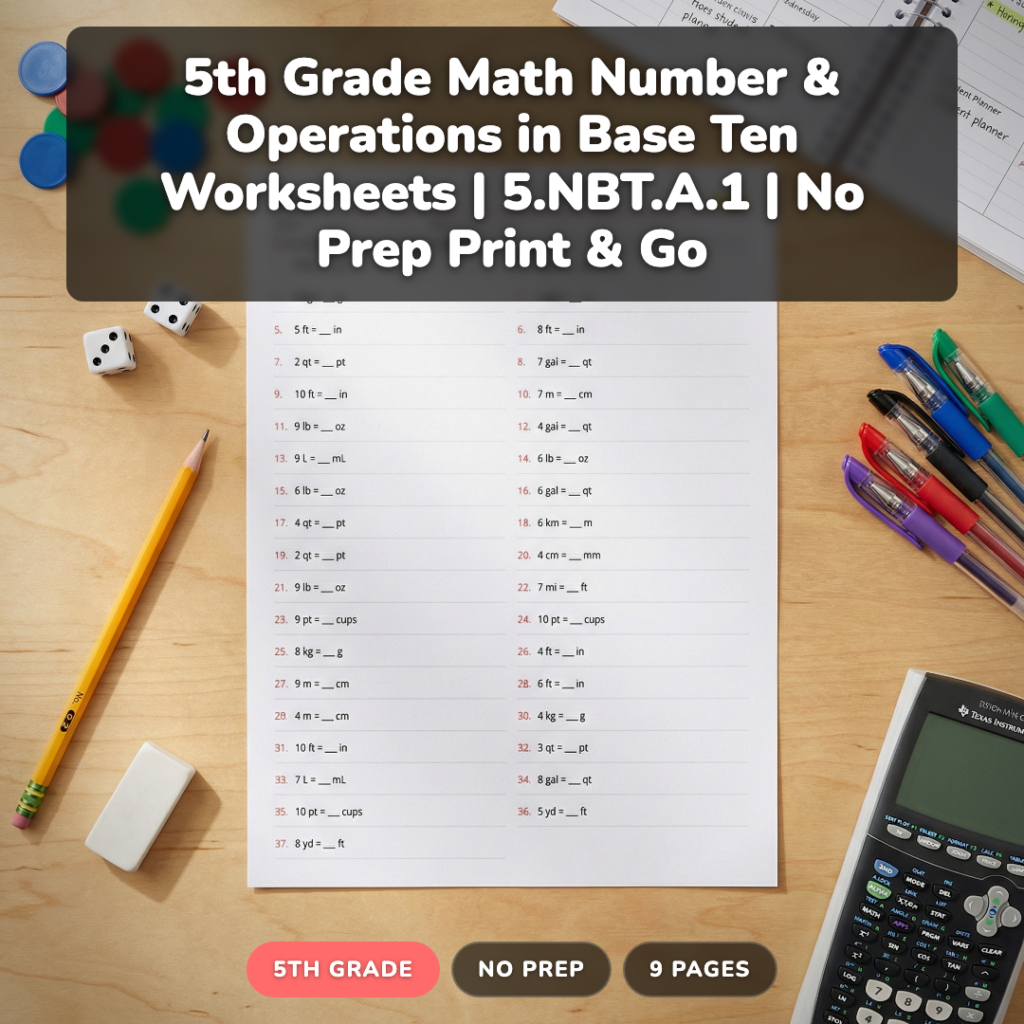
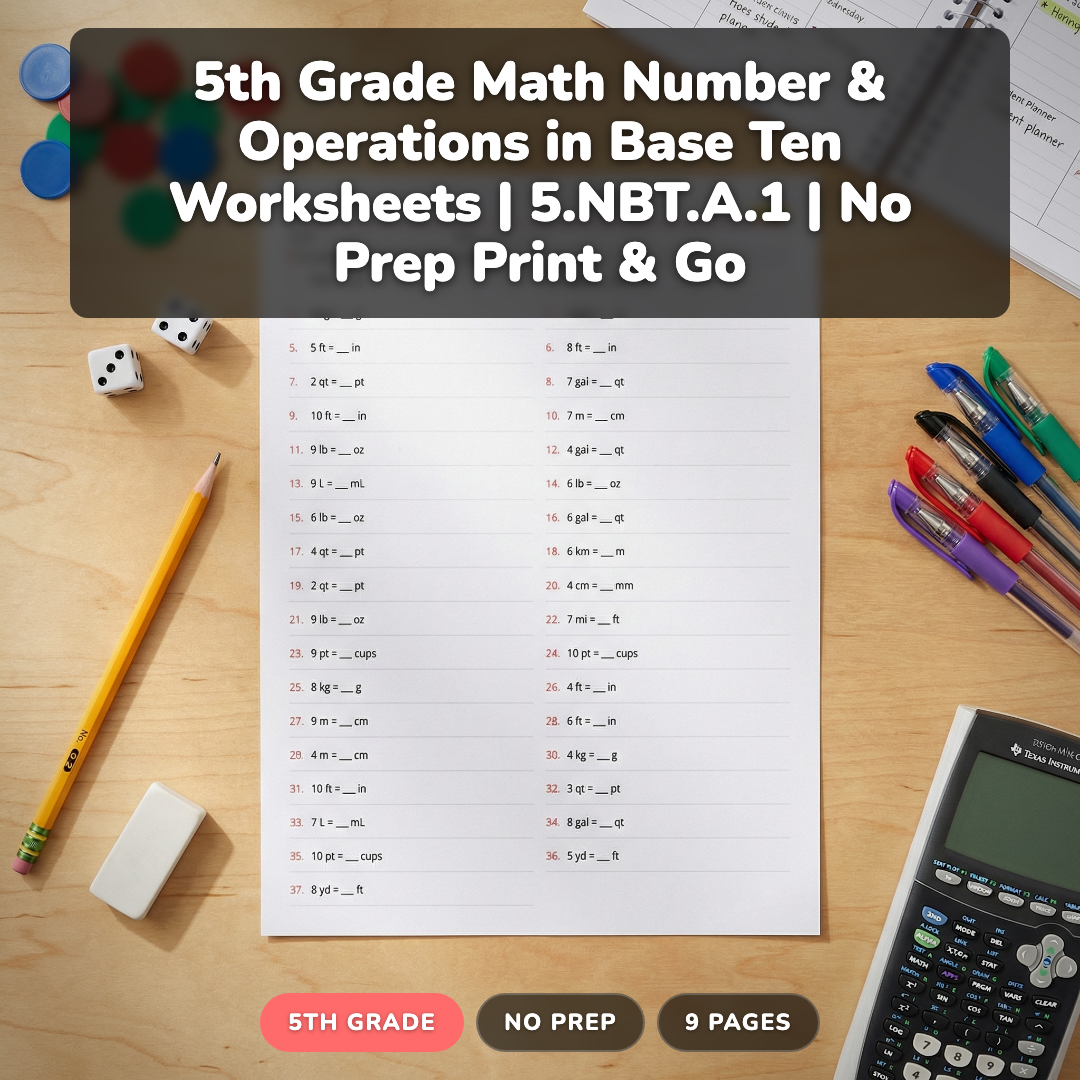
This Number & Operations in Base Ten pack includes 132 carefully crafted problems across three difficulty levels. The Practice level focuses on foundational skills with visual supports, the On-Level section addresses grade-level expectations, and the Challenge problems extend learning with complex applications and real-world connections.
What makes this resource different is the intentional progression within each level. Problems start with concrete examples and build toward abstract thinking, following the research-based CRA (Concrete-Representational-Abstract) model that helps students develop deep understanding.
The pack includes answer keys for easy grading and can be used for homework, centers, or assessment. Each worksheet focuses specifically on CCSS.Math.Content.5.NBT.A.1 without mixing in unrelated skills.
Grab a Free Place Value Sample to Try
Want to see how these differentiated worksheets work in your classroom? I’ll send you a free sample with problems from each level, plus my place value teaching tips checklist.
Frequently Asked Questions About Teaching Place Value
When should 5th graders master place value relationships?
Students should understand that digits represent 10 times more in each place to the left by the end of the first quarter. This foundation supports decimal operations and fraction work later in the year. CCSS.Math.Content.5.NBT.A.1 is typically taught in September-October.
How do I help students who still count by ones with large numbers?
Use base-ten blocks and place value charts to build understanding of groupings. Practice skip counting by 10s, 100s, and 1,000s daily. Explicitly teach that counting by ones becomes inefficient and error-prone with large numbers. Provide visual models showing regrouping.
What’s the difference between place and value in place value?
Place refers to the position (tens place, hundreds place), while value refers to what the digit is worth (30, 400). Students often confuse these concepts. Always ask “What is this digit worth?” rather than “What place is this digit in?” to emphasize value over position names.
Should I teach place value with decimals right away?
Build solid understanding with whole numbers first, then extend to decimals. The same relationships apply — each place represents 10 times more or 1/10 as much. Use money connections (dimes and pennies) to make decimal place value concrete before moving to abstract decimal numbers.
How do I assess place value understanding beyond worksheets?
Ask students to explain their thinking verbally. Use number talks where students compare numbers and justify their reasoning. Observe how they use manipulatives and whether they can create equivalent representations. Look for transfer to new situations, not just memorized procedures.
Place value understanding unlocks every other math concept your 5th graders will learn this year. When students truly grasp why digits change value based on position, they’re ready for decimals, scientific notation, and algebraic thinking.
What’s your go-to strategy for teaching place value relationships? I’d love to hear what works in your classroom. And don’t forget to grab that free sample above — it’s a great way to try these differentiated approaches with your students.