If your 5th graders stare blankly when you mention finding the volume of rectangular prisms, you’re not alone. Volume is one of those mathematical concepts that feels abstract until students can visualize and manipulate it. You need concrete strategies that help students understand what volume actually means before they memorize formulas. Here’s how to make volume click for every student in your classroom.
Key Takeaway
Students master volume when they build understanding through hands-on exploration before applying formulas to solve real-world problems.
Why Volume Matters in 5th Grade Math
Volume represents a crucial bridge between basic measurement concepts and advanced geometric thinking. According to the National Council of Teachers of Mathematics, students who develop strong spatial reasoning skills in elementary school perform 23% better on standardized assessments throughout middle school.
Volume instruction in 5th grade focuses specifically on CCSS.Math.Content.5.MD.C.5b, which requires students to apply the formulas V = l × w × h and V = b × h for rectangular prisms. This standard appears in most curricula between February and April, building on earlier work with area and leading toward 6th grade surface area concepts.
Research from the Journal of Educational Psychology shows that students who learn volume through multiple representations—concrete, visual, and symbolic—retain the concept 40% longer than those who start with formula memorization. The key is connecting the abstract formula to tangible experiences students can see and touch.
Looking for a ready-to-go resource? I put together a differentiated volume practice pack that covers everything below — but first, the teaching strategies that make it work.
Common Volume Misconceptions in 5th Grade
Understanding where students typically struggle helps you address confusion before it solidifies into persistent errors.
Common Misconception: Students think volume and area are the same thing.
Why it happens: Both involve multiplication and measuring space, but students don’t distinguish between 2D and 3D measurement.
Quick fix: Use the phrase “filling up space” for volume and “covering a surface” for area consistently.
Common Misconception: Students multiply length × width only, forgetting height.
Why it happens: They default to area formulas they learned earlier in the year.
Quick fix: Teach the acronym “LWH” (Length, Width, Height) and have students point to each dimension before calculating.
Common Misconception: Students think bigger numbers always mean bigger volume.
Why it happens: They focus on individual measurements rather than the relationship between all three dimensions.
Quick fix: Compare a 10×1×1 prism with a 3×3×3 prism using actual blocks to show 27 > 10.
Common Misconception: Students confuse base area (b) with base length in the V = b × h formula.
Why it happens: They don’t understand that “b” represents the entire base area, not just one dimension.
Quick fix: Always write “base area” instead of just “b” when introducing this formula variation.
5 Research-Backed Strategies for Teaching Volume
Strategy 1: Unit Cube Building Foundation
Start volume instruction by having students physically build rectangular prisms with unit cubes. This concrete experience creates the mental model students need before working with formulas or word problems.
What you need:
- Unit cubes (at least 50 per pair)
- Recording sheets with L × W × H columns
- Rulers for measuring
Steps:
- Give pairs of students 24 unit cubes and challenge them to build different rectangular prisms
- Have them record the length, width, and height of each prism they create
- Students count the total cubes used and record this as the volume
- After building 4-5 different prisms, ask students to look for patterns in their data
- Guide them to discover that length × width × height equals the total number of cubes
Strategy 2: Layer-by-Layer Visualization
Help students understand that volume represents layers of area stacked on top of each other. This strategy directly connects area concepts to volume understanding.
What you need:
- Transparent containers or glass boxes
- Colored water or rice
- Grid paper for base outlines
Steps:
- Show students a rectangular container and trace its base on grid paper
- Calculate the base area together by counting squares
- Fill the container one “layer” at a time, asking students to predict the volume
- After each layer, multiply base area × current height to verify the volume
- Connect this to the formula: V = base area × height
Strategy 3: Real-World Problem Solving Stations
Students apply volume formulas to solve authentic problems they might encounter outside school. This strategy addresses the “real world and mathematical problems” requirement in CCSS.Math.Content.5.MD.C.5b.
What you need:
- Station cards with real-world scenarios
- Measuring tools (rulers, measuring tape)
- Calculators for complex calculations
- Actual boxes or containers when possible
Steps:
- Create 4-5 stations with different volume scenarios (packing boxes, aquarium capacity, storage containers)
- Students rotate through stations, measuring real objects when possible
- Each station requires students to identify length, width, and height before calculating
- Students write their solution process, not just the final answer
- Groups share strategies and compare results at the end
Strategy 4: Formula Comparison and Connection
Explicitly teach both volume formulas (V = l × w × h and V = b × h) and help students understand when to use each one. This prevents confusion and builds flexible thinking.
What you need:
- Anchor chart with both formulas
- Example problems for each formula type
- Colored pencils for highlighting dimensions
Steps:
- Present the same rectangular prism and solve it using both formulas
- Use different colors to highlight length, width, height, and base area
- Show that base area = length × width, so both formulas are equivalent
- Practice identifying which information is given in word problems
- Students choose the most efficient formula based on given information
Strategy 5: Volume Estimation and Reasonableness
Develop students’ number sense for volume by practicing estimation before calculating exact answers. This strategy prevents computational errors and builds mathematical intuition.
What you need:
- Various rectangular objects (books, boxes, containers)
- Estimation recording sheets
- Benchmark volumes for reference
Steps:
- Establish benchmark volumes students can visualize (1 cubic inch, 1 cubic foot)
- Show students a rectangular object and ask for volume estimates
- Students explain their estimation strategy before measuring
- Measure actual dimensions and calculate precise volume
- Compare estimates to actual results and discuss reasonableness
How to Differentiate Volume for All Learners
For Students Who Need Extra Support
Focus on building conceptual understanding before introducing formulas. These students benefit from extended time with manipulatives and visual models. Start with small, whole-number dimensions (2×3×4) and provide pre-drawn rectangular prisms with dimensions labeled. Use the phrase “length times width times height” instead of variables initially. Offer calculator support for multiplication once students understand the concept. Review prerequisite skills like finding area and basic multiplication facts through 10×10.
For On-Level Students
Students working at grade level should master both volume formulas and apply them to solve multi-step word problems. They should work with dimensions up to two digits and begin connecting volume to capacity measurements. Provide practice with both formula formats (V = l × w × h and V = b × h) and expect students to choose the most efficient approach. Include problems that require unit conversions within the same measurement system.
For Students Ready for a Challenge
Advanced students can explore volume applications with fractional dimensions, composite figures made of rectangular prisms, and optimization problems (finding dimensions that maximize volume with constraints). Challenge them to explain why the volume formulas work using mathematical reasoning. Connect volume to other mathematical concepts like ratios and proportional relationships. Introduce them to volume applications in engineering and architecture.
A Ready-to-Use Volume Resource for Your Classroom
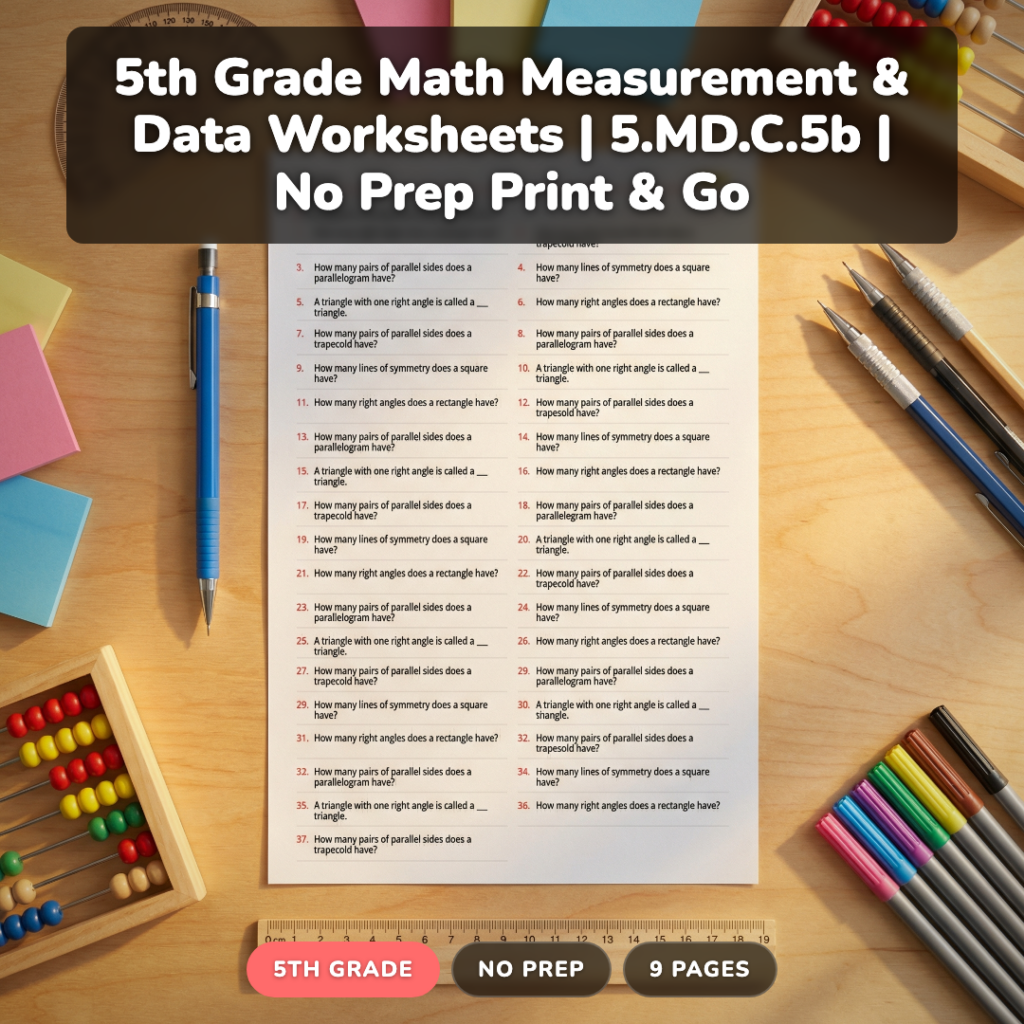
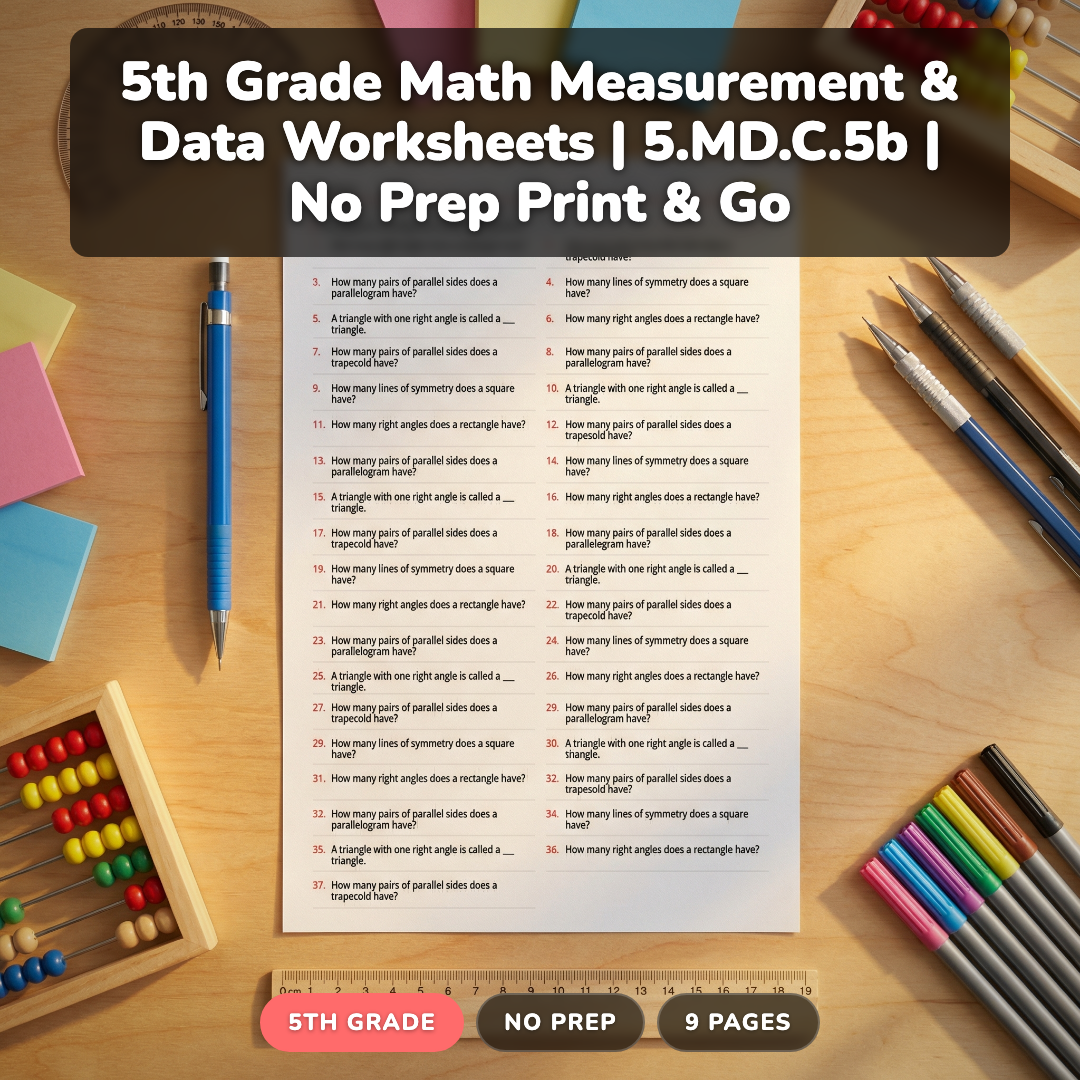
After years of teaching volume, I created a comprehensive practice pack that addresses every challenge mentioned above. This 9-page resource includes 132 carefully scaffolded problems across three difficulty levels: Practice (37 problems), On-Level (50 problems), and Challenge (45 problems).
What makes this resource different is the intentional progression from concrete to abstract thinking. The Practice level focuses on building conceptual understanding with visual supports and smaller numbers. On-Level problems mirror the types students encounter on standardized assessments. Challenge problems push students to apply volume concepts in complex, real-world scenarios.
Each level includes detailed answer keys and aligns directly with CCSS.Math.Content.5.MD.C.5b. The problems progress from basic formula application to multi-step problem solving, giving you flexibility to meet every student’s needs.
This resource saves hours of prep time while ensuring your students get the differentiated practice they need to master volume concepts.
Grab a Free Volume Practice Sheet to Try
Want to see how differentiated volume practice works in your classroom? I’ll send you a free sample with problems from each difficulty level, plus an answer key and teaching tips.
Frequently Asked Questions About Teaching Volume
When should I introduce volume formulas versus hands-on exploration?
Start with 2-3 lessons of hands-on building with unit cubes before introducing formulas. Students need concrete experiences to understand what volume represents. Once they can visualize “filling up space,” formulas become tools rather than memorized procedures.
How do I help students remember which formula to use?
Teach students to identify what information the problem provides. If length, width, and height are given separately, use V = l × w × h. If base area is provided, use V = b × h. Both formulas work for any rectangular prism.
What’s the difference between volume and capacity in 5th grade?
Volume measures the space inside a 3D shape using cubic units (cubic inches, cubic feet). Capacity measures how much liquid a container holds using fluid units (cups, gallons). For rectangular containers, the concepts are mathematically equivalent.
How can I connect volume to other 5th grade math topics?
Volume builds on area concepts and connects to multiplication, decimal operations, and measurement conversions. Students apply volume in geometry, data analysis (comparing container sizes), and problem-solving across multiple mathematical domains throughout the year.
What manipulatives work best for teaching volume concepts?
Unit cubes are essential for building understanding, but also use transparent containers, rice or beans for filling, measuring tools, and real-world rectangular objects. The key is progressing from concrete manipulatives to visual representations to abstract formulas.
Teaching volume successfully means helping students see the connection between concrete experiences and abstract formulas. When students understand that volume represents “filling up space” and can visualize layers of area stacked together, the mathematics becomes meaningful and memorable.
What’s your biggest challenge when teaching volume to 5th graders? Try the strategies above and don’t forget to grab that free practice sheet to see how differentiated instruction can transform your volume lessons.