If your 5th graders freeze when they see “convert 3.5 meters to centimeters” or mix up whether to multiply or divide, you’re not alone. Unit conversion is where many students hit their first real math wall—but with the right strategies, you can turn this stumbling block into a confidence builder.
Key Takeaway
Successful unit conversion instruction combines visual models, real-world contexts, and systematic thinking strategies that help students understand the logic behind the math.
Why Unit Conversion Matters in 5th Grade Math
Unit conversion sits at the heart of CCSS.Math.Content.5.MD.A.1, which requires students to convert among different-sized standard measurement units within a given system and use these conversions in multi-step, real-world problems. This standard bridges the gap between elementary measurement concepts and the algebraic thinking students will need in middle school.
Research from the National Council of Teachers of Mathematics shows that students who master unit conversion in 5th grade demonstrate 23% higher performance on proportional reasoning tasks in 6th grade. The skill appears in October-November of most math curricula, right after students have solidified their decimal operations and before diving into volume and coordinate geometry.
Unit conversion also connects directly to scientific thinking. Students use these skills in science class when converting milliliters to liters in experiments, and in real life when doubling recipes or comparing product sizes at the store.
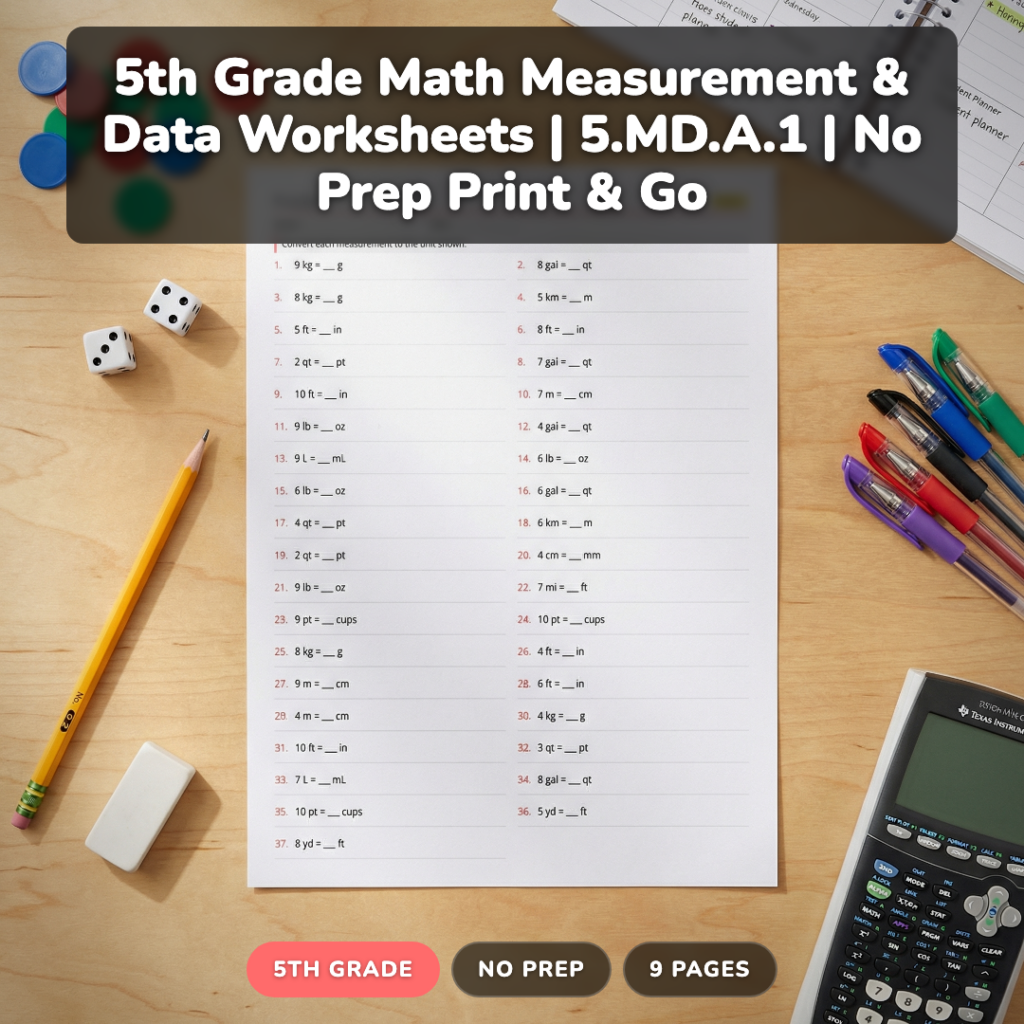
Looking for a ready-to-go resource? I put together a differentiated measurement & data pack that covers everything below — but first, the teaching strategies that make it work.
Common Unit Conversion Misconceptions in 5th Grade
Understanding where students go wrong helps you anticipate and prevent these thinking traps before they become ingrained habits.
Common Misconception: Students always multiply when converting, regardless of the direction.
Why it happens: They memorize “multiply by the conversion factor” without understanding that larger units need fewer of them.
Quick fix: Use the “bigger unit, smaller number” visual anchor with concrete examples.
Common Misconception: Students think 5 cm = 0.5 m instead of 0.05 m.
Why it happens: They confuse the decimal placement when converting between units that differ by factors of 100.
Quick fix: Practice place value charts alongside conversion charts to reinforce decimal movement patterns.
Common Misconception: Students convert correctly but lose track in multi-step word problems.
Why it happens: They focus on the conversion mechanics and forget to organize their problem-solving process.
Quick fix: Teach a consistent problem-solving framework that separates conversion steps from calculation steps.
Common Misconception: Students mix up metric and customary conversion factors.
Why it happens: They try to memorize too many facts without building conceptual understanding of the systems.
Quick fix: Focus on one system at a time and use benchmark comparisons (“A meter is about one big step”).
5 Research-Backed Strategies for Teaching Unit Conversion
Strategy 1: The Conversion Line Visual Model
This concrete visual helps students see the relationship between units and understand why they multiply or divide. Students create a number line showing the relative sizes of units, then use it to determine conversion directions.
What you need:
- Chart paper or whiteboard
- Colored markers
- Meter sticks and rulers for reference
- Conversion anchor charts
Steps:
- Draw a horizontal line and mark common metric length units from left to right: mm, cm, dm, m, km
- Have students place their finger on the starting unit and slide toward the target unit
- If they slide right (to bigger units), they divide. If they slide left (to smaller units), they multiply
- Add the conversion factors above each arrow: ÷10, ÷10, ÷10, ÷1000 going right; ×10, ×10, ×10, ×1000 going left
- Practice with concrete examples: “Start at cm, go to m” (slide right, so divide by 100)
Strategy 2: Real-World Estimation Anchors
Students develop number sense for units by connecting measurements to familiar objects, making conversions feel logical rather than arbitrary.
What you need:
- Collection of classroom objects (paperclip, pencil, desk, etc.)
- Measuring tools
- “Benchmark” reference cards
- Student measurement journals
Steps:
- Establish personal benchmarks: “My thumb is about 1 cm wide, my foot is about 25 cm long”
- Measure and record 5-7 classroom objects in multiple units
- Create conversion problems using these familiar measurements
- Ask estimation questions before calculating: “Should 150 cm be more or less than 1 meter?”
- Connect to cooking, sports, and shopping contexts students know
Strategy 3: The Factor Label Method (Dimensional Analysis)
This systematic approach teaches students to set up conversions like equations, building algebraic thinking while ensuring accuracy in complex problems.
What you need:
- Conversion factor cards
- Step-by-step recording sheets
- Colored pencils for organizing work
- Calculator for checking
Steps:
- Write the given measurement as a fraction: 500 cm/1
- Multiply by the appropriate conversion factor: 500 cm/1 × 1 m/100 cm
- Show how units cancel: the “cm” cancels out, leaving meters
- Calculate the numerical result: 500 ÷ 100 = 5 m
- Check reasonableness: “5 meters makes sense because meters are bigger than centimeters”
Strategy 4: Conversion Game Stations
Students practice conversions through engaging, partner-based activities that build fluency while maintaining motivation.
What you need:
- Conversion task cards
- Timer
- Recording sheets
- Measurement tools for verification
- Answer keys for self-checking
Steps:
- Set up 4 stations: Metric Length, Metric Mass, Metric Capacity, and Mixed Review
- Partners draw cards and solve conversions together
- One student explains their thinking while the other checks with the answer key
- Include “challenge cards” with multi-step problems
- Rotate every 8-10 minutes to maintain engagement
Strategy 5: Multi-Step Problem Solving Framework
Students learn to break down complex, real-world problems that require multiple conversions and operations, addressing the full scope of CCSS.Math.Content.5.MD.A.1.
What you need:
- Multi-step problem templates
- Graphic organizers
- Highlighters for identifying key information
- Conversion reference charts
Steps:
- Read the problem and highlight all measurements and units
- Identify what the question is asking for (what units?)
- List all necessary conversions before starting calculations
- Complete conversions first, then solve the mathematical operations
- Check: Do the units make sense? Is the answer reasonable?
How to Differentiate Unit Conversion for All Learners
For Students Who Need Extra Support
Start with concrete manipulatives and single-step conversions within familiar contexts. Use meter sticks, measuring cups, and scales to make abstract relationships tangible. Provide conversion charts with visual cues and practice with friendly numbers (multiples of 10) before introducing decimals. Focus on one measurement system at a time, spending extra time on metric relationships since they follow consistent base-10 patterns.
For On-Level Students
Students at grade level should master all standard metric conversions and begin working with customary units. They should solve multi-step problems that combine conversion with other operations and explain their reasoning using mathematical vocabulary. Practice should include both computational fluency and conceptual understanding through estimation and real-world applications.
For Students Ready for a Challenge
Advanced learners can explore conversions between measurement systems (metric to customary), work with complex multi-step problems involving area and volume conversions, and investigate how unit conversion applies in scientific contexts. Challenge them to create their own conversion problems and teach strategies to classmates, building deeper understanding through explanation.
A Ready-to-Use Measurement & Data Resource for Your Classroom
Teaching unit conversion effectively requires lots of practice problems at just the right level for each student. After years of creating my own worksheets and searching for quality problems, I developed a comprehensive resource that saves hours of prep time while ensuring every student gets appropriate practice.
This differentiated measurement and data pack includes 132 carefully crafted problems across three levels: Practice (37 problems for building foundations), On-Level (50 problems for grade-level mastery), and Challenge (45 problems for extension). Each level targets CCSS.Math.Content.5.MD.A.1 with problems that progress from single conversions to complex, multi-step real-world scenarios.
What makes this resource different is the intentional scaffolding within each level and the variety of problem types—from straightforward conversions to cooking problems, sports contexts, and science applications that keep students engaged while building essential skills.
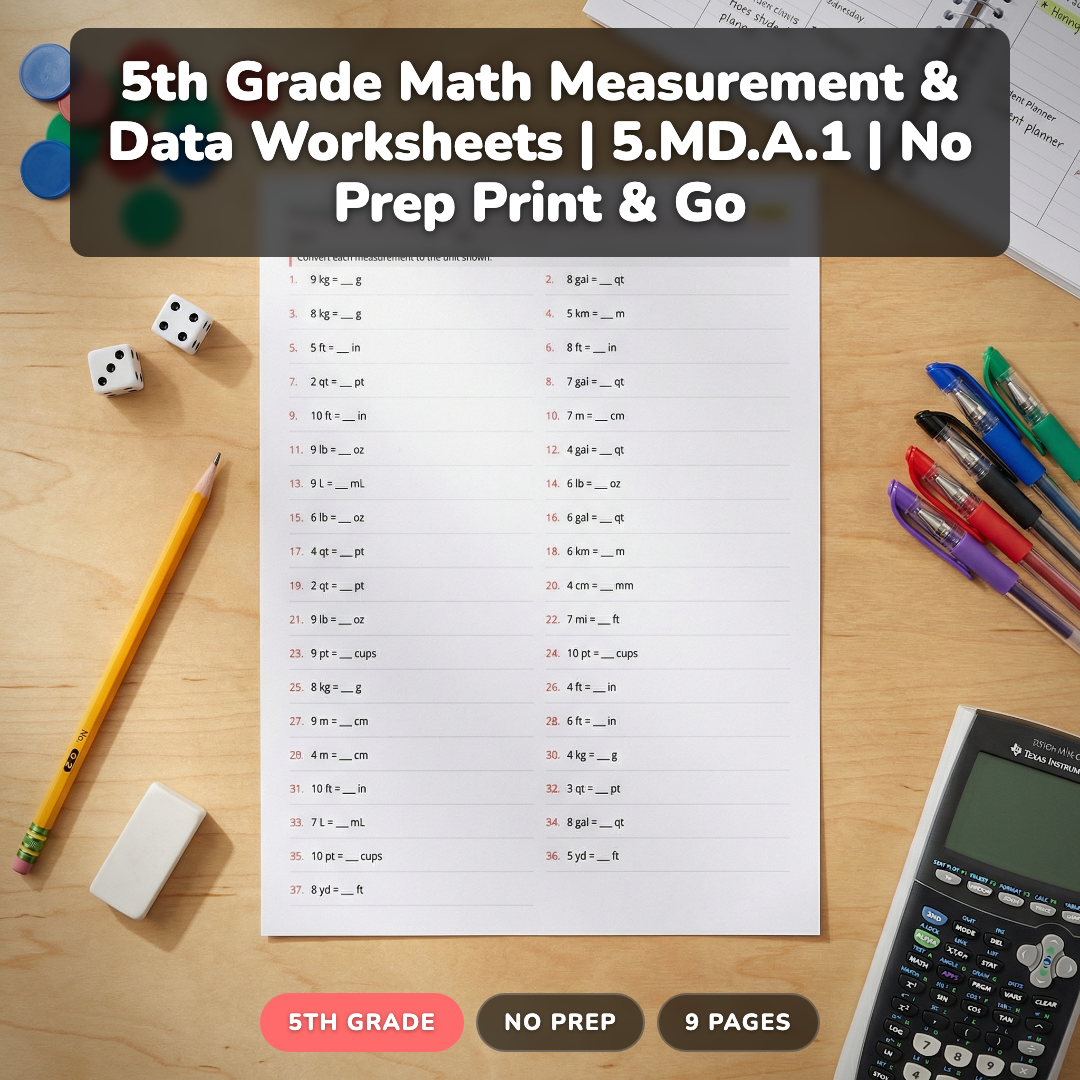
The pack includes answer keys, teaching tips, and can be used for homework, centers, or differentiated assignments. At 9 pages total, it’s substantial enough to last several weeks without overwhelming your planning time.
Grab a Free Unit Conversion Practice Sheet to Try
Want to see how these strategies work in practice? I’ll send you a free sample worksheet with 10 problems that use the visual model and real-world contexts described above.
Frequently Asked Questions About Teaching Unit Conversion
When should I introduce metric vs. customary conversions?
Start with metric conversions in October since they follow predictable base-10 patterns. Introduce customary conversions in November after students have solid decimal skills, as customary factors (12, 16, 3) are more complex and require stronger number sense.
How do I help students remember when to multiply vs. divide?
Teach the “bigger unit, smaller number” principle with visual anchors. When converting to bigger units (cm to m), you need fewer of them, so divide. When converting to smaller units (m to cm), you need more of them, so multiply.
What’s the most important conversion factor for 5th graders to memorize?
Focus on powers of 10 in the metric system: 10 mm = 1 cm, 100 cm = 1 m, 1000 m = 1 km. These patterns transfer to mass and capacity conversions and build foundation for scientific notation in later grades.
How do I assess unit conversion understanding beyond worksheets?
Use performance tasks like planning a garden (converting measurements for space and materials) or cooking projects (scaling recipes). Have students explain their thinking aloud and create their own conversion problems for classmates to solve.
What should I do if students can convert but struggle with multi-step problems?
Separate the conversion practice from problem-solving practice initially. Once conversions are automatic, use graphic organizers that help students identify all needed conversions before starting calculations. Practice with one-step word problems before adding complexity.
Unit conversion doesn’t have to be a stumbling block for your 5th graders. With visual models, real-world connections, and systematic practice, students develop both the skills and confidence to tackle these problems successfully. The key is building understanding alongside fluency—when students know why the math works, they’re much more likely to remember how to do it.
What conversion strategy works best in your classroom? Grab the free practice sheet above and let me know how these approaches work with your students!